Category Archives: Planning

Anatomy of An Insight: Meat Pack Hijack

I had totally slept on this, but luckily was shown it today in a meeting.
Entertaining and effective loyalty idea from this Guatemalan shoe store Meat Pack:

Insight: Most brands and companies are struggling with the top-of-mind. Consumers are promiscuous among brands. There are not many monogamous relationships with brands. If you are able to make your customer think about your brand, when they are shopping around, you are already having the upper hand. If you are able to make them come out running from that same competitor store, you are most likely winning.

Other lesson: If you are challenger brand, you should act like challenger brand. Although you might offend certain big players, your fans will just love you more.

Tagged , , , , ,

Hacking is The Highest Form of Flattery

Don´t let lawyers run your brand.
This becomes quite apparent when you think about cease & desist from Ikea to Ikea Hackers. You have a person who has been an ambassador for your brand and indirectly urged people to buy more of your products. Yes, he has gotten some money out of it through ad sales, but seems quite petty from behemoth like Ikea to care about that. Instead they put the self-professed super-fan in jeopardy on quite dubious legal grounds. Cory Doctorow has a great argument on how the trademark is not copyright. What is most striking is that something like this still happens in 2014. It used to be my usual blog fodder to rip stupid brands harassing people who love their brand. I thought that brands had learned something throughout the years. Apparently not, so here is a reminder about two facts in this social age:

1. Hacking the brand is the highest form of flattery.
Even if someone is doing a parody about your brand, she is still using countless of hours with your brand. She would not do it, if brand would not mean anything to him. The challenge for the brands is not the negative feelings, it is that most of the people do not have any feelings (positive or negative) towards your brand.

2. Reward, don´t punish your biggest fans

Coke´s Facebook Page was originally started by fans. Instead of cease & desist, they invited those fans to visit the factory. Ikea should think about how they could collaborate with Ikea Hackers. Or maybe there would be some interesting cues for product development?

Weird mishap by otherwise generally smart brand. I think some of the solutions in this great Ikea-produced video could contribute as hacks as well:

Tagged , , , ,

Anatomy of An Insight: Fartcode

If you are not even slightly entertained by flatulent humor, there is probably something wrong with your emotional state.

“You don’t have to be smart to laugh at farts, but you have to be stupid not to.”
Louis C.K.

Gas is always a blast for me, so not surprisingly this was highly entertaining:

Insight: Kids are not interested in nutritional value of food. Nutrition in food makes you fart. Fart equals fun. Educate kids through farts about the nutritional value of food. Get smart with your fart.

Nice touch on this app, combining utility and social sharing.

Only question with this brilliance is will it really appeal to kids (kids referring to anyone younger than me)?

The look & feel is actually more resembling an episode of Beavis & Butt-Head from 90´s and the song could have been lifted from the glory days of Epitaph records skate-punk.

Is it something that resonates more with us middle-aged kids than the real target audience?

Tagged , , , , , , ,

You Have Listened to Led Zeppelin, Would You Like to Listen to Prince?

First rule of being a planner:

Don´t think that you represent target audience.

You have to understand the target audience. Know as much as possible about them. Talk with them. But never think that your own behavior resembles anything that normal people are doing.

Unless you are targeting 30+ years old dudes still wearing sneakers and knowing too much about popular culture.

Majority of planners are snobs in various fields, and this does not exclude yours truly. Therefore I have never seen the reason for automated recommendation algorithms. I will always know what I want to listen or watch. I have spent majority of my life listening to obscure records and watching odd movies to be able to entertain myself in every occasion without outside help. If I need recommendation, I only trust in a handful of established aficionados, who have earned my trust.

I will always favor human curation over algorithm.
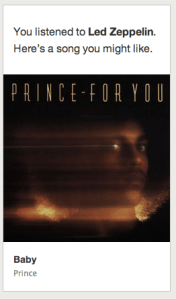
Therefore this recommendation in Spotify made me laugh:
Prince Spotify
You have listened Led Zeppelin, now listen to Prince.

How stupid is that? It would be like recommending broccoli in restaurant because you like meat.

“Eugene Goostman” might be able to act like a human, but this recommendation did not raise hopes for reaching singularity for a while.

But here´s the trick:
I like Led Zeppelin.
I like Prince (the song is from one of my favorite Prince albums).

So actually recommendation was not off. It just came from surprising angle. Maybe the Spotify algorithm knows more than it appears. If there would be more people, who listen both Led Zep and the The Artist Formerly Known As Prince, the world would be a better place.

Eventually it boils down to this: as long as the recommendation pleases the audience, it does not matter how off or not it is. That is why I don´t really think that the future of streaming services lies in super-smart recommendation engines or human curation. It will be about vast catalog. Streaming service, able to secure The Beatles to its service, will probably go long way.

Maybe recommend some Rolling Stones to go with that.

Tagged , , , , ,

Psst… Can I Whisper you A Secret? Anonymous Mobile Messaging Apps Are The Next Big Thing in Digital

Mobile instant messaging is all the rage at the moment. WhatsApp got bought by Facebook for over 19 billionWhopping 73% of China´s online population uses WeChat. The amount of Snapchat users has increased over 67% in the last six months.

Next big thing will be anonymous mobile chatting:

1. There is a demand for anonynomous interest-based social networks
Have you ever wondered why discussion forums still thrive in 2014?
Why I was so amped up about Internet was that I could be able to talk about things I was interested (hiphop, basketball and record collecting) with people all around the world. With my friends I can communicate with every possible method, but finding likeminded people around passion points that new Internet start-ups have not tapped into in a while. Since the demise of MySpace, tech industry has been over-obsessed with friend-based networks and neglected the interest-based connections.

2. Content in anonymous mobile apps is more interesting 
Majority of Facebook content bores the hell out of people. I know that I am not the only one, who could live without a single photo update about “meat trophies” (baby photos), weddings, travel photos and sport achievements (I am guilty of the latter two). Everyone has a role to play in this world and Facebook is the center of humblebrag. It is filled with people trying to give polished side about themselves. Perfection is not really interesting, but the faults are (something marketers should also realize).
At a brief glance my Secret app is filled with dirty stories (both sexual and scatological) and controversial opinions from people who would not post anything of that sort in Facebook. One glance to FB or Twitter puts me to sleep. Posting with your own name puts automatic self-censorship on and usually people overdo it and they just come up with boring stuff.

Anonymity unleashes the real side of the people. In good and bad ways.

But don´t just take my word for it though, advertisers see potential with these applications as well. Combination of mining of the message content and GPS data could provide interesting advertising possibilities. Traditional media has also taken a heed and they are monitoring these apps to get some juicy secrets (usually false ones).

So how you can get started to post your toilet secrets?
Below I have broken down the four most interesting anonymous messaging apps:

Secret
secret-path
Secret is finally available in Android and that might be the tipping point which will propel it to mainstream success.
Basic promise: Share your secrets freely and anonymously. You can upload short posts and images.
Level of anonymity: You will be given an avatar and you can connect Secret with your contact list or find secrets based on the location. This puts interesting twist to usage of Secret as you automatically start to guess whom of your friends is posting the secrets.
Addictiveness: Content is not as explicit as in Whisper but way more interesting than your average FB and Twitter feeds. There seems to be also a steady stream of meaningful discussions in Secret going on. Usage is intuitive and it is the most advanced of the new generation messaging apps.

Whisper

dj
Another anonymous social network gaining popularity at the moment, it is more closer to media company as it has editorial staff headed by former Gawker editor Neetzan Zimmerman.
Basic promise: You can post your secrets in the meme-like format where your text is superimposed on a picture. Whisper also allows sending private messages to users and following topics that interest you most.
Level of anonymity: This app is completely anonymous and does not connect with your contact list.
Addictiveness: The app is messy both from content and functions. The complete anonymity unleashes probably the expressiveness of the users. Because of the private messaging function Whisper is used more to hooking up than other its competitors. Because of the editorial aspects of the app, Whisper is more enjoyable for the passive users as posts can get “viral” based on their algorithm.
 
Yik Yak
yikyak
Yik Yak is taking some cues from other social sites (Reddit) as it is incorporating timeline that consists of purely text updates.
Basic promise: Getting a live feed of what people are saying around you. You can upvote and downvote what is good and what is not. It is mostly targeted to college students.
Level of anonymity: It does not connect to your contact list but connects to your location (everyone in 1.5 mile radius can see the posts)
Addictiveness: Totally related to where you are posting. Being in too crowded area makes content too general but using app where they are no other users feels like having your private party. The look & feel is nicer than Whisper, but not as polished as Secret.

Chance
chance
Chance pretty much brings Chatroulette to mobile.
Basic promise: You can chat with random strangers.
Level of anonymity: Your selfie is taken every time you start a new chat and that acts as an avatar.
Addictiveness: As majority of the users are horny single dudes, expect short conversations if you are not hot girl and plenty of x-rated suggestions.

Naturally being anonymous does not necessarily only result to funny light-hearted frivolous chat. Especially Yik Yak has been getting flak as it has been connected to cyberbullying in High Schools.
It is too early to say are these apps just a passing fad or a sign of something bigger. I believe that there is definitely longer-lasting market for these applications. The founder of 4Chan Christopher  “moot” Poole put it nicely:

“The industry has spent ten years rushing to capitalize on real identity and friendship based networks and now it´s getting turned on to its head.
Now they are rushing to understand the opposite”

Tagged , , , , , ,

#AmazonCart: Innovation in Advertising (not in eCommerce)

I am somewhat skeptical about utility marketing.
Yes, brands should be useful.
But as far as the advertising goes, most of the brands are fighting with the lack of attention. They need to first crack the indifference barrier amongst consumers. For that you have to first entertain and then deliver.
To underline this point, brand apps are generally destined to fail. Over 80% of them struggle to get even 1000 downloads.
That being said this is useful marketing at its finest:

Why this approach rocks?

1. #Amazoncart taps to real behavior
People already use Amazon as a “shopping list” for their future purchases. This just makes it couple of clicks more easier. At its core, this is not really educating new behavior just a minor tweak to existing pattern. I think tapping to the shopping list behavior is the core thing and also something that many of the commentators have not fully grasped. #Amazoncart is not innovation in eCommerce it is an advertising innovation:

2. #Amazoncart is free advertising with every tweet
Besides being rooted to real behavior, every time someone tweets #AmazonCart it will be visible to followers of that person. Making #AmazonCart hashtag famous is one thing, but actually what is the most brilliant part that the amazon product link gets double exposure as you add to Amazon cart by replying. This creates more opportunities for people to see it and go buying in Amazon.
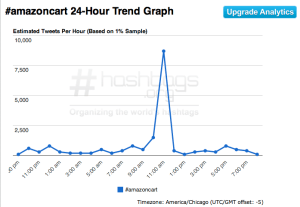
Currently it seems that the amount of #Amazoncart seems already promising (from Hashtags.org):

#Amazoncart

Naturally these are small drops in the ocean for Goliath brand like Amazon but every purchase counts. If Amazon is able to get bursts of over 8k tweets for #AmazonCart in hour constantly it definitely shows great potential for Amazon. Also after the initial development, there is not that much cost for the program (expect for the promoting it).

3. #Amazoncart is super simple
After you have connected your Twitter account to Amazon, you can reply with #AmazonCart to any tweet containing an amazon product link. This puts the item to your shopping cart and you can finish the shopping later. The beauty of this concept is that it keeps it simple enough and does not add too many steps to the progress.

Hopefully in the future we are able reply #AmazonCart to every kind of tweet beyond the Amazon links. Buying products straight from YouTube or Instagram –links anyone?

Tagged , , , , ,

Anatomy of An Insight: Diesel Erotica China

Wise brands should venture where the people are, but other brands do not dare to venture:

Insight: Like in Avenue Q song, Internet is for porn, with over third of web traffic pointing to pornographic sites. That is naturally quite tricky opportunity for brands to exploit, but Diesel did a great work with this campaign. Just because other brands are not there does not necessarily mean that your brand could not be there. It is risky of course, but great advertising usually is.

On a related note, this is a brilliant case study from Eat24 about their experiments on advertising on porn sites. I especially like the creative execution. There are other brands that could take advantage of those cheap CPM prices in the adult sites. For example it would seem quite no-brainer for telcos to advertise their fast broadband connections on the X-rated sites.

While regular brands try to go rude, the rude brands try to go regular. One of the biggest adult sites PornHub has been on a search for creative director to create their first national SFW ad campaign. Some of the entries were quite innovative:
Pornhub Advertising

Tagged , , , , ,

#Cockinasock and the Twisted World of Male Charity

This is a casual observation about men & women:

You should not let men try to invent charity campaigns. Basically they are just excuses to do stupid things legitimately (which men do in general without any higher goal). Usually this involves either making yourself look dumb and spreading the word in Internet:

Case-in-point #1: Movember
November is the month, when guys get their inner Hell´s Angel or Village People, (depending on the moustache style) out. How many actually know that the “idea” for this is to raise awareness of prostate cancer?

Case-in-point #2: #Cockinasock
Basically guys are taking pictures with socks covering their penises, posting them on Internet and hashtagging them with #cockinasock. Apparently this should raise awareness to testicular cancer. Or guys just some sort of excuse to practice their exhibitionism.

I am all for having fun and giving money to good causes as well*, but somehow it just feels fishy to me. Grow moustache and put the cock in the sock because you feel like it. You do not need charity to be your Trojan horse to do it. Men should not need any reason for exercising the acts of stupidity.

Be a man: do idiotic things because it is in your nature and it feels great!

*Although there are some good arguments why awareness campaigns are waste of time & money.

Tagged , , ,

Anatomy of An Insight: Tigerair Infrequent Flyers Club

Quite often I end this section by saying that I wish I would have done something like this. Well this time I actually  have. Campaign we did couple of years back to ST1 was based on similar notion, although the loyalty card worked differently (you got immediate discount when using that card).

Tigerair has been mentioned on this blog before, but this time they really nailed it right:

Insight: People have a love & hate –relationship with loyalty cards. Pretty much everyone knows that they are bullshit and eventually increase the prices you pay. Still almost everyone falls into them and their ridiculous schemes. This campaign makes fun of that notion and recognizes the fact that eventually with budget airline you are only interested about discounts.

I just love when brands have humor to laugh at category conventions.

Tagged , , , ,

Marketing at the Speed of Culture

If you are reading this, you are most likely one of the 16M+ people who have seen this:

The video was uploaded on Monday and started spreading rapidly yesterday. During that same day, the first brand version of the first kiss was produced by Snog Frozen yoghurt:

Not judging the quality of the film, but only applauding the speed of the execution.

The big challenge with many brands right now is that they want to tap into different trends, memes and other popular events. That is nice, but the traditional briefing process does not enable it. If you want to be real-time, reactive and in-tune with the culture, you have to market at the speed of the popular culture. Other option is just to stay true what your brand is all about and be consistent in your communications. You either change constantly or keep it real to your brand core consistently.

Many brands try to dabble little bit with both and fail miserably. That is why every brand is now doing something around selfies. Unfortunately when something is mainstream, you cannot be trendsetter by reacting to that.

Reactive advertising needs different kind of thinking and especially acting:

1)   Different kind of process
Instead of the traditional brief-debrief-creative brief- presentation 1,2, 3, n-production brief the process is streamlined. It consists of one question and one sentence:
Are we doing it?
If yes: Let´s do it.
And then everyone has to be producer.

2)   Different kind of urgency
When your colleagues share it, it is already too late. You have to act immediately when you are feeling something is getting big.

3)   Different kind of production
Do it quick, dirty and preferably yourself.

4)   Different kind of tolerance for risk
You have to accept the fact that when you are acting fast you might fail. Reactive advertising is risky, but so is everything where you can win big. Brand building should not be for the faint-hearted, but unfortunately marketing departments and agencies are filled with wussies afraid of losing their jobs.

If you do not act like this, you will be doing Harlem shake versions in 2015.

Tagged , , , , , ,