Category Archives: Business

Major Keys to Success from Snapchat (that probably only work for Snapchat)

majorkey

Snapchat has surprised me. I mislabeled the platform way back as just a method to share nude selfies (although there is definitely a market for that). They are more popular than ever, valuation is through the roof and they are totally altering the way how millennials communicate and consume content.

As a company they have been really refreshing and bold on their approach in their business. Take the following lessons with a grain of salt, as they might not be right for you:

1.Ask for (too) much
Google made advertising accessible for pretty much anyone and Facebook followed a suit. Snapchat has taken totally different angle. Its ads are expensive, so essentially available to only big advertisers (even though they have reduced their prices). For example branded custom lens costs 450,000 USD. Almost half a million of branded puking rainbow! We will talk about puking rainbows later. They also provide sparsely data about the ad performance and target audience (which might improve in the future). Essentially Snapchat is expensive because it can be expensive. What they offer is that you can be part of the party if you pay the premium. If you don´t, you will be left out. The choice is yours.

Major key to success: Set your price high, as it is easier to go down than to go up.

2. Don´t try to attract everyone
Snapchat is not for the old people; expect if you are Dj Khaled. We will talk about him later.

“I’ll be honest, I had no idea what they were talking about half the time”
– David Gaines about Snapchat training sessions (Chief Planning Officer, Maxus Global)

If you are CMO, it is likely that you are not on Snapchat. Or if you are, you don´t understand anything that is happening there. However, your kids or younger colleagues probably are and that gives you signal that your brand should probably do something there. Snapchat is the ultimate access to one of the hardest target audiences in the world: teens.

If you are not teen, the interface of Snapchat looks messy, complicated and hard-to-use. Essentially they defy all the traditional belief of user design and the users love it. Rest of us don´t understand it but that does not matter. The enigma of Snapchat has probably added to its lure. You cannot compare it to any other app. That is also the reason why they can ask premium. There is no alternative for Snapchat.

Major key to success: If your competition is selling oranges, start selling apples.

3. Embrace the irrational
If you are snapchatting like boss, you have way too much time in your hands. What the success of Snapchat has showed, teens and millennials have lots of time in their hands. And although you are complaining how busy you are, in reality you have too much time in your hands.

The biggest star of Snapchat is Dj Khaled, who has six million followers. He is something like a Paulo Coelho for millennials and his stories are celebrated throughout the Internet. His days “walking on the journey to the path of more success” are filled with eating, drinking Ciroc, jet skiing and sharing his wisdom through major keys (for example key to success is to have lots of pillows).

Whereas Facebook is introducing utility (ordering Uber etc.) to Messenger, the hit function of Snapchat is filter that makes you puking rainbows. The success of Snapchat has prompted Facebook to acquire Masquerade. Its hit function is the ability to switch selfies. And yes, Facebook tried to buy Snapchat back in the day with three billion. Everyone thought Snapchat was crazy to decline the offer. Now they are valued for 16 billion.

pukingrainbows

Although Internet has transformed our life in many ways, you should never underestimate the irrational and random aspect of life. Our attention span is short and that short span is increasingly filled with puking rainbows and major keys to success.

Major key to success: People will favor mindless entertainment against thoughtful utility. Always.

Could you apply some of these lessons in your own business? Maybe, if you are attracting millennials. The challenge with certain successful businesses (that Snapchat is not yet even is, only with high valuation) is that their competitive advantage is hard to be duplicated. Truly phenomenal firms go against the grain and pretty much ignore what other competitors are doing.

Tagged , , , ,

Machines Will Eventually Beat Humans in Everything

“I don´t think it will be a close match. I believe it will be 5–0, or maybe 4–1. So the critical point for me will be to not lose one match.”
Lee Se-Dol (Korean Go champion before his matches against Alphago)

Lee-Se Dol was able to predict the future; it was just the opposite he was envisioning. Alphago (computer Go program done by Google subsidiary Deepmind) slaughtered him in six games.

alphago

Machines beating humans in a game is nothing new. In chess the gap between machines and human is already tremendous. Best chess machines are even able to win joint teams of human and computers. What makes AlphaGo´s victory intriguing is that Go is much more complicated game than chess. The first move of Go can involve 361 positions (chess has only 81) and Go game generally lasts more turns than chess.

Simple heuristics get most of what you need. For example, in chess and checkers the value of material dominates other pieces of knowledge — if I have a rook more than you in chess, then I am almost always winning. 
Go has no dominant heuristics. From the human’s point of view, the knowledge is pattern-based, complex, and hard to program. Until Alphago, no one had been able to build an effective evaluation function.”
-Jonathan Schaeffer (Creator of Chinook, first program to beat humans in Checkers)

The machine victory in Go happened decade earlier than experts predicted.

AlphaGo is based on deep learning and neural networks. So while Deep Blue beat Kasparov with sheer computing strength, Alphago has more artificial intelligence behind it. Firstly neural networks were trained on 30 million moves from games played by human experts. That resulted to ability to predict human move 57 percent of the time. But that gets you to the same level as human players not necessarily able to beat them. So secondly, AlphaGo played thousands of games between its neural networks, and adjusting connections using trial-and-error process through reinforcement learning.

How many humans are even able to comprehend what above means (lest train themselves in even somewhat similar manner)?

Machines can already replace humans in more fields than we are willing to admit. And more importantly, they are playing better job as well. Machines can crunch data to obtain experience, which is impossible for humans during their lifetime. We have to start embracing machine learning and collaborating with machines more if we want to survive. Advertising industry has been especially almost hostile to any technological improvement. That will be a road to sure destruction. Beating a Go champion is much harder task than to do a subpar brand campaign. If we don´t take more proactive and positive approach to data and artificial intelligence, we will make ourselves redundant.

Machines can either be our allies our friends. I would opt for the latter choice.

Tagged , , , , ,

Being Busy Does Not Mean That You Are Working

Busyness as Proxy for productivity: In the absence of clear indicators of what it means to be productive and valuable in their jobs, many knowledge workers turn back toward an industrial indicator of productivity: doing lots of stuff in a visible manner.
-Cal Newport (Deep Work)

Being in a meeting is not our job.
Having a conf-call is not our job.
Sending e-mail is not our job.
Being in front of computer late to suck up your bosses is not our job.

“Being busy” should never be an indicator of how well you are doing our job.

Our job is to think or sell: sometimes both and sometimes in reverse order.

If you are busy because you are thinking really hard and selling even harder, that is great.
If you are busy because you want to look like you are busy, I just feel sorry for you.

Tagged , , , , , , ,

If You Want To Win in Life You Have To Go Little Berserk

“To be a consistent winner means preparing not just one day, one month or even one year –but for a lifetime”
– Bill Rodgers

billrodgers

I have been reading many sports books lately (Open, Sports Gene to name a few). The latest one has been “Marathon Man” about Bill Rodgers. He was a runner who helped to broke running to mainstream and is recommended reading for anyone who runs.

The book is also an eye opening account on how recent phenomenon the jogging phenomenon is. The runners were odd freaks and smoking tobacco was normal. Boston Marathon did not even have water during the early days and Bill Rodgers won the Boston marathon running in oversized Nike shoes. He did it still in 2:09:55. Sports has developed quite a lot, but at the end of the day success is about simple things:

1.Training
There is no shortcut for not putting the miles. If you want to succeed in running, you have to run and run a lot.

“Only ran once – Shit F*** Fart!! about 13 miles at OK pace at 9:00 AM. too tired to run”
From Bill Rodgers training log

2.Strategy
Especially marathon is not only about just letting it go. It is about listening your body, knowing your opponents and knowing your terrain. Bill Rodgers trained on Boston Marathon route constantly and knew it inside out. He was well prepared to win it.

3.Intensity
He was also known as a guy who started out too fast and got burned at the end of the run (recognizing myself here). This handicap also made his great runner. His guts The guy who has the killer instinct will have the final edge. You have to push yourself to limit and then go for the win. If racing does not bring out your intensity, you do not have a change:

“I became intense about the marathon. But I am nowhere near that intense in the rest of my life. In fact, I think running is the only way in which I’m competitive. I have a need to run and sometimes I love it. It’s probably because I wasn’t really good at anything else.”
Bill Rodgers

Or like the late great Steve Prefontaine put it:

“A Lot of people run a race to see who is fastest. I run to see who has the most guts, who can punish himself into exhausting pace, and then at the end, push himself even more”

4. Philosophy
Sports is a much bigger thing than just competition. It is a way of life. If I do not get my morning training, I do not only feel the physical withdrawal, I also feel the mental effects. Pushing yourself to the limit has a strong spiritual aspect.

“Training need not be an all-or-nothing battle, involving punishing track practice, grueling calisthenics, and wrenching interval sessions every afternoon. It could be a fun and easy cruise through the gorgeous New England countryside. It could be an act of freedom by which I could step outside myself and my racing mind. A long run in nature could even be a way to connect my physical body with the unseen spirit of the universe.”

5. Community
Although running is a solitary act, you need other people to help and spar you on the way.

“And you can’t do it alone. No one can. Look at Alberto Salazar’s team now. With Bill Squires I learned to work with a group, we all became friends and supported each other. How cool is that? “
– Bill Rodgers

These things are not limited to running, but apply to all aspects of life.

Tagged , , , , , ,

Are You A Sociopath or Loser?

My good friend recommended reading “Gervais Principle” written by Venkatesh Rao. I think it is probably one of the most on-point analyses of office dynamics. Essentially it is build on this triangle drawn by Hugh Macleod:

macleodcompanyhierarchySociopaths populate top-of-the-food-chain, the vast majority are losers and the guys in the middle have it worse. Losers have the option of turning to sociopath or turning into bare-minimum performers. If you are really clueless, you don’t really have a career path in front of you. Same thing applies for brands, either you are the best or you are the cheapest. Being in the middle is being in the valley of death. Gervais principle is essentially the following equation:

Sociopaths, in their own best interests, knowingly promote over-performing losers into middle-management, groom under-performing losers into sociopaths, and leave the average bare-minimum-effort losers to fend for themselves.

That being said, I was quite recently promoted. Jury is still out about where I fit in the triangle.

Tagged , , , ,

Public Shaming is The Best Motivator

It´s like if your annoying roommate was a fitness tracking app.

cakewalk

Here is app I heartily endorse.

Cakewalk is step-tracking app which nags to you and if you do not reach your goals it will publicly shame you on Twitter. As majority of New Year resolutions will be broken sometime you need a little bit of tough love to stay on the course. Otherwise it is super simple: it will set the goals based on your daily average step count and then insults you if you don´t fulfill your goals.

plasticbags

Probably someone will get upset of this “mean” app. Well get away from your smartphone and just go walking.

Tagged , , , , ,

Three Tips for Better Productivity

Good strategy is more often not about deciding what to do, but deciding what not to do:

1. Do not go to seminars.
The speakers generally resemble something like this:

Speakers are only promoting themselves, their firm or both. The probability of getting surprising new insights or meeting interesting people is close to zero.
Instead: Exercise or go to a stand-up comedy gig.

2. Do not read business books.
Just by glancing the executive summary you will be able to recite enough nuggets to shine in your presentations. Especially avoid books that have started out as blogs (trust me I have written one).
Instead: Read Russian classics.

3. Avoid Networking events
If you need to attend networking event you are not probably a person people would want to network to begin with. As everyone is just trying to maximize the amount of shared business cards, the probability of having meaningful conversation is close to zero.
Instead: Try to go for lunch with interesting people.
Usually more interesting and deep conversations and better food as you can select the restaurant.

With these tips you will notice that your productivity will jump through the roof and you are living more balanced and meaningful life.

Tagged , , , , , ,

Always Go Beyond Numbers

People don´t understand probabilities.

“When people hear these analyses, however, they are not reassured but become more fearful than ever — they hadn’t realized there are so, many ways for something to go wrong! They mentally tabulate the number of disaster scenarios, rather than mentally aggregating the probabilities of the disaster scenarios.
Steven Pinker, Blank Slate
 
I think generally people don´t understand numbers, period.
 
Good example is the probability of someone becoming a NBA player. The odds are naturally low, but there is a good indicator that increases the probability. That indicator is height.

For a man between 6 feet to 6”2”, the chance of being in NBA is five in a million.
At 6”2” to 6”4”, the chances improve slightly to 20 to million.
Man between 6”10” and 7 it is 32000 in a million (3.2%).
And for men over 7 seven feet tall, 17% of them are in the NBA right now*. So every six guy over 7ft you would encounter would be NBA player. Because massive growth is quite often attributed to some disease, it is even more likely that healthy seven-footer is a NBA player. So with narrowing the group, we have actually find quite a good indicator of your probabilities of becoming NBA player.

It is always important to go beyond the numbers.

JJ Redick

JJ Redick is one of the rare NBA player with shorter wingspan than his height

Even the short NBA players are not really that short. Nate Robinson is only 5”7”, but his wingspan is 6”1”. NBA players in general have almost double more wingspan than regular people. Generally it is really rare that a player has shorter wingspan than his height. Yao Ming was one of them, but on the other hand he was 7”6”. So if you would need to predict someone´s ability to be a NBA player and you would need to rely only on two data points: height and wingspan would be probably the best with the former being more important.

*Stats read from a great book by David Epstein: The Sports Gene.

Tagged , , , , , ,

Why Spotify Discover Weekly Is The Best Music Curation Tool?

Apple Music arrived with big bang. Its approach to music streaming is surprisingly old school. It relies a lot on human curation and its programming resembles old radio (some of the shows are definitely worth listening though). It´s biggest rival Spotify is relying more on big data. At the moment it seems that latter approach seems to be the winning formula. Eventually recommendation engines will become a core differentiator (as the libraries will become quite identical) for streaming services, so the headstart Spotify has is not insignificant.

Human curation was the way taste making happened back in the day. I used to rely almost totally to Dj Anonymous on my music recommendations. Best dj´s in the world have much more refined taste than any machine yet. The challenge with human curation is that it does not scale.

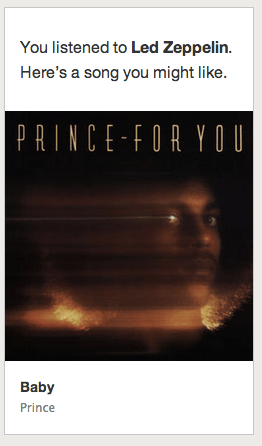
The recommendation engines were not really been yet up to task because the algorithms have not been advanced enough to recommend right songs. Music is nuanced thing and linear recommendation is not usually providing satisfying listening. Previous Spotify recommendations have been borderline ridiculous:

Prince Spotify

Previously there has not also been enough data available. For recommendation engines to work, you need to have massive amounts of data and something that is relevant. The key for Discover Weekly to work so well is that Spotify realized that the data they should be mining are the playlists people are making.

“For all the special sauce and the algorithmic work, the fact that we’ve kept it simple and that it’s just a playlist has really helped it resonate with people”
Matthew Ogle (Discover Weekly Product Owner)

The more people are making playlists in Spotify more “human curation big data” they are gathering. Currently there are over 2 billion playlists in Spotify. Spotify has been able to strike the right balance on learning about your listening habits and combining that with the big data:

“On one side, we’ve built a model of all the music we know about, that is powered by all the curatorial actions of people on Spotify adding to playlists. On the other side, we have our impression of what your music taste is. Every Monday morning, we take these two things, do a little magic filtering, and try to find things that other users have been playlisting around the music you’ve been jamming on, but that we think are either brand new to you or relatively new.”
-Matthew Ogle (Discover Weekly Product Owner)

In the beginning I wasn´t that impressed with Spotify´s weekly recommendations. Majority of the songs I knew already (20+ years of record collecting has its handicaps). After couple of weeks I started to appreciate the brilliance of it. Spotify Discover Weekly has become my “comfort playlist”. It plays stuff I know, but drops every week couple of nice gems I had not heard or had totally forgotten. During working week I listen to lots of weird stuff outside my usual taste profile, Spotify´s weekly recommendations don´t seem to pick on those anomalies and the quality is constant:

Like mentioned earlier, eventually data will trump human experience. In many fields, we are already there.

“In the next generation of software, machine learning won’t just be an add-on that improves performance a few percentage points; it will really replace traditional approaches.

Today, you’re much better off building a smart system that can learn from the real world – what actual listeners are most likely to like next – and help you predict who and where the next Adele might be.”
Eric Schmidt, Alphabet executive chairman

Tagged , , , , , , , , ,

Decisions Are Not Made Through Consensus

I don´t believe in committees.

I don´t believe in creative circle jerks.

I don´t believe in finding consensus.

I believe in getting shit done.

That requires collaboration but combined with firm decision-making.

Shared responsibility usually means no responsibility.

Opinions are like assholes, everyone has one and usually you want to smell only your own one.

Plus ideas are like farts.

Good strategy is about making choice.

And usually making choice means that there are opposing views. Some views will be supported and some won´t. And that is ok. In well-functioning organization you are listened but you also know who makes the decision. Opinions are listened, but not everyone is decision maker. Who makes the decision also holds the responsibility of the outcomes.

Consensus means no ownership. What’s important is not that everyone agrees, but that everyone is heard and then the right person makes a decision.

Gokul Rajaram, Square

Tagged , , , ,