Category Archives: Strategy

9 Tips On How To Be An Interesting Conference Speaker

I used to speak in quite a lot of seminars and conferences.
Nowadays I do it less, which means that I do not generally attend any conferences any more. I have some real work to do.
It is always nice to meet new people, but generally they are always the same people frequenting the seminars (those who have time for them). Other reason why I am avoiding the seminars is the quality of the presentations. Generally they are really boring. If I don´t get a new idea from every presentation, the time spent surfing web and watching cat videos would be time better spent.
Based on my experience in conference circuit, below are nine tips on how to outshine your competitors on the stage. If I would conclude it to one sentence, it would be about: “People are not interested about what you know, but what do you think and feel”. If you can convey that in your presentation, you are already quite far on making compelling presentation:

1. Have a point of view
This is the most important thing. When you are speaking at a conference, your main goal is to be interesting. You are not promoting your company; you are promoting your thinking.
What is the main idea you want to get across? If you do not have that clear idea with your presentation, you should get out of that stage. Now.
Having a point of view does not mean that you are smart or even close to the actually truth. The information is accessible to everyone, but only you can provide your own point-of-view. That is what makes you unique presenter. Don´t tell me stats I already know, but what is your take on those stats.

2. Don´t pitch your company, pitch yourself
I met my ex-colleague during lunch break of seminar he was attending. He mentioned that majority of the talks were just company pitches. This is like a plague especially in Singapore. I even attended Pecha Kucha here and majority of the talks were company pitches without no personality or point-of-view.
It was really downer.
I have gotten leads from every industry seminar I have spoken. I have usually mentioned firm I was working in the beginning and occasionally shown couple of case studies of what I have done (if relevant). That´s it. 99% of the presentation has been trying present compelling point-of-view about the state of world. Generally after the seminar, there has been a queue of people coming to talk more. There will be opportunities to handle your business cards and give your elevator pitch after your presentation. Would you rather talk with an interesting person with compelling views or desperate salesman who just sweats desperation?

3. Go against the grain
You have to make your audience feel something. If you are speaking in Social Media conference, have a title “Social Media is Dead” because every other presentation is praising the collective power of social media and using the same case studies. You don´t need to preach the idea of social media to already those already converted. You have to wake them up!
Generally people who attend seminars are more up-to-date with the world, so you can try provoking some thoughts from them. Also those who would need digital marketing education never attend the digital marketing seminars.

4. Good presentation asks questions, but does not provide answers
Usually length of a presentation in seminar is 45 minutes. It is quite a short time. If you can make people think and asking questions, your goal is accomplished. The idea is not showcase everything you know, but to showcase the highlights of what you know and think in interesting way.

5. Good presentation is entertainment, not education
In seminars you have a fierce competitor for the attention: the smartphone. Immediately you are sounding boring, people start to focus on their mobile devices.

6. Don´t Sweat The Technique
I have seen great presentations without any aids or props. I also have seen awesome presentations, which use all the technical bells and whistles you can imagine. If you have the compelling point-of-view, the technique can either amplify or weaken it. It is more about personal preferences and style you have when presenting. Prepare also that there are always technical difficulties: no Apple adapters, fonts missing, computer breaking down, timelines not met, and microphone on mute… Be professional with it and go through the worst-case scenario before your presentation. Be ready to present even without your precious slides.

7. Adjust to the audience
Smaller the audience, the more interactivity I try to have and vice versa. General rule-of-thumb is that bigger the audience you have the more idiotic the questions will be. That is because they are not questions anymore, but more about showing how smart the asker is. Usually they are also pitching their company. Save that stuff for after-seminar cocktails, please.

8. Don´t Say Sorry
I don´t care if you haven´t had time to prepare your slides. When you are in the stage, be proud and don´t apologize your existence. You should be there for a reason.

9. Dress snappily
If everything else fails, at least they remember that you had flair and mint sneakers.

Speaking of conferences, I don´t like sending my slides in advance either.

Tagged , , , , ,

Who Will Be The Master of Internet Universe?

Web is dead.

That is the title of one of the greatest articles ever written about digital revolution four years ago to Wired. The main points about that brilliant piece are still valid, although speed of mobile revolution surprised many of the players for a while. The main idea of the story is that web starts to resemble more and more traditional industry with handful of players. Web is oligopoly and certain verticals almost resemble monopolies.

If you simplify the consumer-facing web business (so I am excluding infrastructure and other boring things which is where the real money is), it is about three things: products, commerce & advertising. Products enable you to connect to the Internet: smartphones, computers, watches, television sets, fridges and whatnot. Commerce is about being able to buy things from Internet and advertising is what it is: bombarding you with messages to buy more stuff.

Product category as we know it will eventually be commoditized. If you want to remain premium, you have to innovate constantly. That is the only way to remain luxury brand in this realm. Cheap smartphones will eventually beat the premium ones. In the future you are able to connect to Internet in whatever device and you do not really have to pay that much of that privilege.
Where the growth will come? Wearables can be the future winner product category, although they have not really yet taken off. The changes are rapid though. iPad was launched only four years ago, created totally new category and is currently at risk of vanishing because of the phablets. So is the life.
 
Current champions: Apple, Samsung
Challengers: Xiaomi and other cheap manufacturers
Disrupters: Luxury brands (Would connectivity enhance Rolex? I say not, but I might be wrong as well)

Commerce will become even bigger and you are able to buy pretty much everything online. Will all the physical retail vanish? Not necessarily, but the point is not about that. It is about that you are able to buy everything online, and majority of people will do exactly that, because it is more convenient and affordable.
Commerce is the biggest opportunity and a space I follow most closely. Strong brands will definitely start to create their own online retail experiences, which would enable them to bypass the more traditional retail channels. In the next decade there will be lots of turmoil in this category and many big players will fall and new challengers will arise. Biggest challenges are not that much about technology (lots of payment innovations happening), but about logistics.
Second interesting point is that idea of commerce has changed with shared economy. Both Uber and AirBnB are selling physical service, which would not be possible without digital channel. How far collaborative economy can be stretched remains to be seen. It can potentially be really big disruptor to the way we do business in general.
Last point about commerce is the ecosystem approach. Apple makes money constantly through App Store by enabling others to make money. Facebook is building app ecosystem with the acquisition of Instagram, WhatsApp and Parse. Both Amazon and Alibaba are enabling developers to build things on their platform.
 
Current Champions: Amazon, AliBaba, Ebay
Challengers: Google, Facebook, WeChat, Line, Apple (Apple Pay) 
Disrupters: Brands, FMCG brands, Collaborative economy players (Uber, Airbnb…)

Advertising will be important, because people will keep on buying stuff. Stuff makes us happy. More stuff makes us even happier. How are you able to buy that stuff if you do not know that it exists?
Will advertising become smarter in the future? Yes and no. In last decade or so, we have had one revolutionary advertising idea. That is SEM. You show people ads when they actually want to see ads. Contextual advertising and retargeting have been nice inventions, but mainly advertising is still based on interruption (some of it being more relevant like app install ads). One of the most innovative companies in the world, Facebook, makes most of its money by interrupting its users in various ways.
The advertising business is relatively simple: it is all about reach. All of the most successful advertising platforms are based on firstly to reach and then secondly the quality of those who you are reaching. That is unlikely to change. However, the biggest task is to try to narrow the gap between the interruption (advertising) and purchase (commerce). The monetary exchange is the only tangible KPI we have and less you have to travel to do it, the better.

Current Champions: Google, Facebook
Challengers: WeChat, Line, Twitter (was tempted to leave it out completely, but I give it a shot still), “Traditional media companies”(although I do not really have high hopes for their complete digital transformation, but they will remain influential on this space as well)
Disrupters: Amazon (the closer you are to the actual transaction, the less you have to interrupt), Content owners (although none of them has done any major moves and have mainly milked the status quo)

The lines are naturally blurry. The quote from Eric Schmidt summarizes the whole situation:

Many people think our main competition is Bing or Yahoo. But, really, our biggest search competitor is Amazon. People don’t think of Amazon as search, but if you are looking for something to buy, you are more often than not looking for it on Amazon.”

That is also the reason why these big companies are testing weird things and buying obscure companies. Internet has made it easier to disrupt a category and also connect categories in new way. Facebook & Google test drones, so it can bring Internet the people who don´t have it yet. Thus increasing the reach. Amazon tests drones, because shipping is the biggest bottleneck of eCommerce. When your business can start to flourish rapidly, it can also vanish rapidly. There is no time to sleep, because sleep is the cousin of death.

What do you think, who will become the master of the Internet universe?

Tagged , , , , , , , , , , , , , , , , , , , , , , , ,

Want To Change Your Habits? Just Go F*cking Do It

“Change might not be fast and it isn’t always easy. But with time and effort, almost any habit can be reshaped.”

Charles Duhigg (from the Power of Habit)

How many times you have decided to start to lose weight?

Or stop procrastination?

Stop smoking?

Start exercising?

Be happier?

Eat more healthily?

Go travelling?

Cook more often?

Or try to update blog every day?

Quite often, I would say (especially for the last part)

Behavior change is difficult, although the components are simple. You have cue, such as feeling stressed out at work. You have routine, such as smoking to relieve that stress. And then you have reward, which is actually the break from your office desk. To succeed in habit change you should always change one variable at time. So that´s why eating a carrot or “smoking” your pen might work even better than nicotine patch in stopping smoking habit. You alter your routine, but keep cue and reward intact. To be honest though, the physical addiction to smoking makes it one of the trickiest habits to break so you might need the help of some nicotine products as well.

The main principle is still clear. You cannot start a new habit from the scratch. You have to build it upon your existing habits. Lack of this insight results that majority of habit-changing apps don´t really work.

“It is facile to imply that smoking, alcoholism, overeating, or other ingrained patters can be upended without real effort. Genuine change requires work and self-understanding of the cravings driving behaviours.” 

-Charles Duhigg

Cue-routine-reward is the technical side of habit change. Important bit is also the motivation and that is where there are major differences between people. Different things motivate us. I personally am motivated by competition (mostly in sports, but how I see it you can compete in everything). Some people are not motivated by it at all, but more driven by social doing together or sense of fulfillment (and other crap I don´t really care about). The lack of understanding of what motivates people is one of the main reasons why companies can´t keep their employees. We tend to generalize our own motivation to apply to other people as well, so leaders try incentivize and motivate people using quite limited amount of tools.

Money motivates as well to certain extend, but again you have to craft the habit-changing program well. Yearly raise motivates us generally less than getting bonuses throughout the year for good performance (as we humans are quite adaptable). For smoker the schemes where you either get financial rewards or get penalized for not reaching the goal have been proven to be effective in studies. The motivation difference in these two ways is subtle: gaining attracts people who love winning and keeping those who are afraid of losing. Both work well. Also money is never only money. It acts as a metaphor of the sweet triumph or a bitter loss. The strength is that you can put a monetary value to almost anything and it can symbolize the struggle and fight behind reaching your goal.

Tapping into this insight comes this new site with catchy title:

go do it

Go Fucking Do It.

The premise is simple. You set a goal, deadline, supervisor and the amount of money you give if you do no reach your goal. Not surprisingly if you lose that money to charity it reduces the effectiveness of your decision.

“If you want to do something that requires willpower—like going for a run after work—you have to conserve your willpower muscle during the day,” 

-Charles Duhigg

justfkingdoit

The site has a potential, but important thing is to have really sharp and understandable goals. For example getting gluten-free is easily attainable than getting a girlfriend as the former one is only up to you and has clearly identified steps. That you do not have girlfriend can be due to multiple variables, so you would have to fist prioritize those variables and start changing those one at a time.

I like the attitude of the site though. Quite often we should not overcomplicate things and just fucking do it.

Tagged , , , , , , , , ,

I Love Advertising, Because I Love Lying

I think that Jerry Seinfeld´s acceptance speech in Clios this year, was the most appropriate representation of what we actually do. Jerry might just be taking piss on every ad people on the audience and it might be filled with evil sarcasm and irony. I did not take it that way, I think it spoke with clarity and honesty why our industry is so great.

Five important points from Seinfeld´s Clio speech:

1. “I love advertising because I love lying. In advertising, everything is the way you wish it was”

Advertising is not really lying, but more of massaging the truth. Advertising is like your wedding photo, job interview or date. You are not making blatant lies, but you are emphasizing your good parts and trying to hide the bad parts. People are not stupid and this is the way the game is played. Just like in life, it is not the most handsome guy getting the prettiest girl. Who gets the prize will be the

2. “I don’t care that it won’t actually be like when I actually get the product being advertised because, in between seeing the commercial and owning the thing, I’m happy, and that’s all I want.”

I know that the weightlifting shoes I ordered will not make me the most awesome weightlifter in the world (or not even in my gym). There are no shortcuts for hard work and when doing sports your whole life you know it. Having those increases my mood and eventually will make me better lifter. The motivation to buy things is much more nuanced than just showing off or filling some kind emotional void and misery.

3. “We know the product is going to stink. We know that. Because we live in the world, and we know that everything stinks. We all believe, hey, maybe this one won’t stink. We are a hopeful species. Stupid but hopeful”

This is what makes us human beings so great. Our hopefulness exceeds our stupidity, and latter we have plenty of. Majority of start-ups will end in bankruptcy. Majority of marriages will end in divorce. Majority of the diets will end in you getting fat or even fatter again. But the flipside is that there are people who are living happily ever after, becoming multi-millionaires and staying in shape. Our ability for rational thinking combined with total negligence of that same rational thinking makes us the most dominant species in this planet.

4. “I also think that just focusing on making money and buying stupid things is a good way of life.”

I think so too.

5. “I believe materialism gets a bad rap. It’s not about the amount of money. Nothing’s better than a Bic pen, a VW Beetle, or a pair of regular Levi’s. If your things don’t make you happy, you’re not getting the right things.”

My grandmother mentioned in my wedding that after a day of shopping I had happily shouted: “This is the life everyone should live!” On that same occasion my father reminded that when he first took my little brother & me to McDonald´s and I got my first ever Bic Mac. I commented that important event with the declaration: “This is the happiest day of my life”. No wonder I ended up in advertising.
Consumption makes us feel good and yes it gets bad rap for no reason. I still get happy when after meticulous saving, I was able to secure myself a pair of Technics turntables. Those have served me well for over 15 years and I still feel utterly happy about that purchase. How many other events you still savor after 15 years? I still remember getting my first jeans (Levis 501s). They were not just jeans, they were passage to adulthood.

With advertising we try to channel the inner need of consumerism to the brands and products we represent. We do not create any new needs for consumers. We do not try to make you feel miserable of not owning stuff, but rather make you happy when you make the right purchase. Consuming products and experiences can have tremendous uplifting affect to your mood.

That is a great and we should be proud of what we do.
At least I am.

Tagged , , , , , , , ,

Pay Attention to Detail: No Brown M&Ms

If I would be a famous rock artist, I definitely would demand local AA meeting schedules, a sub-machine gun, a 12-foot boa constrictor and a jar of Grey Poupon mustard. And I am not making these ones up; this is straight from Mötley Crüe´s rider.

One of the most famous demands has been the removal of brown M&Ms for Van Halen, which according to urban legend resulted in trashing the hotel room when there were some brown candies in bowl. While at glance it is on the same level of ridiculousness as a rainbow on wheels, it actually served a practical purpose.

van halen rider

During the time this request was made, Van Halen was the biggest, loudest and flashiest of the metal bands. This resulted that their show was also demanding from technical perspective not only with their riders with KY tube jelly. Some of the venues were old and not necessarily that up-to-date with technical or safety requirements. Brown M&Ms served as an indicator of how seriously the concert organizers paid attention to detail. If there were brown candies, that meant they should probably check the technical setup on stage as well. David Lee Roth explains the thinking below:

Attention to detail is an important skill; because it is the most visible manifestation of that you give a shit. If you have job application full of typos and presentation with wrong date, it gives a message that essentially you do not care.

All relationships are based on passion & reliability, and you have to be able to convey both of these traits. One of them can be the driving force, but you cannot neglect either of them if you want to make it last.

You also have to know when to switch details-mode off. There is a time when everything needs to be 100% and there are moments when you can be more relaxed. I have seen so many perfectionists already burn themselves out on trivial tasks and then failing in game-changing moments. It is probably the most important skill to learn in work: when to put it all in and when to just wing it. Some idealists can say that you should always give all in, but that just leads to exhaustion, depression and broken dreams.

It is like sports. You do not need to run as fast as you can as long you run faster than others.

Tagged , , , , , ,

Anatomy of An Insight: Don´t Skip Breakfast

Good insight comes always from human truth. But that human truth can be super simple. That human truth can also come from specific media constraints.

Pre-roll is currently the most under-utilized and boring digital advertising format, but luckily there are brands who are putting some thought to it:

EAT – Don’t Skip Breakfast from Brave on Vimeo.

Insight: People skip most of the pre-roll ads. Many people skip their breakfasts as well. Latter is unhealthy, first probably opposite. Can we combine these two skipping behaviors?

Eat is a sandwhich chain. All of the office workers skipping their breakfast at home and skipping those YouTube pre-rolls at work, are a lucrative target audience for them.

Just acknowledging the fact that the skip ad –button is there is great.
Then rewarding those who watch it to the end is just brilliant.
This is simple, but genius work from Brave.

Tagged , , , , , , , ,

“When I didn’t have a mic, I rapped on headphones”

Although I am white dude from suburban Finland, I have always been quite serious hiphop-head. This song below has always been one of the favorites. Raw simple drums and raw battle rhymes. That is all you need in a perfect hiphop-song:

One Charizma line has become a legendary hiphop-quotable from the song. It is almost like a rally cry for the indie hiphop movement and DIY spirit in mid 90´s and early 2000:

“ When I didn´t have a mic, I rapped on headphones”

For those who know, in the absence of microphone you can usually plug headphones to microphone input of mixer (I have done that as well). More street credible rappers have also been known to rap their records in telephones from jails. However, the line has lived on through the years within the song and also with this cool t-shirt designed by Parra:
tshirt
Now 18 years later, this legendary line has found again a new life with this awesome collaboration by headphone brand AIAIAI and legendary West Coast record label Stones Throw records. You can actually get to the record by rapping to your headphones:

This project is a great example that although you do a contest it can have some innovation with it. The contest promotes actual product launch. Many headphone brands do bespoken collaboration products and some might also do music contests. Stones Throw & AIAIAI have been one of the best ones creating quite holistic and enjoyable consumer experience from the website to the app. Because of that legendary Charizma line, it also makes perfect sense for headphone brand.

Also a good example that you should mine your good ideas way more often from old underground rap songs.

Tagged , , , , , , , , ,

The Art of Making Effective Facebook Ads

Although I am strong believer of catching attention by any (relevant) means necessary, this ad seriously baffled me:

watermelonhead
Are you getting design services from guy, who has a watermelon in his head?
Or is the watermelon head representing guy who needs design help?
I think he definitely needs some kind of professional help, but I would not be worrying about the design. Unless you get some psychiatric advice in addition to the design services, which apparently cost less than a cup of coffee.

On the other hand I saw the ad and started to think about it, which is way more than I can say about the majority of FB ads.
The challenge with Facebook ads is that you seem to notice only the really weird ads, which you would never click on.
When you have small space to work on, it is difficult to get noticed but still be relevant.
Difficult but not impossible.

Tagged , ,

Has This Been Done Before?

The most frustrating part in working in Singapore is the construct of majority of the presentations. Way too often, you spend big portion of the presentation going through examples on how other brands have done, not just similar things, but exactly the same things to sell your idea.

Has this been done before?

It is always good to learn new skills, but I have to say I much prefer my own construct. Show that none of the competitors is doing the thing you are proposing and pinpoint the opportunity. That approach does not sell work in here though.

And it is understandable. Others might not be doing that particular idea, because it does not work. Or they might not be doing that idea, because they are waiting for the proven case studies and benchmarks. So every marketer should remember the following four rules:

If you are doing something for the first time, there is higher probability that you will fail.
If you are doing something for the first time, there is higher probability to do something surprisingly successful. 
When you do something for the first time, it will be groundbreaking: either in negative and positive.
When you are doing something for the first time, either do it as a test or go all-in.

This paradox causes interesting challenges. When you try to duplicate something truly groundbreaking, it is nearly impossible. When you do something for the first time, it is partly about the idea and partly about the speed. Everyone working in this industry long enough knows that coming up with great ideas is not that difficult. Getting them executed fast and first is. Over-benchmarking success stories just results in mediocre campaigns: even though you could copy the exact idea, you cannot copy the exact situation.

This has been done before?

When you are doing something for the first time, it can be a stunt.
When you are doing something for the second time (or third and so forth), it cannot be stunt.
 
Talent borrows and genius steals, but genius also knows from whom to steal. Occasionally you might get the comment with digital ideas that it has been done before. And the same way as the opposite comment above, that does not really make sense either. No one faults you from doing 30s TVC, because it has been done before. It is a proven method, not an idea. It is not an idea anymore in 2014 to react to tweets and hashtags:

It is already a proven method. It becomes an idea when you have Boyz II Men singing those tweets. Same way as the only TVCs catching the attention anymore are the most expensive. That does not mean you should not be doing TVCs or social response, you have to execute with more bells and whistles.

The more proven method has become, the more craft and execution matters in it success.

When you are doing it first, you need less flair.

Tagged , , ,

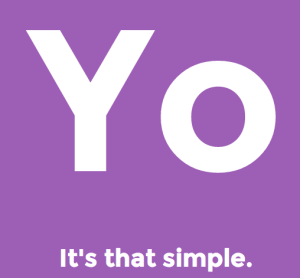
Yo.

Simplicity is beautiful. With messaging apps and especially through stickers our communication has become more effective and simpler. Is there a limit to how simple you can get?

Apparently not.

This week app called “Yo” launched from beta. It is the simplest form of communication I have yet seen. It works in iOs and Android. You select username. Then you add friends. Then you can send your friend “Yo” as a push notification and audio. So essentially you can only communicate through one phrase:

Yo

You got to be kidding?

No I am not. The company behind “Yo” has raised $1 million in venture capital. Currently there is over 50k users sending around 4 million Yos. They are also currently hiring.

For life-long hiphop-enthusiast I can see the merit of the app. Maybe in the future iterations you can have personalized “Yo” or an “Yo” from a famous rapper. Yo is simple, positive and universal.

Unlike many start-ups, the app creators have also thought about potential use cases for companies:

  1. A blog can Yo the readers whenever a new post is published. Imagine getting a Yo From PRODUCTHUNT.
  2. An online store can Yo its customers whenever a new product is offered. Imagine getting a Yo From JENNASHOPIFY.
  3. A football club can Yo the fans whenever the team scores a touchdown. Imagine getting a Yo From THE49ERS.
  4. An ice-cream truck can Yo the kids when it’s around the corner.… Imagine getting a Yo From THEICECREAMTRUCK.

The feedback for the app is hilarious as well. The current users have definitely taken supportive although somewhat ironic stance to it. Here are some of the highlights of App Store comments:

Yo is all I need
When the wife texts me to go get some stuff from the store, all I do is shoot her back a “Yo”. When the kids text for money or a ride, I get on the app and hit them a “Yo”. Yo is a way of life. Live simply, live beautifully. Yo”

This app changed my life
I am a professional scientist who has been scouring the earth for 7 years in search of a program or application so revolutionary, so outside of the box, so groundbreaking, that it could actually reverse the effects of clinical depression and bipolar disorder. “Yo” seems to be a fit. I have tested the effects of yo on several samples of depressed and bipolar tigers. Tigers were a natural choice for testing due to the little known fact that their anatomy is nearly identical to that of a humans. In a sample of depressed tigers, 8 out of 10 became happier due to the app yo and in an all male sample, 9 out of 10 experienced increased libido. I have taken my findings to Pfizer in hopes of negotiating some sort of three way contract between the creators of yo, Pfizer, and myself, Chisley Winsett M.D. So my message is this, creators of yo, this app that you have so sweetly crafted is not just an app, nay, but a highly scientific piece of medical innovation. We could do great things together. Please respond. Regards, Chisley Winsett M.D.”
 
“A life changing app
Yo is the best way to communicate. We no longer need intellectual discussion. We no longer need language. This is the next stage of human evolution!”

This feels more like postmodern commentary of the current app infrastructure or as an art project gone viral. On the other hand, it is hard to predict what eventually becomes hit. I would regard Yo only as a novelty app, but I do not use stickers either. It just might be that Yo will revolutionize messaging. Or it will be remembered as the tipping point when app bubble really started to burst.

Tagged , , , , , ,