Category Archives: Planning

Anatomy of An Insight: Hungry Jack´s Pack That Scares Birds

It is an award season and there is a sudden torrent of relatively dubious case study videos popping up. Not any idea is the following campaign really executed, but it would be awesome if it would be. Some brilliant and functional packaging design shown in here:

Hungry Jack’s – The Pack That Scares Birds from Sarah Parris on Vimeo.

Insight: There is not anything better than eat junk food outside. Unfortunately almost anywhere from Helsinki to Singapore birds are ruining that experience. Pigeons and other parasitic birds are shameless and aggressive in attacking your meal. When shooting is (unfortunately) out of question, we need different solutions to keep pests away from our fries.

The solution shown in this video looks valid at least based on my experience on building scarecrows. Unfortunately birds tend to get accustomed to many of these methods, so it would be interesting to know how long the holographic packaging actually scares the birds.

Tagged , , , ,

Loalty is Laziness: Would You Change to Apple Music From Spotify

Apple will launch its streaming service Apple Music June 30th.

Although there was not anything mind-boggling with the launch, it will dramatically shake up the music streaming service landscape. Below I am answering all the questions that you are thinking about the launch, because I can:

Will Apple Music be bigger than Spotify?
Yes.

In terms of paying customers, Apple Music does not offer free version, which is probably a wise move. Currently paying customers create 26 more times the revenue compared to free customers in Spotify.

Spotify has 70 million users (of 20 million are paying). Apple has over 800 million iTunes accounts. Do the math. Just converting 2,5% of the current user base (of which not all are naturally downloading music) gets them even.

However it might not be as easy or as profitable it would seem at first glance.

Paying for streaming music is a niche activity. Only 5% of the people over 13 years old pay for streaming services. During the digital download heyday, 25% of the people were regularly paying to download music and astonishing 80% of people were regularly buying cd´s when that was popular. Those days will never come back.

Optimist would say that there is an opportunity to increase the amount of subscribers. Pessimist would say that we will never reach a level again where even 25% are paying for music. My thinking is somewhere in between: there is opportunity to increase the paying streaming category but it requires cheaper options than the current default 9.99$/month. In terms of people paying for music streaming services are the best bet for record labels, because ownership of music seems quite expired concept in 2015.

Because of its ecosystem and deeper pockets, Apple has better opportunity to grow the category if it is to grow. Free streaming services will remain in the mix, because too aggressive clampdown for free streaming would probably retort people back to pirating the music. Also those who pay for music are not necessarily the tastemakers of what is hip and cool. In 2015 the investment to music is not necessarily an indication of its popularity.

Is Apple music then a better service than Spotify?
No.

At least based on the current information.

In terms of library they are in parity (30 million songs both, no Beatles in either of them). The main features Apple was talking about were nice-to-haves, but nothing that would immediately make people to switch. Beats 1 is essentially just a tradtional radio. Curation from tastemakers is something that sounds nice in powerpoint, but masses don´t really care. Same thing with Connect, music fandom is way more niche activity than non-committal music consumption on background.

Will people flood from Spotify to use Apple music?
Well, it depends.

If you are invested in Apple ecosystem and have been buying from iTunes music before, that is likely to happen. Over half of the Spotify users are also using iTunes. If you do not have that legacy, you are not likely to switch from Spotify unless Apple manages to bully its way with labels to worsen the current Spotify.

Why?
We are lazy.

Brands often mistake the laziness of users for loyalty. It is natural for people to try to avoid stressful situations and change (even how big or small) is always stressful.

It is hard to unlearn your habits, whether they are good or bad (especially the bad ones). It is also hard to learn new habits even how beneficial they would be to you. Therefore just making things easy-to-use is not enough for people to make a switch. They need incentives and motivation: the right balance of stick & carrot. People keep using hard-to-use methods (like pirating) because that is the way they have accustomed themselves and cost of learning something new feels too hard.

In many ways both Spotify and Apple will benefit from the laziness of their users.

Current Spotify paying users will not flood to Apple. Those who are using the free ad-fueled version are different target audience altogether, so Spotify will also be growing in terms of overall users. If you are Spotify free user and have not turned to paid version with Spotify, it is quite unlikely that you will start paying with Apple. On the other hand, testing the Apple Music will be just a click away and it works seamlessly with your iTunes library. So those people who have been postponing moving to streaming services and have still been paying for digital music downloads, don´t have that many excuses anymore.

And to answer the question posed on the title of this: no, I will not switch to Apple Music. On the other hand, majority of my investment in music still goes to vinyl records. Like said before, old habits die hard.

Tagged , , , , , , ,

Fight for Your Balls

fightforyourballs

Regular readers of my blog know my appreciation of lowbrow humor and brands who take piss out of everything.

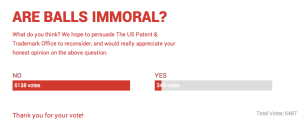
That is why I am a strong supporter for the Norwegian underwear brand Comfyballs. Lately they have been fighting US patent office, because they cannot register their name because it is considered “vulgar”. The reason for that being:

In the context of the applicant’s goods… Comfyballs means only one thing – that a man’s testicles, or ‘balls,’ will be comfortable in the applicant’s undergarments.
The mark does not create a double entendre or other idiomatic expression.
When used in this way, the word, ‘balls’ has an offensive meaning.

I wish more brand, would be as clear as Comfyballs.

Their main product benefit is in their brand name. Double entendre would actually be more offensive, because you try to hide something. Comfyballs is truly honest brand and not hiding behind marketing jargon. When you wear them your balls will be comfortable, because their patented design PackageFront™ reduces heat transfer and restricting movement. There is not anything offensive of having comfortable underwear, on the contrary. Using badly designed underwear when jogging is a truly offense to your crown jewels.

Comfyballs has not just been scratching their balls, but also actually risen to a challenge and they are trying to get their name registered officially in US. They launched the site “Fight for Your Balls” and also created video to celebrate comfortable balls:
Comfyballs has not just scratched their balls, but also actually risen to a challenge and they are trying to get their name registered officially in US. They launched the site “Fight for Your Balls” and also created video to celebrate comfortable balls:

Legalize Comfyballs from Fantefilm on Vimeo.

Naturally the ad was banned in YouTube (those US hypocrites), but again more buzz for the brand. At least the visitors in the site seem to be in their favor.

immoralballs

There are things in the life you should fight for, your balls are one of them.

Tagged , , , , , , ,

Anatomy of An Insight: Rexona Social Experiment

I love doing work that is simple but insightful.

Too often we, as marketers, end up complicating things by weird marketing talk and creating irrelevant associations with our products that are not true. We just should try to be as authentic as possible and honest on what we do. Therefore the recent content series we have been doing with Rexona has been refreshing to do. It is all based on insight about the product and its need on our markets and nothing else.

This is the social experiment from Indonesia (don´t worry if your bahasa is a little bit rusty, you will get the idea):

Insight: People will not say to your face if you smell, but they talk about it behind your back.

The campaign is currently live in Indonesia and Brazil and has gained already over 1,5 million views.

Tagged , , , , ,

Send A Message, Send A Dick

If I had a shiny gun,
I could have a world of fun
Speeding bullets through the brains
Of the folk who give me pains;
 
Or had I some poison gas,
I could make the moments pass
Bumping off a number of
People whom I do not love.
 
But I have no lethal weapon-
Thus does Fate our pleasure step on!
So they still are quick and well
Who should be, by rights, in hell.
Dorothy Parker (Frustration)

Advertising industry is obsessed by positivity. All the ads are filled with shiny happy people pointing their fingers at computer screen. Everyone is smiling. Everyone has friends. No one is fighting. There is no politics, grudge or evil. Everyone cares about the brand and how that special toothpaste comes to save the day.

The advertising reality is pure fiction.

Same time the best advertising is based on truth:

listerine_new

You can dramatize the truth and make it interesting. But there has to be truth in it, otherwise it is meaningless: not connected to the real life, only connected to advertising life. The truth above is simple: bad breath is disgusting and ruins your social chances*. Nothing positive about that, but the message is powerful.

Advertising life should never be separated from the real life. The truth is that your life is filled with annoying tasks, annoying people and annoying circumstances. If more brands would recognize that we would have more truthful advertising. More truthful is also more powerful and resonates with real audience (not focus groups).

There is something profoundly truthful with this new service called “Dicks By Mail”.

dicksbymail

The brand promise is simple:

“In only a few minutes you can send a literal Bag of Dicks to that special asshole in your life.” 

The “dicks” in question are actually candy, which you can send in anonymous package:

candy

This is a great politically incorrect idea. The truth is that everyone could come up with quite long list of people (who are dicks) to whom this jolly gift should be sent (to let the whole world know that they are dicks).

Sometimes the truth hurts.

* Of course advertising played vital role in making halitosis a social problem. That would not have been possible, if Listerine ad message would have been positive. Ad below is naturally revolting when analyzed from today´s point-of-view, but it is based on truth. Sometimes truth is hard to swallow, even harder than Listerine.

listerine_old

Tagged , , , , ,

Much Ado About Meerkat

“Those sorts of consumer shifts used to take years or decades, but now they can happen in months or weeks or days, and we’re becoming accustomed to that idea”
Ian Bogost, game designer

Have you heard about Meerkat?

Don´t worry, you might not even need to.

The hype cycle of new apps gets faster at every moment. I heard about Meerkat couple of weeks ago, this week it has been all the talk of the SXSW town and now it has already been declared dead.

Meerkat is essentially live-streaming app, which used heavily the social graph of Twitter and allowed you to connect to your Twitter connetions in Meerkat. Twitter has already blocked this fun, in conjuction of buying similar app called Periscope. Hence, Meerkat suffered a blow and in the world of tech news hyper babble that blow is naturally deadly.

I was not excited about Meerkat, when I heard about it. I didn´t and don´t recognize the novelty or appeal in the app. Opportunity to livestream is nothing new. When I was working in MySpace, we collaborated with Bambuser, which pretty much was Meerkat with MySpace-era user experience. There are currently many streaming apps available, like the one Twitter just acquired.

So nothing new under the sun, been there done that.

After that comment I can declare that I have officially become an old fart. A person who thinks he has seen anything in his life and can´t just wait to tell that “we tried it already in 2008 and it didn´t work then”. Old farts are the biggest obstacles of any innovation, because the old farts have seen it all. They have also innovated it all. Unfortunately, those innovations have happened only in their heads.

That horrible vision made me think Meerkat again.

The idea can fail for many reasons, but always the reason is not that the idea is bad. iPad was not the first tablet. Facebook was not the first social network. Idea can fail in so many phases, that you cannot really judge the initial idea. Ideas are not unique, executed ideas can be. Technology improves so fast, that the ability to do user-friendly and enticing live-streaming app is totally different than couple of years ago. Maybe 2015 is just the right time to launch live-streaming app. Executing idea is also just one thing, how do you market it and make it sexy is the other thing. Meerkat has been at least way more effective with their PR and hype machine than their competitors.

My opposition against Meerkat is that I do not see live streaming behavior taking off. To be honest, I did not see that Snapchat would evolve to be a legit app beyond teens sending their nude photos to strangers. I can also admit that I was wrong. Although it is easier to latch onto existing behavior, technology can also create new behavior. That we are glued into our smartphones is quite new behavior in history of human race. I don´t think that no one predicted exactly that to happen.

We are obsessed with new.

Meerkat has had disproportionate amount of hype, because media wants a new social media phenomenon. Old farts criticize it, because it is not new enough. Somewhere between the overhype of media (and tech hipsters in SXSW) and underhype of old farts is the truth. Which is: essentially no one really knows what will happen with Meerkat. But it is interesting to see.

You cannot ever evaluate the success of technology when it is hyped and brand new. The true stress test is when technology has become old and boring. That is when they start to make business sense.

Tagged , , , , , ,

What Kind of Planner Are You?

Advertising agencies have not been really good at naming themselves, but we have been quite creative in making up new job titles. We had interesting discussion with fellow Finnish planners about the difference between “planner” and “strategist”. This prompted me to explain the differences between different planning job titles:

Junior Planner: Coffeemaker.
Traditional planner: Hopefully unemployed.
Planner: Person who spends weeks (sometimes months) with creative brief and either comes with truism or something totally unhelpful for creative process.
Planning director: Planner, who uses fancier words.
Head of Planning: Planner, who drives fancier car than you.
Strategist: Wannabe consultant.
Creative strategist: Failed creative, who cannot write or draw.
Growth Hacker: Wannabe start-up guy.
Researcher: Planner, whose slides make even less sense.
Analyst: Person who lies by using numbers instead of words.
Innovation director: Person, who does not have any budget, responsibility or real projects.
Trend planner: Dude who just surfs web and posts random stuff identifying them as “weak signals”.
Digital strategist/planner: Person, who thinks that it is still impressive to put different digital channels in boxes on PowerPoint and call it a channel strategy.
Engagement planner: Same as digital strategist, but he uses arrows between the boxes.
Social media strategist/planner: Person who talks about engagement and conversation and no one is engaged.
Mobile strategist: Person, who says that mobile is the next big thing.
Content strategist: Person, who would not know good content if it would hit him in the face.
Thought leader: Planner, who has written a book (that no has read)
Keynote speaker: Planner, who spends majority of his time self-promoting himself at seminars.

If you have any additions, let me know at the comments.

Tagged , , , ,

Why You Should Not Listen To Social Media Complaints?

I was yesterday listening to Chaka Khan concert* in Singapore Jazz Festival.

The event was typical Singaporean culture event. It was mostly corporate and stiff audience mostly concerned on social media updates and eyes on their mobile phone screens. Presenter talking about “building jazz ecosystem” (whatever that means) made me cringe. I did not have that high expectations, but the music was great and the audience (including couple of stiff Finns) started to dance.

When Chaka Khan had just ended one of her greatest songs “I love you, I Live You” (listen below), someone from the audience screamed:

“PLAY FREEDOM”

Going to the next song (from the same album What Cha´ Gonna Do For Me?), the same dork screamed again.

“PLAY FREEDOM”

I would be a little bit hesitant to treat one of the best soul singers ever as a jukebox, but the main problem is:

Freedom is not even a Chaka Khan song.

Although it is a great song, Aretha Franklin has done it.

First it made me annoyed and then it made me think.

That guy was like your usual social media complainer: he wanted to be heard, he did not know anything about what he was talking about, he was loud and only thought about himself.

Quite often people complaining about you or your advertising on social media are not even your clients. They are people whose main satisfaction in life is to be upset about different things and make other people´s life miserable. If you upset people who are not even buying your product, does it matter at all?

Brands are overly sensitive of negative feedback, but quite seldom they stop to think who is actually giving that feedback. And again if you get any reaction from consumers, it just means you have already passed the clutter and created some cut through amongst your audience. As we know the biggest problem is not that people get angry, it is that they don´t really care. Negative top-of-mind is better than no top-of-mind at all.

Essentially we all were consumers in the show as we had bought (or got bribed) with tickets. Some consumers are more important than others though. Probably the guy (of course it was a guy) is super annoyed that the artist did not play the song he wanted to hear. Essentially his opinion is worthless. Do your homework: if you don´t even know the songs of the performer, shut up and enjoy the performance. Maybe you learn something new.

Well as we are heading to the weekend, we should leave all the negative feelings behind. Therefore I´d like to highlight these three nice edits of classic Chaka Khan songs to appreciate the great artist. No major mutilation to the originals, just extending the best parts. Also because she did not perform either Clouds or Fate yesterday:

Chaka Khan: I Love You, I Live You (Danny Krivit Re-Edit)


Chaka Khan: Clouds (Blackjoy Edit)


Chaka Khan: Fate (Todd Terje Edit)

Also for the guy who was yelling for respect, here is a little bit more re-imagined Baltimore version of it:

*Overall Chaka Khan was actually quite enjoyable. She did only the essential hits (like mentioned above, Fate & Clouds were pretty much only ones I was missing). She sang really well when she was singing but also looked a little tired. I did not mind her 30+ minute-break on the middle though, when her backing band Incognito took the reins. Incognito has always been a little bit too polished on their records to my liking (well they were Acid Jazz), but they actually worked better live. Colibri was an awesome version and their drum & percussion section was on some serious Whiplash-mode at times.

Tagged , , , ,

5 Ways to Make Your YouTube Pre-Rolls Kick Ass

Sometimes media is the message.

Lately there has been one media, which has had a sudden surge of messages: both skippable and non-skippable.

YouTube pre-rolls.

Despite annoying the hell out of users and not really making money, brand advertisers love YouTube pre-rolls. They are the new TV ads. Unfortunately that familiarity often translates to laziness. When there is lack of understanding of digital possibilities, YouTube pre-roll seems like a silver bullet. It feels easy, cosy and ticks all the right boxes (visual storytelling, digital, reach, etc.)

1. Don´t use your TV ads as a pre-roll.
There is an exception to this rule, though. If you have done genuinely funny, entertaining and effective TV ad, which works also in digital format and drives the message home in the first 5 seconds you can skip this part.
Yep, I thought so.
Although it feels tempting and easy solution, dumping your TV ad to YouTube hardly cuts the mustard.
Majority of TV ads are 30 seconds. The media buying behavior is the main reason for the duration. 30 seconds is not magical duration to tell a story. Especially in YouTube, where people watch content ranging from fraction of seconds to multiple hours.
TV ads are more passive format, as you cannot skip them as reaching for the remote is more tasking than moving your cursor on screen. You can be more boring and long-winded in TV ads and still make them work. You don´t have that luxury with YouTube pre-rolls. At its most minimum level, at least make YouTube edit of that TV ad.

2. Understand why people are watching YouTube videos
When you buy that pre-roll, you are, by default, annoying users. They want to watch some idiot eating Naga Morich, not hear about your latest anti-dandruft shampoo. You are not engaging with audience, you are interrupting them. So embrace that fact. Little contextual acknowledgement (Burger King Anti Pre-Roll) or even reward for watching the whole video (EAT: Don´t Skip Your Breakfast) will go a long way.

3. People will likely skip your ad. Make those 5 seconds count.
Depending on the source, over 94% or as little as 70% skip the pre-rolls. Nevertheless of the actual number, you can safely assume that your pre-roll is more likely to be skipped than seen or shared.
Therefore the most important part of a good story is the beginning. You have to catch the attention immediately. Like saying that you electrocute a dog if you skip the ad:

Even after this threat, only 26% watched the video in its full glory. Either there are more latent dog-haters around or people just skip the ads based on the habit. Hardest task is to make people stay and watch the first 5 seconds. After that the consumer is already committed to your content and can just hang on:

4. Don´t Sweat The Length (but make it as short as possible)
Generally non-skippable YouTube ads should be shorter than that and skippable ones could even be significantly longer. So take your time as long as your start is hard-hitting. After first five seconds everything is easier.
Only caveat is that it might be quite overkill to force user to watch 30s pre-roll when she is watching 10s video. Smart marketer would have lots of different versions of the YouTube pre-roll to suit different context (like Burger King Pre-Roll) or different lengths. The following ad from Volkswagen would work brilliantly with shorter-form video:

Doing multiple versions is more expensive from production perspective, but increased investment would also result in increased effectiveness.

 5. If you don´t have anything interesting to say or show, you are not interesting
YouTube pre-roll has certain limitations and opportunities, which are good to keep in mind. At the end of the day, it is still about good marketing communications. Great story is a great story whether it is 5 seconds or 5 hours. And on the other hand: If it looks like shit and smells like shit, you don´t need to really taste it to verify that it is shit.
If you are doing the latter, you should be ashamed of yourself. No matter what the medium. And if you are being clever and having fun with the medium you can actually expand the interest from 5 seconds to 1 minute:

Tagged , , , , , , , , , ,

Rethink Your Marketing Research

Majority of brands are doing research wrong. They spend all their efforts with focus groups, where “target audience” is overanalyzing ad storyboards in conditions that could not be more removed from the reality where those ads really are seen. In addition to focus, there is also qualitative research where the same “target audience” lies to their heart´s content about how they care about sustainability, ethicality but in reality only care about the price.

Don´t get me wrong. Right research is essential to successful marketing. Majority of brands would benefit with constant testing and research in the marketplace. You should be able to change advertising assets based on their actual performance in the media. Yes, it requires a little bit more production budget but will result in better success rate. Although there has been quite a lot talk about optimization, it is still surprising that how few brands and brand managers do the effort to measure, optimize and improve. It is just so much more convenient to blow up the money on useless focus groups.

Research is a powerful tool if we approach it differently. Where boring background research is generally reserved to the beginning of the project and happily forgotten by the time there is the creative development is on its full swing, you could actually make research integral part of your advertising. No need to be too scientific or cerebral about it:

Research is essentially just finding things out.

How you find things out is not limited to traditional methods. With digital tools we have more agile ways to do research and figure things up. Don´t let the bad image of current market research stop you. Be more of a mad scientist, less a census data collector and get your hands dirty with the research. On the right hands research can be a powerful creative tool and not just requisite tick in the box.

Great example about this is Shave Test by Gillette. Gillette could have done the usual boring qualitative study and ask women how they feel about beard. When asking someone for an opinion, you always give her opportunity to lie. Therefore observation is always better than asking. Therefore women might have been tempted to say that they love beards, because all the hipsters around sporting their beardos clouded their judgment. Regardless of the truthfulness of the answer, the guys could not have cared less. It would just have been another boring research piece that brands do all the time and no one really notices.

So instead of opting for boring, Gillette collaborated with Tinder for the rogue research. Right swipe in Tinder has become a unified standard for sex appeal. So Gillette and Tinder tested, which get more right swipes: bearded or well-groomed guys. The results were probably not that surprising to women, maybe a little bit to all bearded hipsters out there. You can watch highlights on the video below or get more detailed results in the campaign website:

How many times have come out with exciting creative from your focus groups?

Tagged , , , , , , ,