Author Archives: Riku Vassinen

Why You Should Not Listen To Social Media Complaints?

I was yesterday listening to Chaka Khan concert* in Singapore Jazz Festival.

The event was typical Singaporean culture event. It was mostly corporate and stiff audience mostly concerned on social media updates and eyes on their mobile phone screens. Presenter talking about “building jazz ecosystem” (whatever that means) made me cringe. I did not have that high expectations, but the music was great and the audience (including couple of stiff Finns) started to dance.

When Chaka Khan had just ended one of her greatest songs “I love you, I Live You” (listen below), someone from the audience screamed:

“PLAY FREEDOM”

Going to the next song (from the same album What Cha´ Gonna Do For Me?), the same dork screamed again.

“PLAY FREEDOM”

I would be a little bit hesitant to treat one of the best soul singers ever as a jukebox, but the main problem is:

Freedom is not even a Chaka Khan song.

Although it is a great song, Aretha Franklin has done it.

First it made me annoyed and then it made me think.

That guy was like your usual social media complainer: he wanted to be heard, he did not know anything about what he was talking about, he was loud and only thought about himself.

Quite often people complaining about you or your advertising on social media are not even your clients. They are people whose main satisfaction in life is to be upset about different things and make other people´s life miserable. If you upset people who are not even buying your product, does it matter at all?

Brands are overly sensitive of negative feedback, but quite seldom they stop to think who is actually giving that feedback. And again if you get any reaction from consumers, it just means you have already passed the clutter and created some cut through amongst your audience. As we know the biggest problem is not that people get angry, it is that they don´t really care. Negative top-of-mind is better than no top-of-mind at all.

Essentially we all were consumers in the show as we had bought (or got bribed) with tickets. Some consumers are more important than others though. Probably the guy (of course it was a guy) is super annoyed that the artist did not play the song he wanted to hear. Essentially his opinion is worthless. Do your homework: if you don´t even know the songs of the performer, shut up and enjoy the performance. Maybe you learn something new.

Well as we are heading to the weekend, we should leave all the negative feelings behind. Therefore I´d like to highlight these three nice edits of classic Chaka Khan songs to appreciate the great artist. No major mutilation to the originals, just extending the best parts. Also because she did not perform either Clouds or Fate yesterday:

Chaka Khan: I Love You, I Live You (Danny Krivit Re-Edit)


Chaka Khan: Clouds (Blackjoy Edit)


Chaka Khan: Fate (Todd Terje Edit)

Also for the guy who was yelling for respect, here is a little bit more re-imagined Baltimore version of it:

*Overall Chaka Khan was actually quite enjoyable. She did only the essential hits (like mentioned above, Fate & Clouds were pretty much only ones I was missing). She sang really well when she was singing but also looked a little tired. I did not mind her 30+ minute-break on the middle though, when her backing band Incognito took the reins. Incognito has always been a little bit too polished on their records to my liking (well they were Acid Jazz), but they actually worked better live. Colibri was an awesome version and their drum & percussion section was on some serious Whiplash-mode at times.

Tagged , , , ,

Can You Really Have A Relationship With A Brand?

77% percent of consumers don’t have a relationship with a brand.
People in US & Europe would not care if 92% of the brands would disappear.

So if you want to “converse” or “engage” with your potential audience you have to be among the 8% of all the brands in the world. Then you are fighting for only 23% of all the potential audience.
That is quite a small pie. Reflected to that it is not that surprising that you don´t get comments on your brand´s Facebook wall.
Although you should never use yourself as the target audience, I wanted to map out with how many brands I have relationship.

Below is the list and the results were quite shocking as I should be brand enthusiast by trade:

Hobby-related: Driven by passion
Nike (Basketball, running, tennis)
Reebok (Crossfit, although I am likely switching to Nike because the passion runs deeper)
Technics (Mostly one product, the epic turntable SL-1200, which has already been discontinued. I own four though, so I should be covered.)

Appearance: Driven by vanity
I generally only buy brand clothes, but I would not cry a river if I some of those brands disappeared.
Watch: Omega (although I would not mind upgrading to Rolex and later to Patek Phillippe, if I ever had the money)

Technology: Driven by convenience
iPhone, iPad, MacBook: Originally using Apple product was driven by the quality, but I have to honestly say I don´t even know have the competitors reached their level. Maybe they have, but I am already locked in Apple ecosystem and I am too lazy to reach out.

Personal care: Driven by price
For deodorant I naturally use Rexona, because it is our client.
For the rest of the personal care I mostly buy the cheapest or what happens to be easily available.

Food: Driven by quality & ideology
I try to eat healthy food and things, which are not filled with sugar and artificial coloring. Generally the rule of thumb is then to stay away from the big brands as they are mostly filled with all the above-mentioned crap.

Indulge: Driven by the quest
For coffee beans, I want to get the best quality but it is not really correlated to brand loyalty. I want to test out different beans from all over the world, from different roasteries and made with different coffee machines.
The same goes with my weekend tipple. I am sucker for expensive gins (example of how advertising and branding works), but again I would not want to drink Plymouth for the rest of my life. So although I am passionate about my coffee and cocktails, the passion translates to constant exploration between different alternatives instead of loyalty.

Working in advertising, I am probably way more brand-driven than average Joe. I generally select brands and appreciate brands. What was surprising for me to notice was that how little brand loyalty I had across the board. Although consuming good definitely shapes my identity, the brands seem to play lesser role I had thought. Only non-exchangeable category was the passion (and only part of it: sports, music) and to some extends technology (I am just too lazy to change my whole digital device ecosystem).

Being a passion brand is hard and it takes time. For certain categories it might be totally impossible (do you feel passionate about your toothpaste?). It might be wiser for your brand to compete in other categories listed above. Or try to be like Apple, where your consumer is locked-in to your system and the cost and effort of getting out just feels too daunting.

No matter what you do, you have to be ready for aggressive competition. Brand loyalty is mostly myth and no brand is safe from consumer churn. Half of the people who described themselves as highly loyal to brand were no longer loyal a later. The reason for this is simple. Even though you think you are unique, there is always opportunity to upgrade (better quality, more features, and more bragging rights) or downgrade (cheaper).

To succeed in this competitive marketplace you must be realistic about how much (or actually how little) consumers care about your brand, constantly improve your products and attract new consumers. You will be losing your current ones eventually.

Tagged , , ,

5 Ways to Make Your YouTube Pre-Rolls Kick Ass

Sometimes media is the message.

Lately there has been one media, which has had a sudden surge of messages: both skippable and non-skippable.

YouTube pre-rolls.

Despite annoying the hell out of users and not really making money, brand advertisers love YouTube pre-rolls. They are the new TV ads. Unfortunately that familiarity often translates to laziness. When there is lack of understanding of digital possibilities, YouTube pre-roll seems like a silver bullet. It feels easy, cosy and ticks all the right boxes (visual storytelling, digital, reach, etc.)

1. Don´t use your TV ads as a pre-roll.
There is an exception to this rule, though. If you have done genuinely funny, entertaining and effective TV ad, which works also in digital format and drives the message home in the first 5 seconds you can skip this part.
Yep, I thought so.
Although it feels tempting and easy solution, dumping your TV ad to YouTube hardly cuts the mustard.
Majority of TV ads are 30 seconds. The media buying behavior is the main reason for the duration. 30 seconds is not magical duration to tell a story. Especially in YouTube, where people watch content ranging from fraction of seconds to multiple hours.
TV ads are more passive format, as you cannot skip them as reaching for the remote is more tasking than moving your cursor on screen. You can be more boring and long-winded in TV ads and still make them work. You don´t have that luxury with YouTube pre-rolls. At its most minimum level, at least make YouTube edit of that TV ad.

2. Understand why people are watching YouTube videos
When you buy that pre-roll, you are, by default, annoying users. They want to watch some idiot eating Naga Morich, not hear about your latest anti-dandruft shampoo. You are not engaging with audience, you are interrupting them. So embrace that fact. Little contextual acknowledgement (Burger King Anti Pre-Roll) or even reward for watching the whole video (EAT: Don´t Skip Your Breakfast) will go a long way.

3. People will likely skip your ad. Make those 5 seconds count.
Depending on the source, over 94% or as little as 70% skip the pre-rolls. Nevertheless of the actual number, you can safely assume that your pre-roll is more likely to be skipped than seen or shared.
Therefore the most important part of a good story is the beginning. You have to catch the attention immediately. Like saying that you electrocute a dog if you skip the ad:

Even after this threat, only 26% watched the video in its full glory. Either there are more latent dog-haters around or people just skip the ads based on the habit. Hardest task is to make people stay and watch the first 5 seconds. After that the consumer is already committed to your content and can just hang on:

4. Don´t Sweat The Length (but make it as short as possible)
Generally non-skippable YouTube ads should be shorter than that and skippable ones could even be significantly longer. So take your time as long as your start is hard-hitting. After first five seconds everything is easier.
Only caveat is that it might be quite overkill to force user to watch 30s pre-roll when she is watching 10s video. Smart marketer would have lots of different versions of the YouTube pre-roll to suit different context (like Burger King Pre-Roll) or different lengths. The following ad from Volkswagen would work brilliantly with shorter-form video:

Doing multiple versions is more expensive from production perspective, but increased investment would also result in increased effectiveness.

 5. If you don´t have anything interesting to say or show, you are not interesting
YouTube pre-roll has certain limitations and opportunities, which are good to keep in mind. At the end of the day, it is still about good marketing communications. Great story is a great story whether it is 5 seconds or 5 hours. And on the other hand: If it looks like shit and smells like shit, you don´t need to really taste it to verify that it is shit.
If you are doing the latter, you should be ashamed of yourself. No matter what the medium. And if you are being clever and having fun with the medium you can actually expand the interest from 5 seconds to 1 minute:

Tagged , , , , , , , , , ,

Rethink Your Marketing Research

Majority of brands are doing research wrong. They spend all their efforts with focus groups, where “target audience” is overanalyzing ad storyboards in conditions that could not be more removed from the reality where those ads really are seen. In addition to focus, there is also qualitative research where the same “target audience” lies to their heart´s content about how they care about sustainability, ethicality but in reality only care about the price.

Don´t get me wrong. Right research is essential to successful marketing. Majority of brands would benefit with constant testing and research in the marketplace. You should be able to change advertising assets based on their actual performance in the media. Yes, it requires a little bit more production budget but will result in better success rate. Although there has been quite a lot talk about optimization, it is still surprising that how few brands and brand managers do the effort to measure, optimize and improve. It is just so much more convenient to blow up the money on useless focus groups.

Research is a powerful tool if we approach it differently. Where boring background research is generally reserved to the beginning of the project and happily forgotten by the time there is the creative development is on its full swing, you could actually make research integral part of your advertising. No need to be too scientific or cerebral about it:

Research is essentially just finding things out.

How you find things out is not limited to traditional methods. With digital tools we have more agile ways to do research and figure things up. Don´t let the bad image of current market research stop you. Be more of a mad scientist, less a census data collector and get your hands dirty with the research. On the right hands research can be a powerful creative tool and not just requisite tick in the box.

Great example about this is Shave Test by Gillette. Gillette could have done the usual boring qualitative study and ask women how they feel about beard. When asking someone for an opinion, you always give her opportunity to lie. Therefore observation is always better than asking. Therefore women might have been tempted to say that they love beards, because all the hipsters around sporting their beardos clouded their judgment. Regardless of the truthfulness of the answer, the guys could not have cared less. It would just have been another boring research piece that brands do all the time and no one really notices.

So instead of opting for boring, Gillette collaborated with Tinder for the rogue research. Right swipe in Tinder has become a unified standard for sex appeal. So Gillette and Tinder tested, which get more right swipes: bearded or well-groomed guys. The results were probably not that surprising to women, maybe a little bit to all bearded hipsters out there. You can watch highlights on the video below or get more detailed results in the campaign website:

How many times have come out with exciting creative from your focus groups?

Tagged , , , , , , ,

ScootBiz Bidding: Gamification That Works

Gamification used to be the trendy buzzword couple of years back. Although industry hot shots are not raving about it anymore, the main idea makes still perfect sense. Gamification is making boring tasks fun, rewarding and immersive (not necessarily even game-like i.e. frequent flier programs).

Small example of this came from Scoot airlines, with whom I was flying last weekend. Little bit before my flight I got a mail from Scoot, which gave me an opportunity to bid for business class seats. I could set my own price and if my bid would be successful, I would get business class seats:

Screen Shot 2015-01-19 at 4.23.17 PM

This is a brilliant idea for two quite obvious reasons:

1. The opportunity makes the thief

My main concern when selecting budget airline is price, price and price. I would never book so calle ScootBiz in normal circumstances as my mindset is minimizing the investment. However, given the opportunity to bid on those Scootbiz seats, it felt different case. The price for economy class was already sunken cost, so I evaluated the opportunity to “win” those seats in new light. Bidding is an attention grabbing, active and addictive way to get people to spend more. It is likely that bidding also makes you spend more than you had thought, because it feels “risk-free” investment. You set your own maximum, which you are willing to spend. What many people do not realize that every price you set is already in addition to what you were first willing to spend. They also show “the strength” of your bid, which naturally prompts you to bid higher.

2. Only upside for Scoot

As you offer the bidding opportunity for those who have already booked their tickets you can wait to sell those seats until last minute. In best case scenario they might get even more money than normally. At its worse, they still get something. No matter what price Scoot gets from the bidding process, it is still better than no price at all.

Simple ideas are always the strongest.

Tagged , , , ,

Anatomy of An Insight: This Girl Can

This could almost be Nike ad (that is highest compliment for an ad I have)

Insight: There is currently a gender gap in sports in UK. The amount of females doing sports is only 66% compared to men. One of the main reasons holding women back is the fear of judgment (apparently guys do not fear it). Women think that other people in gym are semiprofessional low body fat athletes, when in reality everyone can benefit and enjoy from doing sports.

You should not also think about how you look when doing sports, because every one looks stupid when doing sports. Case-in-point: the all-time greatest basketball player Michael Jordan:

michael jordan tongue wag

Michael Jordan and his trademark tongue wag

More important is that when repeated enough times, doing sports makes you look better afterwards.

Will this ad change the sports habits of UK women?

Not solely. It is a great rally cry and provides inspiration for women to take on sports. The usage of regular women in the Nike-esque ad powerfully conveys the message, that everyone can do sports. That is important starting point and good kickstarter for the habit hange

Inspiration is not really enough to change a habit. It is a main component in motivation, but you also have to make sure to address cue, routine and reward to make it stick. Therefore it is interesting to see will “This Girl Can”-campaign play solely on inspiration space or will it expand to even more concrete actions.

Tagged , , , , ,

Newcastle Brown Ale, No Bollocks and The Importance of Consistent Brand Behavior

We are approaching Super Bowl, which is tremendous for ad aficionados (not necessarily for sales, though). During the last year´s Super Bowl, the favorite ad I had was actually one that did not even air at the actual commercial break.

Every brand tries to be a part of big event and competes against limited amount of attention, which is really focused on the actual game. In reality there is more exposure to be had by exploiting an event in the outskirts where the other brands do not dare to venture. They are playing safe and being scared of doing anything out of ordinary. This creates a great opportunity for the bold ambush marketer. Tap into big events and sponsorship, but try not to pay for it, is my motto.

That motto was followed by Newcastle Brown Ale last year with these highly entertaining ads piggybacking Super Bowl ad craze:

The Teaser for The Trailer for Newcastle´s Mega Huge Football Game AD

The Mega Huge Football Game Ad Newcastle Could´ve Made

Rest of the videos can be seen on the campaign site and here is the full case study of the success of the campaign:

I have had debates about the campaign (which is usually good sign, seldom you even notice a campaign, thus argue about it). Does it really fit with Newcastle Brown Ale brilliant brand promise? Their approach has been all about “No Bollocks” which means avoiding the usual beer ad clichés. Their pseudo super bowl ad is essentially in its post-modern sarcasm and ad irony is, well, bollocks. Sometimes you have to point out that you are not bollocks by first demonstrating what the bollocks is. In these ads by showing the beer ad bollocks clichés, Newcastle takes the higher ground by using parody and rises above the bollocks. That´s some serious philosophy right there. Not to mention that the ads are truly the dog´s bollocks.

Consistent brand behavior is not about repeating the same line over and over again. That is just an attempt to bore you into buying. Great brand behavior has strong brand belief (like No Bollocks) that manifests itself in everything or whatever the brand does. Therefore you don´t have to repeat “No Bollocks” if you show and demonstrate what no bollocks –attitude means. Being an underdog is also about the attitude. Newcastle Brown Ale is able to portray challenger underdog mentality, even though they are owned by big beer behemoth Heineken.

Consistent brand behavior also means that you stay true to your course. Quite often brands change their direction too often, although their current approach just started to work. After the success of last year´s Super Bowl Newcastle Brown Ale continues with the same brand behavior and similar tone. Not buying Super Bowl ad, but tapping into this biggest advertising showcase in the world. This time they are trying to “crowdsource” ad with some other brands, because they do not have budget to buy super bowl slot:

Newcastle Brown Ale also tapped into one of the most famous ad properties around Super Bowl (Doritos Crash The Super Bowl) and made their own “Doritos” ad:

Internet does not like sequels, but their approach showcases unique brand consistency, which is rare nowadays. More importantly the ads are funny as well.

Tagged , , , , , , ,

The Rest I Have Learned About Business is From Basketball

joshsmith

Everything I have learned about business, I have learned in basketball court (with some additional help from Wu-Tang Clan). Whether it has been great (or usually horrible) leadership, importance of the team or the value of hard work. This recent incident is a good proof of that:

Detroit Pistons waived their highest paid player and star Josh Smith at the end of December. Waiving is not a little feat, because waived player is included in team salary. The results have been interesting: Pistons has been on a 8-1 winning run only losing to the hottest team in NBA right now: Atlanta Hawks. Interestingly Josh Smith has been good with his new team Houston Rockets as well, so currently it has been win-win for both the of the participants. What can be learned from this whole episode?

1.Don´t play safe: bold moves will be remembered
Sometimes you have to wake up your whole team with dramatic actions. Stan Van Gundy is not just a coach for Detroit Pistons; he is also their president of basketball operations. Waiving Josh Smith was a demonstration of his power and also a dramatic call for their team to wake up. Was it exactly wise is an another question. He had to do something to catch attention of the team. Off-the court jury is still out for Van Gundy´s strategic perspective but on the court his defensive instructions on the video below have strategic clarity that only a few business leaders (or even coaches) have:

2.Even a bad plan is better than no plan
You cannot totally fault bad Pistons season start on Josh Smith and to say so is ludicrous. They did not have proper plan in the place for the team when he was there. Josh Smith had to play a role that did not suit his skills set. When he was waived from the team, Detroit Pistons was forced to have a different game plan and missing one key player made putting a coherent plan into action much easier.

3.Take the responsibility: You either sink or swim
You can never underestimate the importance of mental aspect of sports or business. You need to feel that you are contributing to the team. Because Josh Smith was gone, the rest of the team had to rise up. Other option would have been to tank. The season is now on halfway, so the newly established Pistons can still be a boom or bust. Currently it seems that they have regained their self-esteem and if they continue like this can even make it to the play-offs.

4.Failure is an opportunity to reborn
I like Josh Smith as a player, when he is playing right role. No one denies the physical talent he has, but his attitude to the game has been a question. He has showed maturity by asking to come out of bench with Rockets. Being waived is definitely a slap in the face and you definitely want to show that you still have the skills to be a great player.

5.Team can be more (or less) than its parts
Basketball and advertising industry are similar in a way that you can fill your company or team with stars and still suck. Chemistry plays crucial role. Josh Smith is playing in Houston with his longtime friend Dwight Howard, which probably will be a good thing. Sometimes there can be only one rooster in the coop and if there are too many stars fighting for the attention the end results can be disastrous. Many combinations can work on the paper, but if it does not work on the court it does not really matter. Therefore crazy-sounding ideas like waiving your star player can actually make sense on the long run.

How the episode will pan out, we will see at the end of the season. Currently it seems that everyone seems happy with the end result.

Tagged , , , , , , , , , , ,

Anatomy of An Insight: Norwegian Airlines “The Flag of Flags”

The week filled with flying and airlines continues.

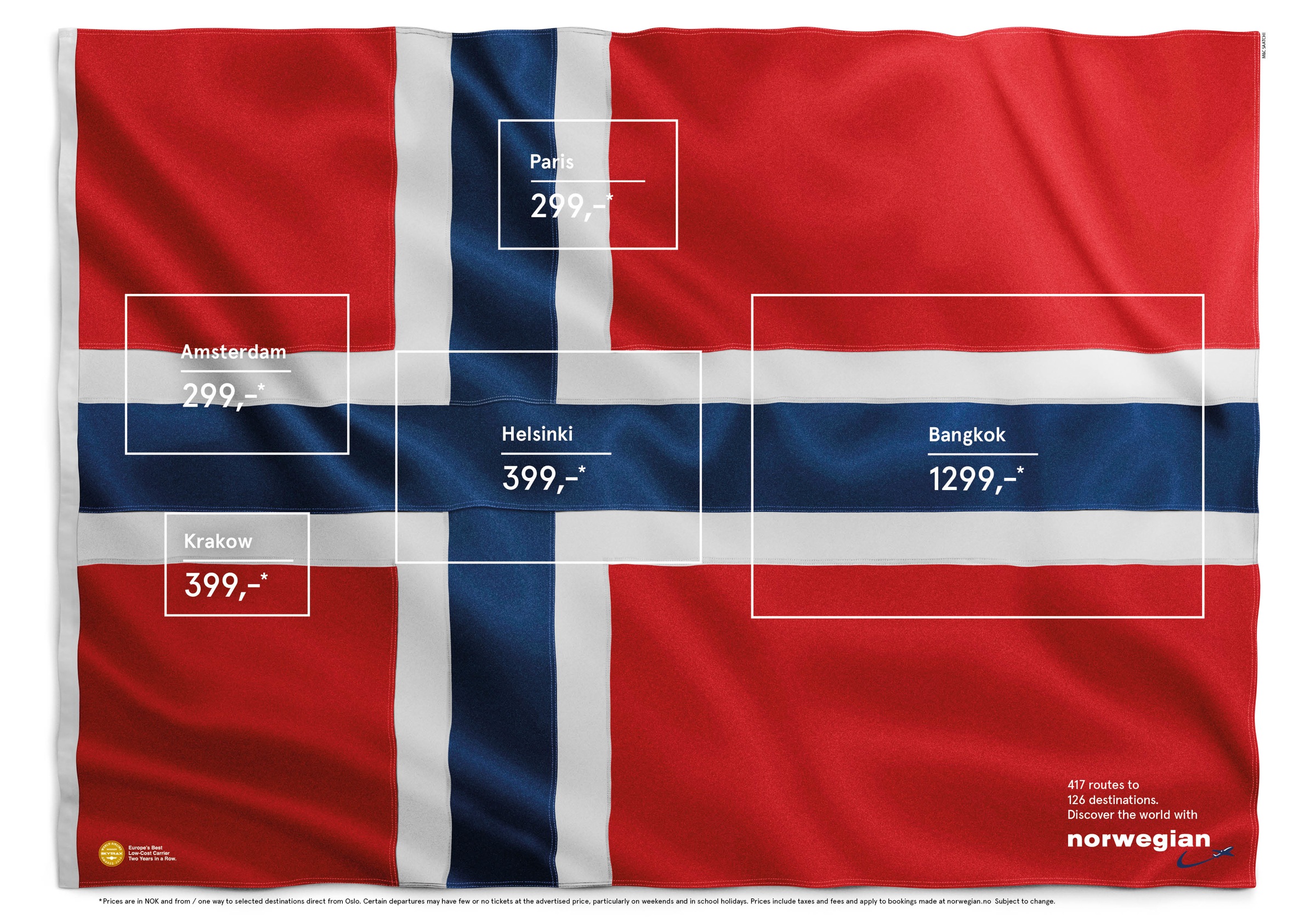
Having been part of the team doing Norwegian launch in Finland, I am delighted that there is still creativity behind the brand in Nordics. This  brilliant print ad comes from M&C Saatchi, Stockholm (probably the first print I have featured in here):

norwegianflagoftheflags

Insight: There are over six flags (Indonesia, Poland, Finland, France, Netherlands & Thailand) in the flag of Norway. Norwegian Airlines is Norwegian company (duh) and after 2013 they are also flying long haul to Thailand (European cities being short haul. What would be better way to showcase new flight discounts than put them inside the Norwegian flag?

Is this original idea?

Definitely not.

Is this a great advertisement?

Definitely yes. It has the element of surprise and delight that great advertisements have. Besides great creative hook it still does the hard sell as well. Although you would not get the trick of the ad, you would still get the fare destinations and discounts. This separates this particular ad from certain previous ads playing with flags inside flags.

Tagged , , , , ,

Skiplagged Sends Airlines to Hell

This week seems to be all about airlines and flight industry.

From Skiplagged website:

Update: Dec 30, Skiplagged is facing significantly higher than normal traffic. Please try again later if you encounter any issues–you will be amazed. Thanks.

The odds that you had heard about Skiplagged before Orbitz & United Airlines sued them last November are quite slim. After that, their visitor count has skyrocketed through the roof. Sometimes all publicity is good publicity.

Lesson #1: Getting sued is a great way for free promotion

Skiplagged effectively helps you to find cheap flights by using “hidden city ticketing”. The direct flight from Singapore to Helsinki can be more expensive than the flight from Singapore to Paris with stopover in Helsinki. Then you just hop over in Helsinki and just don´t use the last flight. This is only recommend to one-way flights because usually your ticket is cancelled afterwards. I have not (yet) tried out hidden-city ticketing, but I have done throwaway ticketing once. It just feels completely odd that if you want to travel one-way you have to pay double the price of return ticket. Actually when I did it, I did not even know that it was not approved. Aktarer Zaman, the founder of Skiplagged explains:

When you are searching for tickets, your market is just to go from this city to this city to this city. And you are shown a price. You are buying this flight when you are buying a ticket. So this is a service you are buying in. Consumers should have the right to partially use the services they buy.

I agree to most extend with the sentiment in here: when you buy something you should also decide not to use it. Not to mention that sometimes you are forced to not use the flights. There are certain arguments that using these loopholes in large scale might increase the costs of airline travel. It might also hurt smaller airline destinations as well. Eventually I feel it is quite fair game though. Airlines try to maximize the money out of us; meanwhile we are doing the opposite. In the bigger picture I think they are in better position to screw us over.

Lesson #2: Digital makes your business model eventually more transparent

Doing different airline booking ploys has been around longer than Skiplagged, but it naturally has done it faster and more effective. Exploiting these loopholes is definitely not illegal, but in can result in losing your loyalty program points. Based on the increased interest to Skiplagged and rising popularity of budget airlines this does not seem to be the a big concern for the majority of users. Consumers are not essentially stupid and millions of loyalty programs and cards have just led to more disloyalty. Also it has lead to increased focus on price especially with airlines.

I was just talking with one friend who mentioned that even with their corporate discounts with major commercial airline, it is still cheaper for the company to fly short-haul with budget airlines. And so they are doing. Consumers are doing the same. Flying has become so commoditized that you do not really care what airline you are flying if is deemed relatively safe.

Lesson #3: Price trumps the loyalty for the majority of consumers

After the lawsuit, Aktarer Zaman put up a crowdfunding-site up to cover up the upcoming legal bills. He has already raised over 60k. The response has been overwhelmingly positive for Skiplagged and quite vicious towards the airlines. One person donated $666 dollars and commented: “send them to hell”.

Lesson #4: People hate airlines

It is interesting to see how this will pan out, but again this a manifestation that no business is “safe” from digitalization. If there is a market fault, it is just easier and faster to point it out and also solve it digitally. That might create a totally new business as well. In the case of Skiplagged, it will be a zero-sum game. Either one will win. Time will tell will the Skiplagged send airlines to hell or will they sue Skiplagged to death.

Lesson #5: Always keep evolving

Tagged , , , , ,