Category Archives: Planning

The Paradox of Thought Leadership

The more effective you are in your “thought leadership”, the more you get business.

The more you get business, less time you have to maintain that thought leadership.

If you do not have time to read outside your day-to-day work, the negative effects will come eventually. As a planner, you should try to maintain your daily reading time no matter how busy you are.

Tagged , ,

Ideas Are Like Farts

Ideas are like farts.

You should let the flow free.

If you force them, they turn out to be shit.
You should not also force them on other people.
Even though your own ones are always the best.

Ideas are like farts.
They can come from anywhere, anytime.
But it can be tricky to capture them.

No matter what people say everyone has them.
But quite often they stink.
Although those that make the biggest noise seldom do.
But silent ones can linger with you for a long while.

Even amateur can release good one once in a while.
But it takes skill to create good ones constantly.
It takes vision to turn them into a profitable business.

There is a thin line between a truly great and a really shitty one.
And you don´t know until you have released them.
You should not be afraid to rip them apart.

It takes courage to share them to public.
But those who have that courage will always be remembered.

Ideas are like farts.

“One must never own up to a fart in public.
That is the unwritten law, the single most stringent protocol of American etiquette. Farts come from no one and nowhere: they are anonymous emanations that belong to the group as whole, and even when every person in the room can point to the culprit, the only sane course of action is denial.”
– 
Paul Auster (Brooklyn Follies)

Tagged , , , , , , ,

Anatomy of An Insight: Sizzl

Moving at the speed of culture has been the catchphrase for many marketers lately.

Oscar Mayer is one of the brands, that has turned that phrase into brand behavior.

Internet has love affair with bacon

Internet loves bacon. Actually there are more bacon-related conversations than there is chatter about Kanye West, Tom Cruise and Lady Gaga combined. They have been the bacon brand that has been capitalizing that eternal love for bacon. Oscar Mayer has done Bacon alarm clock and bacon branded content. Now their newest app will help you to find your true love (for bacon):

Insight: Tinder has become mainstream in the mating game*. When selecting for a potential partner, what could be more important than his or her preference of bacon?

Tinder for bacon-lovers

Tinder for bacon-lovers

Will people really start to use this app?

Probably not, but at least it grabs headlines and increases the brand love among bacon-loving Internet. The brand´s behavior online underlines their belief and dedication to bacon. And that is a noble mission.

*When I started dating my now-wife, we weren´t even on Facebook. We had to rely on real-life Tinder: going to bars. Kids have it easier nowadays.

Tagged , , , , , , , ,

Will Ad Blocking Be The New Napster?

Apple has basically failed at the ad business and they are trying to ruin it for everybody else.

– Jeff Jarvis

Google owns the web. Facebook owns the social. Apple owns the phone. That has been the technology world order for a while.

Now that order is about to shake.

The discussion about ad-blocking has been a hot topic, because the new iOS 9 has ad-blocking features for Safari mobile browser. The strategy for Apple is simple. This is full-frontal attack towards Google. Google hosts majority of the ads in “the normal web” with other Apple rivals like Facebook and Microsoft. Apple does not play the browser ads game. However they are serving ads in iOS applications that they not “surprisingly” block. Also conspicuously Apple launched their news service at the same day as it allowed ad-blocking.

It remains to be seen how things escalate, but the following three things are certain:

  1. Widespread ad-blocking will kill publishers

The casualties of war between Apple and Google will be the content publishers. They are already losing $22 billion of revenue this year because of blocking of the ads. If content publishers are not serving the ads for the content you are consuming, they are not getting paid. If you are not getting paid eventually you go bankrupt. As the piracy shows people do not really want to pay for content, so advertising has been the only way to bankroll the content production. Only 11% in US and 6% in UK have paid for online content. So subscription model online does not really work, although people are advocating for it. Even creator of popular ad-blocker Peace, pulled the ad-blocker from App store because he had regrets:

Achieving this much success with Peace just doesn’t feel good, which I didn’t anticipate, but probably should have. Ad blockers come with an important asterisk: while they do benefit a ton of people in major ways, they also hurt some, including many who don’t deserve the hit.

Marco Arment

Not all of the creators of ad-blockers have surely similar regrets. Even without Peace, ad-blockers have been the most popular paid apps in the new iOS 9.

  1. Generally online ads have been of bad quality

Ad-blocking is already more prevalent than ad-skipping on television. Ad industry should take some responsibility of the horrible, low quality and invasive display advertising as well. Advertising in web is democratic, which is great to certain extent but also has been the core problem. When amateurs do, it is quite often amateur quality. In TV there has at least been some quality (of varying degree and based on channel).

As people have not noticed online ads, they have become more and more invasive and making the user experience worse. Even people from the industry are skipping the ads. Therefore I actually believe more in longevity of pre-roll advertising format than the banner on the long run (although I still think there is much room for creativity when doing banners). Nevertheless, both of these can be blocked so you don´t need to necessarily endure either.

  1. Traditional online ad industry will face the same future as music industry

If ad-blocking will become the norm that will essentially kill the display advertising, as we know it. We can debate whether it was good or bad, but essentially Napster and then after the legal counterpart iTunes and Apple Music killed the music industry, as we knew it. Today´s music business is much more nimble and record labels are playing lesser role than before. Music has not disappeared anywhere though.

Killing the category is only lucrative for the killer. Apple has been the giant killer many times (helps when you are giant yourself), so I doubt that they are hesitating in trying to bring competitors (namely Google) down by any means necessary. For the consumer the fall of online ad industry does not really sound too bad. Generally all of the people (hell, even publishers) find ads annoying. Expect that those annoying ads pay for the content production online like mentioned above (and print media is almost dead already). In every change there is opportunity for innovation. Pagefair is actually serving “non-intrusive ads just for your ad-blockers”. Talk about contradiction in terms.

Modern digital marketer has to follow closely how the situation with the ad-blockers will evolve and act accordingly with your media mix. Native advertising will seem likely winner in this new era. Will that result in better content or just more bad editorials? My fear is the latter.

By the way, I don´t block ads. Maybe just to show solidarity to publishers and to be true to my profession. On the other hand I don´t tolerate sloppy and invasive ads either. We need to improve so that people would not want to block those ads on so alarming pace.

Tagged , , , , ,

Digital Pre-Testing: Harmful Waste of Money

Lately many research agencies have been introducing digital pre-testing opportunities. You can test your campaign creative, whether it is a display ad or Facebook post. While it is lucrative for those research agencies, it is actually utter lunacy for the brands.

The main problem is that this testing does not happen in the real environment. People are too involved in the process and read too much into it. Focus groups are already killing any creativity and cut-through in TV ads. Soon the same will happen to digital assets.

It also doesn’t make any sense as you can test digital in real marketplace. With TV it is harder to test different creative, whereas the main advantage in digital channels is the real-time optimization. You don´t need to guess or academically discuss what creative works the best. Just put the different creative solutions in Google display network with smaller budget and it automatically starts favor what works the best. I remember when we had to do A/B testing manually; nowadays networks do it automatically for you. When you launch the campaign, that is when the real work starts.

Testing & optimizing is really important for brands. Testing digital assets in isolation is expensive way of getting results that you would get with the fraction of the price in the actual environment. So instead of wasting your money on digital pre-testing, give more money to your agency to produce more assets and to test out different alternatives in the real world not in the focus group –altered reality.

Tagged , , , ,

Marginal Gains vs. Changing The Game

“The difference between stupid and genius is that genius has its limits”
– Albert Einstein

We have limits as humans.

Luckily we have not yet reached them in majority of things. But for example, baseball pitcher cannot throw faster than 100 MPH. Although pitcher could get stronger, his tendons and ligaments would just snap throwing it faster.

Throwing the baseball is one aspect of baseball, so that is why there will be plenty of evolution in the baseball. Scientists have calculated that even in other sports the pace of development has slowed down and we are approaching the limits. Actually in some sports like long jump we are getting worse.

Being an optimist, I take there is a still lot to improve for us in humans: whether in sports or in life in general (I don´t know why anyone would make a separation between those two). These developments will happen by either tweaking the small details or reshaping the big picture:

 1. Aggregation of marginal gains

aggregationofmarginalgains
“The marginal gains philosophy requires you to look at every single aspect of what you do so you can try and improve it. It looks at every aspect of performance, and tries to improve each a little bit— even just a tenth of a percent . If you find a training technique that makes an athlete that tiny bit stronger , it alone might not have a huge effect on a race. But if you can stack those very small improvements on one another, finding a bit in tires and a bit in the wheels and a bit on the track surface and a bit in nutrition supplements— well, soon those marginal gains begin to add up to big gaps between you and your competition.”
Dave Brailsford on aggregation of marginal gains

Dave Brailsford started as the general manager for Team Sky (Great Britain´s professional cycling team) in 2010. He had the concept laid down in the quote above: if you improve every area related to cycling by just a little bit (most commonly is used 1 percent), then those small gains would eventually add up to bigger improvement. These improvements ranged from the obvious (training, nutrition) to more surprising (every cyclist had their own pillows when they are travelling). The results were outstanding. Brailsford was wrong in believing that Team Sky could win Tour De France in five years. They did it in three.

This works when the competitive field is already mature. Cycling itself is quite established sports, so there is not necessary that much innovation (doping excluded) to be done.

The difference nowadays between agencies is not in the actual ideas, but in the craft. Similar ideas have gotten totally different reception in marketplace and also in award shows. When we essentially are doing the same things, the difference comes in small details.

Has our industry then just become minor improvements and tweaking in quite predictable playing field?
Not necessarily.

2. Disruptive leaps

Disruptive thinking has radically altered the sports. Quite often the change is driven by technology, but sometimes it is also about the different way to approach the challenge in sports.

a) Technology disruption
golfevolution
“I think the players, I put in the book for example that we should go back to wood rackets, probably they laughed at me, I’m a dinosaur, but I think that you see these great players, have even more variety and you see more strategy, there’d be more subtlety.”
John McEnroe (last player to win major tournament with wooden racket)

Technology has played huge role in certain sports, especially in golf driving distance. We are not talking about marginal gains in here; these technologies have truly revolutionized the sports.

Internet has changed the whole ball game in our industry. Either you have digital capabilities, or you are like a guy trying to play with wooden racquet in tennis court. Not only you look stupid, you will also certainly lose.

b) Approach disruption
vstyle
I adapted an antiquated style and modernized it to something that was efficient. I didn’t know anyone else in the world would be able to use it and I never imagined it would revolutionize the event.
Dick Fosbury (inventor of Fosbury Flop)

Not always you need a technological breakthrough to change the game. V-style jump in ski-jump or Fosbury flop in high jump are examples when smart individuals outsmarted the competition. They looked the problem from a different angle and found a totally new and more effective way to solve it.

Currently every agency is jumping with the old style, where the room for innovation is limited. When the playing field is the same for everyone, the only way you can win is to search for marginal gains. I truly believe that we could approach our business truly differently and take the whole agency business model to the new heights. It is time to rethink the whole jump.

(Full disclosure: These sports anecdotes were mostly lifted from the great book I just read. The book is done by Mark Mucclusky and is called “Faster, Higher, Stronger. Highly recommended reading)

Tagged , , , , , , , , , ,

Illusion of Innovation

allblacks

Our industry nowadays is obsessed about creating something “new”. We are creating stunts instead of establishing icons.

I was reminded by this illusion of new & shiny, when someone commented that New Zealand safety videos are getting boring. Here is the latest one featuring All Blacks as Men In Black:

The reason was that they are nothing new and they did All Blacks video “already” four years before. Not to mention they have done funny safety videos for years:

Hobbit

Betty White

Safety Safari

That comment does not really make any sense.

Firstly, the insight behind those safety videos is really solid. No one watches safety videos, because no one really cares (until it is too late) and usually they are also utterly boring. The idea was just to make those formerly boring videos funny. And that is working really well. Majority of those safety videos are getting millions of views, which is quite a lot of more than your brand´s latest viral video.

Secondly Air New Zealand has kept on innovating within its formula. They target to different target audiences (old, young) and their passion points (Tolkien, sports, weirdness). They have turned a necessary evil into a marketing vehicle and if they are smart, they keep on doing it for the years to come. Also they are really showing these safety videos on flights, so on top of the YouTube views, they are actual a beneficial asset for the firm. That is quite a lot more than you can say about your latest “innovation” project, which might get a mention in PSFK if you were lucky.

In our desperate chase of stunts, we have totally neglected building of formulas. When you have a winning formula for ad, the steps for the success are simple:

  1. If you find something that works, try to replicate it.
  2. If it still works, replicate it even more.
  3. Refresh and innovate but within the formula. No need to think outside the box, if you can rethink the box.
  4. Repeat as long as your audience gets truly bored with it.

The last point is the most important one. If the agency gets bored with the formula, that does not matter. Change the team. If the client gets bored with the formula, agency should fight back to retain the formula (or try to change the client). But if audience gets bored to the formula, change it and fast. It does not matter if everyone in the boardroom likes it, if it does not resonate with the real people. Usually the challenge is opposite though. Because of the cyclical nature of ad industry, we won´t allow things to grow and instead jump over to new things without any sense of direction. Creating iconic ads takes time and too often brands don´t let proven formulas to flourish to iconic ad series.

Finnish coffee brand Paulig Juhla Mokka (The Party Mocca) has been running the same ad concept from the year 1979. It shows artisan honing his craft and then establishes the parallel of the same dedication being applied to their brand. Approach is simple, recognizable and still working.

If it isn’t broken, why fix it?

Tagged , , , , , , , ,

10 Tips To Conduct An Effective Workshop

scaryideas

Don´t be afraid of scary ideas

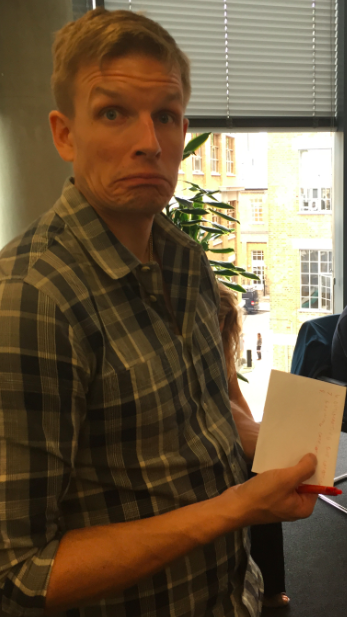
Throughout my career I have been doing lots of workshops. I really enjoy facilitating them. At their best they can be really valuable tool to come up with new ideas and also to get client more engaged to the process.

Conducting a great workshop is not an easy task. Every one of us has been in sloppily conducted workshops, which are as enjoyable as water torture. Just coming back from a great workshop in London, I thought I would share some of my tips I have learned during the years:

10 Tips for An Effective Workshop

1. Plan & prepare well

  • It should go without saying, but it is really important to define what is the goal for the workshop and craft the day through the lens of what you want to achieve.
  • Groups make or break the workshop. One person who “knows it all” and remembers all the cases when something has not worked can poison even the best of the groups. Orchestrate the groups well and gently sideline the bullies if they start to be detrimental for the workshop process.
  • Have an extensive list of exercises before the workshop. Good workshop facilitators have an extensive cookbook of tried & true crow-pleasers and also more experimental pieces. Do not try to predict too much of what works though. Every group is different and the exercise you thought would bomb might be the most helpful of the day and the usually engaging exercise might fail miserably. If some exercise does not generate ideas, just move faster to the next one (see also point 6).

2. Define clear responsibilities

  • Nothing is worse than loosely orchestrated and chaotic workshop. Therefore it is crucial to define clear roles and responsibilities:
    • Who is facilitating?
    • Who is leading?
    • Who is doing the background info?
    • Who is preparing the stimulus?
    • Who is taking notes?
    • Who is doing the memos?
    • Who is leading each group?

3. Stay on time & agenda

  • One of the most important things for facilitator is to be the fun-spoiling stopwatch Nazi. Because when your schedule starts derailing, it starts derailing bad. Good healthy discussion is for good, but instantly when it starts to go around in circles you have to move to the next exercise. Everyone has to have an opportunity to talk, but not everyone needs to talk in every possible exercise.
  • Exercises should left participants feeling hungry to come up with more ideas. Time constraint is one of the most effective methods to force ideas to come out. If you give too much time to polish, people will fall into safe territory.

4. Collect all ideas

  • Post-its are your best friends. They are easy to move and they nicely fit one idea. They have different colors, which can mark the different ideas from different groups. Instruct the usage of the post-its right from the beginning so that all the thoughts are captured.
  • One of the key roles of the facilitator is to develop a laidback and open feeling to the workshop. It does not hurt if you are able to make people laugh. You need to establish vibe, where ideas are flowing freely and no one is shooting them down too early.

5. Plot the drama

  • Good workshop follows the arch of drama. It starts from the chaos and despair and steadily goes towards more clarity. This should be reflected in the exercises as well.
  • Usually participants need a while to get warmed up and eventually will start to lose of steam towards end of the day. Therefore it is good to end the exercise with compiling exercises and idea voting, which does not require as much idea firepower. Brain is muscle as well.
  • Remember that workshop is not a lecture. If you need to go through certain presentations, have them throughout the day so that it does not start to feel too cumbersome.

6. Be strict, but flexible

  • Sometimes one exercise starts to show so much promise that it makes sense to stop and start concentrating on it. Experienced facilitator is able to change things on the fly so that participants do not even notice. The rule of the thumb still is that until lunch you should be more or less on time or you are screwed.
  • Therefore it makes sense to share loose agenda, but not necessarily detailed list of exercises you want to do. This allows you to switch things seamlessly and improvise based on the overall flow of the workshop.
  • When explaining the exercises to the group, be clear and concise. Explain the role of the task, what people need to do and how much they have time to perform the exercise.

7. Document well

  • Even the most enjoyable of the workshops is totally useless if it is not well documented. Quite seldom you come up with readymade ideas, but you have shitloads of great starts. The real work starts after the workshop, when you need to synthetize, compile and find synergies from the workshop ideas. The documentation should be done as soon as possible after the workshop. So sorry, no sleep for the planners.
  • Bonus tip: As part of preparation, assign people with the best handwriting to write down the ideas. This makes your job way easier on documentation phase. Case-in-point: quite often I cannot even comprehend my own handwriting after couple of days.

8. Different exercises

  • You need a good combination of individual, pair & group exercises. I personally want to start always with individual ideation on post-it notes. This ensures that there are enough of ideas when the exercises go forward. It is also refreshing for majority of the people to be alone with their creativity and blank sheet of paper. Either it let’s them loose or show their limits.
  • Loose creative gangbang and brainstorming does not benefit anyone, so give numeric demands for the number of ideas for the groups as well. Do not be afraid to switch the groups if for some reason your pre-planned group dynamics are dysfunctional. Everyone should feel free to express his or her ideas in workshop.

9. Stay hydrated & energized

  • You need to have enough breaks, so that people are not constantly watching the mobile phones during the exercises. When you have enough breaks you can start punishing and publicly shaming people who use mobile when they should be present.
  • Also ensure that there is enough food for all the people. Nothing is more horrible than room full of cranky participants with low blood sugar. Although I try to avoid eating sugar (especially on weekdays), having candy around actually helps people to ideate.

10. Have fun

  • Participants will immediately sense, if you are not experienced workshop facilitator. So don´t stress and try to create a good vibe. If you maintain or have created a good chemistry after the workshop with all the participants, half of the battle has been already won.
  • Workshops are great way to get to know how your clients think, which will be beneficial later on. Have open mind and prepare to have a blast.

For those conducting workshops and looking for new stimulus for exercises, I have found Hyper Island toolbox really useful. Also these cards are good for branding workshops (and the NSFW versions are good for blowing off steam).

Tagged , , , , , , ,

Fight Against Lazy Writing

inastationofametro

Although I am not necessary an advocate for perfection, I am fierce fighter against sloppy writing. I believe in “less is more”. Write like you would be boxing, every hit has to do damage to your opponent. Strip away all the fluff, edit and then condense even more.

I have been reading this excellent book about making of James Joyce´s Ulysses and it reminded me of this Ezra Pound´s classic poem called “In A Station of the Metro” (right spacing in the above picture):

The apparition of these faces in the crowd;
Petals on a wet, black bough.

Short, isn´t it?

The story behind this imagist classic is inspiring. Ezra Pound stepped onto the platform of a metro station and caught a glimpse of transcendent face amongst the crowd. As he turned to follow it, he saw another ones. This mesmerized him and he wanted to write poem about it. He wrote over thirty-line poem about it, tried to finesse it but eventually tore it up. It just was not working the way he intended (Pound was fierce editor). The sight haunted him and he tried to write it again six months later. He failed miserably. Eventually he finished the above poem, year after. Only two lines and 14 words: nothing more and nothing less.

That story should be the guiding light for everyone who has to write in his or her work. Simpler is more difficult to write, but it is more effective. The same Ezra Pound laid out the three laws of writing imagist poetry in his “A Retrospect”:

  1. Direct treatment of the ‘thing’ whether subjective or objective.
  2. To use absolutely no word that does not contribute to the presentation.
  3. As regarding rhythm: to compose in the sequence of the musical phrase, not in sequence of a metronome.

These rules are worth to live by even when not writing poetry. Essentially you must cut the crap, get to the point and let it flow. In advertising where our space is even shorter, it is disrespectful to our audience to write lazy copy. We should be always sharp, simple and short.

Tagged , , , , , , , , ,

Woody Allen Way Of Work

woodyallenquote

Woody Allen is one of my favorite directors. Not all of his movies are necessarily great, but on the other hand he is doing about one good movie constantly every year. He explained his work ethic in the recent interview:

“I’m lazy and an imperfectionist. Steven Spielberg and Martin Scorsese will work on the details until midnight and sweat it out, whereas for me, come six o’clock, I want to go home. I want to have dinner. Filmmaking is not [the] end-all be-all of my existence” 

The comment raises important point. Does it make sense to try to be perfect? Woody Allen is naturally superbly talented and even a half-hearted attempt from him is way better than from majority of directors. Would you want your legacy to be around 50 good movies (as a director and even more as a writer) or just one excellent (and maybe couple of unfinished ones)? Is your good other people´s excellent? If you have tendency to perfectionism, you are the harshest and quite often the most unfair judge of your own work.

There is a balance in perfection and production output. The more you try to perfect, the less you produce.

Dr. Dre just announced that after 16 years in making his magnum opus “Detox” will never come out:

“I didn’t like it. It wasn’t good. The record, it just wasn’t good. I worked my ass off on it, and I don’t think I did a good enough job.”

It is great virtue to be self-critical, but should you cut your losses earlier? Naturally Dr. Dre did not exactly just sat on his laurels during that time, but still. Maybe you should realize that you are not making the masterpiece earlier? Or maybe you just should be less self-critical? Woody Allen makes this exact point:

“My problem is that I’m middle class. If I was crazy I might be better. If I shrieked on the set and demanded, it may be better, but I don’t. I say, ‘Good enough!’ It’s a middle-class quality, which does make for productivity.”

Maybe we need less wannabe perfectionists and crazies reaching desperately for the perfect work in our industry and more people, who can churn good stuff out constantly.

Tagged , , , , , ,