I could not put the following ad to Anatomy of An Insight –section as it is a little bit too in a meta-level. I also have had too many Foot Locker ads featured in here in any case (although they are all pretty much awesome):
Brilliant ad nevertheless and based on equally great ad as well. Now the situation has naturally changed and the match will be happening. Or is it?
Sequels don´t work in advertising, when you just try to duplicate the success of previously successful ad. However if there is opportunity to continue the story and it is still based on strong insight and great idea, you should not change your focus too soon either. The most challenging part in advertising and life in general is to know when it is time to turn on a new leaf.
That is why I am a strong supporter for the Norwegian underwear brand Comfyballs. Lately they have been fighting US patent office, because they cannot register their name because it is considered “vulgar”. The reason for that being:
In the context of the applicant’s goods… Comfyballs means only one thing – that a man’s testicles, or ‘balls,’ will be comfortable in the applicant’s undergarments. The mark does not create a double entendre or other idiomatic expression. When used in this way, the word, ‘balls’ has an offensive meaning.
I wish more brand, would be as clear as Comfyballs.
Their main product benefit is in their brand name. Double entendre would actually be more offensive, because you try to hide something. Comfyballs is truly honest brand and not hiding behind marketing jargon. When you wear them your balls will be comfortable, because their patented design PackageFront™ reduces heat transfer and restricting movement. There is not anything offensive of having comfortable underwear, on the contrary. Using badly designed underwear when jogging is a truly offense to your crown jewels.
Comfyballs has not just been scratching their balls, but also actually risen to a challenge and they are trying to get their name registered officially in US. They launched the site “Fight for Your Balls” and also created video to celebrate comfortable balls:
Comfyballs has not just scratched their balls, but also actually risen to a challenge and they are trying to get their name registered officially in US. They launched the site “Fight for Your Balls” and also created video to celebrate comfortable balls:
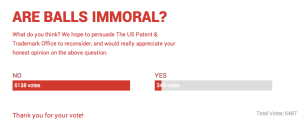
Naturally the ad was banned in YouTube (those US hypocrites), but again more buzz for the brand. At least the visitors in the site seem to be in their favor.
There are things in the life you should fight for, your balls are one of them.
Too often we, as marketers, end up complicating things by weird marketing talk and creating irrelevant associations with our products that are not true. We just should try to be as authentic as possible and honest on what we do. Therefore the recent content series we have been doing with Rexona has been refreshing to do. It is all based on insight about the product and its need on our markets and nothing else.
This is the social experiment from Indonesia (don´t worry if your bahasa is a little bit rusty, you will get the idea):
Insight: People will not say to your face if you smell, but they talk about it behind your back.
The campaign is currently live in Indonesia and Brazil and has gained already over 1,5 million views.
I have been in different agencies during my career. Although the people and process were different, there has been one consistent trait in all of them:
The best agencies live on winning.
Sometimes that might result in competitive cutthroat environment, sometimes to a more collaborative family one and sometimes something in the middle. The latter traits are more around based on the personalities of the people, but the obsession of winning is universal.
As I have been always juggling between business and creativity I have enjoyed the winning from both of the angles. And that is how it should be. Great agencies have a culture that enjoys both creative and business wins. It is everyone´s responsibility to
1. Winning creatively
Great agencies live on pushing the boundaries and moving the needle to right direction. Regardless of the department you are working, doing great work should give you the biggest satisfaction. And if it doesn´t, you are probably in wrong line of work.
2. Winning new business
You are either hunter or a farmer. Both are needed, but nothing gives more jolt to the balls (so to speak) to agencies than winning new business. It is also totally vital for the agency as you always lose some older clients despite how good you are. New business gives the biggest buzz in the agency and the culture should embrace it.
Culture of winning is also a culture of trying, failing and coming back up. Winning mentality does not always mean winning. It just means that every time you step up to the court, you give everything you got and try to win by all means necessary. If it results to losing, you just get back up and try again.
It does not matter how many times you will be knocked down. It is how many times you get up.
If I had a shiny gun, I could have a world of fun Speeding bullets through the brains Of the folk who give me pains; Or had I some poison gas, I could make the moments pass Bumping off a number of People whom I do not love. But I have no lethal weapon- Thus does Fate our pleasure step on! So they still are quick and well Who should be, by rights, in hell.
–Dorothy Parker (Frustration)
Advertising industry is obsessed by positivity. All the ads are filled with shiny happy people pointing their fingers at computer screen. Everyone is smiling. Everyone has friends. No one is fighting. There is no politics, grudge or evil. Everyone cares about the brand and how that special toothpaste comes to save the day.
The advertising reality is pure fiction.
Same time the best advertising is based on truth:
You can dramatize the truth and make it interesting. But there has to be truth in it, otherwise it is meaningless: not connected to the real life, only connected to advertising life. The truth above is simple: bad breath is disgusting and ruins your social chances*. Nothing positive about that, but the message is powerful.
Advertising life should never be separated from the real life. The truth is that your life is filled with annoying tasks, annoying people and annoying circumstances. If more brands would recognize that we would have more truthful advertising. More truthful is also more powerful and resonates with real audience (not focus groups).
There is something profoundly truthful with this new service called “Dicks By Mail”.
The brand promise is simple:
“In only a few minutes you can send a literal Bag of Dicks to that special asshole in your life.”
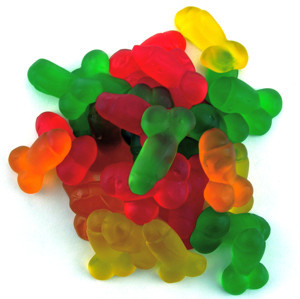
The “dicks” in question are actually candy, which you can send in anonymous package:
This is a great politically incorrect idea. The truth is that everyone could come up with quite long list of people (who are dicks) to whom this jolly gift should be sent (to let the whole world know that they are dicks).
Sometimes the truth hurts.
* Of course advertising played vital role in making halitosis a social problem. That would not have been possible, if Listerine ad message would have been positive. Ad below is naturally revolting when analyzed from today´s point-of-view, but it is based on truth. Sometimes truth is hard to swallow, even harder than Listerine.
If I would need to name iconic US beer, previously I would have said Budweiser. Bland, boring and easy to drink (pretty much same applies to Finnish beers, not to mention Bud Light). Recently when I think about US beers, the first thing that comes to my mind are all the awesome craft beers, which have been hit Budweiser surprisingly hard especially with millennials. Actually 44% of drinkers aged 21 to 27 have never tasted Budweiser. This is a challenge for Budweiser. If you don´t cultivate new users, eventually you will become meaningless.
Their latest social experiment was a nice execution to attract the new users. If you have not tasted Budweiser, you do not necessarily have any idea how it tastes. This ad exposes Budweiser in new light. Does not ridicule or make fun of hipsters, just gives the good old surprise & delight:
Budweiser´s Superbowl ad went to a totally wrong direction in my opinion. ALthough I am always in favor of taking strong stance in your advertising, ridiculing people who could potentially be your consumers is not wise:
The message is strong, but it feels quite redneck as well. It probably appeals to current Budweiser heavy drinkers, but would it pave new way for the brand. Also we know that where beer growth is stagnant, the craft beers and import beers are growing. Would Budweiser start ridiculing foreigners, because US beer consumers want to drink Pilsner Urquell rather than old boring Budweiser?
Even though you drink craft beers, you are likely to drink regular average beers as well. Would you choose the brand that ridicules your hobby and passion? The strong stance Budweiser takes is also sign of weakness. The best way to address your competition if your bigger player is to ignore them. No one roots for Goliath going against David. It gives those Davids also ammunition to go on offensive (and craft breweries are the real challenger brands):
One thing is for certain, craft beers are not fad anymore. Where the regular beer market is shrinking, craft beers are growing and already contribute 11% of Beer market in US and the number still keeps growing. It keeps growing so fast, that total craft beer market share trumps Budweiser. No wonder, that Budweiser is afraid. Naturally Budweiser is way bigger than biggest craft breweries (there is not really any independent craft brewery in top 20 of the most popular beers), so their decision to go against smaller breweries is mind-boggling. Addressing the challenger makes you look weaker, especially if you do not have good alternative. People love underdog stories, but the underdog story has to be believable. The biggest brewery in US is not a likely underdog.
The decline for Budweiser has not only come from craft beers and imports. The biggest beer in US is Bud Light, and it has cannibalized regular Budweiser sales as well. Maybe Budweiser should make ads to ridicule light beer drinkers as well?
Their challenge is simple: “(Budweiser is) mostly to older gentlemen and country kids. Our clientele likes the craft beers.” Jessica Dewey, Bar Owner
So Budweiser has to make a choice. Do they try to attract millennials and ditch those horses as well? Or will they slowly let the brand deteriorate to daddy brand while their parent company buys craft breweries to attract the millennials? Then they can hope that the next generation of hipsters will find Budweiser charmingly retro like Pabst Blue Ribbon.
“We are not encouraging people to just run faster for the sake of being faster. We are saying that ultimately you will be able to enjoy life if you take the time to cater to your own humanity.”
–Matt O´Toole (Reebok President)
Their commitment to fitness has been a bold move and also makes perfect sense (as we have to also bear in mind that Reebok is owned by Adidas). Especially there has been tremendous growth in “tough fitness” which includes crossfit, martial arts and other “more demanding than your regular Zumba”-activities. What started out as a niche exercise has become now mainstream and everyone is flipping tires these days: me as well.
During the latest Super Bowl, Reebok launched their new brand belief piece “Be More Human”:
I like it (mainly because I am part of target audience). Also because the message Reebok conveys is part of my whole life philosophy. I don´t eat to live, I don´t train to live. I live to train & eat. Sports is not just a way to prevent your inevitable physical deterioration, it also strengthens you mentally and socially.
Training hard improves you as a person. Competing against others makes you tougher but it is also social. I have learned more from teamwork, leadership and grit from basketball court than from work. When you push it to the limits in sports, you are more likely to be able to push it to the limits with other things as well.
And that belief I heartily endorse.
The other reason why Reebok´s message is compelling is that it is not for all. Reeboks has made a deliberate decision to be exclusive. Their core focus is in tough fitness and quite hardcore training with blood, blisters, sweat, snot, tears and tear down. Whereas the usual scared brand advertiser would have expanded the target audience and showed people doing all the mundane fitness moves and have message about how “fitness is for everyone”, Reebok kept the focus. Reebok is for those who train hard (or think they train hard, like me). The almost brutal nature of their ads is refreshing compared to the touchy-feely lifestyle-routes the majority of sports brands have chosen.
“We’re confident that when we push ourselves, we not only transform our bodies, we transform our entire lives.” Matt O´Toole
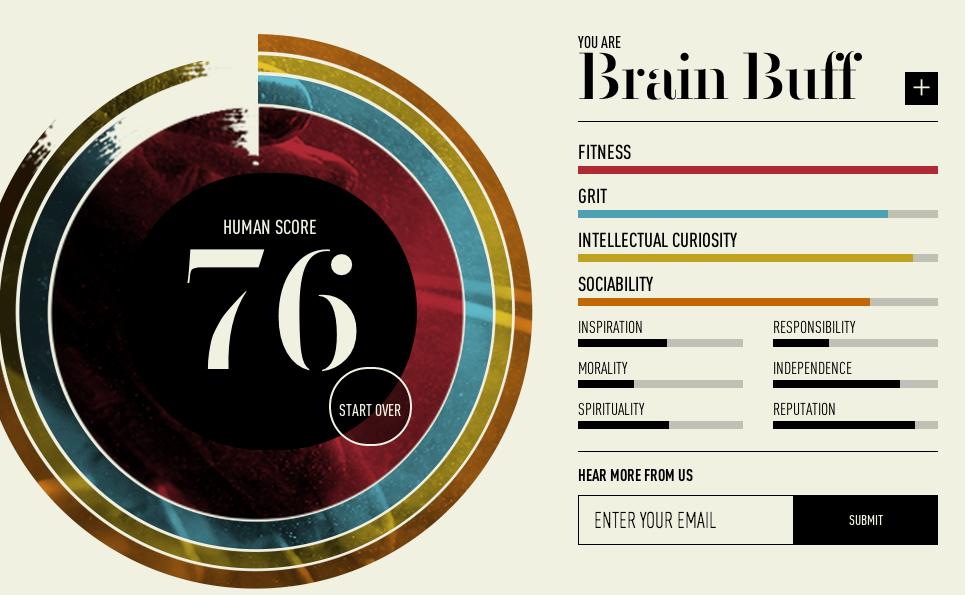
That brings us to the last point. They are expanding, but they are promoting the whole category of tough fitness (which can basically mean quite diverse things) and training hard. Their message resonates naturally to those who currently are sport freaks, but it also has appeal to people who push themselves in other things in life. Showcasing the more “holistic” (in the lack of better word) benefits of intense exercise, they collaborated with scientist David McRaney and created the Human score to calculate your level of humanness:
It is a human nature to be a sucker for tests and I could not wait to test my humanness. I was luckily still more close to human than android. “Brain buff” also sounds like a new upcoming fad term like spornosexual:
As part of the campaign there is also a selfie competition (because no brand is perfect) and some other infographics about how training affects your brain.
Reebok is at least having tight focus on what they are doing. I believe that it will also pay off, if they have the perseverance and patience to follow their daring brand belief through.
Advertising agencies have not been really good at naming themselves, but we have been quite creative in making up new job titles. We had interesting discussion with fellow Finnish planners about the difference between “planner” and “strategist”. This prompted me to explain the differences between different planning job titles:
Junior Planner: Coffeemaker. Traditional planner: Hopefully unemployed. Planner: Person who spends weeks (sometimes months) with creative brief and either comes with truism or something totally unhelpful for creative process. Planning director: Planner, who uses fancier words. Head of Planning: Planner, who drives fancier car than you. Strategist: Wannabe consultant. Creative strategist: Failed creative, who cannot write or draw. Growth Hacker: Wannabe start-up guy. Researcher: Planner, whose slides make even less sense. Analyst: Person who lies by using numbers instead of words. Innovation director: Person, who does not have any budget, responsibility or real projects. Trend planner: Dude who just surfs web and posts random stuff identifying them as “weak signals”. Digital strategist/planner: Person, who thinks that it is still impressive to put different digital channels in boxes on PowerPoint and call it a channel strategy. Engagement planner: Same as digital strategist, but he uses arrows between the boxes. Social media strategist/planner: Person who talks about engagement and conversation and no one is engaged. Mobile strategist: Person, who says that mobile is the next big thing. Content strategist: Person, who would not know good content if it would hit him in the face. Thought leader: Planner, who has written a book (that no has read) Keynote speaker: Planner, who spends majority of his time self-promoting himself at seminars.
If you have any additions, let me know at the comments.
I was yesterday listening to Chaka Khan concert* in Singapore Jazz Festival.
The event was typical Singaporean culture event. It was mostly corporate and stiff audience mostly concerned on social media updates and eyes on their mobile phone screens. Presenter talking about “building jazz ecosystem” (whatever that means) made me cringe. I did not have that high expectations, but the music was great and the audience (including couple of stiff Finns) started to dance.
When Chaka Khan had just ended one of her greatest songs “I love you, I Live You” (listen below), someone from the audience screamed:
“PLAY FREEDOM”
Going to the next song (from the same album What Cha´ Gonna Do For Me?), the same dork screamed again.
“PLAY FREEDOM”
I would be a little bit hesitant to treat one of the best soul singers ever as a jukebox, but the main problem is:
Freedom is not even a Chaka Khan song.
Although it is a great song, Aretha Franklin has done it.
First it made me annoyed and then it made me think.
That guy was like your usual social media complainer: he wanted to be heard, he did not know anything about what he was talking about, he was loud and only thought about himself.
Quite often people complaining about you or your advertising on social media are not even your clients. They are people whose main satisfaction in life is to be upset about different things and make other people´s life miserable. If you upset people who are not even buying your product, does it matter at all?
Brands are overly sensitive of negative feedback, but quite seldom they stop to think who is actually giving that feedback. And again if you get any reaction from consumers, it just means you have already passed the clutter and created some cut through amongst your audience. As we know the biggest problem is not that people get angry, it is that they don´t really care. Negative top-of-mind is better than no top-of-mind at all.
Essentially we all were consumers in the show as we had bought (or got bribed) with tickets. Some consumers are more important than others though. Probably the guy (of course it was a guy) is super annoyed that the artist did not play the song he wanted to hear. Essentially his opinion is worthless. Do your homework: if you don´t even know the songs of the performer, shut up and enjoy the performance. Maybe you learn something new.
Well as we are heading to the weekend, we should leave all the negative feelings behind. Therefore I´d like to highlight these three nice edits of classic Chaka Khan songs to appreciate the great artist. No major mutilation to the originals, just extending the best parts. Also because she did not perform either Clouds or Fate yesterday:
Chaka Khan: I Love You, I Live You (Danny Krivit Re-Edit)
Chaka Khan: Clouds (Blackjoy Edit)
Chaka Khan: Fate (Todd Terje Edit)
Also for the guy who was yelling for respect, here is a little bit more re-imagined Baltimore version of it:
*Overall Chaka Khan was actually quite enjoyable. She did only the essential hits (like mentioned above, Fate & Clouds were pretty much only ones I was missing). She sang really well when she was singing but also looked a little tired. I did not mind her 30+ minute-break on the middle though, when her backing band Incognito took the reins. Incognito has always been a little bit too polished on their records to my liking (well they were Acid Jazz), but they actually worked better live. Colibri was an awesome version and their drum & percussion section was on some serious Whiplash-mode at times.
Lately there has been one media, which has had a sudden surge of messages: both skippable and non-skippable.
YouTube pre-rolls.
Despite annoying the hell out of users and not really making money, brand advertisers love YouTube pre-rolls. They are the new TV ads. Unfortunately that familiarity often translates to laziness. When there is lack of understanding of digital possibilities, YouTube pre-roll seems like a silver bullet. It feels easy, cosy and ticks all the right boxes (visual storytelling, digital, reach, etc.)
1. Don´t use your TV ads as a pre-roll.
There is an exception to this rule, though. If you have done genuinely funny, entertaining and effective TV ad, which works also in digital format and drives the message home in the first 5 seconds you can skip this part.
Yep, I thought so.
Although it feels tempting and easy solution, dumping your TV ad to YouTube hardly cuts the mustard.
Majority of TV ads are 30 seconds. The media buying behavior is the main reason for the duration. 30 seconds is not magical duration to tell a story. Especially in YouTube, where people watch content ranging from fraction of seconds to multiple hours.
TV ads are more passive format, as you cannot skip them as reaching for the remote is more tasking than moving your cursor on screen. You can be more boring and long-winded in TV ads and still make them work. You don´t have that luxury with YouTube pre-rolls. At its most minimum level, at least make YouTube edit of that TV ad.
2. Understand why people are watching YouTube videos
When you buy that pre-roll, you are, by default, annoying users. They want to watch some idiot eating Naga Morich, not hear about your latest anti-dandruft shampoo. You are not engaging with audience, you are interrupting them. So embrace that fact. Little contextual acknowledgement (Burger King Anti Pre-Roll) or even reward for watching the whole video (EAT: Don´t Skip Your Breakfast) will go a long way.
3. People will likely skip your ad. Make those 5 seconds count.
Depending on the source, over 94% or as little as 70% skip the pre-rolls. Nevertheless of the actual number, you can safely assume that your pre-roll is more likely to be skipped than seen or shared.
Therefore the most important part of a good story is the beginning. You have to catch the attention immediately. Like saying that you electrocute a dog if you skip the ad:
Even after this threat, only 26% watched the video in its full glory. Either there are more latent dog-haters around or people just skip the ads based on the habit. Hardest task is to make people stay and watch the first 5 seconds. After that the consumer is already committed to your content and can just hang on:
4. Don´t Sweat The Length (but make it as short as possible)
Generally non-skippable YouTube ads should be shorter than that and skippable ones could even be significantly longer. So take your time as long as your start is hard-hitting. After first five seconds everything is easier.
Only caveat is that it might be quite overkill to force user to watch 30s pre-roll when she is watching 10s video. Smart marketer would have lots of different versions of the YouTube pre-roll to suit different context (like Burger King Pre-Roll) or different lengths. The following ad from Volkswagen would work brilliantly with shorter-form video:
Doing multiple versions is more expensive from production perspective, but increased investment would also result in increased effectiveness.
5. If you don´t have anything interesting to say or show, you are not interesting
YouTube pre-roll has certain limitations and opportunities, which are good to keep in mind. At the end of the day, it is still about good marketing communications. Great story is a great story whether it is 5 seconds or 5 hours. And on the other hand: If it looks like shit and smells like shit, you don´t need to really taste it to verify that it is shit.
If you are doing the latter, you should be ashamed of yourself. No matter what the medium. And if you are being clever and having fun with the medium you can actually expand the interest from 5 seconds to 1 minute:





 Stand-Up Strategy