I have been in different agencies during my career. Although the people and process were different, there has been one consistent trait in all of them:
The best agencies live on winning.
Sometimes that might result in competitive cutthroat environment, sometimes to a more collaborative family one and sometimes something in the middle. The latter traits are more around based on the personalities of the people, but the obsession of winning is universal.
As I have been always juggling between business and creativity I have enjoyed the winning from both of the angles. And that is how it should be. Great agencies have a culture that enjoys both creative and business wins. It is everyone´s responsibility to
1. Winning creatively
Great agencies live on pushing the boundaries and moving the needle to right direction. Regardless of the department you are working, doing great work should give you the biggest satisfaction. And if it doesn´t, you are probably in wrong line of work.
2. Winning new business
You are either hunter or a farmer. Both are needed, but nothing gives more jolt to the balls (so to speak) to agencies than winning new business. It is also totally vital for the agency as you always lose some older clients despite how good you are. New business gives the biggest buzz in the agency and the culture should embrace it.
Culture of winning is also a culture of trying, failing and coming back up. Winning mentality does not always mean winning. It just means that every time you step up to the court, you give everything you got and try to win by all means necessary. If it results to losing, you just get back up and try again.
It does not matter how many times you will be knocked down. It is how many times you get up.
If I would need to name iconic US beer, previously I would have said Budweiser. Bland, boring and easy to drink (pretty much same applies to Finnish beers, not to mention Bud Light). Recently when I think about US beers, the first thing that comes to my mind are all the awesome craft beers, which have been hit Budweiser surprisingly hard especially with millennials. Actually 44% of drinkers aged 21 to 27 have never tasted Budweiser. This is a challenge for Budweiser. If you don´t cultivate new users, eventually you will become meaningless.
Their latest social experiment was a nice execution to attract the new users. If you have not tasted Budweiser, you do not necessarily have any idea how it tastes. This ad exposes Budweiser in new light. Does not ridicule or make fun of hipsters, just gives the good old surprise & delight:
Budweiser´s Superbowl ad went to a totally wrong direction in my opinion. ALthough I am always in favor of taking strong stance in your advertising, ridiculing people who could potentially be your consumers is not wise:
The message is strong, but it feels quite redneck as well. It probably appeals to current Budweiser heavy drinkers, but would it pave new way for the brand. Also we know that where beer growth is stagnant, the craft beers and import beers are growing. Would Budweiser start ridiculing foreigners, because US beer consumers want to drink Pilsner Urquell rather than old boring Budweiser?
Even though you drink craft beers, you are likely to drink regular average beers as well. Would you choose the brand that ridicules your hobby and passion? The strong stance Budweiser takes is also sign of weakness. The best way to address your competition if your bigger player is to ignore them. No one roots for Goliath going against David. It gives those Davids also ammunition to go on offensive (and craft breweries are the real challenger brands):
One thing is for certain, craft beers are not fad anymore. Where the regular beer market is shrinking, craft beers are growing and already contribute 11% of Beer market in US and the number still keeps growing. It keeps growing so fast, that total craft beer market share trumps Budweiser. No wonder, that Budweiser is afraid. Naturally Budweiser is way bigger than biggest craft breweries (there is not really any independent craft brewery in top 20 of the most popular beers), so their decision to go against smaller breweries is mind-boggling. Addressing the challenger makes you look weaker, especially if you do not have good alternative. People love underdog stories, but the underdog story has to be believable. The biggest brewery in US is not a likely underdog.
The decline for Budweiser has not only come from craft beers and imports. The biggest beer in US is Bud Light, and it has cannibalized regular Budweiser sales as well. Maybe Budweiser should make ads to ridicule light beer drinkers as well?
Their challenge is simple: “(Budweiser is) mostly to older gentlemen and country kids. Our clientele likes the craft beers.” Jessica Dewey, Bar Owner
So Budweiser has to make a choice. Do they try to attract millennials and ditch those horses as well? Or will they slowly let the brand deteriorate to daddy brand while their parent company buys craft breweries to attract the millennials? Then they can hope that the next generation of hipsters will find Budweiser charmingly retro like Pabst Blue Ribbon.
“We are not encouraging people to just run faster for the sake of being faster. We are saying that ultimately you will be able to enjoy life if you take the time to cater to your own humanity.”
–Matt O´Toole (Reebok President)
Their commitment to fitness has been a bold move and also makes perfect sense (as we have to also bear in mind that Reebok is owned by Adidas). Especially there has been tremendous growth in “tough fitness” which includes crossfit, martial arts and other “more demanding than your regular Zumba”-activities. What started out as a niche exercise has become now mainstream and everyone is flipping tires these days: me as well.
During the latest Super Bowl, Reebok launched their new brand belief piece “Be More Human”:
I like it (mainly because I am part of target audience). Also because the message Reebok conveys is part of my whole life philosophy. I don´t eat to live, I don´t train to live. I live to train & eat. Sports is not just a way to prevent your inevitable physical deterioration, it also strengthens you mentally and socially.
Training hard improves you as a person. Competing against others makes you tougher but it is also social. I have learned more from teamwork, leadership and grit from basketball court than from work. When you push it to the limits in sports, you are more likely to be able to push it to the limits with other things as well.
And that belief I heartily endorse.
The other reason why Reebok´s message is compelling is that it is not for all. Reeboks has made a deliberate decision to be exclusive. Their core focus is in tough fitness and quite hardcore training with blood, blisters, sweat, snot, tears and tear down. Whereas the usual scared brand advertiser would have expanded the target audience and showed people doing all the mundane fitness moves and have message about how “fitness is for everyone”, Reebok kept the focus. Reebok is for those who train hard (or think they train hard, like me). The almost brutal nature of their ads is refreshing compared to the touchy-feely lifestyle-routes the majority of sports brands have chosen.
“We’re confident that when we push ourselves, we not only transform our bodies, we transform our entire lives.” Matt O´Toole
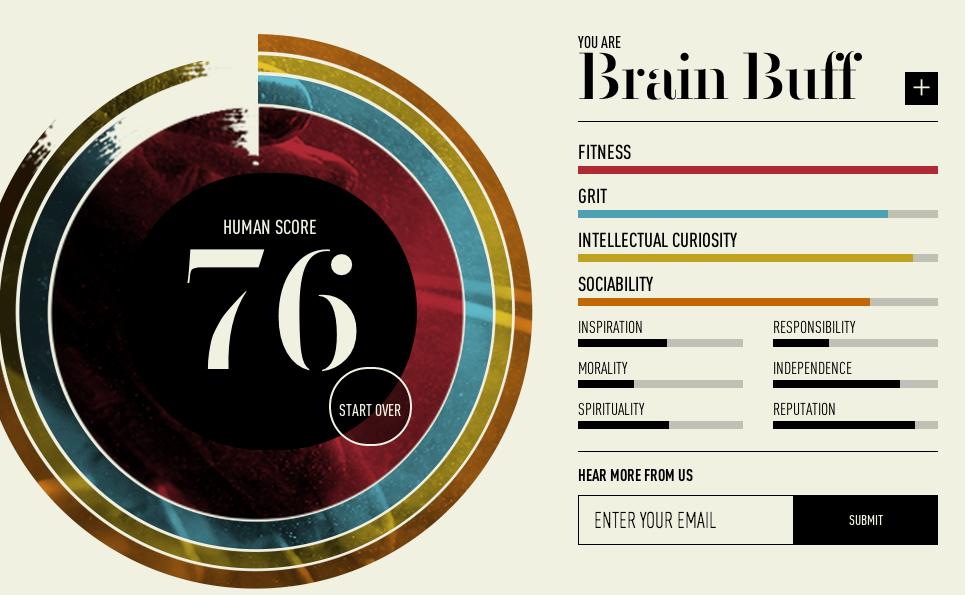
That brings us to the last point. They are expanding, but they are promoting the whole category of tough fitness (which can basically mean quite diverse things) and training hard. Their message resonates naturally to those who currently are sport freaks, but it also has appeal to people who push themselves in other things in life. Showcasing the more “holistic” (in the lack of better word) benefits of intense exercise, they collaborated with scientist David McRaney and created the Human score to calculate your level of humanness:
It is a human nature to be a sucker for tests and I could not wait to test my humanness. I was luckily still more close to human than android. “Brain buff” also sounds like a new upcoming fad term like spornosexual:
As part of the campaign there is also a selfie competition (because no brand is perfect) and some other infographics about how training affects your brain.
Reebok is at least having tight focus on what they are doing. I believe that it will also pay off, if they have the perseverance and patience to follow their daring brand belief through.
Digital bottlenecks are not often solved with only digital means.
Like Scott Galloway points out in this brilliant presentation about the masters of digital universe, the Amazon´s Achilles heel is the shipping:
Their shipping costs are exploding at 40% and shipping fees and transportation costs are over 9 billion. Free shipping has been one of the main reasons why people choose Amazon and what makes them unique. There is no immediate digital solution for shipping (as long as there are physical products). Drones are quite long shot to solve that challenge*.
New digital opportunities might reveal old challenges.
*Interestingly, the unsexy solutions might be the most sustainable. Click & collect is hugely popular, albeit archaic way for eCommerce and traditional retailers might find innovative ways to use their store network for flexible warehousing.
“Premium branded phones are the culmination of decades of research in wireless technology, computing, materials, and design. Shitphones are the culmination of decades of research in wireless technology, computing, materials, and design—minus a year or two.” John Hermann-Shitphone A Love Story
After Apple doing the best quarter ever (for any company), it does not really seem that company is in trouble. However if you investigate the Apple revenue breakdown, there are some things to watch out for. iPhone contributes to almost 70% of Apple´s revenue. iPad (which is declining) is only 17% of iPhone sales and Mac 13%. Services contribute to 0.6% to Apple´s revenue.
Launching the phablet-sized iPhone 6 was brilliant business move in China. The sales soared over 70% in Greater China region.
1.Smartphones will be commoditized
Xiaomi is a great example of this: the phone works ok, but sells in aggressively lower price (thus low margin). Like John Hermann wrote, many technology brands are in situation where “genuine novelty rapidly reduced to thankless anonymity” Apple is more secure than other premium phone brands, as it is guarded with its lock-in ecosystem, but nothing in this world lasts forever.
2. Smartphones will eventually be no longer status symbols
When I got my first mobile phone at the tender age of 12, I was the king of hill in schoolyard. First iPhone was a conversation topic for weeks. New bigger-screen iPhone was a topic for a short question around “does it bend” and that was it. iPhone has already been around eight years, mobile phones even longer, it is getting harder and harder to excite the audience. Same will apply to China, which currently brings huge parts of Apple revenues. Technology status symbols are fickle as the status comes from constant innovation.
3. iPhone eats the other parts of Apple ecosystem
Who normal person needs home computer any more? As our life has become more dominantly mobile, the need for laptop has radically decreased. iPad was the first substitute for your home laptor. At the same time iPhone 6 is killing it, iPad sales have dropped 20%. That is not necessarily worrying; maybe iPad was transition product for something else (such as the bigger mobile). Although you are committed to single device, the previous Apple ecosystem with multiple devices working seamlessly acted as a bigger barrier to switch. Not to mention that the former clue to that ecosystem iTunes does not really do anything at the moment. Streaming services have pretty much killed that business and what will become from Beats acquisition is yet unknown.
This brings us to the watch. Apple Watch is hugely important for Apple because of the following reasons:
1. Opportunity to highlight premium innovation
Apple is a premium technology brand so it needs to be constantly innovating. The recent innovations in mobile phones have been tepid at best (making your phone big require more innovation for jeans makers). Apple watch is an opportunity to showcase their innovation, which entitles them to ask premium price.
2. New behavior
Apple Watch is also an opportunity to teach a new behavior for consumers. If any brand can do that, Apple can. Using iTunes, downloading apps or using iPad were new behaviors for the audience. Jury is still out, have these behaviors become permanent (app downloading seems to still go strong).
3. Stronger lock-in to ecosystem
iPhone is currently the crown jewel for Apple. As Apple Watch requires iPhone to work properly, it is great fit to Apple ecosystem and will increase the time spent on it.
4. Bragging rights
Apple Watch will spark much more lunch hour chatter than previous iPhone models combined. It remains to be seen, do you appear cool or douche when dabbling with your watch.
Apple Watch can be success or not (we will now more when it hits the store April 24th). It is risk because it involves new behavior and wearables have not yet been that succesful. However it is necessary risk for Apple to stay relevant and continue charging premium from their products.
Majority of brands are doing research wrong. They spend all their efforts with focus groups, where “target audience” is overanalyzing ad storyboards in conditions that could not be more removed from the reality where those ads really are seen. In addition to focus, there is also qualitative research where the same “target audience” lies to their heart´s content about how they care about sustainability, ethicality but in reality only care about the price.
Don´t get me wrong. Right research is essential to successful marketing. Majority of brands would benefit with constant testing and research in the marketplace. You should be able to change advertising assets based on their actual performance in the media. Yes, it requires a little bit more production budget but will result in better success rate. Although there has been quite a lot talk about optimization, it is still surprising that how few brands and brand managers do the effort to measure, optimize and improve. It is just so much more convenient to blow up the money on useless focus groups.
Research is a powerful tool if we approach it differently. Where boring background research is generally reserved to the beginning of the project and happily forgotten by the time there is the creative development is on its full swing, you could actually make research integral part of your advertising. No need to be too scientific or cerebral about it:
Research is essentially just finding things out.
How you find things out is not limited to traditional methods. With digital tools we have more agile ways to do research and figure things up. Don´t let the bad image of current market research stop you. Be more of a mad scientist, less a census data collector and get your hands dirty with the research. On the right hands research can be a powerful creative tool and not just requisite tick in the box.
Great example about this is Shave Test by Gillette. Gillette could have done the usual boring qualitative study and ask women how they feel about beard. When asking someone for an opinion, you always give her opportunity to lie. Therefore observation is always better than asking. Therefore women might have been tempted to say that they love beards, because all the hipsters around sporting their beardos clouded their judgment. Regardless of the truthfulness of the answer, the guys could not have cared less. It would just have been another boring research piece that brands do all the time and no one really notices.
So instead of opting for boring, Gillette collaborated with Tinder for the rogue research. Right swipe in Tinder has become a unified standard for sex appeal. So Gillette and Tinder tested, which get more right swipes: bearded or well-groomed guys. The results were probably not that surprising to women, maybe a little bit to all bearded hipsters out there. You can watch highlights on the video below or get more detailed results in the campaign website:
How many times have come out with exciting creative from your focus groups?
This could almost be Nike ad (that is highest compliment for an ad I have)
Insight: There is currently a gender gap in sports in UK. The amount of females doing sports is only 66% compared to men. One of the main reasons holding women back is the fear of judgment (apparently guys do not fear it). Women think that other people in gym are semiprofessional low body fat athletes, when in reality everyone can benefit and enjoy from doing sports.
You should not also think about how you look when doing sports, because every one looks stupid when doing sports. Case-in-point: the all-time greatest basketball player Michael Jordan:
Michael Jordan and his trademark tongue wag
More important is that when repeated enough times, doing sports makes you look better afterwards.
Will this ad change the sports habits of UK women?
Not solely. It is a great rally cry and provides inspiration for women to take on sports. The usage of regular women in the Nike-esque ad powerfully conveys the message, that everyone can do sports. That is important starting point and good kickstarter for the habit hange
Inspiration is not really enough to change a habit. It is a main component in motivation, but you also have to make sure to address cue, routine and reward to make it stick. Therefore it is interesting to see will “This Girl Can”-campaign play solely on inspiration space or will it expand to even more concrete actions.
Every brand tries to be a part of big event and competes against limited amount of attention, which is really focused on the actual game. In reality there is more exposure to be had by exploiting an event in the outskirts where the other brands do not dare to venture. They are playing safe and being scared of doing anything out of ordinary. This creates a great opportunity for the bold ambush marketer. Tap into big events and sponsorship, but try not to pay for it, is my motto.
That motto was followed by Newcastle Brown Ale last year with these highly entertaining ads piggybacking Super Bowl ad craze:
The Teaser for The Trailer for Newcastle´s Mega Huge Football Game AD
The Mega Huge Football Game Ad Newcastle Could´ve Made
Rest of the videos can be seen on the campaign site and here is the full case study of the success of the campaign:
I have had debates about the campaign (which is usually good sign, seldom you even notice a campaign, thus argue about it). Does it really fit with Newcastle Brown Ale brilliant brand promise? Their approach has been all about “No Bollocks” which means avoiding the usual beer ad clichés. Their pseudo super bowl ad is essentially in its post-modern sarcasm and ad irony is, well, bollocks. Sometimes you have to point out that you are not bollocks by first demonstrating what the bollocks is. In these ads by showing the beer ad bollocks clichés, Newcastle takes the higher ground by using parody and rises above the bollocks. That´s some serious philosophy right there. Not to mention that the ads are truly the dog´s bollocks.
Consistent brand behavior is not about repeating the same line over and over again. That is just an attempt to bore you into buying. Great brand behavior has strong brand belief (like No Bollocks) that manifests itself in everything or whatever the brand does. Therefore you don´t have to repeat “No Bollocks” if you show and demonstrate what no bollocks –attitude means. Being an underdog is also about the attitude. Newcastle Brown Ale is able to portray challenger underdog mentality, even though they are owned by big beer behemoth Heineken.
Consistent brand behavior also means that you stay true to your course. Quite often brands change their direction too often, although their current approach just started to work. After the success of last year´s Super Bowl Newcastle Brown Ale continues with the same brand behavior and similar tone. Not buying Super Bowl ad, but tapping into this biggest advertising showcase in the world. This time they are trying to “crowdsource” ad with some other brands, because they do not have budget to buy super bowl slot:
Newcastle Brown Ale also tapped into one of the most famous ad properties around Super Bowl (Doritos Crash The Super Bowl) and made their own “Doritos” ad:
Internet does not like sequels, but their approach showcases unique brand consistency, which is rare nowadays. More importantly the ads are funny as well.
Everything I have learned about business, I have learned in basketball court (with some additional help from Wu-Tang Clan). Whether it has been great (or usually horrible) leadership, importance of the team or the value of hard work. This recent incident is a good proof of that:
Detroit Pistons waived their highest paid player and star Josh Smith at the end of December. Waiving is not a little feat, because waived player is included in team salary. The results have been interesting: Pistons has been on a 8-1 winning run only losing to the hottest team in NBA right now: Atlanta Hawks. Interestingly Josh Smith has been good with his new team Houston Rockets as well, so currently it has been win-win for both the of the participants. What can be learned from this whole episode?
1.Don´t play safe: bold moves will be remembered
Sometimes you have to wake up your whole team with dramatic actions. Stan Van Gundy is not just a coach for Detroit Pistons; he is also their president of basketball operations. Waiving Josh Smith was a demonstration of his power and also a dramatic call for their team to wake up. Was it exactly wise is an another question. He had to do something to catch attention of the team. Off-the court jury is still out for Van Gundy´s strategic perspective but on the court his defensive instructions on the video below have strategic clarity that only a few business leaders (or even coaches) have:
2.Even a bad plan is better than no plan
You cannot totally fault bad Pistons season start on Josh Smith and to say so is ludicrous. They did not have proper plan in the place for the team when he was there. Josh Smith had to play a role that did not suit his skills set. When he was waived from the team, Detroit Pistons was forced to have a different game plan and missing one key player made putting a coherent plan into action much easier.
3.Take the responsibility: You either sink or swim
You can never underestimate the importance of mental aspect of sports or business. You need to feel that you are contributing to the team. Because Josh Smith was gone, the rest of the team had to rise up. Other option would have been to tank. The season is now on halfway, so the newly established Pistons can still be a boom or bust. Currently it seems that they have regained their self-esteem and if they continue like this can even make it to the play-offs.
4.Failure is an opportunity to reborn
I like Josh Smith as a player, when he is playing right role. No one denies the physical talent he has, but his attitude to the game has been a question. He has showed maturity by asking to come out of bench with Rockets. Being waived is definitely a slap in the face and you definitely want to show that you still have the skills to be a great player.
5.Team can be more (or less) than its parts
Basketball and advertising industry are similar in a way that you can fill your company or team with stars and still suck. Chemistry plays crucial role. Josh Smith is playing in Houston with his longtime friend Dwight Howard, which probably will be a good thing. Sometimes there can be only one rooster in the coop and if there are too many stars fighting for the attention the end results can be disastrous. Many combinations can work on the paper, but if it does not work on the court it does not really matter. Therefore crazy-sounding ideas like waiving your star player can actually make sense on the long run.
How the episode will pan out, we will see at the end of the season. Currently it seems that everyone seems happy with the end result.
Update: Dec 30, Skiplagged is facing significantly higher than normal traffic. Please try again later if you encounter any issues–you will be amazed. Thanks.
Lesson #1: Getting sued is a great way for free promotion
Skiplagged effectively helps you to find cheap flights by using “hidden city ticketing”. The direct flight from Singapore to Helsinki can be more expensive than the flight from Singapore to Paris with stopover in Helsinki. Then you just hop over in Helsinki and just don´t use the last flight. This is only recommend to one-way flights because usually your ticket is cancelled afterwards. I have not (yet) tried out hidden-city ticketing, but I have done throwaway ticketing once. It just feels completely odd that if you want to travel one-way you have to pay double the price of return ticket. Actually when I did it, I did not even know that it was not approved. Aktarer Zaman, the founder of Skiplagged explains:
When you are searching for tickets, your market is just to go from this city to this city to this city. And you are shown a price. You are buying this flight when you are buying a ticket. So this is a service you are buying in. Consumers should have the right to partially use the services they buy.
I agree to most extend with the sentiment in here: when you buy something you should also decide not to use it. Not to mention that sometimes you are forced to not use the flights. There are certain arguments that using these loopholes in large scale might increase the costs of airline travel. It might also hurt smaller airline destinations as well. Eventually I feel it is quite fair game though. Airlines try to maximize the money out of us; meanwhile we are doing the opposite. In the bigger picture I think they are in better position to screw us over.
Lesson #2: Digital makes your business model eventually more transparent
Doing different airline booking ploys has been around longer than Skiplagged, but it naturally has done it faster and more effective. Exploiting these loopholes is definitely not illegal, but in can result in losing your loyalty program points. Based on the increased interest to Skiplagged and rising popularity of budget airlines this does not seem to be the a big concern for the majority of users. Consumers are not essentially stupid and millions of loyalty programs and cards have just led to more disloyalty. Also it has lead to increased focus on price especially with airlines.
I was just talking with one friend who mentioned that even with their corporate discounts with major commercial airline, it is still cheaper for the company to fly short-haul with budget airlines. And so they are doing. Consumers are doing the same. Flying has become so commoditized that you do not really care what airline you are flying if is deemed relatively safe.
Lesson #3: Price trumps the loyalty for the majority of consumers
After the lawsuit, Aktarer Zaman put up a crowdfunding-site up to cover up the upcoming legal bills. He has already raised over 60k. The response has been overwhelmingly positive for Skiplagged and quite vicious towards the airlines. One person donated $666 dollars and commented: “send them to hell”.
It is interesting to see how this will pan out, but again this a manifestation that no business is “safe” from digitalization. If there is a market fault, it is just easier and faster to point it out and also solve it digitally. That might create a totally new business as well. In the case of Skiplagged, it will be a zero-sum game. Either one will win. Time will tell will the Skiplagged send airlines to hell or will they sue Skiplagged to death.



 Stand-Up Strategy