“A screenplay can be written quickly and detective story can be knocked out in three weeks, while no one should spend more than a month on a doctoral dissertation. A novel, however, takes longer” -Werner Herzog (A Guide To The Perplexed)
Why majority of agencies are doing such a bad job at the moment?
They are slow.
The best young talent goes to start-ups, because the pace is fast and the mentality is about getting things done. Bigger agencies are filled with bureaucracy, internal meetings and all other fluff, which is not what they should be doing.
Agency business is essentially simple and your time should be divided to three parts:
Figuring things out
Doing the actual things
Selling things
Not to say, we could not be much more effective with all of those three things. Everyone is a procrastinator if just given the opportunity. Agencies also have higher proportion of people with general aversion to anything resembling a process, so our ways of working are not as effective as they could be. That is not the main challenge, though.
The bigger problem is that people cannot focus on these three things. When I talk with my colleagues working in different agencies around the world, the common complaint is that there is not enough time to concentrate on the real work. There are too many people who misattribute internal meetings and all the administrative wanking as real work. And unfortunately as the agencies get more bloated, they also hire more dead weight complicating the real work with all the additional layers.
Unwanted bureaucracy, unnecessary administration and too many useless people result to agencies being slow. At the same time they have to rush things that really matter. Start-ups concentrate on what is important and spend adequate time on it. Rest of the stuff can be bashed out quite quickly.
“It was decision-making by committee, some kind of artificial respiration, which certain inbuilt weaknesses. Too many people were slaves to handouts, forever trying to fulfill the wishes of the boardroom, which is why so many of them made only one film, then gave up. They were too busy filling out paperwork” -Werner Herzog (A Guide To The Perplexed, talking about film subsidies in Western Germany)
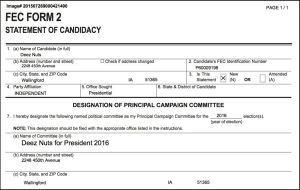
The hype has just begun. Warren G (the originator of Deez Nuts) has volunteered to become vice president for Deez Nuts. The search interest for Nuts has surpassed Hillary Clinton and is almost as high as Donald Trump.
Why Deez Nuts has become such a phenomenon?
It is funny. It is hard to think about more serious decision than selecting your new president. That does not mean that people would not want take the piss out of it.
People adapt to everything. Donald Trump´s candidacy shocked people at first, but now it is already old news. You need constantly some new stimulus or otherwise you get totally numb to the whole election (and we have not even entered the primary phase). There is so long time till the actual election that people will get bored to pretty much everything: eventually even to Deez Nutz.
Shareability. People share things that instantly make them laugh. If newscaster pronouncing “Deez Nuts” does not make you laugh a little bit, you must be too cynical for your own good. The name and the backstory is a perfect example of digital age and what makes people tick in 2015.
It remains to be seen how long Deez Nuts will remain hot topic in US election. For non-voting fans of practical humor hopefully quite long.
“The difference between stupid and genius is that genius has its limits”
– Albert Einstein
We have limits as humans.
Luckily we have not yet reached them in majority of things. But for example, baseball pitcher cannot throw faster than 100 MPH. Although pitcher could get stronger, his tendons and ligaments would just snap throwing it faster.
Throwing the baseball is one aspect of baseball, so that is why there will be plenty of evolution in the baseball. Scientists have calculated that even in other sports the pace of development has slowed down and we are approaching the limits. Actually in some sports like long jump we are getting worse.
Being an optimist, I take there is a still lot to improve for us in humans: whether in sports or in life in general (I don´t know why anyone would make a separation between those two). These developments will happen by either tweaking the small details or reshaping the big picture:
1. Aggregation of marginal gains
“The marginal gains philosophy requires you to look at every single aspect of what you do so you can try and improve it. It looks at every aspect of performance, and tries to improve each a little bit— even just a tenth of a percent . If you find a training technique that makes an athlete that tiny bit stronger , it alone might not have a huge effect on a race. But if you can stack those very small improvements on one another, finding a bit in tires and a bit in the wheels and a bit on the track surface and a bit in nutrition supplements— well, soon those marginal gains begin to add up to big gaps between you and your competition.” Dave Brailsford on aggregation of marginal gains
Dave Brailsford started as the general manager for Team Sky (Great Britain´s professional cycling team) in 2010. He had the concept laid down in the quote above: if you improve every area related to cycling by just a little bit (most commonly is used 1 percent), then those small gains would eventually add up to bigger improvement. These improvements ranged from the obvious (training, nutrition) to more surprising (every cyclist had their own pillows when they are travelling). The results were outstanding. Brailsford was wrong in believing that Team Sky could win Tour De France in five years. They did it in three.
This works when the competitive field is already mature. Cycling itself is quite established sports, so there is not necessary that much innovation (doping excluded) to be done.
The difference nowadays between agencies is not in the actual ideas, but in the craft. Similar ideas have gotten totally different reception in marketplace and also in award shows. When we essentially are doing the same things, the difference comes in small details.
Has our industry then just become minor improvements and tweaking in quite predictable playing field?
Not necessarily.
2. Disruptive leaps
Disruptive thinking has radically altered the sports. Quite often the change is driven by technology, but sometimes it is also about the different way to approach the challenge in sports.
a) Technology disruption “I think the players, I put in the book for example that we should go back to wood rackets, probably they laughed at me, I’m a dinosaur, but I think that you see these great players, have even more variety and you see more strategy, there’d be more subtlety.” John McEnroe (last player to win major tournament with wooden racket)
Technology has played huge role in certain sports, especially in golf driving distance. We are not talking about marginal gains in here; these technologies have truly revolutionized the sports.
Internet has changed the whole ball game in our industry. Either you have digital capabilities, or you are like a guy trying to play with wooden racquet in tennis court. Not only you look stupid, you will also certainly lose.
b) Approach disruption I adapted an antiquated style and modernized it to something that was efficient. I didn’t know anyone else in the world would be able to use it and I never imagined it would revolutionize the event. – Dick Fosbury (inventor of Fosbury Flop)
Not always you need a technological breakthrough to change the game. V-style jump in ski-jump or Fosbury flop in high jump are examples when smart individuals outsmarted the competition. They looked the problem from a different angle and found a totally new and more effective way to solve it.
Currently every agency is jumping with the old style, where the room for innovation is limited. When the playing field is the same for everyone, the only way you can win is to search for marginal gains. I truly believe that we could approach our business truly differently and take the whole agency business model to the new heights. It is time to rethink the whole jump.
(Full disclosure: These sports anecdotes were mostly lifted from the great book I just read. The book is done by Mark Mucclusky and is called “Faster, Higher, Stronger. Highly recommended reading)
Throughout my career I have been doing lots of workshops. I really enjoy facilitating them. At their best they can be really valuable tool to come up with new ideas and also to get client more engaged to the process.
Conducting a great workshop is not an easy task. Every one of us has been in sloppily conducted workshops, which are as enjoyable as water torture. Just coming back from a great workshop in London, I thought I would share some of my tips I have learned during the years:
10 Tips for An Effective Workshop
1. Plan & prepare well
It should go without saying, but it is really important to define what is the goal for the workshop and craft the day through the lens of what you want to achieve.
Groups make or break the workshop. One person who “knows it all” and remembers all the cases when something has not worked can poison even the best of the groups. Orchestrate the groups well and gently sideline the bullies if they start to be detrimental for the workshop process.
Have an extensive list of exercises before the workshop. Good workshop facilitators have an extensive cookbook of tried & true crow-pleasers and also more experimental pieces. Do not try to predict too much of what works though. Every group is different and the exercise you thought would bomb might be the most helpful of the day and the usually engaging exercise might fail miserably. If some exercise does not generate ideas, just move faster to the next one (see also point 6).
2. Define clear responsibilities
Nothing is worse than loosely orchestrated and chaotic workshop. Therefore it is crucial to define clear roles and responsibilities:
Who is facilitating?
Who is leading?
Who is doing the background info?
Who is preparing the stimulus?
Who is taking notes?
Who is doing the memos?
Who is leading each group?
3. Stay on time & agenda
One of the most important things for facilitator is to be the fun-spoiling stopwatch Nazi. Because when your schedule starts derailing, it starts derailing bad. Good healthy discussion is for good, but instantly when it starts to go around in circles you have to move to the next exercise. Everyone has to have an opportunity to talk, but not everyone needs to talk in every possible exercise.
Exercises should left participants feeling hungry to come up with more ideas. Time constraint is one of the most effective methods to force ideas to come out. If you give too much time to polish, people will fall into safe territory.
4. Collect all ideas
Post-its are your best friends. They are easy to move and they nicely fit one idea. They have different colors, which can mark the different ideas from different groups. Instruct the usage of the post-its right from the beginning so that all the thoughts are captured.
One of the key roles of the facilitator is to develop a laidback and open feeling to the workshop. It does not hurt if you are able to make people laugh. You need to establish vibe, where ideas are flowing freely and no one is shooting them down too early.
5. Plot the drama
Good workshop follows the arch of drama. It starts from the chaos and despair and steadily goes towards more clarity. This should be reflected in the exercises as well.
Usually participants need a while to get warmed up and eventually will start to lose of steam towards end of the day. Therefore it is good to end the exercise with compiling exercises and idea voting, which does not require as much idea firepower. Brain is muscle as well.
Remember that workshop is not a lecture. If you need to go through certain presentations, have them throughout the day so that it does not start to feel too cumbersome.
6. Be strict, but flexible
Sometimes one exercise starts to show so much promise that it makes sense to stop and start concentrating on it. Experienced facilitator is able to change things on the fly so that participants do not even notice. The rule of the thumb still is that until lunch you should be more or less on time or you are screwed.
Therefore it makes sense to share loose agenda, but not necessarily detailed list of exercises you want to do. This allows you to switch things seamlessly and improvise based on the overall flow of the workshop.
When explaining the exercises to the group, be clear and concise. Explain the role of the task, what people need to do and how much they have time to perform the exercise.
7. Document well
Even the most enjoyable of the workshops is totally useless if it is not well documented. Quite seldom you come up with readymade ideas, but you have shitloads of great starts. The real work starts after the workshop, when you need to synthetize, compile and find synergies from the workshop ideas. The documentation should be done as soon as possible after the workshop. So sorry, no sleep for the planners.
Bonus tip: As part of preparation, assign people with the best handwriting to write down the ideas. This makes your job way easier on documentation phase. Case-in-point: quite often I cannot even comprehend my own handwriting after couple of days.
8. Different exercises
You need a good combination of individual, pair & group exercises. I personally want to start always with individual ideation on post-it notes. This ensures that there are enough of ideas when the exercises go forward. It is also refreshing for majority of the people to be alone with their creativity and blank sheet of paper. Either it let’s them loose or show their limits.
Loose creative gangbang and brainstorming does not benefit anyone, so give numeric demands for the number of ideas for the groups as well. Do not be afraid to switch the groups if for some reason your pre-planned group dynamics are dysfunctional. Everyone should feel free to express his or her ideas in workshop.
9. Stay hydrated & energized
You need to have enough breaks, so that people are not constantly watching the mobile phones during the exercises. When you have enough breaks you can start punishing and publicly shaming people who use mobile when they should be present.
Also ensure that there is enough food for all the people. Nothing is more horrible than room full of cranky participants with low blood sugar. Although I try to avoid eating sugar (especially on weekdays), having candy around actually helps people to ideate.
10. Have fun
Participants will immediately sense, if you are not experienced workshop facilitator. So don´t stress and try to create a good vibe. If you maintain or have created a good chemistry after the workshop with all the participants, half of the battle has been already won.
Workshops are great way to get to know how your clients think, which will be beneficial later on. Have open mind and prepare to have a blast.
For those conducting workshops and looking for new stimulus for exercises, I have found Hyper Island toolbox really useful. Also these cards are good for branding workshops (and the NSFW versions are good for blowing off steam).
I have mentioned earlier that I practice CrossFit. As a part of the addiction, I have become a victim of advertising and started spending on CrossFit apparel. When I started to train, it was ok to just go with regular running sneakers and whatever gear you had. Now I have different shoes for weightlifting and other exercises. I cannot even think of going back to training with normal (read: non-branded but equally functioning apparel).
Talk about taking your own medicine.
I was reminded of my Crossfit-addiction, when I noticed this ad on my Gmail:
I had not heard about the brand (Rhone) before, but it had the magic words that sparked my interest and also a discount. Discount is an interesting thing: if you are offered it, it already feels like bargain before you even know the starting price. Uncharacteristically I clicked on the ad (which was probably the first Gmail ad I have clicked ever).
The site offered apparently sweat and smell-proof shirts with quite steep prices. With my excessive sweating and vain ways I am of course the ideal target audience. After checking a while there came a pop-up which offered an opportunity to participate in lottery. Discount is interesting, but even more interesting is an opportunity to win something for free.
Naturally I signed up, so they have now my contact details.
After that I have been encountering Rhone advertising in my FB feed. They have been smartly changing the picture so I have noticed it every time:
Again uncharacteristically I clicked and again there was a pop-up with time-limited offer:
Nothing Rhone does is crazy innovative or cutting edge: just simple retargeting. They are essentially using the oldest bribes in marketing world: discount, rewards, exclusivity and lucky draw. If I would encounter as much communications from a brand in different field I would be super pissed off. Now I am more delighted and pondering should I actually test those shirts. That is exactly what smart marketing should do. From the starting point of not even knowing the brand, becoming a potential buyer within only a week is quite a feat.
So the lesson is: if you are able to find audience with natural interest, you can almost borderline spam them if you offer them something rewarding. People get touchy about marketing when it is totally irrelevant for them. It is not so much about what you say, but to whom you say it.
Although it would be disrespectful for the movie to label it only as an “ad movie”, it has one of the most realistic portraits of the creative process (not necessarily of the 1988 election). The film tells the story about Chile´s 1988 election, when Pinochet was eventually brought down. Both of the parties were promised to have 15 minutes of advertising time in national television. The incumbent had the more positive “si”-vote and the challenger the “no”. The whole film starts about making that a product that sells:
“By its very nature, ‘no’ was a negative concept; it was very difficult to sell. “‘No’ was not a person, not a candidate. It had no personality, no ethics, no aesthetics.”
– Eugenio García (the ad man behind Chile´s No campaign in 1988)
Some of the scenes felt almost like a candid camera would have been roaming in the ad agency. The movie has four important lessons for everyone working in advertising.
1.Creativity is not a democracy
There were 16 political parties in the coalition against Pinochet and of course everyone had an opinion. There are times for committees, but not when you are trying to do the great work. Eventually someone has to make the decisions and endless feedback loop from random people does not help it. Also it is easier to have opinion about advertising than for example accounting. It is impossible to take everyone´s opinion into account if you want to be single-minded and make your mark.
2.Solve the real problem for the real audience
The goal of the 15 minutes of advertising was to win the ballot with a single-minded message, not tell everything you know. The debates in the film are centered on the messaging of the campaign. The fictional ad man René Saavedra (played by Gael García Bernal, and based on Eugenio García) tries to show more of the joy, where as the committee members wanted to show the suffering that Pinochet´s coup-seized leadership has caused. Advertising is not necessarily about doing what is right, but doing what has the most impact:
“After years of polarisation, we all needed to live together in peace. We bet on the good nature of the ordinary Chilean; that they didn’t like violence, they didn’t like fear.”
– Eugenio García
Many people don´t understand simplifying the message. They want to cramp too much in every ad. The real showcase of your knowledge is to just tell that part what is interesting and leave rest out. Every extra word is an extra barrier for your message to go through.
3. When market leader starts acknowledging challenger, they are in the trouble
If you acknowledge your competition as a market leader, you are weak. People can also smell fear whether it is on sports field or marketing battlefield. If you are market leader, you have to be immune to criticism and just brush everything off. To make matters worse the “Yes”-party attacked campaign, which was based on hope, joy and happiness. Big mistake. By acknowledging your challenger, they appear more prominent than they really are.
4. Execution matters
The movie is filmed with ¾ inch Sony U-matic magnetic tape, which was widely used by television news in Chile in the 80s. It makes really unique feel to the film and also looks totally different than Larráin´s other movies. That also enables seamless mix of the archived footage.
Whether you are adman or not, this film is highly recommended to everyone.
Lemon lime soft drinks weren’t supposed to succeed against colas. It just didn’t happen. But then again, hip hop wasn’t supposed to succeed against pop, but that’s exactly what Sprite did – – and that sprite campaign is sort of a metaphor for what hip hop did. – Dan Charnas (author of The Big Payback)
Sponsorship is easy, right?
You just stamp your logo to famous musician, athlete, whatever and borrow her relevance to your boring brand. When done well, it works great. Unfortunately quite often sponsorship is quite ad-hoc (our CEO likes cricket, let´s sponsor it!) and the bigger role of brand is totally forgotten. Brands have to stand for something and believe in something. That cannot be changed quarterly.
Brands change their sponsorships too often. Last year you were about music, now you are about start-ups and next year about parkour. Because of the short tenures of CMOs, brands are struggling to keep consistency and sponsorship is definitely something that is too often just an add-on. Brands are trying to desperately collaborate with the current hot thing but at the same time forget for what they are standing for.
It makes sense to have focus on your sponsorship. Find a passion that suits your brand and then stick with it. It is better to go narrow than too wide. Instead of being about sports, be about football. Instead of being about music, be about hiphop. Be sharp. If you are everything for everyone, you are more likely nothing for a few.
And speaking of hiphop, one of the greatest examples of sponsorship has been Sprite. They have been connecting itself with hiphop for over 30 years:
That commitment to hiphop has also been something that has made business sense. In 90s Sprite was challenger brand, so it had to find its own voice in sponsorship as well. They made a bet on hiphop and that bet has paid off during those years. What is underground today, will be mainstream tomorrow.
Obey Your Thirst, which within two years doubles Sprite’s market share, and makes it the fastest growing soft drink in America, and eventually, in power of Sprite, they take away the NBA sponsorship from Coca-Cola.
– Dan Charnas
Brands need to have consistent behavior, whereas tone-of-voice can vary. Sprite was a challenger brand and it collaborated with challenger musicians. It´s collaboration with hiphop went deeper than just having hiphop music on Sprite ads. They understood and respected the culture. When you have right partnerships and sponsorships they make your brand stronger. When Sprite has been moving away from hiphop, it has been a mistake. Stick to what you believe in and where you are good, instead of trying pathetically to reinvent yourself every time.
What the Obey Your Thirst campaign did for corporate America was that it proved to corporate America that, it’s okay Proctor and Gamble, it’s okay IBM, Sprite took a chance on hip hop and it’s beating everybody. It’s at that point that Sprite sets the archetype for dealing with hip hop straight on. Dealing with black culture and by extension black people straight on, rather than trying to water it down, make it slap happy, and that was sort of a feature of some “minority geared advertising” for many years. Hip hop helps to change the tone of that.
– Dan Charnas
The Sprite ads were “content marketing” before that horrible term was coined. Other soda brands had hiphop artists in ads (leaning towards the pop side), Sprite let the artists shine where they were good at.
Pete Rock, CL Smooth and Grand Puba are freestyling on the studio. Funny part is that CL Smooth is dissing “commercial rappers” in commercial. Talking about meta-level:
The consistency and commitment is also apparent with the rappers they work with. With Nas they have worked from 90s and with Drake over 5 years:
Nas & Az over Wild Style beat
Constructing Drake
The assimilation goes deeper than just ads. Sprite has held hiphop talent competitions, pressed vinyl records and now their newest campaign “Obey Your Verse” showcases hiphop verses on the Sprite cans.
The selection is a nice mixture of classic lines mixed with their current brand ambassador Drake.
Sprite connects with the passion of our their target audience in a way deeper level than many other brands. That makes sponsorship a part of brand behavior and not just an afterthought. No need to change your course annually: stick to what you believe in and roll with it.
“There’s three of us but we’re not the Beatles”
– Run DMC (King Of Rock)
Which sounds about right: the evolution of music has been a series of artists, intentionally and not, building on each other.
“Elvis was a hero to most But he never meant sh*t to me you see Straight up racist that sucker was Simple and plain Mother f*ck him and John Wayne”
– Chuck D (Fight The Power)
As a life-long hip-hop fan, it naturally tickles my fancy that the research highlights hiphop as one of the most revolutionary turning points in music charts. Hip-hop is the evolution of music. Through sampling you can turn every musical genre to a potential hip-hop song. Rapping enabled you to have much more message and words in one song as you are not confined by traditional song structure and need to have catchy chorus. You also do not necessarily need to be able to sing or play instrument to make hiphop (little bit similar as in punk). Hip-hop serves as the blueprint on how the innovation should work:
Rethink the traditional form. Rapping is a closer to preaching than singing. With the abandonment of the traditional harmony and music conventions you free up more time to deliver your message
Democratize the tools. The more inclusive are the tools, the more opportunities there are for new interesting and surprising things to happen.
“Most decent popular music researchers would probably agree that the Beatles were not so much innovators as musical magpies – and that’s not a criticism. They, like all of us, listened to all sorts of stuff and were duly inspired”
– Mike Brocken, director of world´s first Beatles master degree (!)
There has not ever been such thing as a solitary inventor. Innovation is not about figuring stuff out in isolation. It is ability to combine existing things in new ways. It has never been about being the first. It is about being the first magpie.
Apple has not really been the first in anything, but they are the most innovative and also the most profitable company in the world. Our obsession in coming up with something new is a quest doomed to fail. We should concentrate to listen to all sorts of stuff, be inspired and combine that existing stuff in new ways.
Unfortunately there is still almost colonial attitude towards emerging markets in the western countries (especially US and Europe). When dealing with people who are not living and working this region, the knowledge of the development and innovation happening in here is still quite modest. Everyone recognizes the business potential, but they think that it is just some void, which can be filled with western products.
There are two prevalent myths, which are just wrong. Other is that all the Asian brands are just copying western brands and doing it cheaper. Other is that their whole success is based on the big local markets. These myths are not the whole picture:
1. Asian brands are not just cheap copycats.
Micromax has cheap phones that is true. They also have a solar powered phone. I think that is quite cool. Xiaomi admittedly copies Apple with pride, but it has also totally disrupted the way to sell the phones. Innovation takes different forms in the Asia that is certain, but identifying all the brands as either copycats or cost cutters is dangerous simplification. Price is a big issue in all the markets and many Asian tech innovations have been able to do things more cheaply which is appreciated also by western consumers.
2. They are not popular because they are local, but because they understand local consumer.
No matter where you are, you should have eye on Asia. Not only because the region is growing, but also because the next big innovation is coming from (around) here.
Roger Martin sums up beautifully what strategy is:
The very essence of strategy is explicit, purposeful choice.
Strategy is saying explicitly, proactively: “We’re going to do these things and not those things for these reasons.”
You only know that you’ve made a real strategic choice if you can say the opposite of what that choice is, and it’s not stupid.
This is the reason why so many brands fail. They are too afraid to make choices. If you are not premium and if you are not cost-cutter, you fall in the middle. And being in the middle is not a choice, it is indecisiveness.
Choices are not always easy. Making a choice is making a sacrifice. But you have also the opportunity to gain something. If you don´t make a choice you end up with nothing.









 Stand-Up Strategy