Category Archives: Planning

The Difference Between Invasive and Innovative Advertising is The Interest

I have mentioned earlier that I practice CrossFit. As a part of the addiction, I have become a victim of advertising and started spending on CrossFit apparel. When I started to train, it was ok to just go with regular running sneakers and whatever gear you had. Now I have different shoes for weightlifting and other exercises. I cannot even think of going back to training with normal (read: non-branded but equally functioning apparel).

Talk about taking your own medicine.

I was reminded of my Crossfit-addiction, when I noticed this ad on my Gmail:

RhoneGmail

I had not heard about the brand (Rhone) before, but it had the magic words that sparked my interest and also a discount. Discount is an interesting thing: if you are offered it, it already feels like bargain before you even know the starting price. Uncharacteristically I clicked on the ad (which was probably the first Gmail ad I have clicked ever).

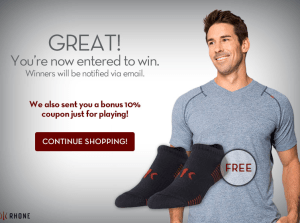
The site offered apparently sweat and smell-proof shirts with quite steep prices. With my excessive sweating and vain ways I am of course the ideal target audience. After checking a while there came a pop-up which offered an opportunity to participate in lottery. Discount is interesting, but even more interesting is an opportunity to win something for free.
Rhonelottery

Naturally I signed up, so they have now my contact details.

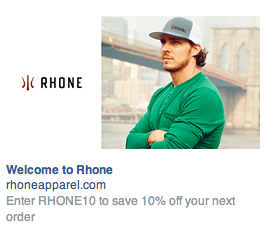
After that I have been encountering Rhone advertising in my FB feed. They have been smartly changing the picture so I have noticed it every time:
RhoneFB2

RhoneFB1

Again uncharacteristically I clicked and again there was a pop-up with time-limited offer:

Rhonesecondchange

Nothing Rhone does is crazy innovative or cutting edge: just simple retargeting. They are essentially using the oldest bribes in marketing world: discount, rewards, exclusivity and lucky draw. If I would encounter as much communications from a brand in different field I would be super pissed off. Now I am more delighted and pondering should I actually test those shirts. That is exactly what smart marketing should do. From the starting point of not even knowing the brand, becoming a potential buyer within only a week is quite a feat.

So the lesson is: if you are able to find audience with natural interest, you can almost borderline spam them if you offer them something rewarding. People get touchy about marketing when it is totally irrelevant for them. It is not so much about what you say, but to whom you say it.
Tagged , , , , ,

How To Make Unskippable Pre-Roll Ads?

“Our ads don’t need to be shorter, quicker, and more snackable; they can be longer, richer, and perhaps even a bit stranger.”

State of advertising in 2015:
Traditional agencies do 30s tv ads.
Digital agencies do 30s skippable pre-roll ads.

In many ways the fun age of experimentation is over and it is back to the status quo and advertising business as usual.

That does not mean there are not opportunities in pre-rolls. They are one form of storytelling. Some of the rules for good story apply to every media, but if you apply TVC storytelling method to skippable pre-rolls in mobile it does not work.

I recommend reading this Google study of Mountain Dew ad and its skip rates. Maybe surprisingly to conventional wisdom in mobile the best performing ad (viewed at 26% higher rate than others) was the longest one:

Some important lessons when you are running your next pre-roll campaign:

1. Just redistributing your TVC is a waste of money and just plain stupid.
When viewer has the power to skip your advertising bullshit, she will most likely do it. Spending a little bit money to different edits or even additional content pays itself back with more effective video advertising and better results.

2. Shorter is not necessarily better.
People have time to watch cat videos, music videos and naked ninja warrior. The problem for brands is that generally people don´t want invest any of their time to it. However, if they start watching your content, they can go longer than the standard 30 seconds…

3. It is all about the beginning
Pre-roll videos should not follow conventional story logic. It is better to start with your outrageous part or the most mysterious part. The main goal is to lure your audience to watch by any means necessary.

4. Do not be obsessed by the branding.
The longest clip has quite moderate branding throughout. Ad recall was worse, but eventually the brand lift was the same as with the other pieces.

5. When in doubt, have animals or cute babies.
Some things in storytelling never change.

Making more unskippable content is not even that difficult. It just requires a new way to approach your content production: more effort, edits, continuous testing and tweaking.

Tagged , , , , ,

No Mas: Selling Hope Against The Hatred

Mad Men aside, there are not really that many (good) movies about advertising. Therefore it was great to finally see No as a part of Pablo Larráin “trilogy”* in O.P.E.N. festival here in Singapore:

Although it would be disrespectful for the movie to label it only as an “ad movie”, it has one of the most realistic portraits of the creative process (not necessarily of the 1988 election). The film tells the story about Chile´s 1988 election, when Pinochet was eventually brought down. Both of the parties were promised to have 15 minutes of advertising time in national television. The incumbent had the more positive “si”-vote and the challenger the “no”. The whole film starts about making that a product that sells:

“By its very nature, ‘no’ was a negative concept; it was very difficult to sell. “‘No’ was not a person, not a candidate. It had no personality, no ethics, no aesthetics.”
Eugenio García (the ad man behind Chile´s No campaign in 1988)

Some of the scenes felt almost like a candid camera would have been roaming in the ad agency. The movie has four important lessons for everyone working in advertising.

1.Creativity is not a democracy
There were 16 political parties in the coalition against Pinochet and of course everyone had an opinion. There are times for committees, but not when you are trying to do the great work. Eventually someone has to make the decisions and endless feedback loop from random people does not help it. Also it is easier to have opinion about advertising than for example accounting. It is impossible to take everyone´s opinion into account if you want to be single-minded and make your mark.

2.Solve the real problem for the real audience
The goal of the 15 minutes of advertising was to win the ballot with a single-minded message, not tell everything you know. The debates in the film are centered on the messaging of the campaign. The fictional ad man René Saavedra (played by Gael García Bernal, and based on Eugenio García) tries to show more of the joy, where as the committee members wanted to show the suffering that Pinochet´s coup-seized leadership has caused. Advertising is not necessarily about doing what is right, but doing what has the most impact:

“After years of polarisation, we all needed to live together in peace. We bet on the good nature of the ordinary Chilean; that they didn’t like violence, they didn’t like fear.”
Eugenio García

Many people don´t understand simplifying the message. They want to cramp too much in every ad. The real showcase of your knowledge is to just tell that part what is interesting and leave rest out. Every extra word is an extra barrier for your message to go through.

3. When market leader starts acknowledging challenger, they are in the trouble
If you acknowledge your competition as a market leader, you are weak. People can also smell fear whether it is on sports field or marketing battlefield. If you are market leader, you have to be immune to criticism and just brush everything off. To make matters worse the “Yes”-party attacked campaign, which was based on hope, joy and happiness. Big mistake. By acknowledging your challenger, they appear more prominent than they really are.

4. Execution matters
The movie is filmed with ¾ inch Sony U-matic magnetic tape, which was widely used by television news in Chile in the 80s. It makes really unique feel to the film and also looks totally different than Larráin´s other movies. That also enables seamless mix of the archived footage.

Whether you are adman or not, this film is highly recommended to everyone.

*Actually Tony Manero got censored, so they only showed two Larráin films in festival.

Tagged , , , ,

Personal Blogs Are Dead. Long Live Personal Blogs.

Fish where the fish are.

That has been my mantra for a long time. It does not make sense for brands to build expensive destinations and then spend shitloads of money trying to force people to discover those destinations where they don´t want to go in a first place. Generally it is better to collaborate with existing successful destinations. Two thirds of the apps get under 1000 downloads. Same way as it makes more sense to borrow relevance from already popular unit than trying to make your brand popular yourself.

In many ways the same applies for blogging. We who are still blogging in WP, blogspot, etc. are relics of an old age. Nowadays if you have some thoughts you want to write, better to highlight them on Medium or LinkedIn. There is an existing user base and recommendation algorithm helps your content to pop out there. Majority of readers to this blog come from Twitter & LinkedIn, so why not be even closer to the reader?

I realize the value of Medium & LinkedIn, but at the same time I also recognize the value for having something “own”. Own naturally being quite relative term in here, because probably WordPress can switch my account off anytime. That is why it also still makes sense for companies to have a website. In the digital world where information ownership is getting centralized to few major players, it might still make sense to retain some of your intellectual property to yourself.

That being said, I will feature some of my “best” posts from here in Medium and later on LinkedIn. Mainly I want to test them out from user perspective and also compare the reach. Also being a lazy and egoistic person, I feel that I could easily revisit my highly intelligent gems with no big effort and get some more readers.
You can find the greatest hits in Medium.

Tagged , , ,

Winning Changes Nothing

andreagassi

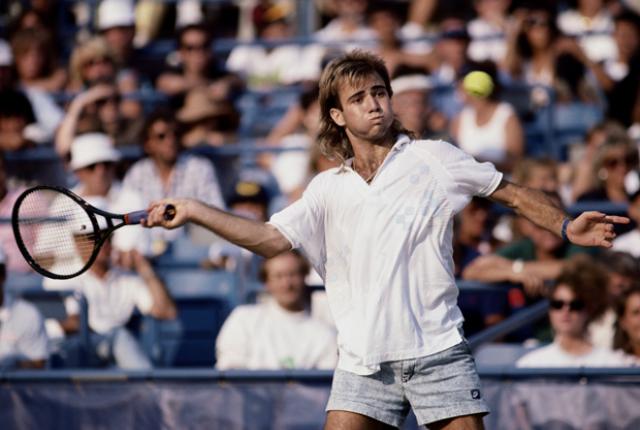
“Now that I´ve won a slam, I know something that very few people on earth are permitted to know. A win doesn´t feel as good as a loss feels bad and the good feeling doesn’t last as long as the bad. Not even close.”
– Andre Agassi (in his book Open, telling about his feelings after winning a Wimbledon)

Andre Agassi´s book Open is probably one of the most inspirational book, I have ever read (and definitely the best sports autobiography). Mainly because he had a career of up-and-downs and he is honest in the book about what drove him to success. Although you can never truly understand a professional sports star if you are not one of them yourself, I found quite a lot of valuable lessons in his book. Especially his drive to win and not to lose was something that resonated strongly to me.

Writing a book was always a dream of mine. When I had finished my first book and was holding it in my hands, I didn´t feel anything. Same thing has happened quite often when I have accomplished goals I have set to myself. You are already looking for the next challenge.

We overestimate the amount of happiness that achieving the goals will bring. Winning a lottery causes a spike in happiness, but soon your overall well being is back to pre-win state.

Therefore you have to enjoy the journey to the goals, because that is the best part. I have been doing quite a lot of weightlifting lately and actually every time I have hit a new PR, it has felt easy. When I have tried to force the results, it has not worked out. The harder I train the better I get, but to achieve the best results I have to try and think less.

Life is about grueling exercise, which should lead to smooth execution. In Agassi´s book, he talks about insane conditioning workouts they are doing with his trainer Gil to get in the shape. Although those exercises were pure hell, sections explaining them in the book are the parts where the true love for the sports comes through. If you don´t enjoy training, you cannot reap the rewards either.

Also you have to be able to embrace the setbacks. Although during the times it might feel that world is collapsing, people have tremendous ability to rebound from even the most grueling situations. Agassi beat the odds many times in his career. Getting your ass kicked is the biggest motivator at least for me. You want to show that you can bounce back. And you want to kick some ass yourself.

Motivation is a key to winning. Andre Agassi explains quite vividly in his book by how his winning streak in 1995 was fueled by his grudge against Boris Becker. He had 26 game winning streak and beat Becker. However, his real opponent was actually Pete Sampras:

I’m 26-1, and I’d give up all those wins for this one. All that work and anger and winning and training and hoping and sweating, and it leads to the same empty disappointed feeling. No matter how much you win, if you’re not the last one to win, you’re a loser. And in the end I always lose, because there is always Pete. As always, Pete.”

After his loss to Pete Sampras, Agassi derailed with his game, took some crystal meth with assistant called “Slim” and fell eventually to 141 slot in the ranking. The anger was not enough motivation, but luckily he met Steffi Graff. That love fueled his comeback in 1999 and cemented Agassi´s legacy as one of the greatest tennis players ever. Not thinking about winning all the time, made him actually want to win more badly when it mattered. And win he did.

“I define success a lot differently, certainly than my father defined it for us. The two things that have given me most joy I have through tennis: my school for under- privileged kids in Las Vegas and my wife. Instead of a love-hate relationship, I had a hate-love relationship with tennis, but I am grateful that I survived to play long enough to appreciate.”

Tagged , , ,

Image is Nothing, Brand Behavior is Everything

Lemon lime soft drinks weren’t supposed to succeed against colas. It just didn’t happen. But then again, hip hop wasn’t supposed to succeed against pop, but that’s exactly what Sprite did – – and that sprite campaign is sort of a metaphor for what hip hop did.
– Dan Charnas (author of The Big Payback)

Sponsorship is easy, right?

You just stamp your logo to famous musician, athlete, whatever and borrow her relevance to your boring brand. When done well, it works great. Unfortunately quite often sponsorship is quite ad-hoc (our CEO likes cricket, let´s sponsor it!) and the bigger role of brand is totally forgotten. Brands have to stand for something and believe in something. That cannot be changed quarterly.

Brands change their sponsorships too often. Last year you were about music, now you are about start-ups and next year about parkour. Because of the short tenures of CMOs, brands are struggling to keep consistency and sponsorship is definitely something that is too often just an add-on. Brands are trying to desperately collaborate with the current hot thing but at the same time forget for what they are standing for.

It makes sense to have focus on your sponsorship. Find a passion that suits your brand and then stick with it. It is better to go narrow than too wide. Instead of being about sports, be about football. Instead of being about music, be about hiphop. Be sharp. If you are everything for everyone, you are more likely nothing for a few.

And speaking of hiphop, one of the greatest examples of sponsorship has been Sprite. They have been connecting itself with hiphop for over 30 years:

That commitment to hiphop has also been something that has made business sense. In 90s Sprite was challenger brand, so it had to find its own voice in sponsorship as well. They made a bet on hiphop and that bet has paid off during those years. What is underground today, will be mainstream tomorrow.

Obey Your Thirst, which within two years doubles Sprite’s market share, and makes it the fastest growing soft drink in America, and eventually, in power of Sprite, they take away the NBA sponsorship from Coca-Cola.
Dan Charnas

Brands need to have consistent behavior, whereas tone-of-voice can vary. Sprite was a challenger brand and it collaborated with challenger musicians. It´s collaboration with hiphop went deeper than just having hiphop music on Sprite ads. They understood and respected the culture. When you have right partnerships and sponsorships they make your brand stronger. When Sprite has been moving away from hiphop, it has been a mistake. Stick to what you believe in and where you are good, instead of trying pathetically to reinvent yourself every time.

What the Obey Your Thirst campaign did for corporate America was that it proved to corporate America that, it’s okay Proctor and Gamble, it’s okay IBM, Sprite took a chance on hip hop and it’s beating everybody. It’s at that point that Sprite sets the archetype for dealing with hip hop straight on. Dealing with black culture and by extension black people straight on, rather than trying to water it down, make it slap happy, and that was sort of a feature of some “minority geared advertising” for many years. Hip hop helps to change the tone of that.
Dan Charnas

The Sprite ads were “content marketing” before that horrible term was coined. Other soda brands had hiphop artists in ads (leaning towards the pop side), Sprite let the artists shine where they were good at.

Pete Rock, CL Smooth and Grand Puba are freestyling on the studio. Funny part is that CL Smooth is dissing “commercial rappers” in commercial. Talking about meta-level:

The knowledge of hiphop roots run through the commercials, like this one which revisits one of the greatest hiphop beefs of all-time:

The consistency and commitment is also apparent with the rappers they work with. With Nas they have worked from 90s and with Drake over 5 years:

Nas & Az over Wild Style beat

Constructing Drake

The assimilation goes deeper than just ads. Sprite has held hiphop talent competitions, pressed vinyl records and now their newest campaign “Obey Your Verse” showcases hiphop verses on the Sprite cans.
spritecans

The selection is a nice mixture of classic lines mixed with their current brand ambassador Drake.
spriterappers

Sprite connects with the passion of our their target audience in a way deeper level than many other brands. That makes sponsorship a part of brand behavior and not just an afterthought. No need to change your course annually: stick to what you believe in and roll with it.

Tagged , , , , , , ,

State Of The Industry: Boring Mass & Irrelevant Niche

“I’ve never met anyone who has seen a vending machine reward them for laughing, I’ve never walked through a door marked ugly, got a Coke from a drone, or been offered a crisp packet with my face on.
I’ve never had a friend share their personalised film, I’ve not seen outdoor ads that are also street furniture or had an ATM give me a funny receipt.
I’ve not received a magazine with a near field communication thing and I’ve not had a virtual reality experience outside advertising conferences.
I’ve not once seen a member of the public 3D print anything.”
Tom Goodwin (Senior Vice President for Strategy & Innovation, Havas Media)

The biggest problem with the advertising industry is not the lack of innovation, but the lack of distribution of that innovation. Ad industry is overly obsessed by the niche “marketing innovations”. At the same time the advertising for the masses has become utterly boring. As we are desperately trying to find something new, we are failing to move people.

When I was a kid, ads from Nike and Levi´s shaped my whole identity. Current ads don´t make feel anything (although I am exposed to them more than ever). There is a divide between relevant real work and totally irrelevant stunts. Big campaigns are researched and focus grouped till death. Stunts are driven by the inner need of us to win awards, not by real consumer need. When worrying about our internal politics and external professional image, we forget our main stakeholder:

The consumer.

Quite often we say that people hate advertising. That is not true.
People hate when they are conned.
People hate when their time is wasted.
People hate when they are interrupted.
Although the technology has developed, we are still having our old bad habits. More desperate we are as marketers the more we are wasting people´s time, the more we are interrupting and the less authentic we are.

People will notice and even care about advertising when it is either meaningful (giving you a tangible benefit, for example) or moving (makes you feel something: laugh, cry, whatever).

If your next campaign is neither of them, why even bother?

Tagged , , , , , ,

Hip-Hop Innovation & About Being The First Magpie

“Good artists copy, great artists steal”
– Pablo Picasso

There was an interesting research lately about musical patterns in US pop charts from 1960 to 2010. One of the most headline-catching “findings” of the study was that the Beatles was not really that innovative, but was merely channeling existing patterns in charts. Contrary to hip-hop, of whom the researchers put to pedestal as the most important music revolution in charts.

“There’s three of us but we’re not the Beatles”
– Run DMC (King Of Rock)

Which sounds about right: the evolution of music has been a series of artists, intentionally and not, building on each other.

“Elvis was a hero to most
But he never meant sh*t to me you see
Straight up racist that sucker was
Simple and plain
Mother f*ck him and John Wayne”
– Chuck D (Fight The Power)

As a life-long hip-hop fan, it naturally tickles my fancy that the research highlights hiphop as one of the most revolutionary turning points in music charts. Hip-hop is the evolution of music. Through sampling you can turn every musical genre to a potential hip-hop song. Rapping enabled you to have much more message and words in one song as you are not confined by traditional song structure and need to have catchy chorus. You also do not necessarily need to be able to sing or play instrument to make hiphop (little bit similar as in punk). Hip-hop serves as the blueprint on how the innovation should work:

  • Use, alter, remix, combine existing material. Other man´s five-second-horn stab is other man´s full song.
  • Rethink the traditional form. Rapping is a closer to preaching than singing. With the abandonment of the traditional harmony and music conventions you free up more time to deliver your message
  • Democratize the tools. The more inclusive are the tools, the more opportunities there are for new interesting and surprising things to happen.

“Most decent popular music researchers would probably agree that the Beatles were not so much innovators as musical magpies – and that’s not a criticism. They, like all of us, listened to all sorts of stuff and were duly inspired”
– Mike Brocken, director of world´s first Beatles master degree (!)

There has not ever been such thing as a solitary inventor. Innovation is not about figuring stuff out in isolation. It is ability to combine existing things in new ways. It has never been about being the first. It is about being the first magpie.
Apple has not really been the first in anything, but they are the most innovative and also the most profitable company in the world.
Our obsession in coming up with something new is a quest doomed to fail. We should concentrate to listen to all sorts of stuff, be inspired and combine that existing stuff in new ways.

Tagged , , , , ,

Rethink What You Take For Granted

“Turnstile has to make a sound, it might as well be beautiful”
– James Murphy

Last week I wrote about sponsorship and one point I forgot to mention was how brands are the patrons of this modern age. Catholic Church used to support the great artists. Now many of the great projects would not happen without the support of beer brands. And that is why I am supporting beer brands by consuming their products.

We can rationalize on how the project to turn subway turnstiles to play music with James Murphy fits into Heineken´s brand onion (or diamond for that matter)*. Whether it is good for the brand or not, does not change the awesomeness of the project. It also makes perfect sense for subway commuters. We have taken for granted that those turnstiles have to make certain sound. That certain sound is currently unobtrusive at its best, invasive at its worst. It actually feels totally weird that they do not play melodies.

Other great lesson about this project is that there are so many hidden opportunities around to rethink conventions. Some of them are opportunities for brands, some for art and some are in the intersection of both.

*They have this thing about improving cities, so I would say it is nice fit for that one.

Tagged , , ,

Just Say The Obvious, but Do It With Flair

Sometimes advertising is just about being simple:

You show the product.

You show how the product is used.

You tell what you offer.

You tell what is new.

You tell that you have a discount.

Essentially you are doing what your supposed to do, but with a flair.

Sometimes you have to state the obvious, but do it with interesting way instead of trying to find your idea from the obscure.

Great speakers are not necessarily having the most original and inspiring thoughts, but they are delivering them in the most original and inspiring way.

That is the magic we have to bring as agencies. Because quite often people just need the obvious, but they have to be lured to hear that.

No matter how interesting your product is, the obvious can be truly boring. Especially product demos, which can be a total bore even for the most interesting products (take whatever Apple ad). If you have gift of the gab, you can do exciting, attention-grabbing and fun product demos for mundane products as well:

This Droga5-campaign for Under Armour won at Big Show (Best Interactive & Best Social). It features Gisele Bündchen punching and kicking a bag and same time projecting comments (both positive and negative) about the partnership:

Using celebrities is not an idea. It is an effective tactic, when done right. And to be honest, for many brands using well-known people is the only way to elevate their brand to rockstar level. By paying celebrities you upgrade your brand´s appeal, but it is not about slapping some mundane celebrity endorsement to your boring product and expecting to become interesting. It is making most out of that collaboration with celebrity: not just having a pretty face, but having the right pretty face (who can kick ass as well). Essentially the above Under Armour ad is a product demo, just that the person using the products is way more interesting than you.

This ad from Nando´s featuring Mac Lethal showcases that you can even make reading your menu sound interesting:

These examples show that often you don´t need a surprising insight, complicated transmedia storytelling or even a drone to create cut-through. You just need to what you are supposed to do, but do it with style.

Tagged , , , , , , , , , ,