Category Archives: Insight

What My Disdain for Grateful Dead Can Teach About Branding

Music has played crucial part of my life. It started with hiphop and heavy metal and has throughout the years expanded to almost every possible genre. One cult band that I have however never truly understood has been Grateful Dead. The hippy band is know for their marathon gigs like this:

I am not the biggest fan on The Beatles, Rolling Stones, Frank Zappa or Bruce Springsteen, but I still can get why people love them so much. I noticed that Grateful Dead was doing their farewell gig (to celebrate their 50th anniversary) on this July and that prompted me to again test some of their material on Spotify.

Nothing.

Nada.

Zip.

I totally fail to realize what makes people to devote a cult following to band so bland. Maybe it is because I don´t do drugs or have not been part of the hippy movement. On the other hand I don´t gangbang, but I still truly enjoy and find resonance in N.W.A.´s music. Grateful dead remains as a big enigma for me and to many others as well.

Grateful Dead

Some old hippies

“We’re like licorice. Not everybody likes licorice, but the people who like licorice really like licorice.”
Jerry Garcia

But why would I care about Grateful Dead? Or why would Grateful Dead care about me? I am not their core audience. If you are selling licorice, you don´t need to care about people who don´t like or licorice. This is the fault that many marketers have. They mistakenly believe that their target audience is everyone, which is hardly ever the case. If your target audience is everyone the individual purchase is small. When you have focused audience, you can ask for premium price.

Brands get super touchy-feely when blogger outside their target audience says something negative. It does not matter at all. Focus on your cult following. If you want to create a cult around your brand, you have to also alienate the non-brand followers. For deadhead, there are only “we” and “they”. If your product is only meant for alpha-male blokes, why should you worry about offending women ot vice versa?

“In the 1960s, Grateful Dead pioneered many social media and inbound marketing concepts that businesses across all industries use today.
Brian Halligan and David Meerman Scott (Marketing Lessons From Grateful Dead)

Although listening to Grateful Dead is equivalent of water torture, I have to applaud their business acumen. They were never high on the charts, but were able to focus on small devoted and lucrative audience. They kept the loyal customers happy and did not waste their efforts on trying to get new and fickle customers. Funnily enough, there are at least two books dedicated to business lessons from Grateful Dead.

Brands spend much of effort on parity. They want to make their brand easy to compare with other brands. That is the main fault. If you create your own category, the customer has only two choices: either buy or not. Love it or hate it. Ambivalence is not an option.

“They’re not the best at what they do, they’re the only ones that do what they do.”
-Bill Graham
Tagged , , , , , , , ,

No Sympathy For Stress

“Some things benefit from shocks; they thrive and grow when exposed to volatility, randomness, disorder, and stressors and love adventure, risk, and uncertainty.” 

– Nassim Nicholas Taleb (Antifragile)

I don´t believe in stress and you should not either.

When you have lots of things on your plate, it is always interesting to see what is on the menu. If you have time to worry, you have enough time for your task. If you would be truly busy, you wouldn´t have time to worry about how busy you are. If you need to get something done, give the task to the busiest person on the office.

“The time to relax is when you don’t have time for it.”
Sydney J. Harris

Some people are always stressed out. I don´t have sympathy for them, because that stress is never reflective to their reality. Those people get stressed out of small and big things. They stress about strategy and the execution. They stress about the past and the future. They also let you know that they are stressed out and try to elevate themselves as martyrs of the workplace. They are also not effective people, because they loiter all their time at work. Truly effective people have life outside their jobs and are doing multiple things. Those people are working but not stressing out.

“My characterization of a loser is someone who, after making a mistake, doesn’t introspect, doesn’t exploit it, feels embarrassed and defensive rather than enriched with a new piece of information, and tries to explain why he made the mistake rather than moving on. These types often consider themselves the “victims” of some large plot, a bad boss, or bad weather.” 

– Nassim Nicholas Taleb (Antifragile)

Stress is a symptom of helplessness. It is giving up to the idea that you are not responsible for your own decisions and your own life. If you have too much work, you should be able to delegate. If you cannot delegate, prioritize. If nothing else helps, resign from your job. Not all the solutions are always easy, but there are always solutions to your life. Stress is about blaming others and utter fear of failure. If you approach things following Murphy´s Law, you will not get stressed out. Because usually things neither go as planned nor they go as bad as they could have gone.

“How do you innovate? First, try to get in trouble. I mean serious, but not terminal, trouble. I hold—it is beyond speculation, rather a conviction—that innovation and sophistication spark from initial situations of necessity, in ways that go far beyond the satisfaction of such necessity (from the unintended side effects of, say, an initial invention or attempt at invention).” 

– Nassim Nicholas Taleb (Antifragile)

One of my friend argued that children should be subjected to stress at young age, so they can cope with the future stress. Not only this stupid argument is not supported by research, but also the whole thinking is wrong. We should raise our children so that they don´t even know the concept of stress. They should embrace the chaos, hustle and bustle of the modern world and take responsibility of their own actions.

So don´t complain about stress, hit it in the face.

Tagged , , , , ,

Why Advertising Still Matters?

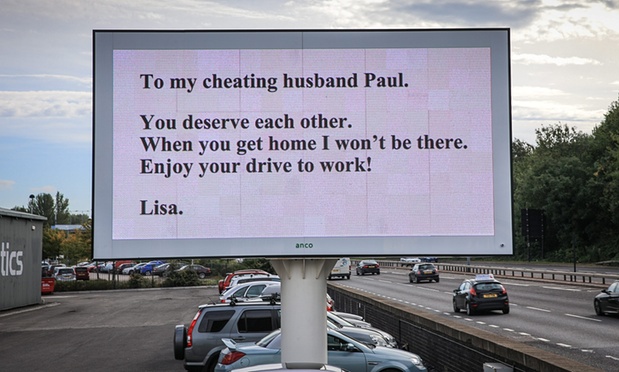
Just when you thought that all the advertising is lacking the feeling, media innovation and overall passion, you come across to this fine out-of-home execution from Sheffield.

ooh

I assume that Lisa did the strategy and concept for this. This has important lessons for us professionals as well:

  1. Content: Don´t write for the masses. Write for the one person in mind. The succinct and sharp message trumps the visual gimmicks.
  2. Context: Know your audience behavior and habits and tailor your message according to that. Do not only generally target traffic, know whether your audience is on their way or way back from work.
  3. Go big or go home: With small media budget, it is better to invest in one big thing than to spread yourself too thin.

Great example that even traditional advertising can still move and surprise.

Tagged , , , ,

When Advertising Just Makes You Angry

When you work in advertising, you mostly become numb to advertising. Occasionally you are awed of great executions and seldom something makes your blood boil. There are two reasons when advertising makes you angry:

  • The execution is so shitty, that it is disgrace to our whole profession.
  • The product is immoral and the whole belief behind it is faulty and harmful.

This ad falls into latter category.

snakeoil

Kids should play and not drink brain-enhancing snake oil. This advertising underlines what is wrong with the education at the moment. The idea of success is really narrow-minded, only celebrating white-collar specialists. When you prepare your whole life to be a banker, it is highly doubtful that you will suddenly become Steve Jobs. It is also sad that only occupations in the list are really boring ones. What kind of sadist wants their children to become IT manager or accountant? Children should dream of becoming astronauts instead of dentists, for goodness sake. For kids to practice sports and participate in cultural events would be way more helpful than the strenuous tuition and placebo drugs.

I spent my childhood and early teens (what the hell; pretty much whole my life) listening to hiphop and playing basketball. That did not prevent me to get in to good university, graduate and become “respectable” contributor to society. I did not need to take performance-enhancing study drugs to achieve this and I doubt anyone else really needs either. Although my background on paper looks the typical business school born and bred planner, I have found all the extra-curriculum activities being much more helpful in my career than my actual studies. And I truly focused on my extra-curriculum activities. But I work in advertising, which hardly constitutes as a real work. At least it is not as desirable job as engineer to put to your Omega-3 oil advertisement.

Learning things by heart is easy and therefore excelling in school does not require extraordinary talent. When we force our children to conform early on, they will never regain their curiosity. Without curiosity there is no new ideas and without them there is eventually no growth in society. When there is only one right and very narrow view of success, we will just grow a generation of dull robots.

Tagged , , , , ,

Even Blank is More Interesting Than Your Brand


Above video generated over 100k views with a shy $1400 investment. About 46 percent of viewers watched it for at least 30 seconds. The “creator” of the video Solve Agency says that on average people watched over 2 minutes of this totally blank video and 22% watched the whole thing through. Maybe there are some hypnotic traits in this blank video or people are just generally slow to understand that the blank section does not belong to the video they are intending to watch. Or maybe people are just stupid.

This was an experiment to showcase that views don´t necessarily mean anything in YouTube (and to promote the agency with the white paper). What I think was the most interesting part that the blank video performed better than many traditional pre-rolls. As the digital industry is becoming more and more video content production relying heavily on paid push, we have been devoutly following the YouTube recommendations for the video content:

  1. Get to the point fast
  2. Brand immediately
  3. First five seconds are the most important

What if it would be more effective to do completely opposite?

  1. Start slow
  2. Brand later
  3. Brand only at the very end

We are not currently leaving any room for imagination or curiosity for our viewers. In this fast paced world if you get the point in 5 seconds why bother for the next 25 seconds to see more of the same. Currently we are designing our pre-rolls for the users with default action for skipping the ad (which is probably the right approach in majority of cases). While we force-fed our message we miss the opportunity to find people who are truly interested in what we say. Of course there are not necessarily any people who are truly interested in what we say. Then I would assume that mastering your pre-rolls is the least of your brand´s problems.

We should experiment more with our video content as well. We are wasting money on researching imaginary consumers in hypothetical situations, when we would have awesome opportunity to test different approaches on real marketplace. Leave five minutes blank to your next pre-roll and see how it works compared to your normal approach. If it would work, maybe you are on to something. If it does not, try something else. The Mountain Dew case study I shared earlier found that the longest version of the ad worked the best. Everything is guesswork until you really test it with real consumers in real situations.

When everyone is doing the same thing, no matter if it is principally right, the one who does something different, whether right or wrong, will be noticed.

Tagged , , ,

Anatomy of An Insight: Straight Outta Somewhere

You are now about to witness the strength of street knowledge…

Biopic about NWA “Straight Outta Compton” has been a massive box office hit. That did not surprise me at all. Middle-aged dudes go watch it because of nostalgia and younger blokes still know Dr. Dre and Ice Cube. It´s a bit like gangsta rap Expendables. I would naturally go see the film straight away, but I doubt it will be probably banned in Singapore:

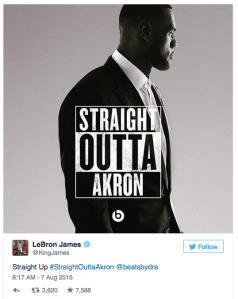
The online campaign (for movie & Beats headphones as well) has also been really successful for the film. Meme generator “Straight Outta Somewhere” has been visited already over 4 million times. In the site you can do your own “Straight Outta Compton” –meme:

straightouttahyvinkaa

Insight: No matter where you from, you want to rep your hood.

Many marketers are wary of user-generated content. It is hard to get people to take part in those campaigns. If they do take a part, the content is quite often shitty and x-rated.

That does not mean you should not do campaigns with “participation element”. The participation has to be as easy as possible. With “Straight Outta Somewhere” you just decide where you are from and upload the picture. Everyone who shares stuff in Internet knows the construct of a meme. It also helps to have some famous celebs to add fuel to the fire in their social media channels:

serenawilliamsstraightoutta jlostraightoutta

straightouttaakron

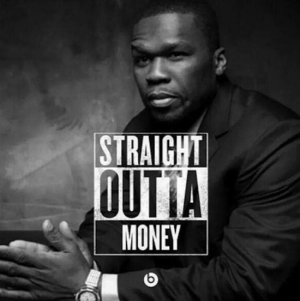
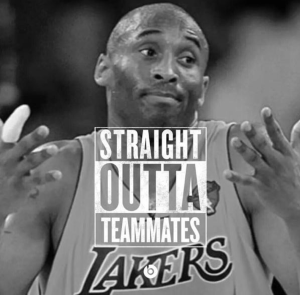
Majority of brands do not realize that when people are starting to make parodies, that is when your campaign starts to be popular. Beats has truly embraced (read: not deleted) the funny memes which naturally are shared more often than boring brand content.

straightoutta50cent

straightouttakobe
If you want people to take part with your campaign:

    1. Make it easy to participate
    2. Do not reinvent the wheel: use formats that people know
    3. Kickstart with influencers
    4. Embrace (don´t censor) the parodies
    5. Partner up (the lines are blurred, is the website advertising the movie or headphones? No matter, it is a hit)

…Word to the mother*cker
Straight outta Compton

Tagged , , , , , , ,

Fight Against Lazy Writing

inastationofametro

Although I am not necessary an advocate for perfection, I am fierce fighter against sloppy writing. I believe in “less is more”. Write like you would be boxing, every hit has to do damage to your opponent. Strip away all the fluff, edit and then condense even more.

I have been reading this excellent book about making of James Joyce´s Ulysses and it reminded me of this Ezra Pound´s classic poem called “In A Station of the Metro” (right spacing in the above picture):

The apparition of these faces in the crowd;
Petals on a wet, black bough.

Short, isn´t it?

The story behind this imagist classic is inspiring. Ezra Pound stepped onto the platform of a metro station and caught a glimpse of transcendent face amongst the crowd. As he turned to follow it, he saw another ones. This mesmerized him and he wanted to write poem about it. He wrote over thirty-line poem about it, tried to finesse it but eventually tore it up. It just was not working the way he intended (Pound was fierce editor). The sight haunted him and he tried to write it again six months later. He failed miserably. Eventually he finished the above poem, year after. Only two lines and 14 words: nothing more and nothing less.

That story should be the guiding light for everyone who has to write in his or her work. Simpler is more difficult to write, but it is more effective. The same Ezra Pound laid out the three laws of writing imagist poetry in his “A Retrospect”:

  1. Direct treatment of the ‘thing’ whether subjective or objective.
  2. To use absolutely no word that does not contribute to the presentation.
  3. As regarding rhythm: to compose in the sequence of the musical phrase, not in sequence of a metronome.

These rules are worth to live by even when not writing poetry. Essentially you must cut the crap, get to the point and let it flow. In advertising where our space is even shorter, it is disrespectful to our audience to write lazy copy. We should be always sharp, simple and short.

Tagged , , , , , , , , ,

Woody Allen Way Of Work

woodyallenquote

Woody Allen is one of my favorite directors. Not all of his movies are necessarily great, but on the other hand he is doing about one good movie constantly every year. He explained his work ethic in the recent interview:

“I’m lazy and an imperfectionist. Steven Spielberg and Martin Scorsese will work on the details until midnight and sweat it out, whereas for me, come six o’clock, I want to go home. I want to have dinner. Filmmaking is not [the] end-all be-all of my existence” 

The comment raises important point. Does it make sense to try to be perfect? Woody Allen is naturally superbly talented and even a half-hearted attempt from him is way better than from majority of directors. Would you want your legacy to be around 50 good movies (as a director and even more as a writer) or just one excellent (and maybe couple of unfinished ones)? Is your good other people´s excellent? If you have tendency to perfectionism, you are the harshest and quite often the most unfair judge of your own work.

There is a balance in perfection and production output. The more you try to perfect, the less you produce.

Dr. Dre just announced that after 16 years in making his magnum opus “Detox” will never come out:

“I didn’t like it. It wasn’t good. The record, it just wasn’t good. I worked my ass off on it, and I don’t think I did a good enough job.”

It is great virtue to be self-critical, but should you cut your losses earlier? Naturally Dr. Dre did not exactly just sat on his laurels during that time, but still. Maybe you should realize that you are not making the masterpiece earlier? Or maybe you just should be less self-critical? Woody Allen makes this exact point:

“My problem is that I’m middle class. If I was crazy I might be better. If I shrieked on the set and demanded, it may be better, but I don’t. I say, ‘Good enough!’ It’s a middle-class quality, which does make for productivity.”

Maybe we need less wannabe perfectionists and crazies reaching desperately for the perfect work in our industry and more people, who can churn good stuff out constantly.

Tagged , , , , , ,

Anatomy of An Insight: Pampers Pooface

Sometimes your whole ad can be filled with the most obvious clichés and it still works:

Insights:

  • Everything looks more epic in slow motion.
  • Everything sounds more epic with “Also Sprach Zarathustra” as a soundtrack.
  • Babies are cute even when they are releasing the brown trout.

It takes skill to be totally predictable, but still totally on point.

Tagged , , , , ,