Category Archives: Insight

Always Go Beyond Numbers

People don´t understand probabilities.

“When people hear these analyses, however, they are not reassured but become more fearful than ever — they hadn’t realized there are so, many ways for something to go wrong! They mentally tabulate the number of disaster scenarios, rather than mentally aggregating the probabilities of the disaster scenarios.
Steven Pinker, Blank Slate
 
I think generally people don´t understand numbers, period.
 
Good example is the probability of someone becoming a NBA player. The odds are naturally low, but there is a good indicator that increases the probability. That indicator is height.

For a man between 6 feet to 6”2”, the chance of being in NBA is five in a million.
At 6”2” to 6”4”, the chances improve slightly to 20 to million.
Man between 6”10” and 7 it is 32000 in a million (3.2%).
And for men over 7 seven feet tall, 17% of them are in the NBA right now*. So every six guy over 7ft you would encounter would be NBA player. Because massive growth is quite often attributed to some disease, it is even more likely that healthy seven-footer is a NBA player. So with narrowing the group, we have actually find quite a good indicator of your probabilities of becoming NBA player.

It is always important to go beyond the numbers.

JJ Redick

JJ Redick is one of the rare NBA player with shorter wingspan than his height

Even the short NBA players are not really that short. Nate Robinson is only 5”7”, but his wingspan is 6”1”. NBA players in general have almost double more wingspan than regular people. Generally it is really rare that a player has shorter wingspan than his height. Yao Ming was one of them, but on the other hand he was 7”6”. So if you would need to predict someone´s ability to be a NBA player and you would need to rely only on two data points: height and wingspan would be probably the best with the former being more important.

*Stats read from a great book by David Epstein: The Sports Gene.
Tagged , , , , , ,

Why Spotify Discover Weekly Is The Best Music Curation Tool?

Apple Music arrived with big bang. Its approach to music streaming is surprisingly old school. It relies a lot on human curation and its programming resembles old radio (some of the shows are definitely worth listening though). It´s biggest rival Spotify is relying more on big data. At the moment it seems that latter approach seems to be the winning formula. Eventually recommendation engines will become a core differentiator (as the libraries will become quite identical) for streaming services, so the headstart Spotify has is not insignificant.

Human curation was the way taste making happened back in the day. I used to rely almost totally to Dj Anonymous on my music recommendations. Best dj´s in the world have much more refined taste than any machine yet. The challenge with human curation is that it does not scale.

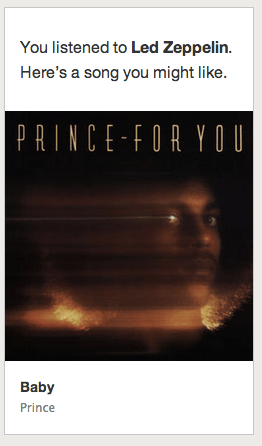
The recommendation engines were not really been yet up to task because the algorithms have not been advanced enough to recommend right songs. Music is nuanced thing and linear recommendation is not usually providing satisfying listening. Previous Spotify recommendations have been borderline ridiculous:

Prince Spotify

Previously there has not also been enough data available. For recommendation engines to work, you need to have massive amounts of data and something that is relevant. The key for Discover Weekly to work so well is that Spotify realized that the data they should be mining are the playlists people are making.

“For all the special sauce and the algorithmic work, the fact that we’ve kept it simple and that it’s just a playlist has really helped it resonate with people”
Matthew Ogle (Discover Weekly Product Owner)

The more people are making playlists in Spotify more “human curation big data” they are gathering. Currently there are over 2 billion playlists in Spotify. Spotify has been able to strike the right balance on learning about your listening habits and combining that with the big data:

“On one side, we’ve built a model of all the music we know about, that is powered by all the curatorial actions of people on Spotify adding to playlists. On the other side, we have our impression of what your music taste is. Every Monday morning, we take these two things, do a little magic filtering, and try to find things that other users have been playlisting around the music you’ve been jamming on, but that we think are either brand new to you or relatively new.”
-Matthew Ogle (Discover Weekly Product Owner)

In the beginning I wasn´t that impressed with Spotify´s weekly recommendations. Majority of the songs I knew already (20+ years of record collecting has its handicaps). After couple of weeks I started to appreciate the brilliance of it. Spotify Discover Weekly has become my “comfort playlist”. It plays stuff I know, but drops every week couple of nice gems I had not heard or had totally forgotten. During working week I listen to lots of weird stuff outside my usual taste profile, Spotify´s weekly recommendations don´t seem to pick on those anomalies and the quality is constant:

Like mentioned earlier, eventually data will trump human experience. In many fields, we are already there.

“In the next generation of software, machine learning won’t just be an add-on that improves performance a few percentage points; it will really replace traditional approaches.

Today, you’re much better off building a smart system that can learn from the real world – what actual listeners are most likely to like next – and help you predict who and where the next Adele might be.”
Eric Schmidt, Alphabet executive chairman

Tagged , , , , , , , , ,

Decisions Are Not Made Through Consensus

I don´t believe in committees.

I don´t believe in creative circle jerks.

I don´t believe in finding consensus.

I believe in getting shit done.

That requires collaboration but combined with firm decision-making.

Shared responsibility usually means no responsibility.

Opinions are like assholes, everyone has one and usually you want to smell only your own one.

Plus ideas are like farts.

Good strategy is about making choice.

And usually making choice means that there are opposing views. Some views will be supported and some won´t. And that is ok. In well-functioning organization you are listened but you also know who makes the decision. Opinions are listened, but not everyone is decision maker. Who makes the decision also holds the responsibility of the outcomes.

Consensus means no ownership. What’s important is not that everyone agrees, but that everyone is heard and then the right person makes a decision.

Gokul Rajaram, Square

Tagged , , , ,

Yes, David Bowie is Dead But Your Brand Should Not Care

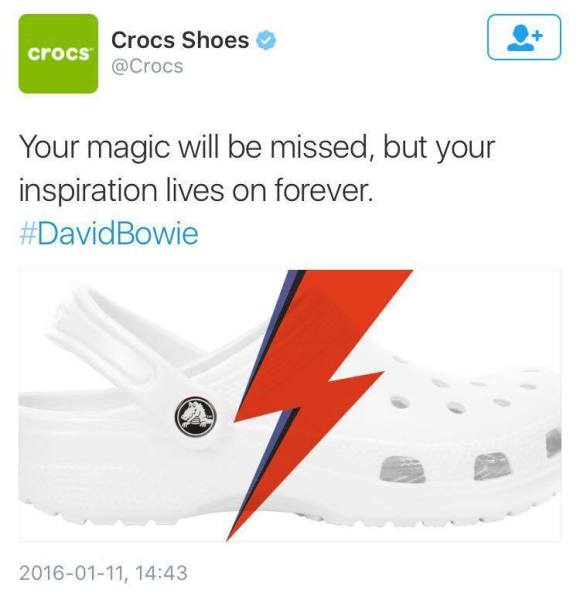
David Bowie was a great musician, whose music will live on for a long time. Because he was such an iconic figure, there has been unleash of public tributes I don´t remember encountering since Lemmy died. All of those public tributes I can understand. The death came as a surprise and people want to showcase their empathy in social media.

However what made me sick this:

crocsbowie

Real-time advertising can be valuable tool, but you should remember the following rules:

1) Just because everyone is talking about it, that does not mean they want you to join the conversation. If you don´t have anything valuable to add to the mix, stay away.
2) If your product is not relevant to what is happening do not jump on the bandwagon (Jack Daniels works with Lemmy, ugly rubber boots not necessarily that well with Bowie)
3) If you have to jump on bandwagon (when in doubt: don´t jump) at least be respectable

Milk and Lemmy don´t necessarily mix that well, but apparently you can do that with a good taste and respect.
4) Generally it is easier to create real-time content on happier topics than death.
5) If what you are doing feels that it makes you a jerk, that is a strong indication that you should not be doing it.

And don´t even start with “every publicity is good publicity”-bullshit, although Crocs Facebook page has not probably gotten this much traction in a long time.

Tagged , , , , , ,

10 Things You Need To Know About Cinemagraphs

If short-form video was the previous content buzzword, in last months people have been raving about cinemagraphs.

Essentially they are individual instants of motion are isolated against a static image, “living photographs” so to speak. They have been around for a while though, invented originally by Kevin Burg & Jamie Beck. Because they work perfectly in visual mobile platforms (Facebook, Instagram), they have been generating more buzz in recent months.

As everyone is raving about cinemagraphs, here is a short cheat sheet to showcase that you know what you are talking about in meetings:

  1. Good cinemagraph should be hypnotizing.

The goal of a cinemagraph is to keep audience longer watching your ad. Same way as fire is hypnotizing, great cinemagraph creates a loop you end up watching longer than you intended.

  1. Good cinemagraph starts with great photo.

You cannot create an effective cinemagraph out of crappy picture. The movement will not capture your attention, photo will. The movement makes you watch it longer.

  1. Ideal for Facebook and Instagram.

The recent looping video in Instagram and FB autoplay are perfect vehicles for cinemagraphs. Cinemagraph is elegant format, which works perfectly to feed-based environments that do not use sound that much.

  1. You buy it like a video.

When considering the ad cost, you have to factor in that cinemagraphs are considered as a video instead of a photo.

  1. It is not necessarily always faster to produce than ordinary video.

It can take weeks to produce high-quality cinemagraph.

  1. Cinemagraph is great vehicle for product advertising.

Because you end up watching the video longer, ensure that your product is there to be seen. Besides ability to increase your brand recall, you can actually show the actual product inside the bottle as well (see below)

dolcegabbana

  1. Currently they are more viral than ordinary photographs

They have 71% more organic reach than regular photos.

  1. Ensure that you make the loop seamless.

Nothing looks more clunky than cinemagraph that does not loop properly. You want to create the hypnotizing effect (point 1)

  1. They will become more commonplace

As your profile image in Facebook can nowadays be 7 second video instead of just a static photo, people are becoming more adapt at creating their own

  1. Be creative

With relatively new format, we have only scratched the surface of the creative possibilities it can provide (like vertical videos). Experiment and test different cinemagraph ideas, the rules have not yet been set in stone.

Our digital world is getting more mobile and visual and the rise of cinemagraphs is just a one manifestation of that.

Tagged , , , , ,

More Willpower for the New Year

Did you make a new year´s resolution?

If you did, you are likely not alone.

Also if you are not able to follow it through, you are definitely not alone either.

62% of Americans make new year´s resolutions, but only 8% are able to fulfill them.

The biggest reason for that is that people are trying to make too big lifestyle change at the same time. You try to quit smoking, lose weight, start exercise, save more money and at the same time live your life to the fullest. No wonder, that you are feeling overwhelmed. One of the goals could be achievable but achieving all of them at the same time would be quite impossible feat.

Willpower is muscle.

Like muscle, it gets tired. In experiments, straight after accomplishing a task that requires people to restrain their impulses (i.e. saying no to chocolate biscuits), students were far more likely to underperform at other willpower-related jobs (i.e. solving a puzzle). So if you ha

Like muscle, you can also train it. In one study, students were asked to watch their posture for a week. At the end of the week, those students performed better on self-control tasks (not related to posture) than students who had not been exercising control all week. That is why people who are able to maintain regular sports regime, are also able to achieve more during their workday (this is just anecdotal experience with myself).

So for this New Year, I will not promise to quit smoking (mainly because I would need to start it to be able to do that) or anything of that sorts. Instead I will recognize the moments that are draining my willpower and keep training the willpower muscle.

Plus I will take better care of my shoes and eat more soups.

Tagged , , ,

Farts, Apple Watch, Racial Tensions: This Is What People Read in 2015

Another year is nearing its end. This year the most popular posts ranged from flatulent humor to Apple watch (and everything in between).

I had time to post a little bit less than on previous year, but readership remained stable and some surprises in the most read post list as well. You never know yourself what post will tickle your reader´s fancy.

This year I read lots of interesting books, saw some interesting movies and had some interesting debates. However, despite the Apple Watch, the year seemed a little bit boring from advertising and technology point of view.

I think it will be calm before storm, and next year will be humongous (both in macro and micro –level).

Or it is just the same old shit, you never know.

Most read posts 2016

  1. Ideas are like farts
  2. Why Apple Watch is Crucial For The Future of Apple
  3. Anatomy of An Insight: #Joulurauhaa
  4. Rethink Your Marketing Research
  5. Forget The Apple Watch This Is The Only Wearable That Truly Matters
  6. 5 Ways To Make Your YouTube Pre-Rolls Kick Ass
  7. Agencies Are Slow
  8. Digital Pre-Testing: Harmful Waste Of Money
  9. Just Say The Obvious, But Do It With Flair
  10. Anatomy of Insight: Straight Outta Somewhere

This will be my last post for the year.

I will be returning, whether you want it or not, in 2016.

Tagged , , , ,

#sometrendit2016: The Only 2016 Social Media Trends You Should Read

tweet

As the year approaches the end, it has become an annual tradition for me take a look at crystal ball and share my views with Kurio Social Media Agency on the next year´s social media trends.

For those adapt at Finnish, I recommend reading the whole report. If you are not interested in the predictions of 28 other Finnish digital marketers, you can also jump straight to the most important ones (mine) below.

Before I go into my answers, I have to quote myself from the last year:

I have to say that I have not been interested in social media as such for a long time. Do not get me wrong. Social plays crucial role in digital business. But I seldom think digital as a separate entity either: digital is air. Digital, mobile and social should be a part of every business. Sometimes at the core, sometimes playing supporting role and sometimes playing no role at all. Strategy is about deciding what to do, but even more importantly what not to do. If you are thinking social media as a separate unit you are missing the bigger picture. 

The dominance of digital universe goes well beyond our traditional silos.

And here are the bold/boring predictions of 2016:

  1. 1. Biggest Social Media Trend in 2016?

Internet will be build more and more upon instant messaging. We have moved to the latest phase of Internet: the Age of Messaging. What is most interesting, who will be the master of that era? If previous phase was the Age of Social and Facebook was the undisputed king, is it able to keep its lead? Currently it seems with the dual-strategy of WhatsApp and Facebook Messenger that Facebook will continue to dominate.

2. Social media platforms to look out for 2015?
Last year I was speculating about anonymous messaging and those services were not able to live up the hype. On the same speculative tip, I would keep an eye on live-streaming platforms like Periscope. It is easy to recognize the opportunities Periscope can bring to the brands. Bigger question is will they be truly interesting to actual users?

It is worthwhile to keep an eye on WeChat, because what it does today in China, Facebook will do in western world tomorrow with its Facebook messenger.

3. Biggest challenges in doing social media marketing in 2015?

The huge portion (probably somewhere around 3/4) of sharing in social media is so-called “dark social”. This means that social media listening gives one-sided and even totally faulty picture about what people are really talking about. People share where the brands play no role.

This is great for consumers, because brands are not ruining your conversation or begging you to like them. It makes our work way more difficult. Established channels like FB and YouTube are 100% paid media. To some IM services you cannot get even when you are paying. There is no such thing as earned media anymore.

4. Social Media Buzzword, which hopefully disappears in 2015?

Content marketing.

Despite all the hoopla about native advertising and new content agencies, the division of labor is simple. In Internet there is only good (or bad) content or good (mostly bad) ads. Ad agencies have shown that they cannot truly create content and content marketers have not been good at creating ads (which essentially move products of the shelves). There is role for both counterparts, but it is utter stupidity to think that you could replace one with another. Or that one agency could be great at creating both of them.

To see what I have been predicting in previous years, see the following links:

Social Media trends 2013

Social Media trends 2014

Social Media trends 2015


Tagged , , , , , , , , , , , , ,

Obey Your Data

For various reasons I have been reading quite a bit about big data lately. Based on everything I read and the experience, I have come to three conclusions:

  1. It does not matter anymore why something happens. It matters that it happens.
  2. In life there is no such thing as certainty; therefore you should just aim for high probability.
  3. Correlation trumps causality.

“In many cases, the deeper search for causality will take place after big data has done its work, when we specifically want to investigate the why, not just appreciate that”
Viktor Mayer-Schönberger, Kenneth Cukier (Big Data)

I would say that in our industry knowing why is more of a philosophical question. Examples show that when you just work on what you have (data) and act on that, the results are better. If data shows that it works, you don´t really need to know why it works. It might be interesting from academic point-of-view, but should not matter when doing marketing for the people.

There is still aversion against data in our industry. Maybe it is because logically thinking people generally don´t gravitate towards advertising (and why our business models are so antiquated). For lack of better data, we have tolerated egomaniacs (disguised as gurus) in our industry for too long.

Advertising is not a rocket science; it is just a data science. Just like everything else in this world.

We have self-inflated view of how difficult our work is, but eventually we will be replaced by algorithm. Gut feeling is not necessarily bad if it is based on experience. I.e. if you have done thousand display campaigns you know anecdotally that call-to-action button should be red. Too often, someone just wants it green because it is his favorite color. And person with no experience could say the right thing just based on the right data.

Experience will trump stupidity.

Data will trump experience.

Tagged , , , ,

Anatomy of An Insight: #joulurauhaa

I haven´t been following that actively the advertising scene in Finland, but this ad truly moved me:

Insight: The vibe in Finland has been quite depressing for a while. There has been lots of animosity against immigrants. This animosity is usually from people in small cities (rather like villages) who have most likely never even met a foreigner. They attribute their own misgivings and failures to foreigners coming to Finland. They let their prejudices cloud their mind. They view themselves as true Finns, but in reality they are not representing true Finland at all.

This film shows how being a Finn is not about your color of your skin. It is great that company takes a stand against xenophobia. It is everyone´s responsibility to fight against it. Different cultures are richness, which countries like Singapore have understood. Finland should understand that as soon as possible.

Great ads touch emotions and this is one of them. The story is a juxtaposition of traditional “manly” Finnish activities (which I never done, expect gone to Sauna and army) done by Finns, who are not necessary fitting to your general stereotype of Finnish person. You should also never underestimate the power of a great soundtrack. The song in the video, for those who are not that familiar with Finnish popular culture, totally summarizes the Finnish psyche:

unemployment, booze, axe and family
Snow, police and the last mistake

Tagged , , ,