I stumbled upon these ads a while back. Despite I always appreciate when organization wants to become more contemporary, these resulted only to maximum embarrathy. It feels a little bit like your father attending spring break and attempting to do Gangnam style in 2014.
I have to admit that I am not probably the best prospect for this campaign. I believe that religions in general have product problem instead of image problem. However I think John Hegarty was on to something when he stated that Roman Catholic Church is the most powerful brand in the world:
Firstly Catholic Church does not sell physical product, it sells a belief. The great brands have evolved beyond the product; Nike & Apple are almost more way of life for their loyalists than just a simple product. They have one of the most well known logos in the world (the cross), a clear mission statement (ten commandments) and own brand book (the bible). Like McDonald´s and Starbucks later on, Church recognized the importance of location. Churches are usually in the center of the city and they used to be the tallest buildings as well (before financial institutions, the religion of our age). It was also a forerunner in branded content, collaborating with the best artists of the world (Da Vinci, Michelangelo, Raphael, Mozart, Beethoven, Bach, etc.). Unlike many other brands, it has also been successful in brand extension and expanded to schools, charities and health care.
Although apparently it was not Catholic Church doing these ads, the brand is the same. For every brand there is a thin line between being too stubborn to change and being too weak to change too much.
If you work with the most powerful brand in the world, would you do ads like these?
This week Singaporean social media has been buzzing about this “viral” video:
The reaction to the video caught Singapore Tourism Board (STB) by “surpise” and they removed the video. The discussion has not stopped though.
I don’t argue that the ad is quite hideous. I actually first bumped in the video in my FB newsfeed with the caption “I can´t stop vomiting”. Overall I think there is no reason to panic about, there is three lessons for every brand to learn about this “fiasco”:
1. Best way to draw attention to video is to remove it
Removing the video was total overreaction from STB. Firstly there is no such thing as removing something from Internet. Removed content is like Arnold Schwarzenegger: it will be back. Removing something just draws attention to it. Secondly it just draws more attention to it. If STB had left the video to its YouTube page, some people would maybe have found other STB content inspired by that. Even this newly upped version has gained over 60k views, which is quite good amount for advertising content in Singapore.
2.There is more horrible things in the world than doing a one horrible ad
Unfortunately the reality is that many firms do ads like this every day and no one raises an eyebrow. STB has done quite a lot of good content as well, such as this:
You can go viral from good and bad reasons, but this is quite far cry from a real full-blown social media crisis. The real problem for brands is not that people talk negative things about them. The problem is that no one is talking about them at all. When you start getting your first negative comments that just means that enough people have seen your content. If you spark any kind of emotion, it shows that people care about the brand. Snarky blog posts and parodies are an opportunity to join the conversation. STB should have taken more lighthearted attitude to the whole hoopla and turn these parodies into their own advantage.
I think overall Singapore Tourism Board should be happy that this video has raised so much emotion and conversation. It shows that people care deeply on what kind of message Singapore conveys abroad. Also it raises hope for Singaporean advertising scene. People should raise hell more often when they see a bad ad. There is still too much mediocrity around in advertising. Hopefully this gives us more opportunities to do more good and relevant advertising.
That is not only right for the brands, it is right for the audience as well.
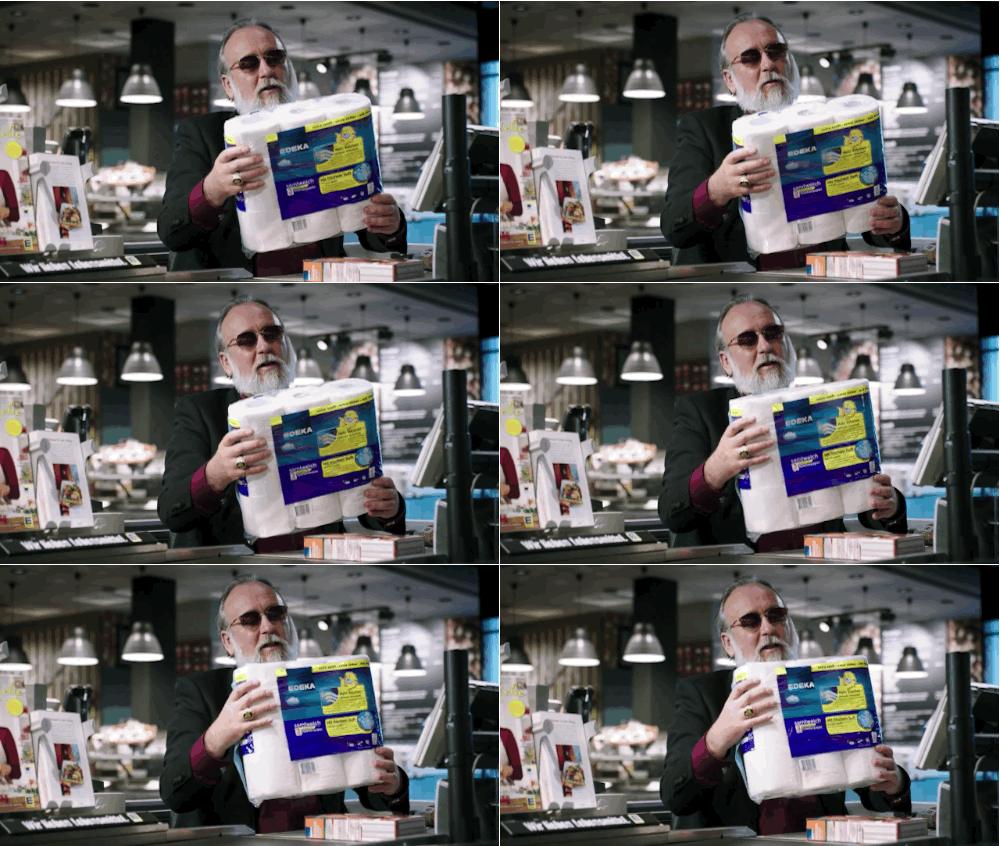
I was having a holiday last week and almost missed the best advertisement thus far this year. Great example that retail advertising does not need to be boring:
Insight #1: When in doubt, steal.
If you are not interesting brand, you should tap into other interesting content. The band called Der Tourist originally did the song in the ad and Friedrich Liechtenstein sang it as well. It was ok viral hit, with over million views. Not overplayed like Gangnam style, but well known enough to build the momentum around.
Insight #2: Interesting is controversial.
Geil meant originally horny in German, but has recently in slang started to mean cool. The whole video and lyrics are filled with sexual innuendo and double entendre (read here the full translation). When you are competing with all the content circulating in Internet, you have to spark the interest immediately. Ad version is actually weirder than the original video. Usually brands start diluting interesting memes and doing politically correct versions of them. That is the recipe for disaster. If you want to be random, you have to be truly random.
Insight #3: Show the product.
I love ads, which put product blatantly to the center but in relevant way. The amount of Edeka products is mind-boggling in the ad. Friedrich is smoking Edeka sausages and bathing in milk and pouring muesli on himself, for god´s sake. If the main premise is right, you can add the product layer easily to your content. Even testing that the house brand toilet paper is plush enough:
Insight #4: Context is the king.
Weird is normal in Internet. That is why the original song was a minor hit. Weird in context of supermarket advertising is abnormal in Internet. That is the reason why Edeka ad has become viral hit. People have the assumption about how retail advertising is. When something like this comes and fights totally the assumption, it is refreshing, surprising and works like hell.
Year 2014 will be turbulent for both brands and agencies working with social media channels. Because of the recent IPO´s (Twitter, Facebook, etc.), the previous rebels have started to resemble more established media houses. It is a double-edged sword. Many agencies are not as stressed out as the social media ecosystem is more predictable (and none of the innovation labs is making money anyway). On the other hand, the activities have been and increasingly will be quite dull and unimaginative.
Beginning of the year is the time to think your social media strategy. For majority of the brands, year 2014 should be year of revolution instead of just evolution:
1.Facebook is the channel for reach.
Majority of your social media paid media investments should happen in Facebook to maximize the reach. In terms of sheer amount of users, it is dominant. However, the recent developments have been really worrying for brand (and other) pages as well. Certain pages have seen dips as low as 88% in organic reach. Even Facebook itself is not talking anymore about free organic reach, but instead brand pages as a way to increase the reach of the paid media. This is natural advancement and should not surprise everyone familiar with market economy. So I believe that Facebook will get bigger media share in 2014, but actually less focus in terms of engagement. I would invest more in those terms with Twitter (customer service, real-time marketing) and to visual platforms (content creation).
2.Use Twitter as the channel for real-time and customer service.
I am not saying that every brand should necessarily be in Twitter, but if you want to jump on the real-time marketing bandwagon, Twitter is the place to be. I have a love-hate relationship with Twitter throughout the years, but despite all the shortcomings the service has proven its worth. It does certain things really well (like customer service), and provides more natural ways to engage with audience than Facebook. Here is example of random interaction with Warby Parker, after I shared their innovative annual report:
3.Invest heavily on visual social media channels.
Whereas online media money is going to Facebook, I would concentrate majority of the production and engagement investments to visual social platforms. No one has time to read text anymore, unless you are able to condense it to 140 characters or say it in photo.
Online video has been the fastest growing online ad format for couple of years. Naturally the pre-roll is the TVC of the new generation, but creation of good content provides great reach & engagement opportunities for brands. Video is a great tool for customer service as well:
Besides video, the photos are naturally huge and I expect the short-form video content to rise rapidly (Instagram video, Vine). Especially tutorials are naturally fit to for shorter video content (Check: #lowesfixinsix).
Many companies should actually rethink their community manager talent pool. In 2014 if you cannot take great photo or shoot a great video, you should not probably be community manager. Social media used to be more verbal, but now it is increasingly more visual.
4. Embrace the renaissance of anonymous randomness.
Contrary to what Facebook says, many people want to remain anonymous while online. 6% of all adults on Internet use Reddit. People engage way more on Tumblr blogs nowadays than on Facebook brand pages. One reason is that not all the people want to attach their Internet personality to real-life. In Internet you can be that backpacker hiphop-dude you really are and do not need even remotely to try to sound smart. It actually reminds me of the original promise of MySpace. You did not need to use it with your real name. You could make a site for your cat if you fancied. Anonymity can naturally bring some problems, such as hate-speech, crime and stuff but it also enables refreshing randomness that is currently missing from Facebook. Many people are more interesting talking about things they are interested and not about themselves (assuming they are not completely narcissistic). So do not underestimate the power of “anonymous” social media channels. Maybe Yahoo was on to something when it bought Tumblr.
5.Experiment with the new upcoming channels.
I have written before about how you should approach your social media strategy like investor. The landscape in terms of the hot newcomers changes really rapidly. Global brands should nowadays be more tuned into what is happening on local level. Experimenting with various social media channels goes hand in hand with that. For example if you had done tests with Path, it would be easier to utilize the learnings in Indonesia (which is the third-biggest Path user country). The innovation in social media sphere is also not limited only to Silicon Valley anymore so cutting-edge firms should empower their local teams to experiment with local social media channels as well. For example WeChat is way more advanced than WhatsApp. Competitive advantage can come from everywhere. The trick is to identify it, experiment with it and scale it.
There will interesting year ahead. In 2014 companies need to dramatically update and revamp the social media strategies. Which is great. Whenever there is turmoil and crisis, there is always an opportunity.
Right after Thailand declared a state of emergency and the unrest in Bangkok increases, I received this mailer from Booking.com yesterday:
Did it caught my attention? Yes.
Did it make me want to book flights or hotel to Bangkok. No, not really.
I have partied before in Bangkok, but the current party is not really something I would consider right now.
Lesson for the marketer: Targeting your message is not enough, you have to remember the timing of the message as well.
Honestly, sometimes I really do not know. For example this clip below has gotten over 1M views:
Many times, it is easier to say why they are not sharing your content. Often the reason is that your content just sucks. And while it sucks, it does not suck enough to commemorate ironic share (like the video above).
While you may theorize the psychology of sharing until the end of the day, I find it relatively easy. You share either useful or funny content. Being useful is more multi-dimensional, as it might mean that the content is useful to either the sharer or the expected receivers. This is the reason why the world´s most uncreative people share all these creativity links and quotes on Facebook. Stop it. You are not fooling anyone.
We attribute sharing to our individual image, but it is quite seldom even a slightest reflection of who we really are. When people are anonymous (discussion forums, Reddit, 9GAG, etc.) in Internet the content that is share is completely different. In real social media, what is truly shared is anti-social content. Anonymous comment is much more authentic representation of human spirit than airy-fairy “we-are-the-world”-share from the self-help guy in newsfeed near you.
It is gross misunderstanding that this age of oversharing is increasing openness to our culture. Facebook is just homogenizing what we share and has people showing their polished desired images. My feed is overpopulated with engagement announcements and baby photos. It is not even statistically possible that there is so much mating going on in my network every single day. You feel forced to like and comment those photos, which creates vicious cycle of boring content to my newsfeed. This is the reason I have decided to like every negative status update from now on to show my support to reality and attitude in 2014. Sadly, I have not been able to walk the walk and my own personal status updates are nowadays only about my sport accomplishments. Facebook has become a commodity, which has made it commercially interesting but same time really boring on an individual level.
We said in our book “Digital Fooprint” in 2010, that in digital age everyone is personal brand. Unfortunately we were right and the social media is full of overtly self-conscious personal branders optimizing every like and comment.
Although making fun of “hipsters” starts to be quite passé, this video still gets a pass. This brilliant piece showcases one hipster doing his best Christian Bale impersonation while having product integrally in the film as well:
Insight: If you do branded content, it has to be interesting content first and foremost. Brand comes later. If you are paying homage one of the nihilistic and violent movies of our generation, you have to be violent as well. Denham is not competing against other jeans brands in YouTube. It is competing against all the content out there. The quality criteria of our target audience has gone up and we either match it or become obsolete.
Denham Psycho is not everyone´s cup of tea. This is not a concept getting lukewarm reception in meeting room. You either love it or hate it. And that is how it should be. Advertising should be discriminating. Your marketing communications should make a clear distinction between them and us. Messaging strategy is not only about thinking to whom we are talking to. It is also about deciding, who you will leave out of your party. If you do not get popular culture reference to cult movie, maybe you are not Denham target audience to begin with.
When creating branded content, it is balance act between brand relevancy and brand controversy. As a jeans brand, Denham is in in the lucky position to dial up the tone to the latter spectrum.
One of the most idiotic campaigns lately has been this effort from Burger King Norway:
Effectively they subsidized their biggest competitor with 50 000 krones and lost 30k of their Facebook audience at the same time. But hey, now they have more engaged Facebook community with only those who care, right? Or they have 8000 fans who have already opted out of Facebook messages and have not seen the status updates about campaign.
Why this campaign was just really idiotic stunt?
1.Fast food is not loyalty business.
Majority of the people eat both in Burger King and McDonald´s. When you are hungry your main selection criteria is location, location & location. 72% of Pepsi drinkers drink Coke as well. Also if you offer free gift coupon for your main competitor and the only downside is that you cannot join a brand Facebook page anymore. Who would not get this deal? We are not talking about your favorite basketball team here. We are talking about burgers. How often you go to social media to really engage with burger? If your brand page disappeared today, who would mourn it?
2. Fast food is a mass business.
Even your most loyal 8k fans do not really make dent in your results. Therefore I rather had 40k disloyal bargain hunters than 8k hardcore Burger King loyalists. Sometimes Facebook is just reach and not engagement. The situation would be different if your average buy would be hundreds of dollars. Buying the fast food is low-interest buy. In reality you want the people fast in-fast out and not really expect them to discuss about your brand further.
3.Fast food business is led by promotions.
People wait for the new burger variants, one-dollar discounts and 2-in-1 deals. Why not give what they are wanting for? Majority of the brands should just realize that their Facebook page is only place for promotions, sweepstakes and occasional social media meltdowns. People go to Facebook because they want to connect with their friends. They do not want to connect with brands. They might do it occasionally, if they really want to or if they are bribed properly. Most likely they are too busy uploading selfies than answering your boring brand poll.
Liking in Facebook is quite seldom an act of loyalty. Quite often your most loyal fans do not even know that you have Facebook. It is totally delusional to argue otherwise. And do not get me wrong, I do not think that there is necessary any value to Facebook like and there has been brilliant campaigns playing around the mindless like-chase. I have to also admit that “Whopper Sacrifice” is still one of the most brilliant FB campaigns ever. They were probably trying to come up with something like that in Norway, but failed miserably.
Much more effective campaign would be to offer people to switch their whopper to Big Mac in Burger King. Then I think more people would show loyalty and you would have gotten nice case study video material. Or do a campaign where you can only like either McDonald´s or Burger King in Facebook, and reward those who select Burger King as their solely FB Burger fan page with free Whopper. With Whopper Sellout the mechanics were just wrong and therefore it failed (and nicely done case study video does not change that fact).
Only good part of the campaign has been the publicity it has garnered (like this long piece on Fast Company). Calculated through that, it might have been worthwhile to lose those 30k fans. They also seem to have gained 2000 new ones after this latest stunt, so maybe it was just really twisted PR stunt and I fell victim to it as well.
Otherwise this just looks like award case study scam gone terribly wrong.
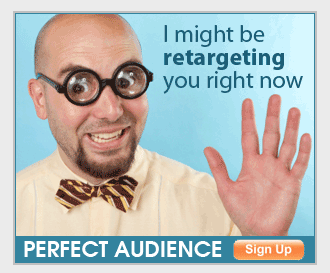
Speaking of retargeting, this creepy ad popped in my screen today:
No, I do not remember that one time I visited your weird site. And even if I would remember, I would surely want to forget that time. Why I would want to visit sites with bald guys with glasses with weird look on them? Was I drunk? Is there something else I should remember? Or try to forget?
I did not click the ad, although I googled the company. Apparently they are company offering retargeting services. Go figure. Probably visited their site when I was writing the post about retargeting last week.
They continued bombarding me with that scary dude later on:
No shit, Sherlock.
Catching the attention is one thing.
Catching relevant attention which converts to engagement is other.
The latter requires more finesse.
Insight: Taking a selfie is about telling a story and capturing a moment. The bragging rights in holiday photos are huge. Travel photos constitute big portion of selfies, so it is great connection for airline to build on. It also continues nicely the rivalry theme from the previous ad featuring Kobe & Messi (over 100 million views). Compared to that one, the bridge to actual brand promise is actually tighter. The whole spot ends with the mention that Turkish Airlines flies to more countries than any other airline. Just brilliant.
This is a great example of utilizing celebrities in smart way and telling insightful brand story at the same time. Guaranteed to garner millions of views.





 Stand-Up Strategy