Category Archives: Digital Strategy

Anatomy of An Insight: Letgo Commercializer

Sometimes your biggest challenge for growth is not that people are not using your platform, but they are just using it wrong:

Insight: The challenge is not that people don´t have stuff to sell, but they don´t know how to sell that. The pictures look bad, there is not that much story behind the stuff and everything lacks enthusiasm. If you are marketplace where people can sell their old stuff this is naturally a problem. You want to make people better sellers so their stuff moves faster and they can sell even more stuff. More stuff equals more money to everyone.

Would you notice a used product ad featuring Dolph Lundgren?

I know that I would.

Tagged , , , , , , ,

Bots and The Rise of Conversational Commerce

Messaging is the new browser and bots are the websites.
Mike Roberts, Kik Head of Messaging and Bot Experience

Bots have been all the rage last weeks. Whether it has been the NSFW Microsoft bot (not only racist, but also encouraging pot smoking in front of cops) or the ability to build chatbots on top of FB messengers.

Why sudden interest in bots?

They are not really a new phenomenon. Eliza was already created in 60s (test it here) and Siri has also been around for a while (test it in your phone). The main reason for the chatbots to gain importance especially now is because of the changed digital landscape. For majority of users, messenger is their digital starting point. Users don´t want to use messaging over Internet, they want to access their Internet to from their messenger. Therefore ability to help, serve and sell to users within messenger is paramount. Short text message (or emoji) is the default way of communicating, should it be also the way to communicate with the brands?

“Conversational commerce is about delivering convenience, personalization, and decision support while people are on the go, with only partial attention to spare.” 
Chris Messina

We are still having long way for the bot economy and below are the core things to fix before chatbots will evolve from novelty to actual user behavior:

1. The bots need to understand normal talk
“They aren’t taking natural language; they are taking menu names,”
Bruce Wilcox,the author of Rose, the winner of the most recent Loebner annual chatbot competition.

Many of the recent Facebook bots are still quite clunky in terms of discussion. People are more casual when they are thinking that they are conversing with real person. The challenge is for the robot to be casual but at the same time providing the transactional value. Current examples have not been particularly promising as they are either pushing you products in unnatural way or trying to be funny but not providing any value:
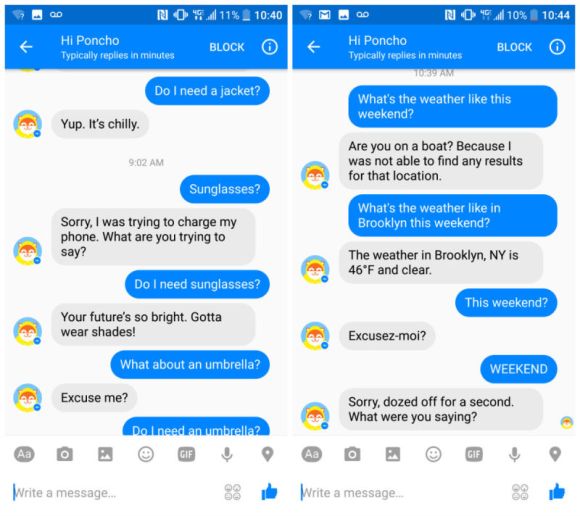
poncho

2. The bots need to become more predictive and fast
Going back and forth with your bot to order a pizza is tedious process. Getting weather details in an hour is just ridiculous. They need to become way more intuitive to use to really rival Google for getting your fast answers. The novelty factor will wear off quickly. If bots are not able to give you solutions fast, they will not be used.

3. Bots are not a destination but a way to enhance the existing discussion
E.g. instead of going to separate weather bot, you should get the weather details when you are chatting with your friend and need that info. Mark Zuckerberg raved about bots as replacements for apps, but with the current experience, it is actually just easier to go to that weather app and get your answer. Ideal situation would be that your messenger would recognize opportunities for commercial interaction from your discussions, but how to build that experience so that it is not creepy?

We are living in the early days of conversational commerce. Using messenger for repeated purchases (like pizza delivery) seems like a no-brainer, but will people actually start browsing products within messenger and asking help from the chatbot?

That depends on the user experience. If AI behind the chatbot actually would know your taste and it would be effective and enjoyable to chat with, messenger economy could become true game changer. Opportunity and potential demand is there, but building a good recommendation engine alone is difficult not to mention that you have to add enjoyable interaction with a robot on top of that. And the core question is, will people want to interact with bots?

Time will tell.

One thing is for certain. Bots will not kill the web, but they will permanently alter it.

Tagged , , , , , , , , ,

Machines Will Eventually Beat Humans in Everything

“I don´t think it will be a close match. I believe it will be 5–0, or maybe 4–1. So the critical point for me will be to not lose one match.”
Lee Se-Dol (Korean Go champion before his matches against Alphago)

Lee-Se Dol was able to predict the future; it was just the opposite he was envisioning. Alphago (computer Go program done by Google subsidiary Deepmind) slaughtered him in six games.

alphago

Machines beating humans in a game is nothing new. In chess the gap between machines and human is already tremendous. Best chess machines are even able to win joint teams of human and computers. What makes AlphaGo´s victory intriguing is that Go is much more complicated game than chess. The first move of Go can involve 361 positions (chess has only 81) and Go game generally lasts more turns than chess.

Simple heuristics get most of what you need. For example, in chess and checkers the value of material dominates other pieces of knowledge — if I have a rook more than you in chess, then I am almost always winning. 
Go has no dominant heuristics. From the human’s point of view, the knowledge is pattern-based, complex, and hard to program. Until Alphago, no one had been able to build an effective evaluation function.”
-Jonathan Schaeffer (Creator of Chinook, first program to beat humans in Checkers)

The machine victory in Go happened decade earlier than experts predicted.

AlphaGo is based on deep learning and neural networks. So while Deep Blue beat Kasparov with sheer computing strength, Alphago has more artificial intelligence behind it. Firstly neural networks were trained on 30 million moves from games played by human experts. That resulted to ability to predict human move 57 percent of the time. But that gets you to the same level as human players not necessarily able to beat them. So secondly, AlphaGo played thousands of games between its neural networks, and adjusting connections using trial-and-error process through reinforcement learning.

How many humans are even able to comprehend what above means (lest train themselves in even somewhat similar manner)?

Machines can already replace humans in more fields than we are willing to admit. And more importantly, they are playing better job as well. Machines can crunch data to obtain experience, which is impossible for humans during their lifetime. We have to start embracing machine learning and collaborating with machines more if we want to survive. Advertising industry has been especially almost hostile to any technological improvement. That will be a road to sure destruction. Beating a Go champion is much harder task than to do a subpar brand campaign. If we don´t take more proactive and positive approach to data and artificial intelligence, we will make ourselves redundant.

Machines can either be our allies our friends. I would opt for the latter choice.

Tagged , , , , ,

Facebook Canvas 101

There has been lots of talk about the new ad format for Facebook, so to save your time, here is all you need to know about it:

What is Facebook Canvas?
Canvas is an immersive and expressive experience on Facebook for businesses to tell their stories and showcase their products (according to Facebook)

So what does that really mean?
Essentially it is expandable Facebook ad with interactive features. It uses the same technology as Instant Articles, so you could almost call them Instant ads. The main benefit is that they load faster than mobile web in general, up to 10x faster.
fb-canvas

What are the features?
Currently you can add following features to your Canvas:

  • Button
  • Carousel
  • Photo
  • Text Block
  • Video
  • Product Set

What brands will benefit from it?
Not surprisingly many of the first examples have been popular culture properties (movies, TV shows) with a lot of interactive elements.
minions

The real opportunity is in my opinion with product catalogues. Swiping set of different product is intuitive and also gets you closer to actually buying of the product. Good example is Verizon´s Holidone-campaign, which was one of the first uses of Facebook canvas (done by R/GA New York):
holidone

I have seen these already before?
This ad format was previously available to only selected premium advertisers, but it is now opened for every one.

How I can do one?
You can do one by utilizing the Facebook self-service tool. There are easy step-by-step tutorials on how to do them. Technically it is easy, but of course making something cut-through requires lot of craft and innovation.

Is it a game-changer?
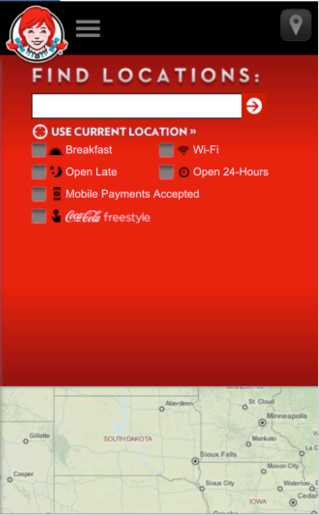
On a surface it is just a new ad format. However with more room to play in Facebook (and keeping in mind its massive reach in majority of countries), you should seriously consider do you need to create separate mobile campaign pages. Or maybe it is just better to create interactive experiences where people already are? Clicking to go to a site is just an artifact of the previous generation of Internet. Also whereas social posts are more about branding, with Canvas you can actually create a more utility to your ad unit (like finding your nearest Wendy´s):
wendys

Will we see a sudden surge of crappy canvas ads?
There are definitely early mover advantages reaped out of Canvas. When format gets more common, it will require more finesse and craft to catch the attention. As with other Facebook advertising, the news feed should not favor ads which are not liked:
 “If an ad doesn’t perform well, News Feed doesn’t show it to many people. And the advertiser gets a lot of feedback very early on.”
-Chris Cox, Facebook Chief Product Officer

What have been the best executions in Facebook Canvas thus far?

Tagged , , , ,

Case Nikon Singapore: How to Keep Beating Your Opponent

Many of you might have heard about Nikon Singapore´s photo competition screw-up. They awarded clearly photoshopped photo and apparently a stolen idea. While it is not the biggest failure of the world, it is slightly embarrassing. It would probably be forgotten quite soon, but their biggest competitor Canon does not want us to forget:

Canon Canada

Quite seldom social competition in Singapore catches the attention in Canada

As we can see, the post has gotten over 11k likes and 7k shares. That is quite great number for a Facebook post and a great indicator that people love when brands are bold and have balls.

Bold brands are cheeky, even frivolous. When their opponent (read: other brand) fails, they attack viciously. Business is about winning and losing and if you can help your rival brand lose even more go for more blows. There is three great lessons here to keep in mind when you thinking of competing with your archenemy:

  1. Admit your own mistakes fast and forget them even faster.
  2. However well on your opponent’s mistakes and rub it in their face. Do it as fast as possible.
  3. …but do it with tongue-in-cheek. It is ok to be evil if you smile at the same time.

Some people and brands need to have an enemy to get the best out of them.

Tagged , , , , ,

Content is Nothing Without Context

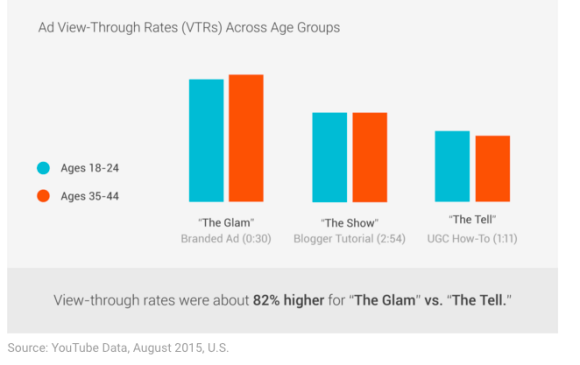
In a recent study with Lóreal and Google, where they tested typical ad, tutorial and testimonial, there were some interesting results. First the typical ad had the best view-through-rate but was not necessarily driving action so much.

viewthroughrate

What really struck me on the study were the following points:


1) If you are interrupted, you want to be interrupted with something that looks good.

Pre-rolls have been around for a while so people are expecting to see ads when they are checking YouTube. It is almost like an ad break, but apparently slightly more annoying.


2) Women are actively looking for the tutorials, not ads

Especially this is true to the millennials, they are used to less ad-looking content production. If you are interrupted with tutorial when you want to watch a tutorial, not surprisingly you are not necessarily watching it through.


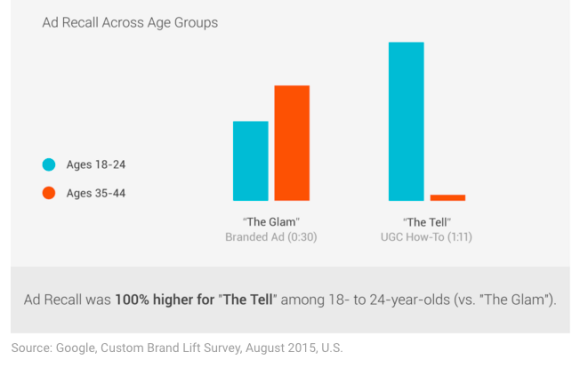
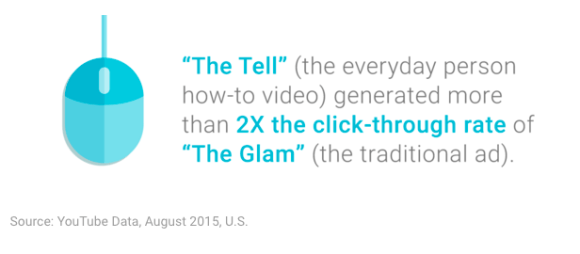
3) Younger audience appreciates the more “real” approach and it drives more action

 youngeraudience

action

This pretty much highlights the point I have been going through for a while. Brands need to have their ad and content game in check. Creating great content is not supplementing the hard-working ads. And vice-versa: hard-working ad is quite seldom great content. What works as a pre-roll does not necessarily work in another formats.

Content production is totally meaningless if you do not think the context where you are showing it.

Tagged , , , , , , , ,

Finnair Stopover Cock-Up

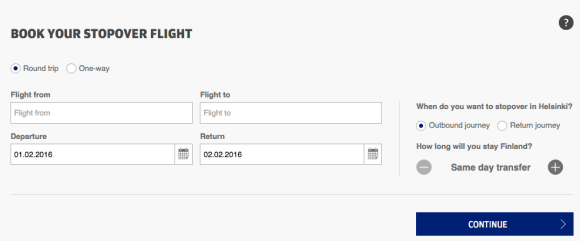
Finnair has a stopover concept in collaboration with VisitFinland.com. In principle it is a great idea to encourage people to come to visit Finland while they are flying Finnar to other destinations. Main emphasis in the term “in principle”.

As I am traveling to Copenhagen this spring, I thought it would be awesome opportunity to utilize tise stopover concept. Expect the booking system does not work. I have tried to do a booking with different browsers, different computers but essentially it always comes back to the starting point. I doubt that tourists are willing to go through too many hoops to be able to come visit Finland. I at least have some vested interest to go the extra mile. Moment-of-truth for your brand is always.

bookingform

That’s not all. Below there is aggregator of #visitfinland-hashtag. Some of the updates are dubious to say at least (like the one in right) and give totally different “feel” to Finnair:visitfinlandfail2

Currently there is no hardcore porn aggregated to the site like last weekend, but I still suppose that having #visitfinland combined with #ihaveburningpussy in your brand´s webpage is not necessarily the right brand association you want have:

visitfinlandfail

Or maybe it is and this is just a smart viral stunt to lure more sex tourists to Finland?

Tagged , , , , ,

Public Shaming is The Best Motivator

It´s like if your annoying roommate was a fitness tracking app.

cakewalk

Here is app I heartily endorse.

Cakewalk is step-tracking app which nags to you and if you do not reach your goals it will publicly shame you on Twitter. As majority of New Year resolutions will be broken sometime you need a little bit of tough love to stay on the course. Otherwise it is super simple: it will set the goals based on your daily average step count and then insults you if you don´t fulfill your goals.

plasticbags

Probably someone will get upset of this “mean” app. Well get away from your smartphone and just go walking.

Tagged , , , , ,

Why Spotify Discover Weekly Is The Best Music Curation Tool?

Apple Music arrived with big bang. Its approach to music streaming is surprisingly old school. It relies a lot on human curation and its programming resembles old radio (some of the shows are definitely worth listening though). It´s biggest rival Spotify is relying more on big data. At the moment it seems that latter approach seems to be the winning formula. Eventually recommendation engines will become a core differentiator (as the libraries will become quite identical) for streaming services, so the headstart Spotify has is not insignificant.

Human curation was the way taste making happened back in the day. I used to rely almost totally to Dj Anonymous on my music recommendations. Best dj´s in the world have much more refined taste than any machine yet. The challenge with human curation is that it does not scale.

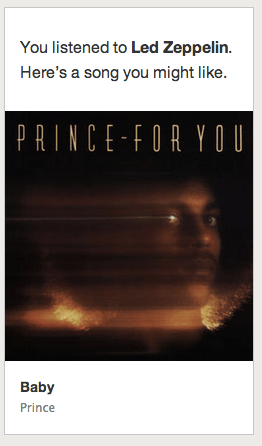
The recommendation engines were not really been yet up to task because the algorithms have not been advanced enough to recommend right songs. Music is nuanced thing and linear recommendation is not usually providing satisfying listening. Previous Spotify recommendations have been borderline ridiculous:

Prince Spotify

Previously there has not also been enough data available. For recommendation engines to work, you need to have massive amounts of data and something that is relevant. The key for Discover Weekly to work so well is that Spotify realized that the data they should be mining are the playlists people are making.

“For all the special sauce and the algorithmic work, the fact that we’ve kept it simple and that it’s just a playlist has really helped it resonate with people”
Matthew Ogle (Discover Weekly Product Owner)

The more people are making playlists in Spotify more “human curation big data” they are gathering. Currently there are over 2 billion playlists in Spotify. Spotify has been able to strike the right balance on learning about your listening habits and combining that with the big data:

“On one side, we’ve built a model of all the music we know about, that is powered by all the curatorial actions of people on Spotify adding to playlists. On the other side, we have our impression of what your music taste is. Every Monday morning, we take these two things, do a little magic filtering, and try to find things that other users have been playlisting around the music you’ve been jamming on, but that we think are either brand new to you or relatively new.”
-Matthew Ogle (Discover Weekly Product Owner)

In the beginning I wasn´t that impressed with Spotify´s weekly recommendations. Majority of the songs I knew already (20+ years of record collecting has its handicaps). After couple of weeks I started to appreciate the brilliance of it. Spotify Discover Weekly has become my “comfort playlist”. It plays stuff I know, but drops every week couple of nice gems I had not heard or had totally forgotten. During working week I listen to lots of weird stuff outside my usual taste profile, Spotify´s weekly recommendations don´t seem to pick on those anomalies and the quality is constant:

Like mentioned earlier, eventually data will trump human experience. In many fields, we are already there.

“In the next generation of software, machine learning won’t just be an add-on that improves performance a few percentage points; it will really replace traditional approaches.

Today, you’re much better off building a smart system that can learn from the real world – what actual listeners are most likely to like next – and help you predict who and where the next Adele might be.”
Eric Schmidt, Alphabet executive chairman

Tagged , , , , , , , , ,

Yes, David Bowie is Dead But Your Brand Should Not Care

David Bowie was a great musician, whose music will live on for a long time. Because he was such an iconic figure, there has been unleash of public tributes I don´t remember encountering since Lemmy died. All of those public tributes I can understand. The death came as a surprise and people want to showcase their empathy in social media.

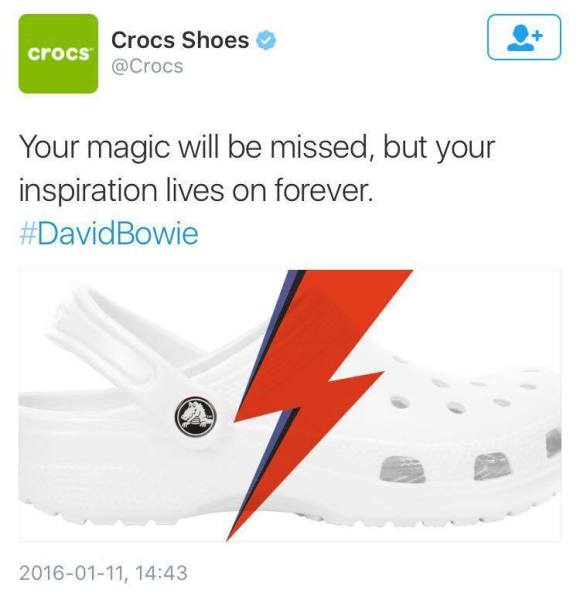
However what made me sick this:

crocsbowie

Real-time advertising can be valuable tool, but you should remember the following rules:

1) Just because everyone is talking about it, that does not mean they want you to join the conversation. If you don´t have anything valuable to add to the mix, stay away.
2) If your product is not relevant to what is happening do not jump on the bandwagon (Jack Daniels works with Lemmy, ugly rubber boots not necessarily that well with Bowie)
3) If you have to jump on bandwagon (when in doubt: don´t jump) at least be respectable

Milk and Lemmy don´t necessarily mix that well, but apparently you can do that with a good taste and respect.
4) Generally it is easier to create real-time content on happier topics than death.
5) If what you are doing feels that it makes you a jerk, that is a strong indication that you should not be doing it.

And don´t even start with “every publicity is good publicity”-bullshit, although Crocs Facebook page has not probably gotten this much traction in a long time.

Tagged , , , , , ,