If you are reading this, you are most likely one of the 16M+ people who have seen this:
The video was uploaded on Monday and started spreading rapidly yesterday. During that same day, the first brand version of the first kiss was produced by Snog Frozen yoghurt:
Not judging the quality of the film, but only applauding the speed of the execution.
The big challenge with many brands right now is that they want to tap into different trends, memes and other popular events. That is nice, but the traditional briefing process does not enable it. If you want to be real-time, reactive and in-tune with the culture, you have to market at the speed of the popular culture. Other option is just to stay true what your brand is all about and be consistent in your communications. You either change constantly or keep it real to your brand core consistently.
Many brands try to dabble little bit with both and fail miserably. That is why every brand is now doing something around selfies. Unfortunately when something is mainstream, you cannot be trendsetter by reacting to that.
Reactive advertising needs different kind of thinking and especially acting:
1) Different kind of process
Instead of the traditional brief-debrief-creative brief- presentation 1,2, 3, n-production brief the process is streamlined. It consists of one question and one sentence: Are we doing it?
If yes: Let´s do it.
And then everyone has to be producer.
2) Different kind of urgency
When your colleagues share it, it is already too late. You have to act immediately when you are feeling something is getting big.
3) Different kind of production
Do it quick, dirty and preferably yourself.
4) Different kind of tolerance for risk
You have to accept the fact that when you are acting fast you might fail. Reactive advertising is risky, but so is everything where you can win big. Brand building should not be for the faint-hearted, but unfortunately marketing departments and agencies are filled with wussies afraid of losing their jobs.
Recently there has been lots of hype about people going on digital detox. Digital detox means that you stay away from your mobile, computer and social media channels for a pre-determined time and then brag about it afterwards in digital channels.
Talk about contradiction in terms.
Generally people can do whatever they want with their life and time. I am also all for people living without digital devices for real. It is everyone´s individual choice and I celebrate that. Digital detox however is just lame attempt to have the cake and eat it too. The problem is that all this hoopla around people going back to the Stone Age blurs the real story around digital:
Digital devices and Internet has made our life better.
This is true to technological advancement in general. Life is better now than it was hundred years ago. Period. Every year people are becoming healthier, happier and more productive.
Thanks to the technology.
As technology develops people develop as well. Before some Luddite turns up the example of atom bomb, I would like to quote Kevin Kelly from his brilliant book “What Technology Wants”:
“The world does not need to be perfectly utopian to see progress. Some portions of our actions, such as war, are destructive. A bunch of what we produce is crap. Maybe nearly half of what we do. But if we create only 1 percent or 2 percent (or even one-tenth of 1 percent) more positive stuff than we destroy, then we have progress”
This the reason why ads like these make me sick:
Yes, it is annoying if your friend is meddling with his phone during your lunch. Or maybe you are just boring? Or whatever happened to the plain old firm saying: “Stop checking your phone”.
Digital detox and ad like this Coke example spread the message that we are digital slaves not capable of control it. This message is wrong and also destructive.
We are the masters of digital devices and social networks.
We can control them and we can control ourselves as well.
That is why I urge everyone to digital retox.
The more we use new digital devices, connect with each other and are open to the future, the more we will develop as a human beings.
I was having a holiday last week and almost missed the best advertisement thus far this year. Great example that retail advertising does not need to be boring:
Insight #1: When in doubt, steal.
If you are not interesting brand, you should tap into other interesting content. The band called Der Tourist originally did the song in the ad and Friedrich Liechtenstein sang it as well. It was ok viral hit, with over million views. Not overplayed like Gangnam style, but well known enough to build the momentum around.
Insight #2: Interesting is controversial.
Geil meant originally horny in German, but has recently in slang started to mean cool. The whole video and lyrics are filled with sexual innuendo and double entendre (read here the full translation). When you are competing with all the content circulating in Internet, you have to spark the interest immediately. Ad version is actually weirder than the original video. Usually brands start diluting interesting memes and doing politically correct versions of them. That is the recipe for disaster. If you want to be random, you have to be truly random.
Insight #3: Show the product.
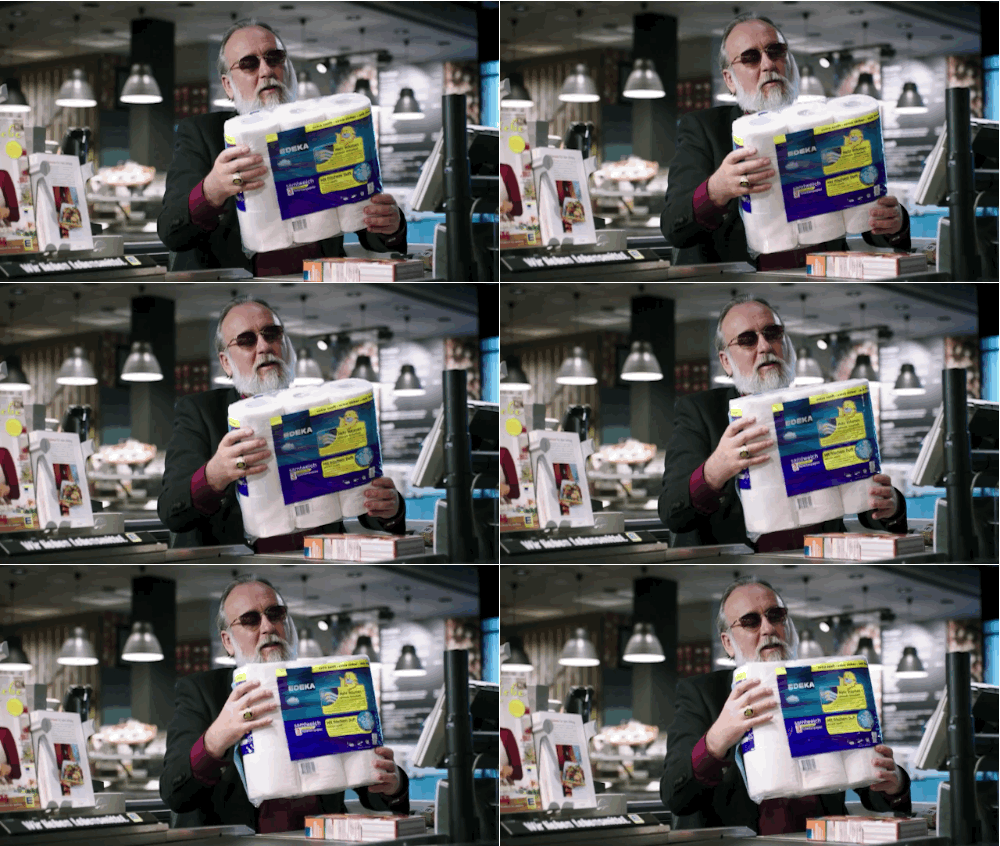
I love ads, which put product blatantly to the center but in relevant way. The amount of Edeka products is mind-boggling in the ad. Friedrich is smoking Edeka sausages and bathing in milk and pouring muesli on himself, for god´s sake. If the main premise is right, you can add the product layer easily to your content. Even testing that the house brand toilet paper is plush enough:
Insight #4: Context is the king.
Weird is normal in Internet. That is why the original song was a minor hit. Weird in context of supermarket advertising is abnormal in Internet. That is the reason why Edeka ad has become viral hit. People have the assumption about how retail advertising is. When something like this comes and fights totally the assumption, it is refreshing, surprising and works like hell.
Facebook´s acquisition of WhatsApp for about 19 billion (!) is the biggest deal ever for venture-capital-backed startup. As far as the money goes, it is naturally mind-boggling amount of cash but strategically I am trying to get my head around this. Four big questions came to my mind, when analyzing the acquisition:
1. What kind of ecosystem Facebook is building?
Currently Facebook is owner of three really strong (and separate) digital platforms: Facebook, Instagram and WhatsApp. Despite launching the ad units in Instagram, the photo platform has been relatively autonomous regarding Facebook. Apparently they will continue similar approach with WhatsApp and even more so as there will be no ads (in foreseeable future) in WhatsApp. See more in question 2 on that matter.
If we compare to Google, who builds their entire product offering under strong Google branding and synergies, Facebook currently resembles more of a venture capitalist and having quite separate and independent entities. Either approach is right or wrong, but at least currently Facebook ecosystem seems quite disjointed compared to the Google one. But maybe they have a bigger plan intact: see question 4.
2. How will Facebook monetize WhatsApp?
On the investor call Facebook mentioned that there would be no ads on WhatsApp and they are mainly concentrating on growth in the near future. Currently WhatsApp is free for one year and then you pay 0.99 for every additional year (and not even in all the markets). Current business model is not exactly breaking the bank as it has quite limited growth opportunities, but compared to many other social ventures coming from Silicon Valley it is already profitable. From monetization standpoint it is interesting opportunity for Facebook to enter also to the subscription business and test it first with WhatsApp before rolling it to wider.
3. Was it strategically right decision?
Initially buying WhatsApp seemed a rather uninspiring and unsurprising act. More forward-looking would have been buying some emerging mobile instant messaging platform from Asia (Line, KakaoTalk, etc.). Especially as Facebook mentioned that the reach in emerging markets was one of the core reasons for acquiring WhatsApp. Asian mobile instant messaging platforms would have been better fit also to current Facebook monetization strategy as these platforms are currently more open to advertising as well? Cynical view of the strategic importance of the buy was that as the main Facebook platform loses steam the growth and engagement had to be bought to please the investors.
4. Will there be Facebook Premium in the future?
How much would you pay for your Facebook account?
It might be that the goal of buying Instagram and WhatsApp is eventually to have capabilities to introduce Facebook Premium. This social network would add the best of the Facebook ecosystem and provide value on certain subscription fee. I have been toying around with that idea for a while, but currently it seems more reality than ever before. I have been quite disappointed of the unimaginative monetization strategies Facebook has had (overtly media-focused) and venturing to subscription models without endangering the crown jewel of free Facebook seems lucrative and interesting option.
That number is good demonstration of Internet market dynamics. It used to be (and still is) hard to get your song on the radio. If you were able get on the playlist, you were quite sure to get certain amount of listens. Nowadays, it is easy to get on Spotify, but to be actually heard requires active promotion. Especially, if you are not Daft Punk.
Forgotify aims to change that (or at least get a couple of these unheard songs on rotation). It is a discovery website, which enables you to randomly listen to those unheard “gems” from Spotify. The songs were not necessarily that horrible. I find some classical music, Hebrew folk songs, chansons and Christian punk*. No one just knows that these songs are there to find and listen. And no one cares enough to promote them. *“Scaterd Few was a Christian punk band from Burbank. CCMmagazine described their music as “pure punk for dread people,” stating that it was a cross between Janes Addiction and Charlie Mingus.
The SodaStream ad for Super Bowl is quite vapid creatively. As a guy, I naturally do not complain having Scarlett Johansson on it but I have seen her in way more interesting settings. The beauty of this ad is that it is already banned:
The reason for the ban is the line in the end: “Sorry Coke & Pepsi”. Apparently Fox was afraid that it would upset those big advertisers and we will not see this 30 s clip in Super Bowl. That hardly does matter as the ad has already been seen over 2 million times. Daniel Birnbaum, the CEO of SodaStream acts furious, but is probably laughing all the way to the bank:
‘“What are they afraid of? Which advertiser in America doesn’t mention a competitor? This is the kind of stuff that happens in China. I’m disappointed as an American”
Insight: If you are challenger brand, you have to aggressively confront the bigger competitors. People love underdogs. This ad further solidifies SodaStream challenger position while making competitor look as evil giants. When your ad is banned, it actually gives extra credibility to your message. Although Coke or Pepsi might not have anything to do with the ad ban, this raises speculation about conspiracy.
Too often brands do not act as challengers or market leaders, but fell in the middle ground. As a brand you are either David or Goliath, there is no middle ground.
Year 2014 will be turbulent for both brands and agencies working with social media channels. Because of the recent IPO´s (Twitter, Facebook, etc.), the previous rebels have started to resemble more established media houses. It is a double-edged sword. Many agencies are not as stressed out as the social media ecosystem is more predictable (and none of the innovation labs is making money anyway). On the other hand, the activities have been and increasingly will be quite dull and unimaginative.
Beginning of the year is the time to think your social media strategy. For majority of the brands, year 2014 should be year of revolution instead of just evolution:
1.Facebook is the channel for reach.
Majority of your social media paid media investments should happen in Facebook to maximize the reach. In terms of sheer amount of users, it is dominant. However, the recent developments have been really worrying for brand (and other) pages as well. Certain pages have seen dips as low as 88% in organic reach. Even Facebook itself is not talking anymore about free organic reach, but instead brand pages as a way to increase the reach of the paid media. This is natural advancement and should not surprise everyone familiar with market economy. So I believe that Facebook will get bigger media share in 2014, but actually less focus in terms of engagement. I would invest more in those terms with Twitter (customer service, real-time marketing) and to visual platforms (content creation).
2.Use Twitter as the channel for real-time and customer service.
I am not saying that every brand should necessarily be in Twitter, but if you want to jump on the real-time marketing bandwagon, Twitter is the place to be. I have a love-hate relationship with Twitter throughout the years, but despite all the shortcomings the service has proven its worth. It does certain things really well (like customer service), and provides more natural ways to engage with audience than Facebook. Here is example of random interaction with Warby Parker, after I shared their innovative annual report:
3.Invest heavily on visual social media channels.
Whereas online media money is going to Facebook, I would concentrate majority of the production and engagement investments to visual social platforms. No one has time to read text anymore, unless you are able to condense it to 140 characters or say it in photo.
Online video has been the fastest growing online ad format for couple of years. Naturally the pre-roll is the TVC of the new generation, but creation of good content provides great reach & engagement opportunities for brands. Video is a great tool for customer service as well:
Besides video, the photos are naturally huge and I expect the short-form video content to rise rapidly (Instagram video, Vine). Especially tutorials are naturally fit to for shorter video content (Check: #lowesfixinsix).
Many companies should actually rethink their community manager talent pool. In 2014 if you cannot take great photo or shoot a great video, you should not probably be community manager. Social media used to be more verbal, but now it is increasingly more visual.
4. Embrace the renaissance of anonymous randomness.
Contrary to what Facebook says, many people want to remain anonymous while online. 6% of all adults on Internet use Reddit. People engage way more on Tumblr blogs nowadays than on Facebook brand pages. One reason is that not all the people want to attach their Internet personality to real-life. In Internet you can be that backpacker hiphop-dude you really are and do not need even remotely to try to sound smart. It actually reminds me of the original promise of MySpace. You did not need to use it with your real name. You could make a site for your cat if you fancied. Anonymity can naturally bring some problems, such as hate-speech, crime and stuff but it also enables refreshing randomness that is currently missing from Facebook. Many people are more interesting talking about things they are interested and not about themselves (assuming they are not completely narcissistic). So do not underestimate the power of “anonymous” social media channels. Maybe Yahoo was on to something when it bought Tumblr.
5.Experiment with the new upcoming channels.
I have written before about how you should approach your social media strategy like investor. The landscape in terms of the hot newcomers changes really rapidly. Global brands should nowadays be more tuned into what is happening on local level. Experimenting with various social media channels goes hand in hand with that. For example if you had done tests with Path, it would be easier to utilize the learnings in Indonesia (which is the third-biggest Path user country). The innovation in social media sphere is also not limited only to Silicon Valley anymore so cutting-edge firms should empower their local teams to experiment with local social media channels as well. For example WeChat is way more advanced than WhatsApp. Competitive advantage can come from everywhere. The trick is to identify it, experiment with it and scale it.
There will interesting year ahead. In 2014 companies need to dramatically update and revamp the social media strategies. Which is great. Whenever there is turmoil and crisis, there is always an opportunity.
Right after Thailand declared a state of emergency and the unrest in Bangkok increases, I received this mailer from Booking.com yesterday:
Did it caught my attention? Yes.
Did it make me want to book flights or hotel to Bangkok. No, not really.
I have partied before in Bangkok, but the current party is not really something I would consider right now.
Lesson for the marketer: Targeting your message is not enough, you have to remember the timing of the message as well.
Honestly, sometimes I really do not know. For example this clip below has gotten over 1M views:
Many times, it is easier to say why they are not sharing your content. Often the reason is that your content just sucks. And while it sucks, it does not suck enough to commemorate ironic share (like the video above).
While you may theorize the psychology of sharing until the end of the day, I find it relatively easy. You share either useful or funny content. Being useful is more multi-dimensional, as it might mean that the content is useful to either the sharer or the expected receivers. This is the reason why the world´s most uncreative people share all these creativity links and quotes on Facebook. Stop it. You are not fooling anyone.
We attribute sharing to our individual image, but it is quite seldom even a slightest reflection of who we really are. When people are anonymous (discussion forums, Reddit, 9GAG, etc.) in Internet the content that is share is completely different. In real social media, what is truly shared is anti-social content. Anonymous comment is much more authentic representation of human spirit than airy-fairy “we-are-the-world”-share from the self-help guy in newsfeed near you.
It is gross misunderstanding that this age of oversharing is increasing openness to our culture. Facebook is just homogenizing what we share and has people showing their polished desired images. My feed is overpopulated with engagement announcements and baby photos. It is not even statistically possible that there is so much mating going on in my network every single day. You feel forced to like and comment those photos, which creates vicious cycle of boring content to my newsfeed. This is the reason I have decided to like every negative status update from now on to show my support to reality and attitude in 2014. Sadly, I have not been able to walk the walk and my own personal status updates are nowadays only about my sport accomplishments. Facebook has become a commodity, which has made it commercially interesting but same time really boring on an individual level.
We said in our book “Digital Fooprint” in 2010, that in digital age everyone is personal brand. Unfortunately we were right and the social media is full of overtly self-conscious personal branders optimizing every like and comment.
Although making fun of “hipsters” starts to be quite passé, this video still gets a pass. This brilliant piece showcases one hipster doing his best Christian Bale impersonation while having product integrally in the film as well:
Insight: If you do branded content, it has to be interesting content first and foremost. Brand comes later. If you are paying homage one of the nihilistic and violent movies of our generation, you have to be violent as well. Denham is not competing against other jeans brands in YouTube. It is competing against all the content out there. The quality criteria of our target audience has gone up and we either match it or become obsolete.
Denham Psycho is not everyone´s cup of tea. This is not a concept getting lukewarm reception in meeting room. You either love it or hate it. And that is how it should be. Advertising should be discriminating. Your marketing communications should make a clear distinction between them and us. Messaging strategy is not only about thinking to whom we are talking to. It is also about deciding, who you will leave out of your party. If you do not get popular culture reference to cult movie, maybe you are not Denham target audience to begin with.
When creating branded content, it is balance act between brand relevancy and brand controversy. As a jeans brand, Denham is in in the lucky position to dial up the tone to the latter spectrum.




 Stand-Up Strategy