Author Archives: Riku Vassinen

Nuttin But A Beats Thang: Apple to The Next Episode

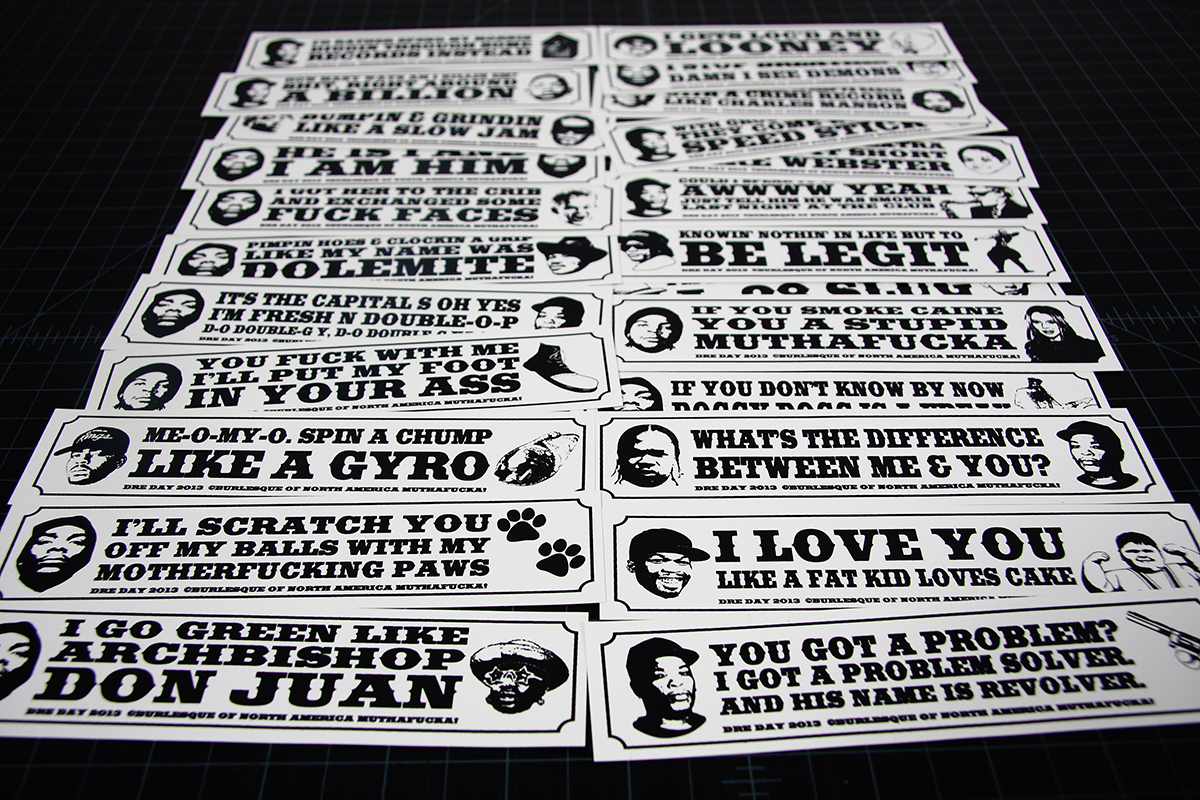
dredaystickers
It has been a real Dre Day, although it is not February 18th.
After long rumor mill, it is finally official. Apple acquired Beats headphones.  The deal has cause quite a lot of buzz around the globe, but I think the deal makes sense from many perspectives:

1. Beats is a good buy.
Buying Beats is not a speculation. Apple is buying a company, who is dominating premium headphones market with over 51% market share (some estimates have it even higher). As Beats is private company there is no public revenue numbers, but there are estimates of 1B of revenue with probably quite high profit margin. Buying 1 billion business for 3 billion is not a long-shot (like WhatsApp acquisition, which had significantly higher price tag) it is pure mathematics. You are buying market leader with an already established business and fast growth.

2. Beats gives Apple a headstart with music streaming service.
Yes, Apple could build their own streaming service, no one doubts that. Having Beats streaming service gives them great launchpad to go into a territory they have neglected. And I would not also worry about negotiating about the rights again. Apple has been quite effective in doing that in the past. Apple CEO Tim Cook stressed the importance of music in the recent interview:

This is all about music, and we’ve always viewed that music was key to society and culture. Music’s always been at the heart of Apple. It’s deep in our DNA. We’ve sold Macs to musicians since the beginning of Macs. And we accelerated the music industry with the digital music revolution with the iPod and the iTunes music store.

When we talk about Apple today, the music has not been on the focus compared to the heyday of iPod & iTunes. This deal makes Apple´s music offering again interesting. The future of music is streaming (although as an avid record collector, the future and past will forever be on vinyl) and that is something where the almighty Steve Jobs was wrong. This acquisition enables Apple to get on the parity with competitors and on the other hand provides Beats Music immediate increase in interest. It is probably no coincidence that Tim Cook mentioned Beats Music as the streaming service which has “gotten it right”.

3. Beats will be an important part of the Apple´s wearable tech puzzle.
You seldom buy companies because of their current state, but because of the current potential. That is where I think this gets really interesting and I am quite sure that Apple will be having some tricks on the sleeves and not just concentrating on music with this acquisition.
iWatch has been rumored for a while. It will probably arrive when you least expect it. It is certain that Apple will enter to the wearables and they will probably do it right as well. Although the wearables have not yet really taken off, believe me eventually they will. We overestimate technological disruption on a short-term and underestimate it on a long-term. Apple has also been massively successful in fulfilling needs of the people, they do not even realize they have.
Beats headphones have been one of the best examples of wearable tech, because they have really nailed the lifestyle aspect. Sound quality is one thing, but you really want to be seen with your Beats headphones. This is something the first wearables have not really grasped. When wearable tech looks ugly only the geekiest early adopters will wear them. And no offence to geeks but they do not start trends. Wearable technology is even more fashion than technology.
Apple has definitely understood this as they have also been recruiting fashion specialists from YSL and Burberry. I don´t believe that is an isolated strategy from the Beats acquisition.

4. Buying beats is getting the right talent
You are hiring Dr. Dre, one of the most legendary music producers ever and Jimmy Iovine, who knows the ins and outs of the music business. Iovine has been also key partner with Apple during the launch iTunes Store. Both are visionaries and can definitely help Apple to shape the future of music and wearable offering. Will they fit in Apple corporate culture? Who knows, but at least you could not hire more capable talent to help you in your future endeavors.

Also I do not really get the talk about how uncharacteristic this acquisition is for Apple.
Yes, they are usually buying smaller and more obscure companies (at least for mainstream audience). Nevertheless they are buying companies.
If you have loaded cash reserves, I don´t understand why you should withdraw from buying other companies. If it makes sense and in this case it does.
Necessary part of evolution of a company is to know when to do something surprising. This was surprising move (initially, not necessarily today because it pretty much just confirmed the rumors), which showcases that Apple does not sway away from being bold.

So put on “The Chronic” on your turntable or your favorite streaming service and:

Tagged , , , , , , , ,

Psst… Can I Whisper you A Secret? Anonymous Mobile Messaging Apps Are The Next Big Thing in Digital

Mobile instant messaging is all the rage at the moment. WhatsApp got bought by Facebook for over 19 billionWhopping 73% of China´s online population uses WeChat. The amount of Snapchat users has increased over 67% in the last six months.

Next big thing will be anonymous mobile chatting:

1. There is a demand for anonynomous interest-based social networks
Have you ever wondered why discussion forums still thrive in 2014?
Why I was so amped up about Internet was that I could be able to talk about things I was interested (hiphop, basketball and record collecting) with people all around the world. With my friends I can communicate with every possible method, but finding likeminded people around passion points that new Internet start-ups have not tapped into in a while. Since the demise of MySpace, tech industry has been over-obsessed with friend-based networks and neglected the interest-based connections.

2. Content in anonymous mobile apps is more interesting 
Majority of Facebook content bores the hell out of people. I know that I am not the only one, who could live without a single photo update about “meat trophies” (baby photos), weddings, travel photos and sport achievements (I am guilty of the latter two). Everyone has a role to play in this world and Facebook is the center of humblebrag. It is filled with people trying to give polished side about themselves. Perfection is not really interesting, but the faults are (something marketers should also realize).
At a brief glance my Secret app is filled with dirty stories (both sexual and scatological) and controversial opinions from people who would not post anything of that sort in Facebook. One glance to FB or Twitter puts me to sleep. Posting with your own name puts automatic self-censorship on and usually people overdo it and they just come up with boring stuff.

Anonymity unleashes the real side of the people. In good and bad ways.

But don´t just take my word for it though, advertisers see potential with these applications as well. Combination of mining of the message content and GPS data could provide interesting advertising possibilities. Traditional media has also taken a heed and they are monitoring these apps to get some juicy secrets (usually false ones).

So how you can get started to post your toilet secrets?
Below I have broken down the four most interesting anonymous messaging apps:

Secret
secret-path
Secret is finally available in Android and that might be the tipping point which will propel it to mainstream success.
Basic promise: Share your secrets freely and anonymously. You can upload short posts and images.
Level of anonymity: You will be given an avatar and you can connect Secret with your contact list or find secrets based on the location. This puts interesting twist to usage of Secret as you automatically start to guess whom of your friends is posting the secrets.
Addictiveness: Content is not as explicit as in Whisper but way more interesting than your average FB and Twitter feeds. There seems to be also a steady stream of meaningful discussions in Secret going on. Usage is intuitive and it is the most advanced of the new generation messaging apps.

Whisper
dj
Another anonymous social network gaining popularity at the moment, it is more closer to media company as it has editorial staff headed by former Gawker editor Neetzan Zimmerman.
Basic promise: You can post your secrets in the meme-like format where your text is superimposed on a picture. Whisper also allows sending private messages to users and following topics that interest you most.
Level of anonymity: This app is completely anonymous and does not connect with your contact list.
Addictiveness: The app is messy both from content and functions. The complete anonymity unleashes probably the expressiveness of the users. Because of the private messaging function Whisper is used more to hooking up than other its competitors. Because of the editorial aspects of the app, Whisper is more enjoyable for the passive users as posts can get “viral” based on their algorithm.
 
Yik Yak
yikyak
Yik Yak is taking some cues from other social sites (Reddit) as it is incorporating timeline that consists of purely text updates.
Basic promise: Getting a live feed of what people are saying around you. You can upvote and downvote what is good and what is not. It is mostly targeted to college students.
Level of anonymity: It does not connect to your contact list but connects to your location (everyone in 1.5 mile radius can see the posts)
Addictiveness: Totally related to where you are posting. Being in too crowded area makes content too general but using app where they are no other users feels like having your private party. The look & feel is nicer than Whisper, but not as polished as Secret.

Chance
chance
Chance pretty much brings Chatroulette to mobile.
Basic promise: You can chat with random strangers.
Level of anonymity: Your selfie is taken every time you start a new chat and that acts as an avatar.
Addictiveness: As majority of the users are horny single dudes, expect short conversations if you are not hot girl and plenty of x-rated suggestions.

Naturally being anonymous does not necessarily only result to funny light-hearted frivolous chat. Especially Yik Yak has been getting flak as it has been connected to cyberbullying in High Schools.
It is too early to say are these apps just a passing fad or a sign of something bigger. I believe that there is definitely longer-lasting market for these applications. The founder of 4Chan Christopher  “moot” Poole put it nicely:

“The industry has spent ten years rushing to capitalize on real identity and friendship based networks and now it´s getting turned on to its head.
Now they are rushing to understand the opposite”

Tagged , , , , , ,

Don´t You Want Me Baby?

I was in movie theatre yesterday. During the commercials before the movie (Fading Gigolo, awesome movie btw!), I experienced a rare phenomenon. There was genuine positive audience reaction for one of the ads:

Whole audience bursted in laughter.
Yes, the ad is stupid, but that is the whole point.
Many times the stupid is enough.

For low-involvement FMCG products you seldom need a groundbreaking insight, complicated strategy or even grandiose big idea. Having funny characters and some Human League gets you far.

Chips Ahoy could fall into the trap of usual ad bullshit how eating chocolate cookies unleashes your potential and allows you to experience the world to the fullest.  Or other similar crap that delusional brand managers and their equally clueless agencies come up with.

You eat chocolate cookies and you get fat.
That is the truth, so you have to switch the focus to the fact that eating things that make you fat is fun. Cookie characters singing British new wave are fun. People like fun. Make fun advertising. Advertising is no rocket science.

On top of all this the ad is already over seven years old but it felt completely timeless for me. This underlines also the point that too often brands change their direction too often.
Find effective way to communicate and stick with it.
For cookie brand, you cannot really get better than singing cookies cruising on cabriolet and getting eaten in the process.

Tagged , , , ,

#AmazonCart: Innovation in Advertising (not in eCommerce)

I am somewhat skeptical about utility marketing.
Yes, brands should be useful.
But as far as the advertising goes, most of the brands are fighting with the lack of attention. They need to first crack the indifference barrier amongst consumers. For that you have to first entertain and then deliver.
To underline this point, brand apps are generally destined to fail. Over 80% of them struggle to get even 1000 downloads.
That being said this is useful marketing at its finest:

Why this approach rocks?

1. #Amazoncart taps to real behavior
People already use Amazon as a “shopping list” for their future purchases. This just makes it couple of clicks more easier. At its core, this is not really educating new behavior just a minor tweak to existing pattern. I think tapping to the shopping list behavior is the core thing and also something that many of the commentators have not fully grasped. #Amazoncart is not innovation in eCommerce it is an advertising innovation:

2. #Amazoncart is free advertising with every tweet
Besides being rooted to real behavior, every time someone tweets #AmazonCart it will be visible to followers of that person. Making #AmazonCart hashtag famous is one thing, but actually what is the most brilliant part that the amazon product link gets double exposure as you add to Amazon cart by replying. This creates more opportunities for people to see it and go buying in Amazon.
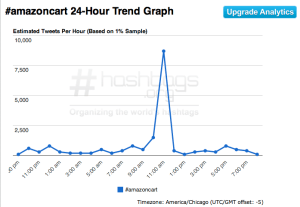
Currently it seems that the amount of #Amazoncart seems already promising (from Hashtags.org):

#Amazoncart

Naturally these are small drops in the ocean for Goliath brand like Amazon but every purchase counts. If Amazon is able to get bursts of over 8k tweets for #AmazonCart in hour constantly it definitely shows great potential for Amazon. Also after the initial development, there is not that much cost for the program (expect for the promoting it).

3. #Amazoncart is super simple
After you have connected your Twitter account to Amazon, you can reply with #AmazonCart to any tweet containing an amazon product link. This puts the item to your shopping cart and you can finish the shopping later. The beauty of this concept is that it keeps it simple enough and does not add too many steps to the progress.

Hopefully in the future we are able reply #AmazonCart to every kind of tweet beyond the Amazon links. Buying products straight from YouTube or Instagram –links anyone?

Tagged , , , , ,

Anatomy of An Insight: Diesel Erotica China

Wise brands should venture where the people are, but other brands do not dare to venture:

Insight: Like in Avenue Q song, Internet is for porn, with over third of web traffic pointing to pornographic sites. That is naturally quite tricky opportunity for brands to exploit, but Diesel did a great work with this campaign. Just because other brands are not there does not necessarily mean that your brand could not be there. It is risky of course, but great advertising usually is.

On a related note, this is a brilliant case study from Eat24 about their experiments on advertising on porn sites. I especially like the creative execution. There are other brands that could take advantage of those cheap CPM prices in the adult sites. For example it would seem quite no-brainer for telcos to advertise their fast broadband connections on the X-rated sites.

While regular brands try to go rude, the rude brands try to go regular. One of the biggest adult sites PornHub has been on a search for creative director to create their first national SFW ad campaign. Some of the entries were quite innovative:
Pornhub Advertising

Tagged , , , , ,

#Cockinasock and the Twisted World of Male Charity

This is a casual observation about men & women:

You should not let men try to invent charity campaigns. Basically they are just excuses to do stupid things legitimately (which men do in general without any higher goal). Usually this involves either making yourself look dumb and spreading the word in Internet:

Case-in-point #1: Movember
November is the month, when guys get their inner Hell´s Angel or Village People, (depending on the moustache style) out. How many actually know that the “idea” for this is to raise awareness of prostate cancer?

Case-in-point #2: #Cockinasock
Basically guys are taking pictures with socks covering their penises, posting them on Internet and hashtagging them with #cockinasock. Apparently this should raise awareness to testicular cancer. Or guys just some sort of excuse to practice their exhibitionism.

I am all for having fun and giving money to good causes as well*, but somehow it just feels fishy to me. Grow moustache and put the cock in the sock because you feel like it. You do not need charity to be your Trojan horse to do it. Men should not need any reason for exercising the acts of stupidity.

Be a man: do idiotic things because it is in your nature and it feels great!

*Although there are some good arguments why awareness campaigns are waste of time & money.

Tagged , , ,

Sharing Economy: A Threat or An Opportunity for Your Business?

“Our guests don’t want the Airbnb feel and scent”

– Christopher Norton, EVP of global product and operations at the Four Seasons (Fast Company 184/April 2014)

If I would be running hotel chain at the moment, I would not be saying comments like one above. I would be trying to learn meticulously what Airbnb is doing well and taking some cues to my existing business. Some of the hotel companies are already experiment with it, like W Hotels and Desks Near Me collaboration.

There are two major trends driving the sharing economy which are affecting your business as well :

1)   Digital tools have enabled global sharing economy services. This provides adequate scale for the companies to make financial sense. For consumers this means user-friendly services and tapping into global offerings.

2)   Ownership is not cool: experience is the new Rolex. Owning stuff is not ecological or smart: people are increasingly more investing in services and experiences.

Sharing economy is not a means to an end. Where it has already been successful (accommodation & transportation), it is actually improving the current experience. Majority of Airbnb users could use hotels as well, but they are bored with existing Hotel offerings and want more personalized experience. Uber works best in markets, where there are problems with Taxi services or public transport. Consumers are ruthless: they select the best service nevertheless of how it is produced. It works other way around as well. When trying to reach mainstream success, your experience has to be able to compete with “normal” offerings as well. Price plays naturally part as well, but only low price cannot be the competitive difference for the new services.

It is likely that many sharing economy initiatives will fail and badly. Some of them will succeed and in big way. Airbnb founders will not be the only billionaires emerging from sharing economy. That is why brands should experiment with sharing economy initiatives now, when their category has not yet been disrupted with the strong sharing economy player.

Other option is to only concentrate on suing the new competitors and hope that they go away. Unfortunately, that is not a winning solution. Successful companies have to grow and constant innovation is the only way for that growth.

Tagged , ,

Anatomy of An Insight: Tigerair Infrequent Flyers Club

Quite often I end this section by saying that I wish I would have done something like this. Well this time I actually  have. Campaign we did couple of years back to ST1 was based on similar notion, although the loyalty card worked differently (you got immediate discount when using that card).

Tigerair has been mentioned on this blog before, but this time they really nailed it right:

Insight: People have a love & hate –relationship with loyalty cards. Pretty much everyone knows that they are bullshit and eventually increase the prices you pay. Still almost everyone falls into them and their ridiculous schemes. This campaign makes fun of that notion and recognizes the fact that eventually with budget airline you are only interested about discounts.

I just love when brands have humor to laugh at category conventions.

Tagged , , , ,

You Have A Friend Request from Jesus Christ

Friend Request from Jesus Christ
I stumbled upon these ads a while back. Despite I always appreciate when organization wants to become more contemporary, these resulted only to maximum embarrathy. It feels a little bit like your father attending spring break and attempting to do Gangnam style in 2014.

I have to admit that I am not probably the best prospect for this campaign. I believe that religions in general have product problem instead of image problem. However I think John Hegarty was on to something when he stated that Roman Catholic Church is the most powerful brand in the world:

Firstly Catholic Church does not sell physical product, it sells a belief. The great brands have evolved beyond the product; Nike & Apple are almost more way of life for their loyalists than just a simple product. They have one of the most well known logos in the world (the cross), a clear mission statement (ten commandments) and own brand book (the bible). Like McDonald´s and Starbucks later on, Church recognized the importance of location. Churches are usually in the center of the city and they used to be the tallest buildings as well (before financial institutions, the religion of our age). It was also a forerunner in branded content, collaborating with the best artists of the world (Da Vinci, Michelangelo, Raphael, Mozart, Beethoven, Bach, etc.). Unlike many other brands, it has also been successful in brand extension and expanded to schools, charities and health care.

Although apparently it was not Catholic Church doing these ads, the brand is the same. For every brand there is a thin line between being too stubborn to change and being too weak to change too much.

If you work with the most powerful brand in the world, would you do ads like these?

Singaporean Viral Surprise

This week Singaporean social media has been buzzing about this “viral” video:

The reaction to the video caught Singapore Tourism Board (STB) by “surpise” and they removed the video. The discussion has not stopped though.

I don’t argue that the ad is quite hideous. I actually first bumped in the video in my FB newsfeed with the caption “I can´t stop vomiting”. Overall I think there is no reason to panic about, there is three lessons for every brand to learn about this “fiasco”:

1. Best way to draw attention to video is to remove it
Removing the video was total overreaction from STB. Firstly there is no such thing as removing something from Internet. Removed content is like Arnold Schwarzenegger: it will be back. Removing something just draws attention to it. Secondly it just draws more attention to it. If STB had left the video to its YouTube page, some people would maybe have found other STB content inspired by that. Even this newly upped version has gained over 60k views, which is quite good amount for advertising content in Singapore.

2.There is more horrible things in the world than doing a one horrible ad
Unfortunately the reality is that many firms do ads like this every day and no one raises an eyebrow. STB has done quite a lot of good content as well, such as this:


Singapore Board of Tourism from Yellow Box Studios on Vimeo.

3.Parody is the highest form of flattery

You can go viral from good and bad reasons, but this is quite far cry from a real full-blown social media crisis. The real problem for brands is not that people talk negative things about them. The problem is that no one is talking about them at all. When you start getting your first negative comments that just means that enough people have seen your content. If you spark any kind of emotion, it shows that people care about the brand. Snarky blog posts and parodies are an opportunity to join the conversation. STB should have taken more lighthearted attitude to the whole hoopla and turn these parodies into their own advantage.

I think overall Singapore Tourism Board should be happy that this video has raised so much emotion and conversation. It shows that people care deeply on what kind of message Singapore conveys abroad. Also it raises hope for Singaporean advertising scene. People should raise hell more often when they see a bad ad. There is still too much mediocrity around in advertising. Hopefully this gives us more opportunities to do more good and relevant advertising.

That is not only right for the brands, it is right for the audience as well.

Tagged , , , , ,