Category Archives: Strategy

What Can You Learn Just By Buying Yoghurt?

I find working with supermarket retail clients really interesting. The fast pace and the sheer amount of consumers visiting single store is mind-boggling. Actually one of my first projects when I started to work in Singapore was around retail clients (having done my share of retail clients back in Finland). Although I do not currently work with retail client, I am still learning every time I go to my near store. You learn from the actual store, the products and especially how people go berserk in the queues.

Last Saturday I started to count my lessons during one (not brief, not pleasant) trip to my nearest hypermarket, Giant. There were five major ones:

1. Your habits change only when you are forced to it
As we know shopping habits are hard to break. Usually it requires quite drastic change for person to change his everyday shopping habits. One of those drastic changes is moving to another country.
In Helsinki my shopping habits was probably best described as wanna-be hipster yuppie being extreme hurry. Weekday groceries were done in the fast and convenient nearby store. On weekends I was mostly shopping in overpriced organic artisanal specialty shops spending my hard-earned pennies in hyper-expensive bread, beers, charcuterie and probably some superfoods (although I do not even know what that means).
After moving to Singapore, I took a drastic time travel and suddenly became middle-aged suburbanite who goes to hypermarket every week. What the hell happened to me? Suddenly I also became super price-conscious and am currently comparing the price development of guavas weekly. I am ashamed of myself, but there is practical reason for this change.

2.Identify the key products that drive the shopping decisions
Behavioral psychologist would probably find different traumas attached to my moving, but actually the sudden shift of my shopping habits was tied to one single product: yoghurt. Although I appreciate my hokkien mee as the next man, I still need my western breakfast (yoghurt+muesli) every morning. Smaller convenience stores do not stock bigger yoghurt packages, so the closest option was the nearby hypermarket. It is always truly educating experience to get lost in there.

3. When you learn the floor plan, you do not want to change your store
It took me last weekend almost 20 minutes to find light bulbs!
You think that the floor plans of the hypermarkets are logical, but they are not. They are deceptive mazes, where you get lost and end up buying candy and dental floss even though you do not need either one. Messy floor plans are good way to increase the loyalty. You do not want to search another 20 minutes of light bulbs in a strange store. Once you learn the floor plan of your designated store, you shop there forever. Even if the store would close down.

4. Not every promotion is an effective one
Back to the yoghurt: my main brand Marigold has the creepiest promotions and promoters. Last Saturday they handed me this:

Creepy Marigold Promotion
What the hell is this? Turtle with udders? Also it was super odd situation in general. I was stacking the yoghurt when promoter suddenly came and handed me this item (+coasters as well, which I could understand). How weird is that? You have promoters stalking the dairy shelves and attacking the person who is buying certain brand. Truly disturbing, but on the other hand I got a Christmas present for some lucky bastard.

5.Do smart innovations
I am all for innovative solutions, but sometimes too much innovation does not make sense. I tested out first time the self-service check out in Giant and it was a complete fiasco.
Majority of the products I was buying were. Fruits do not have barcodes. Barcodes are quite essential for self-scanning. I was not the only one messing up the fancy new technology.  I actually took certain pride of being the only customer who did not double scan any of the items.
Because of this design flaw, every self-service check out kiosk actually had one person to help people to go through the tedious process. How in the hell that makes business sense? How can you even call those kiosks self-serve?
Eventually the self-checking of the products took way longer than the normal route. Sometimes it is better to innovate more modestly. Good way to start in Singapore would be to introduce self-packing and start charging for the plastic bags. Nevertheless what I buy I always end with over 20+ plastic bags and every single item in different bags. In environment like this self-service is just too big step for an average consumer like me!

I learned so much last week during my hypermarket visit that I can´t just wait to skip the whole process this week. I rather live without my yoghurt.

Tagged , , ,

Is SEO Finally Dead?

SEO is dead.
I have never been specialized in search. I have many times worked with search specialists in various projects and I appreciate the work they do. Understanding the meaning of Google in consumer life is crucial, but SEO (or SEM for that matter) is just a part of a bigger picture. Remembering the time when clients believed that SEO is a silver bullet, I have always had my firm principals on how I approach the search:

1)   SEO is competitiveness, not competitive advantage.
Making your website search engine optimized is easy for your competitors to do as well. How do you differ from them when they have are optimizing same way as you do as well? This is apparent in highly competed fields of traffic. Tabloids or online travel portals compete head-to-head and the number one search position changes hourly. Of course if you have not made sure of the basic hygiene issues, you have most likely lost the game already. Doing search well is something that is not enough to differentiate anymore.

2)   You should create your content for people not for the search engines. 
I have blogged for almost 10 years in various instances. Sometimes I have done tests and wrote the content more with the keyword-glasses on. What I have noticed is that good content will always become popular no matter what words you use. Some of my most read posts have had actually really mundane titles and go against all the rules of the traditional “write for search engines” –rule. Of course I know that I am not Perez Hilton or Seth Godin (or do I?), and my blog post is only a tiny-tiny-tiny fraction of what is happening in Internet in general. But so is majority of the web content. Companies should first concentrate on how they can be useful & interesting, and then think about keywords. Not the other way around. Being useful & interesting is hard and there are not short cuts to it.

3)   Real Popularity is the most important optimization
Google likes content, which is popular and which is shared. After Google Panda-algorithm change two years ago, the traffic to news sites and social media sites surged whereas “content farms” really slumped (and majorly have not been able to come back). We also now that Google has increased the weight to social sharing with its search algorithm. Social media shares are harder to fake. You really have to be useful & interesting to get those shares, because they are done by real people.

These principles are still valid, and with the recent algorithm changes (like above-mentioned Panda) more accurate than ever. Google is aiming to eventually stop gaming the system and also make search to emulate more human way of searching the information. With latest Google Hummingbird there has been maybe the biggest leap in search, and the following changes will change the search game totally:

1.  Security Search is now the Default: Less visibility on why your visitors are visiting your site
In conjunction with Hummingbird-algorithm change, there was also other major change in September. All the Google searches are now secure by default. Basically this means that you do not know what keywords your site visitors have used when they arrive on your site. This change was eventually inevitable, but still makes traditional SEO harder. There are also certain workarounds to try to capture the traffic.

2. Enter the Semantic Search: Forget the keywords, give answers
More and more searches are currently made by mobile and in the future increasingly with your voice (Siri & Google Glass). Traditional “googling” is not a normal way for people to find what they are looking for. We have taught ourselves to use keywords, but what we really are trying to find is answers.
Giving right answers tailored to you is the direction where Google is going. It takes account your device, previous search history and location and gives tailored search results based on your existing and expected future behavior. Some of these developments we have already seen. Google corrects your misspelled words and proposes alternatives to what you are trying to search. Knowledge graph tries to guess what you are searching on the right side under the search bar.

The search game is totally different than it was couple of years ago.
Do we still need specialized SEO-agencies or is search business nowadays mainly SEM?

Tagged , , , , , , ,

How Shopping Bags Revolutionized Retail

Have you heard about Walter H. Deubner?
 
If you have not, you should be ashamed. By simple observation and great insight, he was able to create good business for himself and the same time changed the way we shop.
 
He invented shopping bag.
 
Small business grocer Deubner noticed in 1912 that his customers always bought as much they could carry. Not more and sometimes less. He designed the way for customers to buy more items on one go. He patented the idea and in just three years he was already selling over million shopping bags a year.
 
That invention revolutionized shopping, as we know it.
 
Quite often our consumers would actually buy more, but they do not realize the opportunity or have barriers for doing it. Too often we are too fixed to the traditional way of selling our product that we do not recognize the barriers that prevent current consumers to buy more, or new consumers to enter our category. Coming back to the post I wrote earlier this week about subscription model, there is huge potential in rethinking the way we sell:
 
Could you sell single item in bulk?
Or bulk item as a single?
Physical product online?
Online product in retail?
Supersize it?
Minimize it?
 
Walter H. Deubner essentially created post-purchase service. Consumer journey seldom starts or end in the transaction.

Tagged , , , , ,

Could You Sell Everything with Subscription Business Model?

There has been a surge of subscription-based businesses lately. I am not only talking about subscription entertainment services like Netflix, Hulu or Spotify. There has been also surge in subscription models both in mundane physical (Dollar Shave Club) and in high-interest software (Adobe Creative Cloud).

Naturally the model is not new, newspaper subscriptions have been around for almost 300 years. You could also view library institution as some kind of a precursor to Spotify and other entertainment subscription services. You “subscribe” by paying taxes (in Finland), or by paying nominal fee (in Singapore).  Digital has enabled more smoother service and also more innovative business models (Birchbox). In catalog-era Birchbox model would not have been feasible, but thanks to Internet you can convert people more easily from receiving the samples to buying the actual products online.

The upside for the companies with subscription model is two-folded, firstly lifetime-customer-value will likely be higher and the business becomes more predictable. For consumer the main benefit is of course the convenience. You are getting new socks every month, they are invoiced automatically and you do not run out of socks.

“All the evidence suggests that consumers love subscription content models — it’s the original model of magazines and newspapers and cable, and now it’s the power behind Netflix.”
James McQuavey (Forrester)

Subscription model is not right approach for every company, but might be something to consider. Whether you are working in product or service, it might be interesting addition to your portfolio or differentiator against competitors. Some considerations I have noticed based on subscription based models:

1. It has to be habitual usage for products
Tie-a-month works for snappy-dressed businessman but is not necessarily appealing to a person, who puts on the tie only to weddings and funerals. Usually the cycle is monthly, but could subscription model work with longer breaks? Your computer would be updated yearly? Your car would be updated every second year? Maybe not.
Interesting examples:
Miru (Monthly subscription to contact lenses)
French Cellar (Monthly subscription to French wines in Singapore)
The main challenge with product subscriptions is that you end up with lots of stuff. For many people that is not necessarily a problem, but as people. That is why I think there is definitely some kind of opportunity with combined subscription & swapping/recycling service (Such as Swapstyle or Boxcycle). It is definitely route to explore.

2. Subscribed Service is about access you value
Actually with Spotify you are not really paying for ability to listen to the music you are paying for the access to the music. You might not listen to music that much, but you want to pay for the access to that Barry White song on just the right moment. This is especially easy to see with Priority Pass. The knowledge that you could go to lounge in Airport makes already your travelling more enjoyable, whether you entertain that access or not.
Interesting examples (besides the abovementioned):
Ordergroove: They actually create subscription model platforms for their clients. I am not sure if they have some kind of subscription based compensation system build in their billings, but it would make sense.
One opportunity comes to mind with services. I like to go to different culture events, but the information for those comes many times too sporadically. You might notice interesting exhibition when it is already over. You have to search for the info from different sources, which takes time. What if you could have subscription-based culture package? You would select your level of commitment: from light once-a-month to heavy-user once-a-week. Then you would get access to an event on a fixed date. The model could also have range from just recommendation to total turnkey solution with tickets and transportation. That would be also at least worth an exploration.

Could you change your business to subscription model?

Tagged , , , , , , , ,

Five Success Lessons from Nordic Noir

Whenever I have homesickness, I go to the nearest library and borrow some Nordic crime fiction. I read Stieg Larsson, Lars Kepler, Jussi Adler-Olsen, James Thompson, Arnaldur Indriðason, Jo Nesbo and whoever has Scandinavian sounding name. Then I read them in the sun and miss the cold and dark winter.

Because the phenomenon has been so close to me (geographically), I have been thinking lots about these writers and identified five key success factors:

1. Success feeds even more success
Typical Finnish way is to think that the success is a zero-sum game. If someone wins, other people will lose. That is not the case.  Success feeds success. After the phenomenal sales of “The Girl With The Dragon Tattoo”, the appetite for even more Scandinavian crime novels has been infinite. The halo effect has gone also beyond Scandinavia and it is now actually easy to find detective novels also from Finland and Iceland around the world. People think in clusters and now it is definitely advantage if you happen to come from cold northern country and write detective novels (with preferably semi-alcoholic main character). The appeal has also expanded to TV-series as well, with US-versions from The Killing and The Bridge. Movie adaption of “The Girl With Dragon Tattoo” was a success and I cannot wait the “Snowman”-movie whether it will be done or not by Martin Scorsese.

2. Success does not come out of nothing
All the Nordic countries have strong roots in detective novels and especially Finland has one of the finest curated detective novel series (Sapo). Although “Girl With Dragon Tattoo” opened the flood gates, it would have not been possible without the pioneer work of Henning Mankell & Håkan Nesser, to name a few. And funnily enough, also they are currently witnessing surge in their popularity.

3. Turn your weaknesses to strengths
Especially during this time of year, all the Nordic countries might be depressing places. It is dark and although they really do not have that much of problems, those few problems are visible. Drunks are on the streets and it is quite unlikely that you have not witnessed some violent outburst. Whereas other countries sweep the problems under the carpet, part of the social-democratic ethos is that society should take care of everyone. When it fails, the visible problems serve as constant reminders for everyone about the failures of individuals and the whole collective who has left them down.
Although there have not really been serial killers in Nordic countries (only handful based on Wikipedia), the Nordic Noir writers excel in those dark narratives of twisted killers and mixing it up with cultural peculiarities. Big part of the appeal of the Nordic Noir novels is the faulty detective heroes. They struggle with their own personal demons, whether it is booze, drugs, women or short temper. Most of the times, it is combination of all these.

4. You do not need to compromise
Twenty years ago it would have been totally unheard of that there is bestseller with a main character called Joona Linna who is operating in Stockholm. You would have been forced to try to do something more universal and write agent stories spanning different continents. When you write about something you know, you write with real feeling and express your true emotions. Audience identifies with that reality everywhere. That is more universal than your protagonist jetsetting around the globe, driving latest cars and having the latest gadgets. No offense, 007.

5. Remember your local roots, but think global
Digital revolution has helped these writers to expand their reach and connect with their audience. First thing I did when I found “The Healer” by Antti Tuomainen in Singaporean library, I immediately went to like his Facebook-page to show the support. Digital tools enable these authors to connect and reach people, which would have been almost difficult before.

For those new to the genre, I recommend especially Harry Hole –series from Jo Nesbo. Books are packed with really thrilling plots, starring the half-man half-amazing, who fixes his gun-blasted jaw with duct-tape and carries on. That is how you roll in Oslo.

Tagged , , , ,

Stop Being in Brand Bubble and Smell The Roses

Because I work in advertising, I focus more on the advertisements than normal person. After spending the whole day crafting strategy, I have to always remind myself at the end of the day, that no normal person really cares that much.  Serves as a good reminder before I bore non-advertising people at the dinner table. It is natural human tendency to place high value for something just because we spend much time with something. Being important for you does not equal being important to everyone, not even anyone else.

Marketers fell victim to similar thinking and end up living on their own “brand bubble”. When you live and breathe your brand everyday, you start become blind to its real meaning in people´s life. Usually that meaning is quite limited at best and totally obsolete at worst. Therefore it is always important to try to escape your brand bubble, go talk to real people and keep these five points clear in your mind:

1. Product feature is not a product benefit.
Consumer decides the product benefit, not the company. Even though you introduce product feature you have been developing for years, if the consumer does not find use for it, it is completely useless. You have to dig deep to really find why target audience uses your product or selects your brand. Sometimes the truth might be bad news for your brand (see 5.)

2. Do not follow your category: differ from it
I think that benchmarking your direct competitors is one of the biggest traps marketers fall. Usual fallacy is that when you conclude that your whole category is boring, you end up being boring yourself. Benchmarking should be used only in these two ways:

  1. Analyze what your competitors are doing and do something totally different.
  2. Benchmark other categories which are successful and use those tactics in innovative ways (Utilize retailing tactics in luxury products or vice versa, make your service a product, sell subscription model, etc..)

3. You compete against everyone, not just your category
Especially with digital, you are on the battlefield with the best ones in the world. On YouTube you are competing with Ylvis. On Facebook you are competing with the friends of your target audience. On Twitter you are competing with biggest opinion leaders in the world. You better be interesting or go home.

4. Being simple is being confident.
If you can make people to remember one thing about you, you have already succeeded. Usually marketer wants to tell too much. You have been spending time doing all these different features, which you mistake as benefits and want to cram them all on one banner ad. Telling too much is turn-off. You should intrigue the curiosity by letting the audience have the opportunity to find out more. Too many times we tell everything immediately, so there is nothing left to say and learn. Sexy lingerie is more erotic than nudity, because it leaves room for the imagination. You should do the same with your brand.

5. Be honest about your brand.
Does your market share represent the true strength of your brand? Many times especially with FMCG brands, you realize that the biggest selling brands might actually have quite low brand equity. They are just big because of the price point, logistics or lack of real competition. And there is nothing wrong with that if you know where the market share is coming. Low brand equity poses a threat for rapid market share loss because of the price competition. For example, your category might not yet been affected by private labels, but that does not mean it will not happen. Knowing the real health of you brand is really important, so you can prepare yourself for the upcoming challenges.

Every time you start falling too deep in your own brand world, go back to these five points and remember that you play only small role in the world on your audience.

Tagged ,

What CrossFit Can Teach You About Branding

Those who read my post last week will already know that I have not yet become totally cynical to the art of marketing. I fell victim to good branding once in a while. I have been reminded of this gullibility, because lately I have desperately wanted to start CrossFit.

For those who are not in the know, CrossFit is an intense exercise program characterized by functional training using non-traditional weighlifting equipment (such as kettlebells). It has been probably been the hottest thing lately (especially among guys) in exercise circles and become quite mainstream in last couple of years. Reebok is also betting heavily on the rise of CrossFit.

I am already sports crazy. I run and do circuit training every morning, play in two basketball teams and try to swim once in a while. I do not really need any additions to my sports regime. I am healthy enough. The urge to start Crossfit is not rational decision. It has been branded well. It feels natural, because the exercise is functional. It feels total antithesis of the shiny gyms: many times CrossFit-sessions happening in the old warehouses. It has strong ethos of pushing to the limit, which resonates well with my view of sports in general. Exercising is not supposed to be fun. Only pain brings gain.

However when I was searching for the alternatives for CrossFit training in Singapore, I was shocked by the steep price tag of monthly prices. You should not really pay over 200+ dollars for basic circuit training in shitty warehouse. Or should you?

This is the inner dialogue I had:

Left brain: Hey that guy just took your our basketball summer training and is now charging hundreds of dollars a month from a glorified circuit training!
Right brain: But I want to push tractor tires to feel like a man!

Left brain: You push yourself too hard even in your morning jogs, CrossFit can actually destroy your muscles.
Right brain: Whatever, I want to train until I puke.
(Actually I heard a rumour that Red Bull sales increased when there was news coverage about alleged deaths of mixing Red Bull with Alcohol. Danger attracts.Also a vast majority of the news stories about harmfulness of different sports are written and shared by people who just want to find excuses for not exercising)

Why Crossfit is currently so appealing?

1. Proven business model
Crossfit.inc (founded in 2000 by Greg Glassman) follows in many ways the same success formula of the rise of “Les Mills”-branded classes, best known for Bodypump-classes. They license the Crossfit name to gyms for an annual fee and certify trainers. Licensing business is one of the most profitable types of business in the world.

 2. Room for creativity
Whereas Les Mills feels more like the McDonald´s of Gym Exercise (it is the same in every part of the globe), CrossFit still feels like a rebel alternative for it. Every CrossfFit-training can be different and the possible variations for the training are infinite.

3. Perfect training type for digital office worker
No-frills type of training feels perfect antidote for the overtly digital world we are living in. Also the sessions are high-intensity short bursts, which you can easily fill even to the busiest calendar.

4. Fueled by social media
I doubt that the sports would not be as big without the connected world we are living. There are CrossFit-forums, Facebook pages and endless amount of training videos. After watching this video by Finnish CrossFit-hero Mikko Salo, it almost felt I was training myself (150k views, btw):

5. Good story to tell
Exercising should always be about your own health and development. The truth is though that many times people exercise also for the bragging rights. CrossFit just sounds way cooler than being in Spinning. No offense to Spinning.

I probably try CrossFit despite the steep price tag. If no for other reason than to give a nod for the branding well done.

Tagged , , , , ,

Build Your Brand on the Myth, Not Facts

I always use Moleskine notebook.

And yes I know it is quite silly. I know that Hemingway, Picasso or Van Gogh never used Moleskines, per se. Yes, they used some kind of notebooks back in the day, but not any particular brand. Moleskine just started to do notebooks “inspired” by those old notebooks in 1997. I found it out a while after I had filled my first couple of Moleskines with my brilliant ideas (emphasis mine). Of course, I had envisioned myself scribbling concepts like Hemingway wrote his punctuated prose. Finding out the truth did not stop me from buying Moleskine though. The notebooks were ok enough and it still send my aspiration message to others. Good story is interesting than boring truth.

Some brands should be built on myths not facts.

Notebooks were totally low interest category when Moleskine arrived. Which does not really make sense, because you produce high interest content in your notebook. It is disrespectful for your ideas to go on cheapskate notebook or back of a printed A4. There was opportunity to bring new product there to celebrate the creativity of the people (or their perceived creativity) and make some money at the same time.

Also as our life becomes increasingly more filled with digital devices, people have the desire to do & have something tangible. The rise of Moleskine has actually happened almost parallel to digitalization: starting from dotcom boom, to Web2.0 and the current mobile revolution.

If your product is good enough (if Moleskine product would be really inferior, no one would use it, no matter the story), your audience is not really searching for performance. You are searching for the inspiring story and a product which makes you feel good about yourself.

I have had numerous discussions with clients, who have also Moleskines. Usually being the party pooper planner I tell the real story of the brand. That has not been a reason to stop using Moleskine for anyone. We rather believe in a good story than in the reality. Having a Moleskine showcases certain desired attitude. It also shows that you are still falling prey to marketing communications. I find it as a very comforting thought: there is still need for our line of industry. People still need interesting stories to justify their consumption.

Tagged , , , , ,

#LufthansaFAIL: Why You Cannot Separate Customer Service and Social Media?

I am usually not a fan of writing how different brands “fail” on social media. Too often these fails are actually quite trivial and more driven by the urge of “social media experts” to nitpick on every thing. However sometimes you just stumble on things which are quite hard to believe that are still happening in 2013.

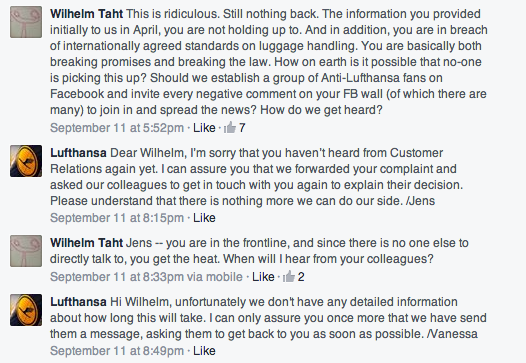
Today I noticed there was discussion from Lufthansa wall spreading in Facebook. I went to check it out. You can read the whole correspondence from here, but if post will be deleted, you can also see the highlights below:

Lufthansa fails in Facebook
Because this is all public correspondence from Lufthansa wall (part of the #fail-part), I have not censored any names or such because it is public post.

The start after the first post was a guidebook social media example answer from the company with no customer service capabilities within social media team:
Lufthansafail2

Good answer. Now Lufthansa would just need to make the final reply and everything would be ok.
How Lufthansa fails in Facebook
Further assurances are made that thing is progressed further, but nothing happens for a week:
Lufthansafail3

During this part of the discussion the social media team actually shows that they only work as messengers within the company with no real access to customer service personnel. It also seems that customer service personnel does not really care what comes from social media team either. It also showcases well how the airline companies (not only Lufthansa) are making the access to customer service increasingly difficult. You cannot call anyone and the mails are not answered (or your mails are bounced back). In Facebook you get answered, but unfortunately the answers are not any good. And of course nothing happens on the customer service front:

Lufthansafail4

After this something totally peculiar happens: Lufthansa Facebook team goes totally quiet. Maybe they counted that the situation will eventually die down. But as you can notice from this post, the discussion did not die down. It actually just got more vivid. People started to share this post in social media and now it has garnered almost 100 likes and 72 comments. The post has not been taken down (not that it would probably help in this situation) or not addressed in any way. If you decide to ignore someone in social media, you should make that decision first and not halfway through.

This discussion gives us three lessons:

1. You cannot have the cake and eat it too.
It is impossible to just get the “good” side of the social media such as likes and positive comments. Your Facebook page is also customer service channel whether you have customer service working in your social media team or not. This correspondence shows that the company treats social media as a nice sugarcoating and not really a part of the business. You have to also be accountable for your answers. If you say you are getting back, you really should get back. You do not really need social media expert to tell this. It is just common courtesy and common sense.

2. Handle the social media complaints first
All the customers are not equal. You should treat those better who pay more (your best customers) and you should also treat those first who can cause you the biggest damage (damage prevention). This post has been escalating for three weeks and I do not doubt that it will escalate further.  How difficult it would just to get back to the guy?

3. If you answer the questions in Facebook, follow through
It is of course respectable to have open unsolicited discussion on your Facebook page. In this case, the situation just looks bad and shows more that you do not care about customers. Also although the discussion does not show in your FB front-page it does not mean that it is forgotten. Currently the whole discussion sends the message that anyone in the organization does not really care.

Airline industry is one of the most complained industries in the world and I have had my fair share of challenges with them. Nothing new under the sun in many ways you could say. This situation could have been saved easily on many occasions during this discussion (not to mention the thing has been boiling for three months before). The situation can of course be saved, but it is much harder now.

I am looking forward to how Lufthansa will respond.  At least they have been pondering for the right comment for 1,5 weeks.

EDIT (Apparently now the situation has been sorted out):

Lufthansa Customer Service

Tagged , , , , ,

Never Say Sorry

Never say:
“Sorry, I haven´t had time to prepare for the presentation.”
If I would get my money back every time someone has started presentation in seminar with these words, I would be millionaire. Of course not mentioning which currency that would be in and provided I would ever actually pay for seminar attendance. The principle still remains. Speaking to any kind of audience is privilege and it is just impolite to be unprepared.

“Sorry, I haven´t been updating my blog recently.”
Readers can already see that from the timestamps. Majority of them does not even really care. When you are not updating your blog, you fail first and foremost yourself. Blogging is time for thinking and if you skip it, it starts showing. Not immediately, but after a while.

Perspiration & Inspiration
Although I have written two books, hundreds of blog posts, thousands of presentations, documents & mails during my career, I do not enjoy writing, especially the starting of it. Whether I have an idea for blog post or not, the first words are the most difficult ones. After those ones, the process usually starts to work. You either get an idea or start polishing and evolving the one you had. Writing gives necessary boundaries to the thinking. You have to argument your points. In our field of work you cannot separate idea from its argumentation. Putting things in written format forces you to take responsibility of what you are saying.

For me, inspiration starts totally out of perspiration. And that being said, I am aiming to perspire way lot of more in the future. Also in this blog.

Tagged , ,