Category Archives: Social Media

Anatomy of An Insight: I Hate Thailand

Although this spot is a little bit long-winded and the protagonist probably deserved to be robbed, it is still quite refreshing travel ad from Thailand ´s Tourism Authority:

Insight: Setbacks can happen on your holiday, but that is part of the whole charm of travelling. By starting to build up this spot from the negative experience, it gives more authentic point-of-view than traditional destination advertising. Thailand has had bad year in tourism due to numerous reasons so overtly positive advertising would have felt totally out of place.

Brands do not generally understand that consumers actually love honesty instead of sugarcoated fantasy. Their cellphones have been snatched by ladyboy, they have gotten violent diarrhea from raw sesame chocolate balls or been tricked by taxi uncle. When brand addresses upfront that something bad might happen if you are unlucky, drunk or both, it can actually concentrate on your positive message.

Some people have actually mistaken this to be a real thing and not an ad. I think it is obvious that it is ad (no one would make this cheesy of a story) and if you had mistaken it for real thing, I recommend courses in media literacy. The ad has been success with the audience as well, clocking almost 2 million views.

Tagged , , , , ,

The Power of Surprise

I got married this September. It was done semi-secretly, so my friends in Singapore did not have opportunity to organize a bachelor party. I thought I was off the hook, but learned to my surprise that you can apparently have a bachelor party although you are already married. I was kidnapped from my morning run to a flight to Saigon. And the rest was history. Luckily all the kidneys are intact, no tigers were in hotel room and no one got a tattoo to a face.

In addition to a heightened appreciation for the great friends I have, this weekend reminded me of the power of surprise.

Surprise is one of the greatest emotions in the world that brands can tap into. There has been a flood of surprise & delight campaigns, but still good campaign always works. Surprise also comes with a range of different emotions. Sometimes the brand does not flex to be funny or really sentimental, but almost every brand can surprise (hopefully in a positive way). As long as the surprise is meaningful and/or really outrageous, the surprise & delight will work.

Many of the surprise and delight campaigns have been one-off stunts but the best brands have made it as a part of their brand behavior. KLM is a prime example of this and their latest “Cover greetings” just gets the job done:

Mastercard has also done great job by building a surprise platform with their Priceless Surprises:

One of my all-time favorite “surprise & delight” campaigns has been this Coke campaign for overseas Filipino workers. If this does not get you emotional, I don´t know what will:

These examples show that, it is not necessarily about the budget or the most overboard surprise, it is about the meaning of the surprise for the recipient. If you can spark a genuine human emotion, the surprise works.

There are naturally quite a lot of lackluster surprises. Especially this is true with one sub-category of surprise campaigns: prankvertising. Humor is always delicate matter and one man´s prank is other man´s insult. To every awesome Pepsi Max Stunt (or Uncle Drew anyone), there is always the raining bus stop –stunts, which just makes you question quite hard the future of our industry.

To put the flood of surprise campaigns in proper perspective, this “surprise video” really cracked me up:

It is funny because it is true.

Tagged , , , , , , ,

#OperationAirKangKang: Why You Should Not Hustle People in Internet Age?

Internet has not made us safe from con artists. However, thanks to Internet, it is harder to keep scamming people. The frauds are exposed and shared faster. The backlash for them is also fierce.
On recent days the whole Singapore has been buzzing about one fishy store in Sim Lim Square (famous mall in Singapore for buying electronics and getting conned). The shop called Mobile Air first refunded $1000 dollars in coins to Chinese tourist:
Refunding with coins
Then they scammed Vietnamese tourist of his two-months worth of salary and made him beg and kneel with the refund:
Begging for refund
These are not isolated acts and the store has gotten over 25 complaints in just three months. Mobile Air is also not the only shady operator at the same venue as news about other cheats has been reported.
Previously these outrageous acts would have been forgotten and maybe addressed by officials later or not. Enter the Internet. Now thanks to certain anonymous individuals this thing has been exposed and “the justice” is served.

There four important lessons to be learned about the whole incident:

1. If you have deal too good to be true. It usually is.
This serves as a reminder for all of us consumers.
If you are sold brand stuff (iPhone 6, Rolex Watches, etc.) at below the market prices, they are either fakes, stolen or there is some string attached. According to former Mobile Air worker, the scam with Mobile Air was to lure person with the best price. Then you sign a contract, which forces you to take an extra $1000 warranty. No one reads the fine print, but it still is a binding agreement. When you demand refund you are bullied to not get on it.
Mobile air supervisor compared these totally unforgivable tactics to chicken rice price difference in high-end hotel and food court (as if stall in Sim Lim Square is comparable to high-end hotel). In desperate attempt to justify this scam he likened it to upselling you jeans if you buy a top.
Pardon my French, but bitch, please.

2. Clever scam artists don´t draw attention to themselves
Mobile air is not the only dubious merchant in Sim Lim Square. If you want to keep doing your dirty deeds you better do it smoothly. If you refund 1000 dollars with coins and publicly humiliate people you are just begging to get caught eventually. Best (or worst depending on your viewpoint) deceptions are the ones you do not even realize that you are have been scammed.

3. Citizen punishment can be harsher than the capital one
The owner of the Mobile Air has been thoroughly exposed thanks to the troll site SMRT Ltd (Feedback). Basically they have collected enough info on him to do an identity theft (address, phone number, email, etc.) To see the whole scope of the activities, I recommend reading this full lowdown.
The guys (I assume they are guys) are really ripping him apart and based on their latest post, they will just keep going:

//

Citizen vigilantism is a double-edged sword. At its best it helps to bring justice to people when official organizations have failed the individual. At its worst it will activate Internet lynch mobs with incomplete information but a lot of hatred. With Jover Chew dude though, it reminds me of the old saying: you reap, what you sow. You can check how things unfold by following the hashtag #operationairkangkang.4. It is now easier to be involved
Searching for dirt on wrongdoer is quite extreme way to find justice. What has really delighted me though is that Singaporeans have pledged over 10k for that poor Vietnamese guy to get him an iPhone 6 in Indiegogo.

I just hope that this fundraiser is not a scam as well.

Tagged , , , , , , , , , , , , ,

Who Will Be The Master of Internet Universe?

Web is dead.

That is the title of one of the greatest articles ever written about digital revolution four years ago to Wired. The main points about that brilliant piece are still valid, although speed of mobile revolution surprised many of the players for a while. The main idea of the story is that web starts to resemble more and more traditional industry with handful of players. Web is oligopoly and certain verticals almost resemble monopolies.

If you simplify the consumer-facing web business (so I am excluding infrastructure and other boring things which is where the real money is), it is about three things: products, commerce & advertising. Products enable you to connect to the Internet: smartphones, computers, watches, television sets, fridges and whatnot. Commerce is about being able to buy things from Internet and advertising is what it is: bombarding you with messages to buy more stuff.

Product category as we know it will eventually be commoditized. If you want to remain premium, you have to innovate constantly. That is the only way to remain luxury brand in this realm. Cheap smartphones will eventually beat the premium ones. In the future you are able to connect to Internet in whatever device and you do not really have to pay that much of that privilege.
Where the growth will come? Wearables can be the future winner product category, although they have not really yet taken off. The changes are rapid though. iPad was launched only four years ago, created totally new category and is currently at risk of vanishing because of the phablets. So is the life.
 
Current champions: Apple, Samsung
Challengers: Xiaomi and other cheap manufacturers
Disrupters: Luxury brands (Would connectivity enhance Rolex? I say not, but I might be wrong as well)

Commerce will become even bigger and you are able to buy pretty much everything online. Will all the physical retail vanish? Not necessarily, but the point is not about that. It is about that you are able to buy everything online, and majority of people will do exactly that, because it is more convenient and affordable.
Commerce is the biggest opportunity and a space I follow most closely. Strong brands will definitely start to create their own online retail experiences, which would enable them to bypass the more traditional retail channels. In the next decade there will be lots of turmoil in this category and many big players will fall and new challengers will arise. Biggest challenges are not that much about technology (lots of payment innovations happening), but about logistics.
Second interesting point is that idea of commerce has changed with shared economy. Both Uber and AirBnB are selling physical service, which would not be possible without digital channel. How far collaborative economy can be stretched remains to be seen. It can potentially be really big disruptor to the way we do business in general.
Last point about commerce is the ecosystem approach. Apple makes money constantly through App Store by enabling others to make money. Facebook is building app ecosystem with the acquisition of Instagram, WhatsApp and Parse. Both Amazon and Alibaba are enabling developers to build things on their platform.
 
Current Champions: Amazon, AliBaba, Ebay
Challengers: Google, Facebook, WeChat, Line, Apple (Apple Pay) 
Disrupters: Brands, FMCG brands, Collaborative economy players (Uber, Airbnb…)

Advertising will be important, because people will keep on buying stuff. Stuff makes us happy. More stuff makes us even happier. How are you able to buy that stuff if you do not know that it exists?
Will advertising become smarter in the future? Yes and no. In last decade or so, we have had one revolutionary advertising idea. That is SEM. You show people ads when they actually want to see ads. Contextual advertising and retargeting have been nice inventions, but mainly advertising is still based on interruption (some of it being more relevant like app install ads). One of the most innovative companies in the world, Facebook, makes most of its money by interrupting its users in various ways.
The advertising business is relatively simple: it is all about reach. All of the most successful advertising platforms are based on firstly to reach and then secondly the quality of those who you are reaching. That is unlikely to change. However, the biggest task is to try to narrow the gap between the interruption (advertising) and purchase (commerce). The monetary exchange is the only tangible KPI we have and less you have to travel to do it, the better.

Current Champions: Google, Facebook
Challengers: WeChat, Line, Twitter (was tempted to leave it out completely, but I give it a shot still), “Traditional media companies”(although I do not really have high hopes for their complete digital transformation, but they will remain influential on this space as well)
Disrupters: Amazon (the closer you are to the actual transaction, the less you have to interrupt), Content owners (although none of them has done any major moves and have mainly milked the status quo)

The lines are naturally blurry. The quote from Eric Schmidt summarizes the whole situation:

Many people think our main competition is Bing or Yahoo. But, really, our biggest search competitor is Amazon. People don’t think of Amazon as search, but if you are looking for something to buy, you are more often than not looking for it on Amazon.”

That is also the reason why these big companies are testing weird things and buying obscure companies. Internet has made it easier to disrupt a category and also connect categories in new way. Facebook & Google test drones, so it can bring Internet the people who don´t have it yet. Thus increasing the reach. Amazon tests drones, because shipping is the biggest bottleneck of eCommerce. When your business can start to flourish rapidly, it can also vanish rapidly. There is no time to sleep, because sleep is the cousin of death.

What do you think, who will become the master of the Internet universe?

Tagged , , , , , , , , , , , , , , , , , , , , , , , ,

The Art of Making Effective Facebook Ads

Although I am strong believer of catching attention by any (relevant) means necessary, this ad seriously baffled me:

watermelonhead
Are you getting design services from guy, who has a watermelon in his head?
Or is the watermelon head representing guy who needs design help?
I think he definitely needs some kind of professional help, but I would not be worrying about the design. Unless you get some psychiatric advice in addition to the design services, which apparently cost less than a cup of coffee.

On the other hand I saw the ad and started to think about it, which is way more than I can say about the majority of FB ads.
The challenge with Facebook ads is that you seem to notice only the really weird ads, which you would never click on.
When you have small space to work on, it is difficult to get noticed but still be relevant.
Difficult but not impossible.

Tagged , ,

Has This Been Done Before?

The most frustrating part in working in Singapore is the construct of majority of the presentations. Way too often, you spend big portion of the presentation going through examples on how other brands have done, not just similar things, but exactly the same things to sell your idea.

Has this been done before?

It is always good to learn new skills, but I have to say I much prefer my own construct. Show that none of the competitors is doing the thing you are proposing and pinpoint the opportunity. That approach does not sell work in here though.

And it is understandable. Others might not be doing that particular idea, because it does not work. Or they might not be doing that idea, because they are waiting for the proven case studies and benchmarks. So every marketer should remember the following four rules:

If you are doing something for the first time, there is higher probability that you will fail.
If you are doing something for the first time, there is higher probability to do something surprisingly successful. 
When you do something for the first time, it will be groundbreaking: either in negative and positive.
When you are doing something for the first time, either do it as a test or go all-in.

This paradox causes interesting challenges. When you try to duplicate something truly groundbreaking, it is nearly impossible. When you do something for the first time, it is partly about the idea and partly about the speed. Everyone working in this industry long enough knows that coming up with great ideas is not that difficult. Getting them executed fast and first is. Over-benchmarking success stories just results in mediocre campaigns: even though you could copy the exact idea, you cannot copy the exact situation.

This has been done before?

When you are doing something for the first time, it can be a stunt.
When you are doing something for the second time (or third and so forth), it cannot be stunt.
 
Talent borrows and genius steals, but genius also knows from whom to steal. Occasionally you might get the comment with digital ideas that it has been done before. And the same way as the opposite comment above, that does not really make sense either. No one faults you from doing 30s TVC, because it has been done before. It is a proven method, not an idea. It is not an idea anymore in 2014 to react to tweets and hashtags:

It is already a proven method. It becomes an idea when you have Boyz II Men singing those tweets. Same way as the only TVCs catching the attention anymore are the most expensive. That does not mean you should not be doing TVCs or social response, you have to execute with more bells and whistles.

The more proven method has become, the more craft and execution matters in it success.

When you are doing it first, you need less flair.

Tagged , , ,

Psst… Can I Whisper you A Secret? Anonymous Mobile Messaging Apps Are The Next Big Thing in Digital

Mobile instant messaging is all the rage at the moment. WhatsApp got bought by Facebook for over 19 billionWhopping 73% of China´s online population uses WeChat. The amount of Snapchat users has increased over 67% in the last six months.

Next big thing will be anonymous mobile chatting:

1. There is a demand for anonynomous interest-based social networks
Have you ever wondered why discussion forums still thrive in 2014?
Why I was so amped up about Internet was that I could be able to talk about things I was interested (hiphop, basketball and record collecting) with people all around the world. With my friends I can communicate with every possible method, but finding likeminded people around passion points that new Internet start-ups have not tapped into in a while. Since the demise of MySpace, tech industry has been over-obsessed with friend-based networks and neglected the interest-based connections.

2. Content in anonymous mobile apps is more interesting 
Majority of Facebook content bores the hell out of people. I know that I am not the only one, who could live without a single photo update about “meat trophies” (baby photos), weddings, travel photos and sport achievements (I am guilty of the latter two). Everyone has a role to play in this world and Facebook is the center of humblebrag. It is filled with people trying to give polished side about themselves. Perfection is not really interesting, but the faults are (something marketers should also realize).
At a brief glance my Secret app is filled with dirty stories (both sexual and scatological) and controversial opinions from people who would not post anything of that sort in Facebook. One glance to FB or Twitter puts me to sleep. Posting with your own name puts automatic self-censorship on and usually people overdo it and they just come up with boring stuff.

Anonymity unleashes the real side of the people. In good and bad ways.

But don´t just take my word for it though, advertisers see potential with these applications as well. Combination of mining of the message content and GPS data could provide interesting advertising possibilities. Traditional media has also taken a heed and they are monitoring these apps to get some juicy secrets (usually false ones).

So how you can get started to post your toilet secrets?
Below I have broken down the four most interesting anonymous messaging apps:

Secret
secret-path
Secret is finally available in Android and that might be the tipping point which will propel it to mainstream success.
Basic promise: Share your secrets freely and anonymously. You can upload short posts and images.
Level of anonymity: You will be given an avatar and you can connect Secret with your contact list or find secrets based on the location. This puts interesting twist to usage of Secret as you automatically start to guess whom of your friends is posting the secrets.
Addictiveness: Content is not as explicit as in Whisper but way more interesting than your average FB and Twitter feeds. There seems to be also a steady stream of meaningful discussions in Secret going on. Usage is intuitive and it is the most advanced of the new generation messaging apps.

Whisper
dj
Another anonymous social network gaining popularity at the moment, it is more closer to media company as it has editorial staff headed by former Gawker editor Neetzan Zimmerman.
Basic promise: You can post your secrets in the meme-like format where your text is superimposed on a picture. Whisper also allows sending private messages to users and following topics that interest you most.
Level of anonymity: This app is completely anonymous and does not connect with your contact list.
Addictiveness: The app is messy both from content and functions. The complete anonymity unleashes probably the expressiveness of the users. Because of the private messaging function Whisper is used more to hooking up than other its competitors. Because of the editorial aspects of the app, Whisper is more enjoyable for the passive users as posts can get “viral” based on their algorithm.
 
Yik Yak
yikyak
Yik Yak is taking some cues from other social sites (Reddit) as it is incorporating timeline that consists of purely text updates.
Basic promise: Getting a live feed of what people are saying around you. You can upvote and downvote what is good and what is not. It is mostly targeted to college students.
Level of anonymity: It does not connect to your contact list but connects to your location (everyone in 1.5 mile radius can see the posts)
Addictiveness: Totally related to where you are posting. Being in too crowded area makes content too general but using app where they are no other users feels like having your private party. The look & feel is nicer than Whisper, but not as polished as Secret.

Chance
chance
Chance pretty much brings Chatroulette to mobile.
Basic promise: You can chat with random strangers.
Level of anonymity: Your selfie is taken every time you start a new chat and that acts as an avatar.
Addictiveness: As majority of the users are horny single dudes, expect short conversations if you are not hot girl and plenty of x-rated suggestions.

Naturally being anonymous does not necessarily only result to funny light-hearted frivolous chat. Especially Yik Yak has been getting flak as it has been connected to cyberbullying in High Schools.
It is too early to say are these apps just a passing fad or a sign of something bigger. I believe that there is definitely longer-lasting market for these applications. The founder of 4Chan Christopher  “moot” Poole put it nicely:

“The industry has spent ten years rushing to capitalize on real identity and friendship based networks and now it´s getting turned on to its head.
Now they are rushing to understand the opposite”

Tagged , , , , , ,

#AmazonCart: Innovation in Advertising (not in eCommerce)

I am somewhat skeptical about utility marketing.
Yes, brands should be useful.
But as far as the advertising goes, most of the brands are fighting with the lack of attention. They need to first crack the indifference barrier amongst consumers. For that you have to first entertain and then deliver.
To underline this point, brand apps are generally destined to fail. Over 80% of them struggle to get even 1000 downloads.
That being said this is useful marketing at its finest:

Why this approach rocks?

1. #Amazoncart taps to real behavior
People already use Amazon as a “shopping list” for their future purchases. This just makes it couple of clicks more easier. At its core, this is not really educating new behavior just a minor tweak to existing pattern. I think tapping to the shopping list behavior is the core thing and also something that many of the commentators have not fully grasped. #Amazoncart is not innovation in eCommerce it is an advertising innovation:

2. #Amazoncart is free advertising with every tweet
Besides being rooted to real behavior, every time someone tweets #AmazonCart it will be visible to followers of that person. Making #AmazonCart hashtag famous is one thing, but actually what is the most brilliant part that the amazon product link gets double exposure as you add to Amazon cart by replying. This creates more opportunities for people to see it and go buying in Amazon.
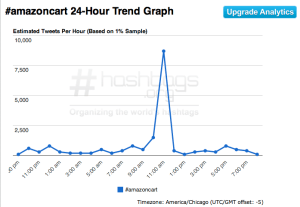
Currently it seems that the amount of #Amazoncart seems already promising (from Hashtags.org):

#Amazoncart

Naturally these are small drops in the ocean for Goliath brand like Amazon but every purchase counts. If Amazon is able to get bursts of over 8k tweets for #AmazonCart in hour constantly it definitely shows great potential for Amazon. Also after the initial development, there is not that much cost for the program (expect for the promoting it).

3. #Amazoncart is super simple
After you have connected your Twitter account to Amazon, you can reply with #AmazonCart to any tweet containing an amazon product link. This puts the item to your shopping cart and you can finish the shopping later. The beauty of this concept is that it keeps it simple enough and does not add too many steps to the progress.

Hopefully in the future we are able reply #AmazonCart to every kind of tweet beyond the Amazon links. Buying products straight from YouTube or Instagram –links anyone?

Tagged , , , , ,

You Have A Friend Request from Jesus Christ

Friend Request from Jesus Christ
I stumbled upon these ads a while back. Despite I always appreciate when organization wants to become more contemporary, these resulted only to maximum embarrathy. It feels a little bit like your father attending spring break and attempting to do Gangnam style in 2014.

I have to admit that I am not probably the best prospect for this campaign. I believe that religions in general have product problem instead of image problem. However I think John Hegarty was on to something when he stated that Roman Catholic Church is the most powerful brand in the world:

Firstly Catholic Church does not sell physical product, it sells a belief. The great brands have evolved beyond the product; Nike & Apple are almost more way of life for their loyalists than just a simple product. They have one of the most well known logos in the world (the cross), a clear mission statement (ten commandments) and own brand book (the bible). Like McDonald´s and Starbucks later on, Church recognized the importance of location. Churches are usually in the center of the city and they used to be the tallest buildings as well (before financial institutions, the religion of our age). It was also a forerunner in branded content, collaborating with the best artists of the world (Da Vinci, Michelangelo, Raphael, Mozart, Beethoven, Bach, etc.). Unlike many other brands, it has also been successful in brand extension and expanded to schools, charities and health care.

Although apparently it was not Catholic Church doing these ads, the brand is the same. For every brand there is a thin line between being too stubborn to change and being too weak to change too much.

If you work with the most powerful brand in the world, would you do ads like these?

Marketing at the Speed of Culture

If you are reading this, you are most likely one of the 16M+ people who have seen this:

The video was uploaded on Monday and started spreading rapidly yesterday. During that same day, the first brand version of the first kiss was produced by Snog Frozen yoghurt:

Not judging the quality of the film, but only applauding the speed of the execution.

The big challenge with many brands right now is that they want to tap into different trends, memes and other popular events. That is nice, but the traditional briefing process does not enable it. If you want to be real-time, reactive and in-tune with the culture, you have to market at the speed of the popular culture. Other option is just to stay true what your brand is all about and be consistent in your communications. You either change constantly or keep it real to your brand core consistently.

Many brands try to dabble little bit with both and fail miserably. That is why every brand is now doing something around selfies. Unfortunately when something is mainstream, you cannot be trendsetter by reacting to that.

Reactive advertising needs different kind of thinking and especially acting:

1)   Different kind of process
Instead of the traditional brief-debrief-creative brief- presentation 1,2, 3, n-production brief the process is streamlined. It consists of one question and one sentence:
Are we doing it?
If yes: Let´s do it.
And then everyone has to be producer.

2)   Different kind of urgency
When your colleagues share it, it is already too late. You have to act immediately when you are feeling something is getting big.

3)   Different kind of production
Do it quick, dirty and preferably yourself.

4)   Different kind of tolerance for risk
You have to accept the fact that when you are acting fast you might fail. Reactive advertising is risky, but so is everything where you can win big. Brand building should not be for the faint-hearted, but unfortunately marketing departments and agencies are filled with wussies afraid of losing their jobs.

If you do not act like this, you will be doing Harlem shake versions in 2015.

Tagged , , , , , ,