Category Archives: Planning

Auftragstaktik and The Lack of Leadership in Advertising Industry

“No plan survives contact with enemy”
– Helmut von Moltke
 
I have met great people, personalities and borderline geniuses during my years in advertising. What have I encountered less is good leaders and visionary leadership.

The biggest problem in advertising industry is leadership problem. Majority of us (me included) have been promoted because we are great experts. We are good strategists, writers or suits but majority don´t have any experience or natural skills to lead or inspire teams. I would argue also that the major reason for churn in ad agencies is due to bad management and lack vision and strategic vigor. When you don´t have the vision you end up doing things yourself or micro-managing your team which naturally annoys any sensible person.

Because majority of leaders are former experts, only few can do the leap to strategic level from tactical grunt work. Contrary to the stereotypes, the right leadership approach to creative industries can be found from military strategy and of all places in usually rigid and authoritarian Germany. “Auftragstaktik” or Mission command in US, is a mission-type tactics doctrine, which promotes freedom and speed of action within defined constraints. The idea of Auftragstaktik originates with Frederick the Great, who was frustrated by the lack of initiative within his leaders. Military strategist Helmut von Moltke coined the actual idea hundred years later (whose quote above is one of the best articulations of strategy). Currently similar types of command are advocated in US, Canadian, Dutch and British armies. The basic idea of Augftagstaktik is simple:

  1. Leaders give the team clearly defined goal
  2. Leader gives the team specific timeframe to accomplish that goal
  3. Leader lets them accomplish that goal independently

Essentially in Auftragstik you say your team what you want them to achieve but you are not saying how they can achieve that. This should result to two benefits:

  1. The team has the ownership and pride of the particular project. They will become better at solving problems and you also cultivate future leaders. They are closer to the project/actual fight so they should do their decisions where things are actually happening.
  2. The leader frees his/her time from tactics and keeps focused on the broader strategy. The leader should have better visibility of business/the war so he/she should be able to show guidance and vision to the team.

If you cannot give responsibility to your team and don´t trust them, you have either made bad hires or you are control freak. Both things are naturally highly worrying. If your leadership is diluted to micro managing you do more harm than good in your company. Then your choices are either to evolve from manager to true leader by trusting your team or you just have to face the reality that you are not cut as a leader at the first place.

Tagged , , , , , , , ,

Marketer Time Gap: Why Singapore Overspends in Print Media?

I was astonished to read the new report from Datalicious and eConsultancy about where the media budgets are generally going in Singapore. Based on the respondents on that survey, they use 42% of their marketing budget to print, although audience uses only 10% of their time there. This feels like a massive overspending in print and total waste of money.

eConsultancy & Datalicious: Media Budgets Index- Comparing Media Budget Allocation to media consumption

eConsultancy & Datalicious: Media Budgets Index- Comparing Media Budget Allocation to media consumption (2016)

That people are spending time on some channel does not necessarily mean that you can reach people there effectively. E.g. people spend time on WhatsApp where advertisers are not allowed. Or TV viewership is moving towards Netflix, where you cannot interrupt the audience with TV ads. Impact is not equal to time. Still this statistic gives indication that advertisers are not using their media money as wisely as they could. These results strengthen the five principles I have encountered anecdotally during my time in here:

  1. Stop overspending on print. The time consumers spent on print will not be growing so do not let the affordability fool you.
  2. Keep your TV spend around where it is. It is expensive channel, but still one of the most effective mediums to gain massive reach and also tell emotional story.
  3. Consider the role of digital for your company. Your audience is spending bigger proportion of their time every year in digital. If you are not understanding what your consumers are doing there, you will be marketing in places where your customers aren´t. The question should not be should you invest on digital, but how you will invest on digital.
  4. Reconsider radio. Radio is the unsung hero of the media mix. Cost-effective channel that people still spend surprisingly long time with. During my whole advertising career, radio has always been pariah of different media types but based on these results there is opportunity to improve your media effectiveness by adding it to your media mix. Plus it is opportunity to do some really great ads.
  5. Based on the same research over half of the marketers are not using attribution or don´t even know what it is. If you are not measuring and assessing the effectiveness of your different media channels, start now. Otherwise you keep spending on print, because it doesn´t seem to be completely broken method based on your results (which are not based on attribution). Unfortunately there will be no transition from working ok to not working at all.

Throughout my whole career, I have advocated for digital and it seems that my clients have been waking up to the consumer reality. This study shows that there is a still lot of work to do to make all the marketers realize the current lay of the land.

Tagged , , , , , , ,

Ferment and Distill Your Ideas

“Alcohol, taken in sufficient quantities, may produce all the effects of drunkenness.” 
– Oscar Wilde

I like alcohol in its various forms and like with many things the more you know the background of it, the more you enjoy the experience. Therefore I don´t only consume ethanol, I read a lot literature about it (hence camouflaging it from problem to hobby). Besides Three Martini lunches, the art of making booze and the art of making great marketing have lots of similarities. For example this passage about the difference of fermentation and distillation in the “Proof” by Adam Rogers captures something essential about our field of work as well:

Fermentation is a natural process, as close to a miracle as a science-minded type like me would ever acknowledge. Over human history we have learn to harness and adapt it. We domesticated the micro-organisms that make it possible, designed containers friendlier to it, created business around it. But a winemaker taking credit for fermentation is like beekeeper taking credit for honey. Fermentation would happen whether men and women were here on earth or not. If a fig spontaneously ferments in the forest, a monkey is there to hear it. (And eat the fig. And get drunk.  

Distillation, though, is technology. Human being invented it; we came up with the process and developed the equipment. It requires the ability to boil a liquid and reliably collect the resulting vapors, which sounds simple. But to do it you have to learn a lot of other skills first. You have to be able to control fire, work metal, heat things and cool them, make airtight, pressurized vessels. You need a big brain with wrinkled cortex, maybe some opposable thumbs. But most of all you need a desire to change your environment instead of just live with what you have. Distillation takes intelligence and will. To distill, literally or metaphorically, requires the hubris to believe you can change the world.
 

The great marketers understand the difference of fermentation and distillation and when to utilize both of the methods to come up with ideas.

“Fermentation may have been a greater discovery than fire”
– David Wallace

Ferment: There is time and place to rely on your emotions and gut feeling. Fermentation is a skill that you either have or not. Let it flow and don´t try to control things. Use just pad and pen, technology does not make fermenting better. Usually when fermenting, the quantity is better than quality. Third beer tastes better than the first one. There is time to distill later on.

“Civilization begins with distillation”
-William Faulkner

Distill: After you had your ideas ferment freely it is time to distill your ideas to purest form. You have to try to control your ideas, make sense out of them. Use technology to find the essence of your idea. Distillation you can learn when you have the discipline. The less is more. If you have truly potent idea, one shot is enough and you don´t need to mix it with anything.

The best marketers are the masters of in balancing between chaos and discipline.

Tagged , , , , ,

Vodka From A Village and The Secret of a Great Brand Film

finlandialessordinary

I hate majority of brand films. They just revisit same old clichés and not even the employees get kick out of them:

The false deduction would be to conclude that if majority is shit, everything is. Brand film, when done well, can be truly uplifting experience. It can put your brand´s stake in the ground and convey your attitude in a manner that resonates both to your consumers and your employees.

This rebranding of Koskenkorva is a great example of a good brand film. The product consists of water and barley. It is coming from a small village. It is Finnish and we don´t brag or boast. The understated tone actually oozes confidence and in a minute shows what the brand stands for. Brilliant stuff from Bob The Robot:

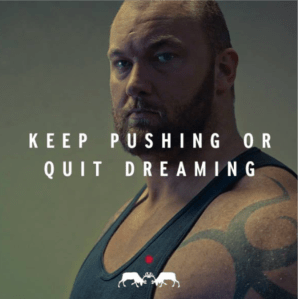
Finnish vodka brands seem to have learnt something during the years, because the following example is from Finlandia vodka. Whereas Koskenkorva is the rural and rustic everyday drink, Finlandia has always been a little bit upscale. Upscale in Finland meaning still that you have weird attitude that other markets don´t understand. This is a brand film that is built around the desired attitude of the brand. After seeing this you are hyped up to grab a bottle of vodka and try your new deadlift record (this is done by W+K London):

Great brand film:

1) Tells something interesting about brand.
2) Is something that only your brand can do
3) Makes you feel something
4) Looks good (there is no such thing as lo-fi brand film)

Tagged , , , ,

Anatomy of An Insight: Kraft Macaroni & Cheese It´s Changed But It Hasn´t

macandcheese

“This is like the largest blind tasting ever”

Insight: Brand is all about perception. When you are changing the recipe of an iconic food item, you have to be careful. Expectations play important role on what we taste and how we experience it. Taste is shaped by our past experiences, our current mood, our expectations, and any number of incidental details.

“What we think is going into our mouth actually changes what we taste, down to the level of the taste buds themselves.”

Michael Norton, assistant professor of business administration in the marketing department of the Harvard Business School

So instead of doing big bang like New Coke and failing miserably, Mac & Cheese starts sneakily by just testing it out. Not surprisingly people didn´t notice any difference and generally having no artificial ingredients should be good thing. macandcheese2

I also recommend watching this longer story about the project and to visit the website.

Powerful, simple, big and real (not scam or some crappy innovation) campaigns are not that common nowadays, so this definitely deserves some praise.

Tagged , , , ,

Real Omni-Channel Customer Experience

We consumers are living in truly omni-channel environment. We live in app economy. We don´t just want things fast, we want them now. This a real user journey from this new brave world:

  1. I realize that I don´t have any food in the fridge. This might pose a problem to my survival. I am too lazy to walk to smaller store so I decide to buy online.
  2. Because I am also a cheapskate, my online store of choice is Giant Online.
  3. The experience starts by not remembering your password. After resetting your password, you are finally into system.
  4. Giant Online has a great system called Shopping list. It enables you to put items you buy frequently to “shopping list” so it would be faster to buy your items. Expect when it is not.
  5. You cannot just import your shopping list to the cart, but you have to check every single item one-by-one.
  6. After you have put those products in the really innovative product feature kicks in. The products that are not currently available will disappear. So you have to start checking what items are actually missing from your shopping list.
  7. Because I buy lots of fruits and vegetables, Giant recognizes those as individual items. So if I put Avocado from US to shopping list and they do not have those exact fruits they will disappear from my shopping cart. The system is not smart enough to recommend avocadoes from New Zealand (or vice versa). The system does not also learn in any way of my purchase history. So then again I need to spend another 10 minutes by putting the missing items manually.
  8. Because I have used this store for long I have also realized certain quirks of it (like the one above). Sometimes you don´t find products with search and you have to go to specific category to go them through. Sometimes you can find certain products only through search. The time it has took me to master this online shopping platform could have been used to learn a new language.
  9. Finally you seem to have everything on your cart so it is time to check out.
  10. Expect the system tries to sell me something totally unnecessary. This time they offer me a funky green saucepan. Great deal, expect I don´t have any need for that product. Naturally these upselling offers are totally random and not connected to what I am normally purchasing.giantpromotion
  11. I select the option that if I miss any items they would be replaced automatically if there is a substitute item and they would not call me. Usually these calls are only about that the item is missing and there is no replacement. No idea to call if there are no solutions to missing items.
  12. I check out from the store. Great, it only took 20 minutes. My nearest store is five minutes walk so I probably would have already done this faster in there. But at least I didn´t need to stand up from my computer. Wait a minute; I did it on my stand-up desk at work. So at least I burned some calories.
  13. Ok of I go or so I think.
  14. Because I selected to pay with credit card, I have to do some extra security confirmation through SMS. So I have to check a code from my phone and type it into the system.
  15. Ok, not that hard, the card is valid. I will get e-mail confirmation of my order. By this point I have already utilized desktop, mobile and received e-mail during this shopping journey. And this for the quite mundane order of cabbage and yoghurt.
  16. My earliest time slot I could get the order was two days away. So eventually I had to go to nearby store to get some emergency stuff because otherwise I would have died of hunger meanwhile. So already this process has took an hour. Smooth…
  17. Day before the shipment, they call me (although I explicitly forbid them of calling). Well they call me anyway and say that certain items are missing and there are no replacements. Thank you for the information.
  18. The big day is here; I finally get my food delivery. Expect the delivery time frame is four hours from 9AM to 1PM, so I have to stay home and wait for that delivery. Luckily NBA playoffs are on so these four hours are not total waste of time. Way to go Boston!
  19. Little bit before 1PM the delivery is there. I check the order list and naturally some additional items are missing. I call Giant and they promise to reimburse (which they always do, just an additional phone call to do)
  20. I put the stuff into fridge taking around 10 minutes.
  21. Mission accomplished. I can´t wait to do this again in couple of days.

So to conclude, making things easier and digital meant the following:

  • Over 20 steps for a very simple process: select your food, buy your food, store your food
  • 5 hours total for making, managing and waiting the order
  • Using laptop for the order, doing two phone calls, receiving one SMS and one e-mail. So truly omni-channel experience!

So why do I still subject myself to this torture?

Answer: laziness.

I cannot be bothered to walk to the store because I am lazy bastard. I cannot be bothered to change to Redmart, because I am not convinced it would be any better. I have already registered to one service and cannot be bothered with my passwords. Laziness trumps loyalty.

Quite often companies do not actually need to make things easier or cheaper, they just need to give you the illusion that they provide easier and cheaper solution.

Tagged , , , , , ,

Advertising At The Right Place but At The Wrong Time

The main rule in contextual advertising is simple:

Ensure that your contextual advertising is done on right context.

Sounds redundant but it isn´t. Let me show an example of advertising aimed at particular time-of-the-day:

McDonalds1
Hmm, it is 11AM on Monday morning. I have barely woken up. I don´t necessarily want to be up, but generally if you work at the office you don´t have choice. Or are you referring to my stand-up desk?

McDonalds2
I don´t even know what I will do tomorrow, not to mention knowing will I oversleep or not. I was planning to go sleep early, but do you know more about my Netflix addiction?

McDonalds3
I have already eaten breakfast and I am already dreaming about my lunch. Would you have any lunch deals? Or will you be targeting those ads at my dinner time?

McDonalds4
This ad was definitely at the right place because I noticed it. Probably in the media report it will also be really effective because I replayed it zillion times to get proper screenshots. So probably we will get more of this kind of lazy targeting in the future.

In many ways the opportunities in digital media are really interesting right now: ability to target people at the right place, right time and to retarget based on their behavior is fascinating. Unfortunately media and the media agencies are too often just too damn lazy to really utilize these opportunities, or just plain creepy.

This experience was not without silver lining, it reminded me to listen this awesome song by Dr. John to cheer up my Monday:

Tagged , , , , ,

Anatomy of An Insight: Letgo Commercializer

Sometimes your biggest challenge for growth is not that people are not using your platform, but they are just using it wrong:

Insight: The challenge is not that people don´t have stuff to sell, but they don´t know how to sell that. The pictures look bad, there is not that much story behind the stuff and everything lacks enthusiasm. If you are marketplace where people can sell their old stuff this is naturally a problem. You want to make people better sellers so their stuff moves faster and they can sell even more stuff. More stuff equals more money to everyone.

Would you notice a used product ad featuring Dolph Lundgren?

I know that I would.

Tagged , , , , , , ,

Bots and The Rise of Conversational Commerce

Messaging is the new browser and bots are the websites.
Mike Roberts, Kik Head of Messaging and Bot Experience

Bots have been all the rage last weeks. Whether it has been the NSFW Microsoft bot (not only racist, but also encouraging pot smoking in front of cops) or the ability to build chatbots on top of FB messengers.

Why sudden interest in bots?

They are not really a new phenomenon. Eliza was already created in 60s (test it here) and Siri has also been around for a while (test it in your phone). The main reason for the chatbots to gain importance especially now is because of the changed digital landscape. For majority of users, messenger is their digital starting point. Users don´t want to use messaging over Internet, they want to access their Internet to from their messenger. Therefore ability to help, serve and sell to users within messenger is paramount. Short text message (or emoji) is the default way of communicating, should it be also the way to communicate with the brands?

“Conversational commerce is about delivering convenience, personalization, and decision support while people are on the go, with only partial attention to spare.” 
Chris Messina

We are still having long way for the bot economy and below are the core things to fix before chatbots will evolve from novelty to actual user behavior:

1. The bots need to understand normal talk
“They aren’t taking natural language; they are taking menu names,”
Bruce Wilcox,the author of Rose, the winner of the most recent Loebner annual chatbot competition.

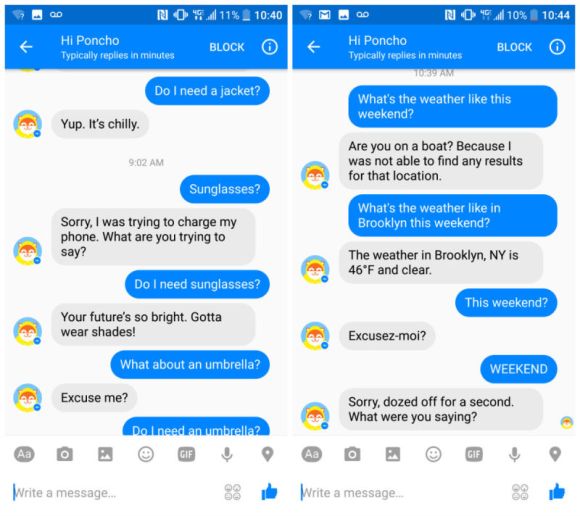
Many of the recent Facebook bots are still quite clunky in terms of discussion. People are more casual when they are thinking that they are conversing with real person. The challenge is for the robot to be casual but at the same time providing the transactional value. Current examples have not been particularly promising as they are either pushing you products in unnatural way or trying to be funny but not providing any value:
poncho

2. The bots need to become more predictive and fast
Going back and forth with your bot to order a pizza is tedious process. Getting weather details in an hour is just ridiculous. They need to become way more intuitive to use to really rival Google for getting your fast answers. The novelty factor will wear off quickly. If bots are not able to give you solutions fast, they will not be used.

3. Bots are not a destination but a way to enhance the existing discussion
E.g. instead of going to separate weather bot, you should get the weather details when you are chatting with your friend and need that info. Mark Zuckerberg raved about bots as replacements for apps, but with the current experience, it is actually just easier to go to that weather app and get your answer. Ideal situation would be that your messenger would recognize opportunities for commercial interaction from your discussions, but how to build that experience so that it is not creepy?

We are living in the early days of conversational commerce. Using messenger for repeated purchases (like pizza delivery) seems like a no-brainer, but will people actually start browsing products within messenger and asking help from the chatbot?

That depends on the user experience. If AI behind the chatbot actually would know your taste and it would be effective and enjoyable to chat with, messenger economy could become true game changer. Opportunity and potential demand is there, but building a good recommendation engine alone is difficult not to mention that you have to add enjoyable interaction with a robot on top of that. And the core question is, will people want to interact with bots?

Time will tell.

One thing is for certain. Bots will not kill the web, but they will permanently alter it.

Tagged , , , , , , , , ,

What Deadpool Teaches You About Branding?

deadpoolemoji

I finally saw Deadpool last week and it is definitely a contender for the best movie of this year. Where I actively avoid mainstream movie theatres (especially in Singapore, where the selection is even narrower. Luckily we have Projector), it was like a breath of fresh air to watch something totally politically incorrect on big screen. And I am not the only one enjoying it, Deadpool is becoming the third biggest superhero movie of all-time.

1.Don´t listen to focus groups
There is a lie, damn lie and then your target audience analyzing your ads in focus groups. Deadpool is the kind of movie that would not ever get a green light in focus group. There is senseless violence, infantile humor and jabs and insults to everything that is sacred. The hero is flawed and does not even want to be hero. Not surprisingly, despite the strong hype movie was not exactly going anywhere:

We developed the script six years ago, wrote this fantastic script, it leaked online, Deadpool fans went nuts for it, so the studio granted us a small amount of money to make test footage. This test footage that we shot then sat on the shelf for four years, as it does, they didn’t do anything with it, then just a little under two years ago it leaked, accidentally, onto the internet.
Ryan Reynolds (in Jimmy Fallon)

Deadpool would not have happened if there had not been groundswell to get the film released. Ryan Reynolds continues:

“Here’s the thing, the fans freaked out and overwhelmed Fox, and Fox basically had to greenlight the movie. The problem is the footage was owned by Fox so it was kind of illegal … I know that one of us did it.”

If you truly believe in your product, sometimes you have to bend the rules (or even ignore them) a little bit.

2.Embrace the constraints
Fox tried to do pretty much everything to not get the movie released, e.g. cutting the budget on the last minute:

“We had to carve something like $7-8 million out of the budget in a 48-hour window. And we, as a group, just put our heads together, got creative, and said ‘How do we cut what is essentially nine pages out of a 110 page script?’”
Rhett Reese (writer)

But when there is a will, there is a way. Deadpool is not about the special effects. It is about the attitude. If you have the attitude, that can shine through but if you are only about who is having the biggest explosions, that kind of cut would be fatal.

3.Ride the trend…but in opposite direction
People start to get bored of superhero movies. They still are going to see them, because essentially you don´t have a choice, as they are everywhere. Everyone knows the formula and every superhero comes from the same mold. When someone breaks the pattern, it will definitely get noticed. That is why it is important to know your competition, so you can do exactly the opposite than them.

4.Be top-of-mind
The marketing campaign for Deadpool is a perfect example of a great integrated campaign. Top-of-mind is ensured with heavy use of traditional channels.

deadpooloooh

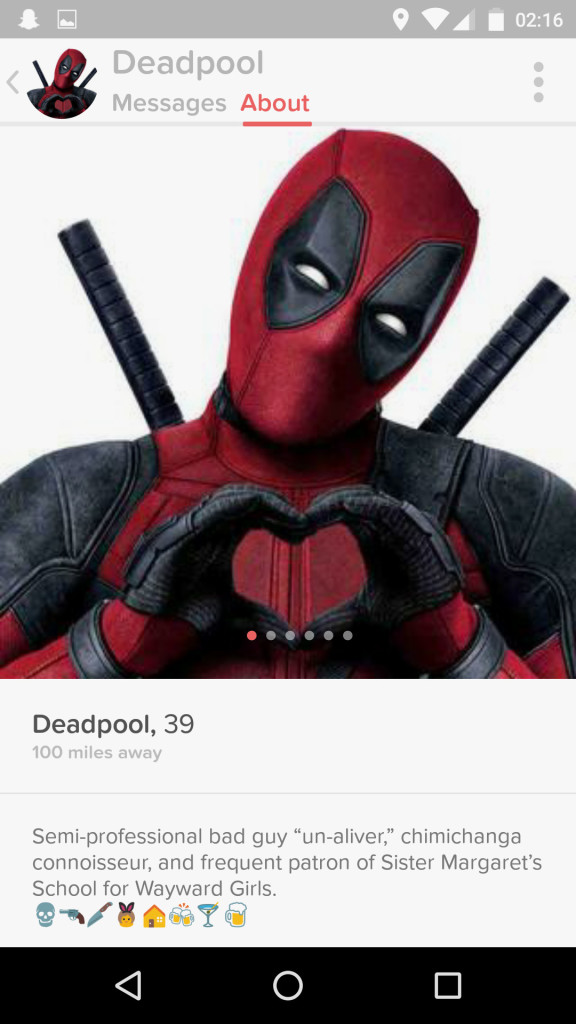
In digital you are really starting to have fun. Like with Deadpool emojis or a Tinder profile:

deadpooltinder

5.Keep it real
Traditionally having a R-rated film is a deathblow to a film. Deadpool has gone against all the conventional Hollywood wisdom, mainly because the makers had a strong belief to the film.

So that´s all. If you have not seen Deadpool, go see it now.

Tagged , , , ,