Category Archives: Planning

What CrossFit Can Teach You About Branding

Those who read my post last week will already know that I have not yet become totally cynical to the art of marketing. I fell victim to good branding once in a while. I have been reminded of this gullibility, because lately I have desperately wanted to start CrossFit.

For those who are not in the know, CrossFit is an intense exercise program characterized by functional training using non-traditional weighlifting equipment (such as kettlebells). It has been probably been the hottest thing lately (especially among guys) in exercise circles and become quite mainstream in last couple of years. Reebok is also betting heavily on the rise of CrossFit.

I am already sports crazy. I run and do circuit training every morning, play in two basketball teams and try to swim once in a while. I do not really need any additions to my sports regime. I am healthy enough. The urge to start Crossfit is not rational decision. It has been branded well. It feels natural, because the exercise is functional. It feels total antithesis of the shiny gyms: many times CrossFit-sessions happening in the old warehouses. It has strong ethos of pushing to the limit, which resonates well with my view of sports in general. Exercising is not supposed to be fun. Only pain brings gain.

However when I was searching for the alternatives for CrossFit training in Singapore, I was shocked by the steep price tag of monthly prices. You should not really pay over 200+ dollars for basic circuit training in shitty warehouse. Or should you?

This is the inner dialogue I had:

Left brain: Hey that guy just took your our basketball summer training and is now charging hundreds of dollars a month from a glorified circuit training!
Right brain: But I want to push tractor tires to feel like a man!

Left brain: You push yourself too hard even in your morning jogs, CrossFit can actually destroy your muscles.
Right brain: Whatever, I want to train until I puke.
(Actually I heard a rumour that Red Bull sales increased when there was news coverage about alleged deaths of mixing Red Bull with Alcohol. Danger attracts.Also a vast majority of the news stories about harmfulness of different sports are written and shared by people who just want to find excuses for not exercising)

Why Crossfit is currently so appealing?

1. Proven business model
Crossfit.inc (founded in 2000 by Greg Glassman) follows in many ways the same success formula of the rise of “Les Mills”-branded classes, best known for Bodypump-classes. They license the Crossfit name to gyms for an annual fee and certify trainers. Licensing business is one of the most profitable types of business in the world.

 2. Room for creativity
Whereas Les Mills feels more like the McDonald´s of Gym Exercise (it is the same in every part of the globe), CrossFit still feels like a rebel alternative for it. Every CrossfFit-training can be different and the possible variations for the training are infinite.

3. Perfect training type for digital office worker
No-frills type of training feels perfect antidote for the overtly digital world we are living in. Also the sessions are high-intensity short bursts, which you can easily fill even to the busiest calendar.

4. Fueled by social media
I doubt that the sports would not be as big without the connected world we are living. There are CrossFit-forums, Facebook pages and endless amount of training videos. After watching this video by Finnish CrossFit-hero Mikko Salo, it almost felt I was training myself (150k views, btw):

5. Good story to tell
Exercising should always be about your own health and development. The truth is though that many times people exercise also for the bragging rights. CrossFit just sounds way cooler than being in Spinning. No offense to Spinning.

I probably try CrossFit despite the steep price tag. If no for other reason than to give a nod for the branding well done.

Tagged , , , , ,

Planners Make Ugly Slides

I won´t deny it, in most things I am a straight ridah.

However there is one common characteristic, I share with all the wack planners around the world. I do really ugly slides. That is why I have condensed my presentations nowadays mostly to one-sentence blank slides (so-called power-slides).
This cheat sheet from Julian Cole comes definitely in handy for me (download here with a tweet):

If you want to see some of my ugly presentations, click here.

Tagged , ,

How Teens Abandoned Facebook and Other Lies You Can Find From Research

First of all, I recommend everyone to read “Wrong: Why Experts Keep Failing Us”, a brilliant book by David H. Freedman. It showcases that painstakingly big portion of scientific research is completely faulty. The book did not address the subject of marketing research, but as the situation was quite bad with scientific research, I would say that nearly all of the marketing research is somewhat inferior. That does not mean it is not useful, but you should always take it with grain of salt.

I was reminded of this when there were lots of shares in social media about research on how Facebook is not the most important social network for teens. The news coverage it got made me sad and angry because of three things. First of all, that study was conducted to 802 teens (there are 20+ million teens in US). Second, it was focus group, not assessing the real behavior online. Third, it was mainly a study about privacy, which might also skew the answers to certain direction (like the previous study about social media effect on teen purchasing patterns). If you look at cold facts, not feelings coming out from the focus groups, the truth is different:

Numbers trump feelings
The so-called popular network Twitter has 24% penetration in teen audience, while Facebook has 94%. That gives a clear signal about reality: Facebook is “only” over 3.5 times bigger than the “most-liked” social network. You rather have actual reach than likes. When you are crafting your next campaign for teens, I would still concentrate on Facebook to get that actual reach. Instagram (owned by Facebook, which is good to remember) or Twitter might be good for more engagement, but by the time of writing, something new is probably surpassing them as the social network of choice for teens.

Do not replace your common sense with research
Main takeaway from the research was that teens do not find Facebook cool anymore. That is hardly surprising and you do not really need research to get that insight. Why would teens even find it cool? Their parents are using Facebook, for god´s sake. There will be always a demand for that “new thing” amongst teens (whether SnapChat or twerking). That “new thing” enables teens to differentiate from adults and hopefully shock parents as well. When Twitter becomes popular enough, teens will “abandon” it as well. That “abandonment” does not mean that Twitter would be irrelevant. On the contrary, that might mean it is just big enough to make business sense for the target audience.

This rant is not really about the teens fleeing away from Facebook (which they actually do, to some extent). It is about that I am totally sick and tired of sloppily executed research and lazy misinterpretation of that research. You run into these bullshit stats taken out of their context everyday, whether you are reading blogs, industry press or just browsing the latest deck from the research agency. When these stats get passed on in social media without any deeper thought, I sincerely hope that people are just too lazy to check details of the research. Other alternative is that marketing people are just too stupid. Hopefully not.

Especially we, as planners, should take a stand and always dig deeper to the research and be the devil´s advocate when it comes to research. Find the occasional nuggets and gems between the lines and rip the other pieces of the research apart.

Tagged , , , , , , , ,

Build Your Brand on the Myth, Not Facts

I always use Moleskine notebook.

And yes I know it is quite silly. I know that Hemingway, Picasso or Van Gogh never used Moleskines, per se. Yes, they used some kind of notebooks back in the day, but not any particular brand. Moleskine just started to do notebooks “inspired” by those old notebooks in 1997. I found it out a while after I had filled my first couple of Moleskines with my brilliant ideas (emphasis mine). Of course, I had envisioned myself scribbling concepts like Hemingway wrote his punctuated prose. Finding out the truth did not stop me from buying Moleskine though. The notebooks were ok enough and it still send my aspiration message to others. Good story is interesting than boring truth.

Some brands should be built on myths not facts.

Notebooks were totally low interest category when Moleskine arrived. Which does not really make sense, because you produce high interest content in your notebook. It is disrespectful for your ideas to go on cheapskate notebook or back of a printed A4. There was opportunity to bring new product there to celebrate the creativity of the people (or their perceived creativity) and make some money at the same time.

Also as our life becomes increasingly more filled with digital devices, people have the desire to do & have something tangible. The rise of Moleskine has actually happened almost parallel to digitalization: starting from dotcom boom, to Web2.0 and the current mobile revolution.

If your product is good enough (if Moleskine product would be really inferior, no one would use it, no matter the story), your audience is not really searching for performance. You are searching for the inspiring story and a product which makes you feel good about yourself.

I have had numerous discussions with clients, who have also Moleskines. Usually being the party pooper planner I tell the real story of the brand. That has not been a reason to stop using Moleskine for anyone. We rather believe in a good story than in the reality. Having a Moleskine showcases certain desired attitude. It also shows that you are still falling prey to marketing communications. I find it as a very comforting thought: there is still need for our line of industry. People still need interesting stories to justify their consumption.

Tagged , , , , ,

Anatomy of An Insight: Never Say No to Panda


Damn I am getting old, I am not up-to-date with all the different memes at the moment. I also have totally missed this advertising hit from 2010 as well.

Panda Cheese commercials are classic marketing. TV spots build around dramatizing the tagline. Simple approach: Just hammering home that you should never say no to panda. What makes these spots modern marketing is the craft and flair of them. Without the product tagline these would still be entertaining content and not out of place in sites like 9GAG or Reddit.

There is not really any major consumer insight here. If you don´t count that people like to laugh and it is disturbingly funny to see cute animal like Panda behaving like bully and terrorizing people. Too often planners spend time on inventing pseudo-insights like “Eating cheese makes you reminisce and you are actually eating your childhood memories” instead of being truly helpful. Cheese is cheese, make it fun and make sure your brand is remembered. Our field of work is not rocket science, simple is effective. Effective is beautiful.

Different approach and great idea trumps half-boiled consumer insight any day.

Tagged , , , ,

#LufthansaFAIL: Why You Cannot Separate Customer Service and Social Media?

I am usually not a fan of writing how different brands “fail” on social media. Too often these fails are actually quite trivial and more driven by the urge of “social media experts” to nitpick on every thing. However sometimes you just stumble on things which are quite hard to believe that are still happening in 2013.

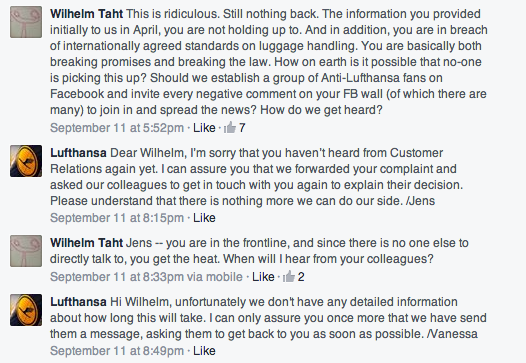
Today I noticed there was discussion from Lufthansa wall spreading in Facebook. I went to check it out. You can read the whole correspondence from here, but if post will be deleted, you can also see the highlights below:

Lufthansa fails in Facebook
Because this is all public correspondence from Lufthansa wall (part of the #fail-part), I have not censored any names or such because it is public post.

The start after the first post was a guidebook social media example answer from the company with no customer service capabilities within social media team:
Lufthansafail2

Good answer. Now Lufthansa would just need to make the final reply and everything would be ok.
How Lufthansa fails in Facebook
Further assurances are made that thing is progressed further, but nothing happens for a week:
Lufthansafail3

During this part of the discussion the social media team actually shows that they only work as messengers within the company with no real access to customer service personnel. It also seems that customer service personnel does not really care what comes from social media team either. It also showcases well how the airline companies (not only Lufthansa) are making the access to customer service increasingly difficult. You cannot call anyone and the mails are not answered (or your mails are bounced back). In Facebook you get answered, but unfortunately the answers are not any good. And of course nothing happens on the customer service front:

Lufthansafail4

After this something totally peculiar happens: Lufthansa Facebook team goes totally quiet. Maybe they counted that the situation will eventually die down. But as you can notice from this post, the discussion did not die down. It actually just got more vivid. People started to share this post in social media and now it has garnered almost 100 likes and 72 comments. The post has not been taken down (not that it would probably help in this situation) or not addressed in any way. If you decide to ignore someone in social media, you should make that decision first and not halfway through.

This discussion gives us three lessons:

1. You cannot have the cake and eat it too.
It is impossible to just get the “good” side of the social media such as likes and positive comments. Your Facebook page is also customer service channel whether you have customer service working in your social media team or not. This correspondence shows that the company treats social media as a nice sugarcoating and not really a part of the business. You have to also be accountable for your answers. If you say you are getting back, you really should get back. You do not really need social media expert to tell this. It is just common courtesy and common sense.

2. Handle the social media complaints first
All the customers are not equal. You should treat those better who pay more (your best customers) and you should also treat those first who can cause you the biggest damage (damage prevention). This post has been escalating for three weeks and I do not doubt that it will escalate further.  How difficult it would just to get back to the guy?

3. If you answer the questions in Facebook, follow through
It is of course respectable to have open unsolicited discussion on your Facebook page. In this case, the situation just looks bad and shows more that you do not care about customers. Also although the discussion does not show in your FB front-page it does not mean that it is forgotten. Currently the whole discussion sends the message that anyone in the organization does not really care.

Airline industry is one of the most complained industries in the world and I have had my fair share of challenges with them. Nothing new under the sun in many ways you could say. This situation could have been saved easily on many occasions during this discussion (not to mention the thing has been boiling for three months before). The situation can of course be saved, but it is much harder now.

I am looking forward to how Lufthansa will respond.  At least they have been pondering for the right comment for 1,5 weeks.

EDIT (Apparently now the situation has been sorted out):

Lufthansa Customer Service

Tagged , , , , ,

Anatomy of An Insight: The Scarecrow

Unlike Hollywood, Internet usually does not favor sequels. Of course there are always expectations to the rule:

If you are working in advertising it has been hard to avoid the new Chipotle ad. All the praises have been duly deserved; it is really great piece of work. Seldom you get such a wide variety of feelings by watching an advertisement. Which is really refreshing. Ad made me want to cry and also to have a burrito to wipe those tears with. There is a wide range of human emotions that trigger people to buy (both positive & negative). Unfortunately, too few advertisers are venturing outside the “smiling happy people”-convention and end results are boring at best and disastrous at worst.

Insight: Often to define yourself, it is more important to state what you are not than what you are. The majority of the ad is about everything that Chipotle does not represent (or at least say they do not represent).
Like Simon Veksner pointed out in his blog, it is dramatizing the negative. Which is the only proper way for challenger brand to behave. Old habits die hard, so you need to aggressively point the problems in incumbent. Saying happily that you are alternative, is not sufficient. If you are challenger brand, you have to challenge.

Scarecrow campaign is a great example of integrated approach. The video is just the starting point to play Scarecrow-game and the loop is nicely closed when you win the burritos after you finished all the stages.

Tagged , , ,

Why Facebook Allowed Promotions in Page timelines?

Facebook finally updated their promotions guidelines to allow the usage of natural Facebook functions in promotions. Brands can now collect entries by having users post on their page or comment/like a page post. Likes can also be utilized as voting mechanism. So now you do not necessarily need to build 3rd party app to host a competition.

This makes things clearer for brands, because the former guidelines of building the 3rd party apps seemed to be relatively difficult for brands to understand and caused a lot of confusion. Using status updates as competition vehicles has already been a tool, which especially smaller brands have utilized although it has been forbidden. From user´s standpoint this will mean that the newsfeed will be even more populated with promotional content in addition and conjunction with sponsored stories. The recent change is also total turnaround from the rhetoric of pre-listed Facebook about not populating user feeds with commercial messages. Besides the constant pressure of shareholders the reason for this change is super simple:

Mobile.

The biggest caveat of Facebook tabs has been that they are not working on mobile. For some reason, it has been tricky or trivial thing for Facebook to fix. Enabling the contests in normal brand page timeline allows brands to tap into the dramatic mobile usage growth of Facebook. It is also a painstaking proof that traditional status updates do not drive people to like the brands as much as the incentivized ones.

Is this the end of the Facebook tabs?

Now there is no idea to host simple competitions using Facebook tab. Status update competition with appropriate paid media push works totally fine and allows having more smaller competitions outside normal campaign cycle. It is quite limited way for customer interaction. Therefore I would not count Facebook tabs totally off just yet. They provide opportunities for deeper engagement, richer storytelling and more impressive experience than the native Facebook functions. Facebook has not really replaced the campaign microsites due to its limited offering for brands. If you want to wow your audience in Facebook, you pretty much still have to utilize tabs. Which unfortunately do not work in mobile.

Easing the promotion guidelines is a quick fix for Facebook and addresses certain key promotion issues regarding the mobile. If Facebook really wants to replace the still prevalent usage of microsites they either need to fix the tab formats to work in mobile or completely revamp the brand page structure to give more freedom to brands.

Tagged ,

Anatomy of An Insight: National Day Proposal

Too seldom I am able to highlight Singaporean ads here. Therefore I was delighted when I stumbled upon the new Mentos National Day song by BBH Asia-Pacific. The first Mentos National Day song about boosting the birth rate of Singapore was probably the most shared ad last year in Singapore. For Finnish person who has built his ad career mainly on rap songs and nationalism, this new song is even better:

Insight: Singapore & Finland are similar countries. Small, but highly successful countries which both are high on different international rankings (such as level of education). Singaporean media also regularly highlights news from Finland and has articles about the international rankings.
Based on my experience living in both countries, the mindset of the people is also somewhat similar. Both Singaporeans and Finns are obsessive about what other countries are talking about them. Which will mean that last year´s view counts might double as every Finn wants also to see what is talked about them.

Craft-wise this is definite improvement over last year´s campaign. Song is better (Lonely Island has been on heavy rotation), animation more sharp and the video is filled with more puns to find (also in Finnish). The chorus is nice nod to either strong Heavy Metal –heritage of Finland or to musical mish-mosh of this year´s official national day song.

Although the planner in me has not yet found the connection between Mentos and birth rate in Singapore, that was not as big issue as last year. The concept is already familiar enough. If (and hopefully when) Mentos does new song next year it is already an annual tradition and no one really thinks about why Mentos does National day song urging people to have sex.

Good example if you invent something which works, stick with it. Usually it works next time as well.

Tagged , , , , ,

Mathematics of Creativity

John Leach on the “Mathematics of creativity” Part 1 from accountplanninggroup on Vimeo.

Stumbled upon this awesome presentation from John Leach. Although technically this is more about calculation than actual mathematics, it is still worth a look. Really entertaining and useful keynote.

Tagged , ,