Category Archives: Marketing Strategy

Has This Been Done Before?

The most frustrating part in working in Singapore is the construct of majority of the presentations. Way too often, you spend big portion of the presentation going through examples on how other brands have done, not just similar things, but exactly the same things to sell your idea.

Has this been done before?

It is always good to learn new skills, but I have to say I much prefer my own construct. Show that none of the competitors is doing the thing you are proposing and pinpoint the opportunity. That approach does not sell work in here though.

And it is understandable. Others might not be doing that particular idea, because it does not work. Or they might not be doing that idea, because they are waiting for the proven case studies and benchmarks. So every marketer should remember the following four rules:

If you are doing something for the first time, there is higher probability that you will fail.
If you are doing something for the first time, there is higher probability to do something surprisingly successful. 
When you do something for the first time, it will be groundbreaking: either in negative and positive.
When you are doing something for the first time, either do it as a test or go all-in.

This paradox causes interesting challenges. When you try to duplicate something truly groundbreaking, it is nearly impossible. When you do something for the first time, it is partly about the idea and partly about the speed. Everyone working in this industry long enough knows that coming up with great ideas is not that difficult. Getting them executed fast and first is. Over-benchmarking success stories just results in mediocre campaigns: even though you could copy the exact idea, you cannot copy the exact situation.

This has been done before?

When you are doing something for the first time, it can be a stunt.
When you are doing something for the second time (or third and so forth), it cannot be stunt.
 
Talent borrows and genius steals, but genius also knows from whom to steal. Occasionally you might get the comment with digital ideas that it has been done before. And the same way as the opposite comment above, that does not really make sense either. No one faults you from doing 30s TVC, because it has been done before. It is a proven method, not an idea. It is not an idea anymore in 2014 to react to tweets and hashtags:

It is already a proven method. It becomes an idea when you have Boyz II Men singing those tweets. Same way as the only TVCs catching the attention anymore are the most expensive. That does not mean you should not be doing TVCs or social response, you have to execute with more bells and whistles.

The more proven method has become, the more craft and execution matters in it success.

When you are doing it first, you need less flair.

Tagged , , ,

Psst… Can I Whisper you A Secret? Anonymous Mobile Messaging Apps Are The Next Big Thing in Digital

Mobile instant messaging is all the rage at the moment. WhatsApp got bought by Facebook for over 19 billionWhopping 73% of China´s online population uses WeChat. The amount of Snapchat users has increased over 67% in the last six months.

Next big thing will be anonymous mobile chatting:

1. There is a demand for anonynomous interest-based social networks
Have you ever wondered why discussion forums still thrive in 2014?
Why I was so amped up about Internet was that I could be able to talk about things I was interested (hiphop, basketball and record collecting) with people all around the world. With my friends I can communicate with every possible method, but finding likeminded people around passion points that new Internet start-ups have not tapped into in a while. Since the demise of MySpace, tech industry has been over-obsessed with friend-based networks and neglected the interest-based connections.

2. Content in anonymous mobile apps is more interesting 
Majority of Facebook content bores the hell out of people. I know that I am not the only one, who could live without a single photo update about “meat trophies” (baby photos), weddings, travel photos and sport achievements (I am guilty of the latter two). Everyone has a role to play in this world and Facebook is the center of humblebrag. It is filled with people trying to give polished side about themselves. Perfection is not really interesting, but the faults are (something marketers should also realize).
At a brief glance my Secret app is filled with dirty stories (both sexual and scatological) and controversial opinions from people who would not post anything of that sort in Facebook. One glance to FB or Twitter puts me to sleep. Posting with your own name puts automatic self-censorship on and usually people overdo it and they just come up with boring stuff.

Anonymity unleashes the real side of the people. In good and bad ways.

But don´t just take my word for it though, advertisers see potential with these applications as well. Combination of mining of the message content and GPS data could provide interesting advertising possibilities. Traditional media has also taken a heed and they are monitoring these apps to get some juicy secrets (usually false ones).

So how you can get started to post your toilet secrets?
Below I have broken down the four most interesting anonymous messaging apps:

Secret
secret-path
Secret is finally available in Android and that might be the tipping point which will propel it to mainstream success.
Basic promise: Share your secrets freely and anonymously. You can upload short posts and images.
Level of anonymity: You will be given an avatar and you can connect Secret with your contact list or find secrets based on the location. This puts interesting twist to usage of Secret as you automatically start to guess whom of your friends is posting the secrets.
Addictiveness: Content is not as explicit as in Whisper but way more interesting than your average FB and Twitter feeds. There seems to be also a steady stream of meaningful discussions in Secret going on. Usage is intuitive and it is the most advanced of the new generation messaging apps.

Whisper
dj
Another anonymous social network gaining popularity at the moment, it is more closer to media company as it has editorial staff headed by former Gawker editor Neetzan Zimmerman.
Basic promise: You can post your secrets in the meme-like format where your text is superimposed on a picture. Whisper also allows sending private messages to users and following topics that interest you most.
Level of anonymity: This app is completely anonymous and does not connect with your contact list.
Addictiveness: The app is messy both from content and functions. The complete anonymity unleashes probably the expressiveness of the users. Because of the private messaging function Whisper is used more to hooking up than other its competitors. Because of the editorial aspects of the app, Whisper is more enjoyable for the passive users as posts can get “viral” based on their algorithm.
 
Yik Yak
yikyak
Yik Yak is taking some cues from other social sites (Reddit) as it is incorporating timeline that consists of purely text updates.
Basic promise: Getting a live feed of what people are saying around you. You can upvote and downvote what is good and what is not. It is mostly targeted to college students.
Level of anonymity: It does not connect to your contact list but connects to your location (everyone in 1.5 mile radius can see the posts)
Addictiveness: Totally related to where you are posting. Being in too crowded area makes content too general but using app where they are no other users feels like having your private party. The look & feel is nicer than Whisper, but not as polished as Secret.

Chance
chance
Chance pretty much brings Chatroulette to mobile.
Basic promise: You can chat with random strangers.
Level of anonymity: Your selfie is taken every time you start a new chat and that acts as an avatar.
Addictiveness: As majority of the users are horny single dudes, expect short conversations if you are not hot girl and plenty of x-rated suggestions.

Naturally being anonymous does not necessarily only result to funny light-hearted frivolous chat. Especially Yik Yak has been getting flak as it has been connected to cyberbullying in High Schools.
It is too early to say are these apps just a passing fad or a sign of something bigger. I believe that there is definitely longer-lasting market for these applications. The founder of 4Chan Christopher  “moot” Poole put it nicely:

“The industry has spent ten years rushing to capitalize on real identity and friendship based networks and now it´s getting turned on to its head.
Now they are rushing to understand the opposite”

Tagged , , , , , ,

#AmazonCart: Innovation in Advertising (not in eCommerce)

I am somewhat skeptical about utility marketing.
Yes, brands should be useful.
But as far as the advertising goes, most of the brands are fighting with the lack of attention. They need to first crack the indifference barrier amongst consumers. For that you have to first entertain and then deliver.
To underline this point, brand apps are generally destined to fail. Over 80% of them struggle to get even 1000 downloads.
That being said this is useful marketing at its finest:

Why this approach rocks?

1. #Amazoncart taps to real behavior
People already use Amazon as a “shopping list” for their future purchases. This just makes it couple of clicks more easier. At its core, this is not really educating new behavior just a minor tweak to existing pattern. I think tapping to the shopping list behavior is the core thing and also something that many of the commentators have not fully grasped. #Amazoncart is not innovation in eCommerce it is an advertising innovation:

2. #Amazoncart is free advertising with every tweet
Besides being rooted to real behavior, every time someone tweets #AmazonCart it will be visible to followers of that person. Making #AmazonCart hashtag famous is one thing, but actually what is the most brilliant part that the amazon product link gets double exposure as you add to Amazon cart by replying. This creates more opportunities for people to see it and go buying in Amazon.
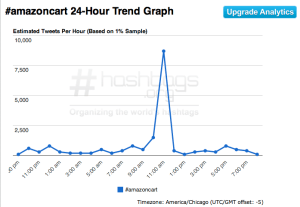
Currently it seems that the amount of #Amazoncart seems already promising (from Hashtags.org):

#Amazoncart

Naturally these are small drops in the ocean for Goliath brand like Amazon but every purchase counts. If Amazon is able to get bursts of over 8k tweets for #AmazonCart in hour constantly it definitely shows great potential for Amazon. Also after the initial development, there is not that much cost for the program (expect for the promoting it).

3. #Amazoncart is super simple
After you have connected your Twitter account to Amazon, you can reply with #AmazonCart to any tweet containing an amazon product link. This puts the item to your shopping cart and you can finish the shopping later. The beauty of this concept is that it keeps it simple enough and does not add too many steps to the progress.

Hopefully in the future we are able reply #AmazonCart to every kind of tweet beyond the Amazon links. Buying products straight from YouTube or Instagram –links anyone?

Tagged , , , , ,

Anatomy of An Insight: Tigerair Infrequent Flyers Club

Quite often I end this section by saying that I wish I would have done something like this. Well this time I actually  have. Campaign we did couple of years back to ST1 was based on similar notion, although the loyalty card worked differently (you got immediate discount when using that card).

Tigerair has been mentioned on this blog before, but this time they really nailed it right:

Insight: People have a love & hate –relationship with loyalty cards. Pretty much everyone knows that they are bullshit and eventually increase the prices you pay. Still almost everyone falls into them and their ridiculous schemes. This campaign makes fun of that notion and recognizes the fact that eventually with budget airline you are only interested about discounts.

I just love when brands have humor to laugh at category conventions.

Tagged , , , ,

You Have A Friend Request from Jesus Christ

Friend Request from Jesus Christ
I stumbled upon these ads a while back. Despite I always appreciate when organization wants to become more contemporary, these resulted only to maximum embarrathy. It feels a little bit like your father attending spring break and attempting to do Gangnam style in 2014.

I have to admit that I am not probably the best prospect for this campaign. I believe that religions in general have product problem instead of image problem. However I think John Hegarty was on to something when he stated that Roman Catholic Church is the most powerful brand in the world:

Firstly Catholic Church does not sell physical product, it sells a belief. The great brands have evolved beyond the product; Nike & Apple are almost more way of life for their loyalists than just a simple product. They have one of the most well known logos in the world (the cross), a clear mission statement (ten commandments) and own brand book (the bible). Like McDonald´s and Starbucks later on, Church recognized the importance of location. Churches are usually in the center of the city and they used to be the tallest buildings as well (before financial institutions, the religion of our age). It was also a forerunner in branded content, collaborating with the best artists of the world (Da Vinci, Michelangelo, Raphael, Mozart, Beethoven, Bach, etc.). Unlike many other brands, it has also been successful in brand extension and expanded to schools, charities and health care.

Although apparently it was not Catholic Church doing these ads, the brand is the same. For every brand there is a thin line between being too stubborn to change and being too weak to change too much.

If you work with the most powerful brand in the world, would you do ads like these?

Marketing at the Speed of Culture

If you are reading this, you are most likely one of the 16M+ people who have seen this:

The video was uploaded on Monday and started spreading rapidly yesterday. During that same day, the first brand version of the first kiss was produced by Snog Frozen yoghurt:

Not judging the quality of the film, but only applauding the speed of the execution.

The big challenge with many brands right now is that they want to tap into different trends, memes and other popular events. That is nice, but the traditional briefing process does not enable it. If you want to be real-time, reactive and in-tune with the culture, you have to market at the speed of the popular culture. Other option is just to stay true what your brand is all about and be consistent in your communications. You either change constantly or keep it real to your brand core consistently.

Many brands try to dabble little bit with both and fail miserably. That is why every brand is now doing something around selfies. Unfortunately when something is mainstream, you cannot be trendsetter by reacting to that.

Reactive advertising needs different kind of thinking and especially acting:

1)   Different kind of process
Instead of the traditional brief-debrief-creative brief- presentation 1,2, 3, n-production brief the process is streamlined. It consists of one question and one sentence:
Are we doing it?
If yes: Let´s do it.
And then everyone has to be producer.

2)   Different kind of urgency
When your colleagues share it, it is already too late. You have to act immediately when you are feeling something is getting big.

3)   Different kind of production
Do it quick, dirty and preferably yourself.

4)   Different kind of tolerance for risk
You have to accept the fact that when you are acting fast you might fail. Reactive advertising is risky, but so is everything where you can win big. Brand building should not be for the faint-hearted, but unfortunately marketing departments and agencies are filled with wussies afraid of losing their jobs.

If you do not act like this, you will be doing Harlem shake versions in 2015.

Tagged , , , , , ,

What´s App Facebook? 4 Questions You Need to Ask to Understand The Acquisition of WhatsApp

Facebook´s acquisition of WhatsApp for about 19 billion (!) is the biggest deal ever for venture-capital-backed startup. As far as the money goes, it is naturally mind-boggling amount of cash but strategically I am trying to get my head around this. Four big questions came to my mind, when analyzing the acquisition:

1. What kind of ecosystem Facebook is building?
Currently Facebook is owner of three really strong (and separate) digital platforms: Facebook, Instagram and WhatsApp. Despite launching the ad units in Instagram, the photo platform has been relatively autonomous regarding Facebook. Apparently they will continue similar approach with WhatsApp and even more so as there will be no ads (in foreseeable future) in WhatsApp. See more in question 2 on that matter.
If we compare to Google, who builds their entire product offering under strong Google branding and synergies, Facebook currently resembles more of a venture capitalist and having quite separate and independent entities. Either approach is right or wrong, but at least currently Facebook ecosystem seems quite disjointed compared to the Google one. But maybe they have a bigger plan intact: see question 4.

2. How will Facebook monetize WhatsApp?
On the investor call Facebook mentioned that there would be no ads on WhatsApp and they are mainly concentrating on growth in the near future. Currently WhatsApp is free for one year and then you pay 0.99 for every additional year (and not even in all the markets).  Current business model is not exactly breaking the bank as it has quite limited growth opportunities, but compared to many other social ventures coming from Silicon Valley it is already profitable. From monetization standpoint it is interesting opportunity for Facebook to enter also to the subscription business and test it first with WhatsApp before rolling it to wider.

3. Was it strategically right decision?
Initially buying WhatsApp seemed a rather uninspiring and unsurprising act. More forward-looking would have been buying some emerging mobile instant messaging platform from Asia (Line, KakaoTalk, etc.). Especially as Facebook mentioned that the reach in emerging markets was one of the core reasons for acquiring WhatsApp. Asian mobile instant messaging platforms would have been better fit also to current Facebook monetization strategy as these platforms are currently more open to advertising as well? Cynical view of the strategic importance of the buy was that as the main Facebook platform loses steam the growth and engagement had to be bought to please the investors.

4.  Will there be Facebook Premium in the future?
How much would you pay for your Facebook account?
It might be that the goal of buying Instagram and WhatsApp is eventually to have capabilities to introduce Facebook Premium. This social network would add the best of the Facebook ecosystem and provide value on certain subscription fee. I have been toying around with that idea for a while, but currently it seems more reality than ever before. I have been quite disappointed of the unimaginative monetization strategies Facebook has had (overtly media-focused) and venturing to subscription models without endangering the crown jewel of free Facebook seems lucrative and interesting option.

The reaction from the markets to the acquisition was slightly disappointed and Facebook stock plunged slightly.

Tagged , , , , , , ,

Anatomy of An Insight: Sorry, Coke & Pepsi.

The SodaStream ad for Super Bowl is quite vapid creatively. As a guy, I naturally do not complain having Scarlett Johansson on it but I have seen her in way more interesting settings. The beauty of this ad is that it is already banned:

The reason for the ban is the line in the end: “Sorry Coke & Pepsi”. Apparently Fox was afraid that it would upset those big advertisers and we will not see this 30 s clip in Super Bowl. That hardly does matter as the ad has already been seen over 2 million times. Daniel Birnbaum, the CEO of SodaStream acts furious, but is probably laughing all the way to the bank:

“What are they afraid of? Which advertiser in America doesn’t mention a competitor? This is the kind of stuff that happens in China. I’m disappointed as an American”

Insight: If you are challenger brand, you have to aggressively confront the bigger competitors. People love underdogs. This ad further solidifies SodaStream challenger position while making competitor look as evil giants. When your ad is banned, it actually gives extra credibility to your message. Although Coke or Pepsi might not have anything to do with the ad ban, this raises speculation about conspiracy.

Too often brands do not act as challengers or market leaders, but fell in the middle ground. As a brand you are either David or Goliath, there is no middle ground.

Tagged , , , , , , , , ,

How To Approach Your Social Media Strategy in 2014?

Year 2014 will be turbulent for both brands and agencies working with social media channels. Because of the recent IPO´s (Twitter, Facebook, etc.), the previous rebels have started to resemble more established media houses. It is a double-edged sword. Many agencies are not as stressed out as the social media ecosystem is more predictable (and none of the innovation labs is making money anyway). On the other hand, the activities have been and increasingly will be quite dull and unimaginative.

Beginning of the year is the time to think your social media strategy. For majority of the brands, year 2014 should be year of revolution instead of just evolution:

1.Facebook is the channel for reach.
Majority of your social media paid media investments should happen in Facebook to maximize the reach. In terms of sheer amount of users, it is dominant. However, the recent developments have been really worrying for brand (and other) pages as well. Certain pages have seen dips as low as 88% in organic reach. Even Facebook itself is not talking anymore about free organic reach, but instead brand pages as a way to increase the reach of the paid media. This is natural advancement and should not surprise everyone familiar with market economy. So I believe that Facebook will get bigger media share in 2014, but actually less focus in terms of engagement. I would invest more in those terms with Twitter (customer service, real-time marketing) and to visual platforms (content creation).

2.Use Twitter as the channel for real-time and customer service.
I am not saying that every brand should necessarily be in Twitter, but if you want to jump on the real-time marketing bandwagon, Twitter is the place to be. I have a love-hate relationship with Twitter throughout the years, but despite all the shortcomings the service has proven its worth. It does certain things really well (like customer service), and provides more natural ways to engage with audience than Facebook. Here is example of random interaction with Warby Parker, after I shared their innovative annual report:
Warby Parker Tweet

3.Invest heavily on visual social media channels.
Whereas online media money is going to Facebook, I would concentrate majority of the production and engagement investments to visual social platforms. No one has time to read text anymore, unless you are able to condense it to 140 characters or say it in photo.
Online video has been the fastest growing online ad format for couple of years. Naturally the pre-roll is the TVC of the new generation, but creation of good content provides great reach & engagement opportunities for brands. Video is a great tool for customer service as well:

Besides video, the photos are naturally huge and I expect the short-form video content to rise rapidly (Instagram video, Vine). Especially tutorials are naturally fit to for shorter video content (Check: #lowesfixinsix).
Many companies should actually rethink their community manager talent pool. In 2014 if you cannot take great photo or shoot a great video, you should not probably be community manager.  Social media used to be more verbal, but now it is increasingly more visual.

4. Embrace the renaissance of anonymous randomness.
Contrary to what Facebook says, many people want to remain anonymous while online. 6% of all adults on Internet use Reddit. People engage way more on Tumblr blogs nowadays than on Facebook brand pages. One reason is that not all the people want to attach their Internet personality to real-life. In Internet you can be that backpacker hiphop-dude you really are and do not need even remotely to try to sound smart. It actually reminds me of the original promise of MySpace. You did not need to use it with your real name. You could make a site for your cat if you fancied. Anonymity can naturally bring some problems, such as hate-speech, crime and stuff but it also enables refreshing randomness that is currently missing from Facebook. Many people are more interesting talking about things they are interested and not about themselves (assuming they are not completely narcissistic). So do not underestimate the power of “anonymous” social media channels. Maybe Yahoo was on to something when it bought Tumblr.

5.Experiment with the new upcoming channels.
I have written before about how you should approach your social media strategy like investor. The landscape in terms of the hot newcomers changes really rapidly. Global brands should nowadays be more tuned into what is happening on local level. Experimenting with various social media channels goes hand in hand with that. For example if you had done tests with Path, it would be easier to utilize the learnings in Indonesia (which is the third-biggest Path user country). The innovation in social media sphere is also not limited only to Silicon Valley anymore so cutting-edge firms should empower their local teams to experiment with local social media channels as well. For example WeChat is way more advanced than WhatsApp. Competitive advantage can come from everywhere. The trick is to identify it, experiment with it and scale it.

There will interesting year ahead. In 2014 companies need to dramatically update and revamp the social media strategies. Which is great. Whenever there is turmoil and crisis, there is always an opportunity.

Tagged , , , , , , , ,

Booking.com and Party in Bangkok

Right after Thailand declared a state of emergency and the unrest in Bangkok increases, I received this mailer from Booking.com yesterday:
Booking.com
Did it caught my attention?
Yes.
Did it make me want to book flights or hotel to Bangkok.
No, not really.
I have partied before in Bangkok, but the current party is not really something I would consider right now.

Lesson for the marketer: Targeting your message is not enough, you have to remember the timing of the message as well.

Tagged , , , ,