Category Archives: Insight

Anatomy of An Insight: Grey Poupon Society of Good Taste

LIKE US ON FACEBOOK!!!!

That has been the battle cry for the brands in the social media for the last couple of years. And fair enough, for the majority of the brands the more likes you have the better. But what if you are classy luxury brand? You do not necessarily want everyone and their neighbor to like your brand if you want it to be exclusive.

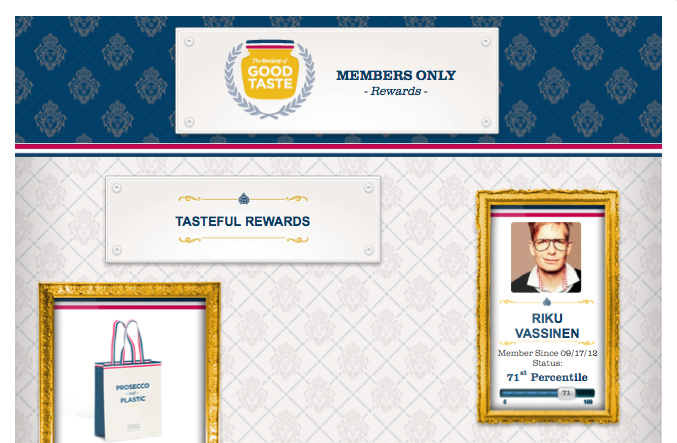
The new Grey Poupon Facebook-campaign*”The Society of Good Taste” feels like a breath of fresh air amidst the traditional like-begging campaigns. In this tongue-in-cheek application the mustard brand will only accept “classy” fans. Your “classiness” will be evaluated with algorithm searching and judging your user profile. Apparently not all of the applicants will be selected, although my social media profile seemed to be “classy enough”:

Apply for Grey Poupon fan status in their Facebook page.

Insight: When every brand is begging and bribing you to like them on Facebook, the value of the like for the consumer has become worthless. If something is easy and available to everyone, it does not seem interesting. Like Groucho Marx said “I don’t care to belong to any club that will have me as a member”.

This Grey Poupon campaign seems like a modern day and more humorous version of this classic Chivas Regal ad by Neil French:


THIS IS AN ADVERTISEMENT FOR CHIVAS REGAL.

IF YOU NEED TO SEE THE BOTTLE,
YOU OBVIOUSLY DON’T MOVE IN THE RIGHT SOCIAL CIRCLES.

IF YOU NEED TO TASTE IT,
YOU JUST DON’T HAVE THE EXPERIENCE TO APPRECIATE IT.

IF YOU NEED TO KNOW WHAT IT COSTS,
TURN THE PAGE, YOUNG MAN.

In addition to the Facebook, Grey Poupon is upping the ante in social media and has also build their website entirely on Pinterest.

*Spotted from Adrants.

Tagged , , , , ,

The Seven Characteristics of the Great Concept

I think many advertising problems are mainly problems on having a common language.

People talk about same terms, but everyone has a different meaning attached to them. The most alerting situation is when there is not an unified vision of the most basic advertising terms within the agency. When people do not share the same ideals while speaking about strategy, concept, insight & idea, you end up doing disoriented work. That work does not answer business problems and it does not touch the target audience in relevant ways. I think one of the most misused terms is concept, so I wanted to share my views about that particular term.

The Seven Characteristicts of the Great Concept

1. There should not be ever such thing as a bad concept.
I believe in quantity when it comes to ideas. I rather come up with 999 ideas to be happy with the one brilliant one, instead of doing five rather good ones. The concept is build on the great ideas. And upon the killed ones at well. When you are moving from ideas to concepting phase, you should not be medling anymore in mediocrity. That should be scrapped along the process. Bad ideas might help to make good concept, but you cannot turn bad concept into a good one. Be ruthless when evaluating which makes concept.

2. The concept is integrated by nature.
TV ad is not a concept. Website is not a concept. Funny stunt is not a concept. Still I bet that everyone has encountered (or even provided) ideas, which might be fairly good ads but could not be leveraged to work properly and fluently across all the channels. If someone says: “We have a good concept, but it does not turn to mobile/tv/internet/outdoor/inset whatever channel here”, you really do not have a good concept. Good concepts rise above the media channels. In good concepts all the touchpoints work together to build the greater campaign. So even though coming up great concepts is hard work, the executions in different touchpoints should come quite effortlessly.
There is always a need for great conceptual thinkers in this industry. That conceptual thinking ability is what separates the truly great from a mere wordsmith or visualist.

3. The concept has potential to live long.
We live in fast world, which is just getting faster everyday. Even the really brilliant concepts have less time in market than before. However, with good concepts you sense the potential that it is more than just an one-off. You can see the opportunities to carry and nurture it for years and years to the future. The common mistake is to change winning concept too fast. Brand representatives and advertising agencies get tired of the concepts more faster than general public does. Many times you see that fully functioning concept has been replaced with a new mediocre one, just for the sake of it being new. New is not always equivalent for better.

4. Concept fullfills strategy.
Strategy is about identifying the most pressing business problem/opportunity for the customer and finding the most straightforward answer to it. Concept is the creative path to the consumer mind, action & wallet fulfilling that strategy. If strategy is wrong, you will not be able to come up with great concepts. That is why agency should really spend more time kicking around the customer´s main business problem (and not just just planning department). Whole team has to believe the strategy and be behind it. If there is reason of doubt or resistance among the team, the end-result will again be a lackluster campaign.

5. The concept is scalable & flexible.
Because of the channel-agnostic nature of great concepts, you have much more flexibility in terms of production. You get better results with an excellent concept under tight budget, compared with mediocre concept pumped up with big production money. The scalability goes other way as well, the more resources you can put into concept the better it gets.

6. Great concept pushes the envelope

You have to fight for the great concept within the agency and with your client. Mediocre and small-minded people will always try to find reasons to prevent groundbreaking and highly effective work to come out. Good concept pushes the boundaries and goes against the category conventions. This does not necessarily mean controversial work, but if your concept is not highly differentiating, it will not work.

7. Great concept is simple at its core
No matter how complicated or how many phases in the initial campaign will be, the core of the great concept is usually explained easily in a couple of sentences. The answers to questions “Why” and “What” should be as simple as possible, the “How” might be more pages or presentations. The craftmanship, rigor and the time invested to actual production based on that brilliant simplicity will make miracles. There is no shortcut for perfection and many times the final extra mile makes all the difference.

“When working in agency, we have to speak the same language both inside and to outside as well”

Tagged , , , , , ,

Kicking the Habit: Five Tips to Capture the Habitual Shopper

“We knew that if we could identify them (pregnant women) in their second trimester, there’s a good chance we could capture them for years”
-Andrew Pole, statistician (Target)

One of the most thought-provoking articles I have read this year  was “How Companies Lean Your Secrets” by Charles Duhigg. Besides that it is quite unbelievable feat that you can actually track from data when your customer is in her second trimester, it had me also to think about power of habit and habitual purchases. When our conscious thinking and habits collide, usually the habit will win. Just ask anyone trying to stop smoking!

We, consumers, do not spend enourmous amount of brainpower to make everyday buying decisions. When we stroll in the aisles in our grocery store and pack our shopping carts, we usually think totally other things. We are guided by certain buying rules and only thing which might change our shopping behavior is that certain product is over. Especially when working with FMCG, the habitual buying processes are something which you cannot ignore when crafting your marketing strategy and tactics.

Five Tips to Capture the Habitual Shopper

1. Identify the habitual cues
Although consumer might shop in autopilot mode and does not really think about what he is buying, he is guided with certain habitual cues to make his selection. Certain people might make their selection based on price, others with brand and others just to minimize their walking in the store. Nielsen gives following examples of common Omega Rules:

“I always buy brand X …unless guests are coming!”
“I buy the cheapest brand on special, as long as it’s not X!”
“Brand X works for my family, but if Y is on special, I buy that!”

It is crucial to identify what is your product´s main habitual cues and rules of buying. Because if it is mainly price, even a slightest price increase might make your customer think other alternatives. And if it is not, you actually have a good opportunity to raise prices and customer will continue business as usual.

2. Avoid making the customer think during the autopilot phase.
Advertising might even be countereffective, when dealing with habitual shoppers. When customer starts to think actively about your category, he starts to also think about the competitors as well. To simplify things: if you are market leader in your category you should try to actively encourage the autopilot. If you are challenger you should try to disrupt the habitual buying process. Also advertising is crucial for the new products, because only way besides price-dumping is to get people to interested about it and buy it because of the buzz.

3. Identify the events when the habits change
Why Target is so interested about the state of pregnancy of their customers? Within certain life events, even the most permanent habits of people might change. For example these events can be the following (but not limited to): moving, having a child, changing job, getting married or divorced. Not surprisingly these are also the most stressing moments of your life. Although you have decided that you never change your morning cereal brand, when encountering above-mentioned changes, it might not be that big deal anymore.

4. Remember that customer is not always in autopilot
Consumer might be totally different shopper during weekdays compared to weekends. On weekdays we stroll like zombies trying to get our shopping done as fast as possible, but when saturday comes we might be actually seeking variety and inspiration within the same aisles. Some might also say that finding something new is also habitual behavior for humans. There are at least the following motivational segments when buying:

Bargain: You are looking for the best deal. (The weapon of choice: Discounts)
Buzz: You are excited to find certain product because of the recommendation, advertising, product placement or news mention. (The weapon of choice: In-store promotion to ensure that the first buzz does not die off)
Variety-seeking: You are actively looking for new experiences. (The weapon of choice: Trials in the store)

Important to notice is that people might shift through these different motivational ways. Also your product can be bought from many motivational standpoints. It is essential to find the main motivational cue for majority of your customers.

5. Customer satisfaction does not mean a thing for habitual purchases.
Average customer satisfaction is usually 75-85 on the scale of 100. Company might think that they are scoring well, but actually that result is just average. Other shocking statistic is that customer satisfaction explains only 8% of repurchase*. With mundane every day products, when conducting a customer satisfaction survey you actually trigger totally artificial thought process. Consumer starts to rationalize his habitual shopping behavior and basically just starts lying.

So habits are strong factor of our buying behavior. If you do not recognize that, you might do fatal mistakes as a marketer.

Recommended reading
Charles Duhigg: The Power Of Habit
Neale Martin: Habit: The 95% of Behavior Marketers Ignore*
Nielsen Deltaqual

“Recognize and leverage the power of habit and identify the opportunities to try to alter it”

Tagged , , , , , , , ,

How to Come up with Ideas? Prt.1-Food For Thought

Disclaimer: I have no idea (no pun intented), do the following methods help to actually get the ideas or insights. At least they seem to work for me. Also, this is somewhat representation of the ideal world. I have never really enough time to read all the books, magazines & websites I intend to. But I surely try to.

I think coming up with ideas and insights is mostly hard work. Writing them down, bouncing them with the team and killin the not-so-good-ones. That is why I also do not really believe in being inspired when coming up with ideas. It of course helps. You might wait whole your life of inspiration and watch as the deadlines pass by. There is no shortcut for perspiration.

I am more of a believer of being in a state of constant inspiration all the time. This is achieved by the following method:

1. Mental Scrapbook: Picking things constantly at random
I do not even know all that I don´t know. That is why I really believe in constant idea gathering. You just observe, read and pick things at random all the time. Do not stress about how useful they are, just round yourself with different ideas. They might or might not become handy later on:

a) Internet
For gathering food for thought for ideas in Internet, I rely on social media:
1) Facebook: What is really popular?
Besides I think Facebook is the pulse of what is really happening on the Internet. What news start to catch on? What videos are hot? What topics are people discussion on? Also knowing most of the people, you can socially filter the content: why this people share this and may be. Also it is always great to just spy on your old friends.
2) Twitter: What is popular in professional circles?
I follow mainly Twitter accounts, which are somehow connected to my professional life (and couple of rap artists). Through this channel you encounter ideas from places you are not that used to and which you are not yet familiar.
3) Google reader: The thinkers I want to follow
Some have said that blogs are dead, but those who say that are dead wrong. The sheer volume of blogs I actively follow has probably reduced during the years. The quality on the other hand has increased. Coming up with a blog post of a good thinking is a respectable feat and if done well, it beats 140 characters any time. Good blog post is also timeless. That is why I do not stress if I have not for some reason gone through my blogroll for a while.
4) Writing blog: Testing out ideas
I learn by writing. That is the most important reason for me to blog. This is the litmus test for the ideas. If some of the ideas spark a discussion, it is just an added bonus.
5) Bookmarking: Making an idea scrapbook
If I encounter something interesting I bookmark it. I use del.ici.ous, mainly because I have gotten accustomed to it. In there I have just lots of odd stuff, which might become useful some day.

b) Other reading
1. Books
I have always at least three books going on and it is very rare that I don´t finish a book (with the expection of Ulysses, which nearly ruined one of my summer holiday). Depending on the time, the finishing of the book might take a day or month. I usually only read books when I commute or have to wait for a long time somewhere.
I use libraries quite a lot, because it is great place to find great books which you would not read otherwise. I just pick up books with interesting names, covers and blurps. Sometimes they are great, sometimes horrible. However, I really have not read so bad book that I have not learned anything from it.
For the three books I try to have a healthy balance of different content:
a) Professional: Just opened Del Breckenfeld: The Cool Factor, a book about partnership marketing.
b) Non-fictional (but non-professional): As a big fan of 30 Rock, I am currently reading Tina Fey´s Bossypants.
c) Fictional: Trying to test out Singaporean literature, I started out easily with Singaporean detective story:Shamini Flint-Inspector Singh Investigates: The Most Peculiar Malaysian Murder

I think the biggest mistake many professionals do is to read too little of fiction books. Mediocre fiction beats good business book.

2.Magazines
I read couple of magazines frequently (VF, New Yorker, Fast Company), but try to grab occassionally pretty much everything I see. For example, when I go to the barbershop, I always check out Cosmopolitan and other women´s magazines. Other thing which I always try to do is to read all the stories cover-to-backcover in certain magazine. This way you encounter stuff you would not necessarily choose to pick if you would choose it yourself.

d) News
I read newspaper every morning. I know it is old-school. That is usually enough to know what is happening in the world so that you do not appear stupid during the day and you do not have to spend time during the day to follow all the news in Internet news channels. Usually if something major happens during the day you will see it in social media.

e) Other popular culture
Actually the same process that goes to the books applies to movies, music and other things. I try watch the most popular movies, just to understand what makes people tick. Then you just try learn from the experience. And enjoy it as well. Although the enjoying bit is easier for me with the new Superhero-movies than for example Twilight-series. Other than the smash-hits, movie or music festivals are great way to get yourself familiar with the more obscure art. For example there is Japanese Film Festival going on here and I would haven´t probably see those movies anywhere else.

f) Personal talks
I think one of the hardest thing about ageing is that you do not get to see as much new people as you used to be. Especially being in the same place for a long time, you end up spending your time with the same people all the time. That is good to move once in a while, so that you are forced to meet new people.

g) Travelling & observing
It is easy to pick things at random when you are in totally new place. The skill is to find something new and worthwhile in the place you are staying for a long time. It is so easy to just fell on the certain routines. My noble goal is that whenever I am, I try to test something new every week. Currently it has been really easy, because I have been in Singapore only couple of months.

2. Building up specialty: Frequent deep-dives

With couple of topics I tend to go deeper and also frequently and actively search the information about it. Those topics include such as social media (professional) & hiphop-music (non-professional). I think the main difference with frequent deep-dives and random idea gathering, is that former is more conscious effort and the other just happens more organically.

3. Hitman-for-hire: Case-specific deep-dives

When I start working with a new client, project or am working with the pitch for a new client, I usually follow the following steps to gather food-for-thought for ideation process.
a) Search of your mental scrapbook
I first go by all the material from the category, brand, company and product which I have already encountered: all the books, bookmarks, magazine stories, discussions and such. This provides the backbone of where I continue my search further.
b) Specified reading
After going through the mental scrapbook, I dive deeper to the subject.  I try to read at least couple of the highly-regarded books and industry magazines about the subject to get on the right mood.
c) Industry outreach
Picture might worth a thousand words, but a good discussion is worth probably a million. Try to spend as much time with the client as possible. Meet people from the same category, client´s customers and people from the target audience. Try to pick them brain as effectively as possible.
d) Observe the marketplace
Especially with FMCG gategory, I try to spend as much time as possible in different retail stores packing that brand or competitor´s product as possible. By observing actually shopping behavior you learn so much.
e) Use the product
With B2B-category this might be trickier and there might be certain limitations with other products as well. You should still try to immerse yourself with the product in question as deep as possible. And again I cannot stress the importance of talking with the target audience and the actual users of the product.

On the next part, I will reveal the “process” of the actual ideation process when I am working with the tight deadline.

Inspiration is hard to come by when you are forced to, that´s why you should try be in a state of constant inspiration by randomly stumbling on interesting things.

Tagged , ,

Best of Cannes: The Most Popular Song (JWT Puerto Rico)

The Grand Prix winner in PR-category was definitely one of my favourites this year:

Three reasons why this resonates:
* Grounded on the deep understanding of the culture (both popular & national).
* Succesful integration of the channels (Not just 360 but more of 365: great example how the different touchpoints compliment each other)
* Story-telling mode (The story started with a bang, had the interesting middle part and then ended with another bang)

Many times there is awarded advertising which can only be categorized as a stunt. This shows that you can go much deeper than just being a stunt, being a part of popular culture and being a movement. Making the leap from making advertising to making movements is a long and hard road. It is still the only road to take in 2012.

Tagged , , , , ,

Anatomy Of An Insight: Nike Barbershop

How do you know an ad gots a good insight?

When you see it, you find it so obvious that you nearly start beating yourself in the head, because you hadn´t used it before. I bet I wasn´t the only one with that reaction when I saw this Balotelli ad.

The main Nike Euro Film was great in all its megalomaniac glory and secret tunnels, but I appreciated the subtle irony in this Nike Barbershop ad & Facebook app.

The insight is simple: footballers have stupid personal-looking hairdos.

The better footballer, the more odd hairstyle. Or you do not even have to be so good, you should be remembered at least from your hair. I remember my first favourite player was Maradona (cool hair) then Ruud Gullit (even cooler hair), Valderrama (The most epic hair ever) and then Cantona (Ordinary hair, but super cool collar). Balotelli is not my favourite player, but he definitely holds it own on the hairdo front.

Good insight is someone that everyone knows, but no one has dared to use it yet.

Tagged , , ,