Category Archives: Insight

Sharing is A Selfish Act

Why people share things?

Honestly, sometimes I really do not know. For example this clip below has gotten over 1M views:

Many times, it is easier to say why they are not sharing your content. Often the reason is that your content just sucks. And while it sucks, it does not suck enough to commemorate ironic share (like the video above).

While you may theorize the psychology of sharing until the end of the day, I find it relatively easy. You share either useful or funny content. Being useful is more multi-dimensional, as it might mean that the content is useful to either the sharer or the expected receivers. This is the reason why the world´s most uncreative people share all these creativity links and quotes on Facebook.
Stop it. You are not fooling anyone.
We attribute sharing to our individual image, but it is quite seldom even a slightest reflection of who we really are. When people are anonymous (discussion forums, Reddit, 9GAG, etc.) in Internet the content that is share is completely different. In real social media, what is truly shared is anti-social content. Anonymous comment is much more authentic representation of human spirit than airy-fairy “we-are-the-world”-share from the self-help guy in newsfeed near you.

It is gross misunderstanding that this age of oversharing is increasing openness to our culture. Facebook is just homogenizing what we share and has people showing their polished desired images. My feed is overpopulated with engagement announcements and baby photos. It is not even statistically possible that there is so much mating going on in my network every single day. You feel forced to like and comment those photos, which creates vicious cycle of boring content to my newsfeed. This is the reason I have decided to like every negative status update from now on to show my support to reality and attitude in 2014. Sadly, I have not been able to walk the walk and my own personal status updates are nowadays only about my sport accomplishments. Facebook has become a commodity, which has made it commercially interesting but same time really boring on an individual level.

We said in our book “Digital Fooprint” in 2010, that in digital age everyone is personal brand. Unfortunately we were right and the social media is full of overtly self-conscious personal branders optimizing every like and comment.


Tagged , , , ,

Anatomy of An Insight: Denham Psycho

Although making fun of “hipsters” starts to be quite passé, this video still gets a pass. This brilliant piece showcases one hipster doing his best Christian Bale impersonation while having product integrally in the film as well:

Insight: If you do branded content, it has to be interesting content first and foremost. Brand comes later. If you are paying homage one of the nihilistic and violent movies of our generation, you have to be violent as well. Denham is not competing against other jeans brands in YouTube. It is competing against all the content out there. The quality criteria of our target audience has gone up and we either match it or become obsolete.

Denham Psycho is not everyone´s cup of tea. This is not a concept getting lukewarm reception in meeting room. You either love it or hate it. And that is how it should be. Advertising should be discriminating. Your marketing communications should make a clear distinction between them and us. Messaging strategy is not only about thinking to whom we are talking to. It is also about deciding, who you will leave out of your party. If you do not get popular culture reference to cult movie, maybe you are not Denham target audience to begin with.

When creating branded content, it is balance act between brand relevancy and brand controversy. As a jeans brand, Denham is in in the lucky position to dial up the tone to the latter spectrum.

Tagged , , ,

100th Post: Year 2013 in Review

This is my 100th post on this blog.   Tennis clap. Or even Nolia clap, if you are really excited about the fact.   If you want to read my point-of-view about this year´s digital trends, I recommend reading these predictions.   I started this blog for one simple reason: I wanted some channel where to express myself verbally about (marketing) subjects that tickle my interest. I used to blog in Finnish to the biggest marketing & advertising magazine, but stopped it immediately when I moved to Singapore in 2012. It would have felt odd to blog in Finnish weekly when you are living abroad. So it was also naturally to switch the language to my second one, English.

This year I was asked to write a regular column (once every third month) in the biggest business daily in Finland. It has been great to write in Finnish again and surprisingly I also always get feedback from those columns, although they are only published in offline format. Maybe print is not dead after all. In terms of written output, I am still more of a digital guy, so I regard this as my main channel for verbal expression. Also because I can write here as often or seldom as I want. Also there are no size restrictions and I can have as long-winding introductions as I want (which might be a bad thing as well).

I do not stress too much about writing these posts. Sometimes I write daily, sometimes there is even a month break. Last year I wrote 52 posts: exactly on steady weekly pace. I do not worry that much about views or comments either. Blogging for me is one method of working and thinking. When you have to condense certain topic (like Google Search Algorithm changes) to blog format it automatically sharpens your thinking. Planning is not only research, but more about finding and presenting insights influenced by research. This blog is one tool to do the research, find and present different insights and opinions. Hopefully also in a format which is interesting for readers.

Luckily I am not the only who is reading this blog and the most popular posts have gotten thousands of views last year:
The Most Read Blog Posts
Read them below:
1. Rethinking the Advertising Agency Team Structure
2. #Lufthansafail: Why You Cannot Separate Customer Service and Social Media?
3. The Seven Characteristics of a Great Concept
4. Craft Your Presentation like FBI Interrogation
5. Psycho Marketing 101

Expect for the Lufthansa-post, the top five list comprises of timeless content (three of them actually written in 2012) and some of them are my own favorites as well. It is interesting to analyze what kind of post strikes a chord with your readers. For example, I do not know why FBI interrogation techniques and marketing of Psycho movie are more popular than critical analysis of selfies. I liked the latter way more, but eventually the audience decides the value of every post. The most popular post was not a surprise though. I have talked about the subject and that particular post with many people from our industry, and it feels that I have been onto something with it. Not yet entirely sure what.

This year I will continue to write when I feel like it and about the things I feel passionate about. Thanks for everyone who has read these rants thus far. There will be plenty more. Stay tuned and Happy New Year to everyone!

Tagged , , ,

How to Disrupt the Marketplace like Beyonce

“I didn’t want to release my music the way I’ve done it. I am bored with that. I feel like I am able to speak directly to my fans. There’s so much that gets between the music, the artist and the fans. I felt like I didn’t want anybody to give the message when my record is coming out. I just want this to come out when it’s ready and from me to my fans.”
-Beyonce Knowles

Sometimes the best marketing is just let the product speak for itself. Just as the speculation for the albums of the year seemed to slow down, Beyonce dropped a bombshell. In this era of leaking albums way ahead their release dates, Beyonce actually was able to release her record “in a secret”. Last Friday morning without  advance single, marketing campaign, radio airplay or TV performances. That naturally was not a secret for long as every media jumped to cover that. What is also notable that the album is currently sold only as an album exclusively in iTunes. What can we learn from this approach?

1.    Reward your fans first
As the average life cycle of hit song is only weeks at best, who actually buys albums anymore? Who remembers that Harlem Shake happened this year? Beyonce is one of the few artists who still have a fan base big enough to move considerable amount . Why you should not treat your most loyal customers well and give them something they hold in high value? The approach has been successful: the album sold 430k units on one day. The rest can cherry-pick their songs later (see point 3)

2.    Good content is the best marketing
When you are superstar and you really believe in your music, it is only natural to believe that every song in that album is a potential single. The most-sold and most solid pop album ever Thriller was quite close to it: having seven of the nine songs as singles. Beyonce has done video out of every song of her new album (17). Actually some radio stations are currently having all the songs in rotation. Don´t be misunderstood though, this is not cheap way to do it. Although you save a little in media spend, having Hype Williams to produce your video is still costing you quite a much.

3.    You do not really need to disrupt everything, just one thing
What is really brilliant with Beyonce-approach is that it is rare instance when you can have the cake and actually eat it too. Beyonce just skipped the pre-launch PR & advertising bits. The download is album-exclusive only for a week. Then it is back to the usual: streaming services start, there will be singles from the album and I bet that Beyonce will not decline interview requests.

4.    Finding the right partner is crucial
Beyonce partnered with iTunes to make this happen, her husband Jay-Z partnered with Samsung to make other hyped album launch of the year. From the bigger artist perspective, the music business is increasingly more B2B than B2C:

5.    Understand what business you are in
So what is music business nowadays? It is not about selling albums or even singles. It is about creating experiences. This is obvious when analyzing how much the biggest artists get from touring. Experiences are not limited to real-life, but are happening more in digital. Before you made music video to promote the song. Now you do song to be able to do the YouTube-video.

To pull something like this out and with this effect, you need to be an artist of Beyonce-calibre (there is not that many) and also you have to be first to do it. Free publicity of the stunt is something you cannot duplicate. So this approach per se is not the future of music business. What is the future, that the money does not come from only music, it comes from the whole package.

Although for this week, we can try to believe that music album still matters like in 1980´s. The album is actually quite good, but naturally not the Thriller.

Tagged , , , , , , , ,

Anatomy of An Insight: Burger King Anti-Pre-Roll

Accidentally I stumbled upon two Burger King campaigns this week which were on totally opposite side of the spectrum. Whopper Sellout was a disaster, but this pre-roll campaign is great:

Insight: People hate pre-roll videos. Ironically, you probably have to watch one to see the case study above. There is nothing more annoying than seeing boring ads, when you just want to see Japanese diarrhea dance. I pretty much always skip the pre-roll, expect if it really captures my attention immediately. Kobe & Messi Selfie Shootout was probably one of the latest pre-rolls I watched from beginning to end. But what if you tailor your pre-roll message to the content your audience is going to watch?

Really simple and effective idea also tied to promotional message. It would be interesting to see some stats from the campaign as well and to compare the finishing rates to regular Burger King promotional pre-roll.  My hunch is that this execution did quite well. This is also a great example that nowadays you really cannot separate creative and channel planning. They go hand in hand.

 Content is king, but context is king kong. 

Tagged , , , , ,

Whopper Sellout: Facebook Like is Not A Sign of Loyalty

One of the most idiotic campaigns lately has been this effort from Burger King Norway:

Effectively they subsidized their biggest competitor with 50 000 krones and lost 30k of their Facebook audience at the same time. But hey, now they have more engaged Facebook community with only those who care, right? Or they have 8000 fans who have already opted out of Facebook messages and have not seen the status updates about campaign.

Why this campaign was just really idiotic stunt?

1.Fast food is not loyalty business.
Majority of the people eat both in Burger King and McDonald´s. When you are hungry your main selection criteria is location, location & location. 72% of Pepsi drinkers drink Coke as well. Also if you offer free gift coupon for your main competitor and the only downside is that you cannot join a brand Facebook page anymore. Who would not get this deal? We are not talking about your favorite basketball team here. We are talking about burgers. How often you go to social media to really engage with burger? If your brand page disappeared today, who would mourn it?

2. Fast food is a mass business.
Even your most loyal 8k fans do not really make dent in your results. Therefore I rather had 40k disloyal bargain hunters than 8k hardcore Burger King loyalists. Sometimes Facebook is just reach and not engagement. The situation would be different if your average buy would be hundreds of dollars. Buying the fast food is low-interest buy. In reality you want the people fast in-fast out and not really expect them to discuss about your brand further.

3.Fast food business is led by promotions.
People wait for the new burger variants, one-dollar discounts and 2-in-1 deals. Why not give what they are wanting for? Majority of the brands should just realize that their Facebook page is only place for promotions, sweepstakes and occasional social media meltdowns. People go to Facebook because they want to connect with their friends. They do not want to connect with brands. They might do it occasionally, if they really want to or if they are bribed properly. Most likely they are too busy uploading selfies than answering your boring brand poll.

Liking in Facebook is quite seldom an act of loyalty. Quite often your most loyal fans do not even know that you have Facebook. It is totally delusional to argue otherwise.  And do not get me wrong, I do not think that there is necessary any value to Facebook like and there has been brilliant campaigns playing around the mindless like-chase. I have to also admit that “Whopper Sacrifice” is still one of the most brilliant FB campaigns ever. They were probably trying to come up with something like that in Norway, but failed miserably.

Much more effective campaign would be to offer people to switch their whopper to Big Mac in Burger King. Then I think more people would show loyalty and you would have gotten nice case study video material. Or do a campaign where you can only like either McDonald´s or Burger King in Facebook, and reward those who select Burger King as their solely FB Burger fan page with free Whopper. With Whopper Sellout the mechanics were just wrong and therefore it failed (and nicely done case study video does not change that fact).

Only good part of the campaign has been the publicity it has garnered (like this long piece on Fast Company). Calculated through that, it might have been worthwhile to lose those 30k fans. They also seem to have gained 2000 new ones after this latest stunt, so maybe it was just really twisted PR stunt and I fell victim to it as well.

Otherwise this just looks like award case study scam gone terribly wrong.

Tagged , , , , , , ,

Cut The Bullsh*t: What Cutting Your Hair in Subway Station Can Teach You on Innovation?

Besides my grocery shopping habits I have changed my haircutting habits as well. Before I used to spend quite a lot time and money to fancy barbers, but as the time is tighter in fast-paced Singapore, I have found my new favorite business venture QB House. They are fast barbershop located in MRT stations and offering just cut really fast and really cheap.
 
Today while taking my haircut, I started to think what all the other categories could learn from their approach:
 
1. Concentrate on essentials
Especially for the guys you seldom need washing the hair or coloring services. You just need the quick cut. Many times the route for drastic category reinvention is to start taking things away. Crossfit is great example of this in sports category (having higher margins though as well). Think about budget airlines. Do we really need airline food? For many of us, the answer is resounding no.
 
2. Make it faster in slow category
I used to spend altogether almost two hours to my visit in Barbershop. Reserving it was a pain in the ass and it took weeks of time. Now I just pop to QB House on my lunch break and does not even think about it. What if you could get your glasses in a hour? Or your car in one day?
 
3. Give bold promise
“10 minutes just cut” is the tagline for QB House.  I have actually timed the experience in QB House and many times it goes a little bit over it. I don´t really care about that. The bold promise gives indication that it is fast and something you can do within time restraints of your lunch hour or when you are waiting for subway. What bold promise you could give in your category? We give you credit card in an hour? We give you a loan in an hour?
 
4. Be cheap
Until last year the QB House promise was even more compelling from price-perspective: 10 minutes and 10 Singaporean dollars. Now the inflation has taken its toll, but price is still reasonable: 12 Singaporean dollars (7 €/9.5$). Price is totally connected with cutting all the unnecessary bits away. What is the core of your business and what are just the add-ons?
 
5. Be consistent
Instead of being loyal to specific barber or even specific location. QB House is located in MRT stations and strategic mall locations, which means that I can actually visit barber no matter where I have to go. The process is so fast that I can accidentally pop by. Before having the haircut defined my whole day routine. QB House is the McDonald´s of barbershops. You always know what to get. Again consistency and strict processes contribute to two things: effectiveness and familiarity. Effectiveness makes business sense for company and familiarity makes the consumer to come back. Although I never get the comb they offer me, it is still a nice gesture. And actually because the barbers cut so many people, the quality is actually really consistent as well. But to be honest I would not try to get new hairstyle from QB House. I don´t think they would want that either. Stick to the essentials and be consistent.
 
Actually I go more often to barbershop nowadays as well (every three weeks, might also be that I am rocking the undercut), so the new way of doing things has actually altered my behavior as well. The yearly customer value adds up though and I bring over 200 dollars for QB House yearly. You do not even think about it, because the single transaction is so low.
 
If your category has done things certain way for a long time, it is good indication that you could do it differently. How could you be faster, cheaper and more revolutionary on your category?

Tagged , , , , ,

Disturbing Retargeting Pt.2

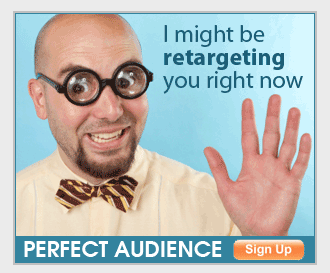
Speaking of retargeting, this creepy ad popped in my screen today:
Creepy retargeting
No, I do not remember that one time I visited your weird site. And even if I would remember, I would surely want to forget that time. Why I would want to visit sites with bald guys with glasses with weird look on them? Was I drunk? Is there something else I should remember? Or try to forget?

I did not click the ad, although I googled the company. Apparently they are company offering retargeting services. Go figure. Probably visited their site when I was writing the post about retargeting last week.

They continued bombarding me with that scary dude later on:
perfectaudience2
No shit, Sherlock.

Catching the attention is one thing.
Catching relevant attention which converts to engagement is other.
The latter requires more finesse.

Tagged , ,

Anatomy of An Insight: Kobe vs. Messi Selfie Shootout

Turkish Airlines taps into the selfie-phenomenon in their new ad:

Insight: Taking a selfie is about telling a story and capturing a moment. The bragging rights in holiday photos are huge. Travel photos constitute big portion of selfies, so it is great connection for airline to build on. It also continues nicely the rivalry theme from the previous ad featuring Kobe & Messi (over 100 million views). Compared to that one, the bridge to actual brand promise is actually tighter. The whole spot ends with the mention that Turkish Airlines flies to more countries than any other airline. Just brilliant.

This is a great example of utilizing celebrities in smart way and telling insightful brand story at the same time. Guaranteed to garner millions of views.

Tagged , , , , , ,

#Selfie: New Way of Communication or The Tipping Point of Narcissism

I ran a marathon last Sunday (in time 3:58:55 if you want to know) and I noticed people taking photos of themselves with smartphones during the run. The act of taking selfies did not seem to cause accidents in Singapore like in Hong Kong, but selfie-taking is truly fascinating phenomenon and the selection as the “word of the year” by Oxford dictionary underlines the importance.

Last year I wrote how Pinterest is the tool for lazy & self-obsessed and cynically you could say that selfie is the tipping point of that laziness and narcissism. You do not even need to be interested about anything particular expect yourself. However, when looking more closely the selfie-picture is more revealing than your average duckface:

Visual storytelling: Selfie is about the process, not the end product
In your average marathon you have professional photographers almost in every turn. So taking a selfie is not about having a photo of yourself, it is about taking the photo as well. Selfie is about being the creator and the subject. How you take the selfie is almost as important as how you look. Do you take the photo from up or down, portrait or landscape and what is your pose? Do you squinch, smize or prune? I think where many analysis go wrong is that taking a selfie is a purely narcissistic endeavor. Many times selfies are not solely about how you look, but what is the message you really want to convey. What is the moment you want to capture? As the visual storytelling becomes more and more important, taking a selfie is same as sending SMS was to my generation. Like Frédéric della Faille (founder of Frontpage) concludes in New York Times article:

“The idea of the selfie is much more like your face is the caption and you’re trying to explain a moment or tell a story. It’s much more of a moment and a story than a photo. It is not about being beautiful.”

When people wondered why Facebook offered three billion for Snapchat, this is the main reason. Selfies are a new communication vehicle. Why Snapchat turned the offer down? Maybe they have clearer vision in the selfie crystal ball than us. Or they are just crazy.

Looking good: Expect the rise of selfie-enhancing tools in 2014
Although me, myself & I are not the only drivers for selfies, they are naturally the main ones. Teenagers taking selfies at funerals or exposing private parts in Snapchat are sad examples of selfies. Selfies strengthen the worrying trend of overtly focus on appearance even at younger age. You are bombarded everywhere with certain beauty ideal, how you will match it?

Well, if you do not have the right looks naturally you can always fake it.

Modification and enchanching the selfies are huge opportunities for innovation and quick monetization. China is leading the way on this one. Meitu Xiu Xiu (super simple photo editor) is already one of the most popular apps there, and Momentcam reached no.1 position in Appstore also beyond the China borders. If people are spending so much time taking photos of themselves, natural next step is that they will spend more time polishing them. That will enable them either to look good (Meitu) or tell their story or capture the current moment better (Momentcam).

The selfie-phenomenon will not disappear soon. More likely we see acceleration in the amount of selfies. What started from teenagers has already expanded to adults. According to Samsung study 30% of all pictures taken by 18-24 year olds are selfies. That is quite many gigabytes of duckfaces. Soon you will see your parents taking selfies. And you remember what happened when your parents joined Facebook?

When the trends get tired is the moment when they come commercially interesting.

Tagged , ,