Category Archives: Business

#AmazonCart: Innovation in Advertising (not in eCommerce)

I am somewhat skeptical about utility marketing.
Yes, brands should be useful.
But as far as the advertising goes, most of the brands are fighting with the lack of attention. They need to first crack the indifference barrier amongst consumers. For that you have to first entertain and then deliver.
To underline this point, brand apps are generally destined to fail. Over 80% of them struggle to get even 1000 downloads.
That being said this is useful marketing at its finest:

Why this approach rocks?

1. #Amazoncart taps to real behavior
People already use Amazon as a “shopping list” for their future purchases. This just makes it couple of clicks more easier. At its core, this is not really educating new behavior just a minor tweak to existing pattern. I think tapping to the shopping list behavior is the core thing and also something that many of the commentators have not fully grasped. #Amazoncart is not innovation in eCommerce it is an advertising innovation:

2. #Amazoncart is free advertising with every tweet
Besides being rooted to real behavior, every time someone tweets #AmazonCart it will be visible to followers of that person. Making #AmazonCart hashtag famous is one thing, but actually what is the most brilliant part that the amazon product link gets double exposure as you add to Amazon cart by replying. This creates more opportunities for people to see it and go buying in Amazon.
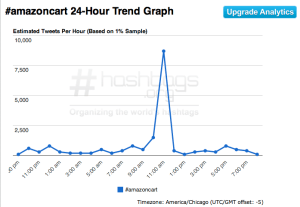
Currently it seems that the amount of #Amazoncart seems already promising (from Hashtags.org):

#Amazoncart

Naturally these are small drops in the ocean for Goliath brand like Amazon but every purchase counts. If Amazon is able to get bursts of over 8k tweets for #AmazonCart in hour constantly it definitely shows great potential for Amazon. Also after the initial development, there is not that much cost for the program (expect for the promoting it).

3. #Amazoncart is super simple
After you have connected your Twitter account to Amazon, you can reply with #AmazonCart to any tweet containing an amazon product link. This puts the item to your shopping cart and you can finish the shopping later. The beauty of this concept is that it keeps it simple enough and does not add too many steps to the progress.

Hopefully in the future we are able reply #AmazonCart to every kind of tweet beyond the Amazon links. Buying products straight from YouTube or Instagram –links anyone?

Tagged , , , , ,

Sharing Economy: A Threat or An Opportunity for Your Business?

“Our guests don’t want the Airbnb feel and scent”

– Christopher Norton, EVP of global product and operations at the Four Seasons (Fast Company 184/April 2014)

If I would be running hotel chain at the moment, I would not be saying comments like one above. I would be trying to learn meticulously what Airbnb is doing well and taking some cues to my existing business. Some of the hotel companies are already experiment with it, like W Hotels and Desks Near Me collaboration.

There are two major trends driving the sharing economy which are affecting your business as well :

1)   Digital tools have enabled global sharing economy services. This provides adequate scale for the companies to make financial sense. For consumers this means user-friendly services and tapping into global offerings.

2)   Ownership is not cool: experience is the new Rolex. Owning stuff is not ecological or smart: people are increasingly more investing in services and experiences.

Sharing economy is not a means to an end. Where it has already been successful (accommodation & transportation), it is actually improving the current experience. Majority of Airbnb users could use hotels as well, but they are bored with existing Hotel offerings and want more personalized experience. Uber works best in markets, where there are problems with Taxi services or public transport. Consumers are ruthless: they select the best service nevertheless of how it is produced. It works other way around as well. When trying to reach mainstream success, your experience has to be able to compete with “normal” offerings as well. Price plays naturally part as well, but only low price cannot be the competitive difference for the new services.

It is likely that many sharing economy initiatives will fail and badly. Some of them will succeed and in big way. Airbnb founders will not be the only billionaires emerging from sharing economy. That is why brands should experiment with sharing economy initiatives now, when their category has not yet been disrupted with the strong sharing economy player.

Other option is to only concentrate on suing the new competitors and hope that they go away. Unfortunately, that is not a winning solution. Successful companies have to grow and constant innovation is the only way for that growth.

Tagged , ,

You Have A Friend Request from Jesus Christ

Friend Request from Jesus Christ
I stumbled upon these ads a while back. Despite I always appreciate when organization wants to become more contemporary, these resulted only to maximum embarrathy. It feels a little bit like your father attending spring break and attempting to do Gangnam style in 2014.

I have to admit that I am not probably the best prospect for this campaign. I believe that religions in general have product problem instead of image problem. However I think John Hegarty was on to something when he stated that Roman Catholic Church is the most powerful brand in the world:

Firstly Catholic Church does not sell physical product, it sells a belief. The great brands have evolved beyond the product; Nike & Apple are almost more way of life for their loyalists than just a simple product. They have one of the most well known logos in the world (the cross), a clear mission statement (ten commandments) and own brand book (the bible). Like McDonald´s and Starbucks later on, Church recognized the importance of location. Churches are usually in the center of the city and they used to be the tallest buildings as well (before financial institutions, the religion of our age). It was also a forerunner in branded content, collaborating with the best artists of the world (Da Vinci, Michelangelo, Raphael, Mozart, Beethoven, Bach, etc.). Unlike many other brands, it has also been successful in brand extension and expanded to schools, charities and health care.

Although apparently it was not Catholic Church doing these ads, the brand is the same. For every brand there is a thin line between being too stubborn to change and being too weak to change too much.

If you work with the most powerful brand in the world, would you do ads like these?

Why Digital Detox is Bullsh*t?

Recently there has been lots of hype about people going on digital detox. Digital detox means that you stay away from your mobile, computer and social media channels for a pre-determined time and then brag about it afterwards in digital channels.

Talk about contradiction in terms.

Generally people can do whatever they want with their life and time. I am also all for people living without digital devices for real. It is everyone´s individual choice and I celebrate that. Digital detox however is just lame attempt to have the cake and eat it too. The problem is that all this hoopla around people going back to the Stone Age blurs the real story around digital:

Digital devices and Internet has made our life better.

This is true to technological advancement in general. Life is better now than it was hundred years ago. Period. Every year people are becoming healthier, happier and more productive.

Thanks to the technology.

As technology develops people develop as well. Before some Luddite turns up the example of atom bomb, I would like to quote Kevin Kelly from his brilliant book “What Technology Wants”:

“The world does not need to be perfectly utopian to see progress. Some portions of our actions, such as war, are destructive. A bunch of what we produce is crap. Maybe nearly half of what we do. But if we create only 1 percent or 2 percent (or even one-tenth of 1 percent) more positive stuff than we destroy, then we have progress”

This the reason why ads like these make me sick:

Yes, it is annoying if your friend is meddling with his phone during your lunch. Or maybe you are just boring? Or whatever happened to the plain old firm saying: “Stop checking your phone”.

Digital detox and ad like this Coke example spread the message that we are digital slaves not capable of control it. This message is wrong and also destructive.

We are the masters of digital devices and social networks.
We can control them and we can control ourselves as well.
That is why I urge everyone to digital retox.

The more we use new digital devices, connect with each other and are open to the future, the more we will develop as a human beings.

Tagged , , , , , ,

What´s App Facebook? 4 Questions You Need to Ask to Understand The Acquisition of WhatsApp

Facebook´s acquisition of WhatsApp for about 19 billion (!) is the biggest deal ever for venture-capital-backed startup. As far as the money goes, it is naturally mind-boggling amount of cash but strategically I am trying to get my head around this. Four big questions came to my mind, when analyzing the acquisition:

1. What kind of ecosystem Facebook is building?
Currently Facebook is owner of three really strong (and separate) digital platforms: Facebook, Instagram and WhatsApp. Despite launching the ad units in Instagram, the photo platform has been relatively autonomous regarding Facebook. Apparently they will continue similar approach with WhatsApp and even more so as there will be no ads (in foreseeable future) in WhatsApp. See more in question 2 on that matter.
If we compare to Google, who builds their entire product offering under strong Google branding and synergies, Facebook currently resembles more of a venture capitalist and having quite separate and independent entities. Either approach is right or wrong, but at least currently Facebook ecosystem seems quite disjointed compared to the Google one. But maybe they have a bigger plan intact: see question 4.

2. How will Facebook monetize WhatsApp?
On the investor call Facebook mentioned that there would be no ads on WhatsApp and they are mainly concentrating on growth in the near future. Currently WhatsApp is free for one year and then you pay 0.99 for every additional year (and not even in all the markets).  Current business model is not exactly breaking the bank as it has quite limited growth opportunities, but compared to many other social ventures coming from Silicon Valley it is already profitable. From monetization standpoint it is interesting opportunity for Facebook to enter also to the subscription business and test it first with WhatsApp before rolling it to wider.

3. Was it strategically right decision?
Initially buying WhatsApp seemed a rather uninspiring and unsurprising act. More forward-looking would have been buying some emerging mobile instant messaging platform from Asia (Line, KakaoTalk, etc.). Especially as Facebook mentioned that the reach in emerging markets was one of the core reasons for acquiring WhatsApp. Asian mobile instant messaging platforms would have been better fit also to current Facebook monetization strategy as these platforms are currently more open to advertising as well? Cynical view of the strategic importance of the buy was that as the main Facebook platform loses steam the growth and engagement had to be bought to please the investors.

4.  Will there be Facebook Premium in the future?
How much would you pay for your Facebook account?
It might be that the goal of buying Instagram and WhatsApp is eventually to have capabilities to introduce Facebook Premium. This social network would add the best of the Facebook ecosystem and provide value on certain subscription fee. I have been toying around with that idea for a while, but currently it seems more reality than ever before. I have been quite disappointed of the unimaginative monetization strategies Facebook has had (overtly media-focused) and venturing to subscription models without endangering the crown jewel of free Facebook seems lucrative and interesting option.

The reaction from the markets to the acquisition was slightly disappointed and Facebook stock plunged slightly.

Tagged , , , , , , ,

How To Approach Your Social Media Strategy in 2014?

Year 2014 will be turbulent for both brands and agencies working with social media channels. Because of the recent IPO´s (Twitter, Facebook, etc.), the previous rebels have started to resemble more established media houses. It is a double-edged sword. Many agencies are not as stressed out as the social media ecosystem is more predictable (and none of the innovation labs is making money anyway). On the other hand, the activities have been and increasingly will be quite dull and unimaginative.

Beginning of the year is the time to think your social media strategy. For majority of the brands, year 2014 should be year of revolution instead of just evolution:

1.Facebook is the channel for reach.
Majority of your social media paid media investments should happen in Facebook to maximize the reach. In terms of sheer amount of users, it is dominant. However, the recent developments have been really worrying for brand (and other) pages as well. Certain pages have seen dips as low as 88% in organic reach. Even Facebook itself is not talking anymore about free organic reach, but instead brand pages as a way to increase the reach of the paid media. This is natural advancement and should not surprise everyone familiar with market economy. So I believe that Facebook will get bigger media share in 2014, but actually less focus in terms of engagement. I would invest more in those terms with Twitter (customer service, real-time marketing) and to visual platforms (content creation).

2.Use Twitter as the channel for real-time and customer service.
I am not saying that every brand should necessarily be in Twitter, but if you want to jump on the real-time marketing bandwagon, Twitter is the place to be. I have a love-hate relationship with Twitter throughout the years, but despite all the shortcomings the service has proven its worth. It does certain things really well (like customer service), and provides more natural ways to engage with audience than Facebook. Here is example of random interaction with Warby Parker, after I shared their innovative annual report:
Warby Parker Tweet

3.Invest heavily on visual social media channels.
Whereas online media money is going to Facebook, I would concentrate majority of the production and engagement investments to visual social platforms. No one has time to read text anymore, unless you are able to condense it to 140 characters or say it in photo.
Online video has been the fastest growing online ad format for couple of years. Naturally the pre-roll is the TVC of the new generation, but creation of good content provides great reach & engagement opportunities for brands. Video is a great tool for customer service as well:

Besides video, the photos are naturally huge and I expect the short-form video content to rise rapidly (Instagram video, Vine). Especially tutorials are naturally fit to for shorter video content (Check: #lowesfixinsix).
Many companies should actually rethink their community manager talent pool. In 2014 if you cannot take great photo or shoot a great video, you should not probably be community manager.  Social media used to be more verbal, but now it is increasingly more visual.

4. Embrace the renaissance of anonymous randomness.
Contrary to what Facebook says, many people want to remain anonymous while online. 6% of all adults on Internet use Reddit. People engage way more on Tumblr blogs nowadays than on Facebook brand pages. One reason is that not all the people want to attach their Internet personality to real-life. In Internet you can be that backpacker hiphop-dude you really are and do not need even remotely to try to sound smart. It actually reminds me of the original promise of MySpace. You did not need to use it with your real name. You could make a site for your cat if you fancied. Anonymity can naturally bring some problems, such as hate-speech, crime and stuff but it also enables refreshing randomness that is currently missing from Facebook. Many people are more interesting talking about things they are interested and not about themselves (assuming they are not completely narcissistic). So do not underestimate the power of “anonymous” social media channels. Maybe Yahoo was on to something when it bought Tumblr.

5.Experiment with the new upcoming channels.
I have written before about how you should approach your social media strategy like investor. The landscape in terms of the hot newcomers changes really rapidly. Global brands should nowadays be more tuned into what is happening on local level. Experimenting with various social media channels goes hand in hand with that. For example if you had done tests with Path, it would be easier to utilize the learnings in Indonesia (which is the third-biggest Path user country). The innovation in social media sphere is also not limited only to Silicon Valley anymore so cutting-edge firms should empower their local teams to experiment with local social media channels as well. For example WeChat is way more advanced than WhatsApp. Competitive advantage can come from everywhere. The trick is to identify it, experiment with it and scale it.

There will interesting year ahead. In 2014 companies need to dramatically update and revamp the social media strategies. Which is great. Whenever there is turmoil and crisis, there is always an opportunity.

Tagged , , , , , , , ,

How to Disrupt the Marketplace like Beyonce

“I didn’t want to release my music the way I’ve done it. I am bored with that. I feel like I am able to speak directly to my fans. There’s so much that gets between the music, the artist and the fans. I felt like I didn’t want anybody to give the message when my record is coming out. I just want this to come out when it’s ready and from me to my fans.”
-Beyonce Knowles

Sometimes the best marketing is just let the product speak for itself. Just as the speculation for the albums of the year seemed to slow down, Beyonce dropped a bombshell. In this era of leaking albums way ahead their release dates, Beyonce actually was able to release her record “in a secret”. Last Friday morning without  advance single, marketing campaign, radio airplay or TV performances. That naturally was not a secret for long as every media jumped to cover that. What is also notable that the album is currently sold only as an album exclusively in iTunes. What can we learn from this approach?

1.    Reward your fans first
As the average life cycle of hit song is only weeks at best, who actually buys albums anymore? Who remembers that Harlem Shake happened this year? Beyonce is one of the few artists who still have a fan base big enough to move considerable amount . Why you should not treat your most loyal customers well and give them something they hold in high value? The approach has been successful: the album sold 430k units on one day. The rest can cherry-pick their songs later (see point 3)

2.    Good content is the best marketing
When you are superstar and you really believe in your music, it is only natural to believe that every song in that album is a potential single. The most-sold and most solid pop album ever Thriller was quite close to it: having seven of the nine songs as singles. Beyonce has done video out of every song of her new album (17). Actually some radio stations are currently having all the songs in rotation. Don´t be misunderstood though, this is not cheap way to do it. Although you save a little in media spend, having Hype Williams to produce your video is still costing you quite a much.

3.    You do not really need to disrupt everything, just one thing
What is really brilliant with Beyonce-approach is that it is rare instance when you can have the cake and actually eat it too. Beyonce just skipped the pre-launch PR & advertising bits. The download is album-exclusive only for a week. Then it is back to the usual: streaming services start, there will be singles from the album and I bet that Beyonce will not decline interview requests.

4.    Finding the right partner is crucial
Beyonce partnered with iTunes to make this happen, her husband Jay-Z partnered with Samsung to make other hyped album launch of the year. From the bigger artist perspective, the music business is increasingly more B2B than B2C:

5.    Understand what business you are in
So what is music business nowadays? It is not about selling albums or even singles. It is about creating experiences. This is obvious when analyzing how much the biggest artists get from touring. Experiences are not limited to real-life, but are happening more in digital. Before you made music video to promote the song. Now you do song to be able to do the YouTube-video.

To pull something like this out and with this effect, you need to be an artist of Beyonce-calibre (there is not that many) and also you have to be first to do it. Free publicity of the stunt is something you cannot duplicate. So this approach per se is not the future of music business. What is the future, that the money does not come from only music, it comes from the whole package.

Although for this week, we can try to believe that music album still matters like in 1980´s. The album is actually quite good, but naturally not the Thriller.

Tagged , , , , , , , ,

Social Media Trends 2014: The Truth According to Me

Good folks at Kurio Digital Marketing Think Thank asked me (again) and 21 other Finnish digital dudes & dudettes some views of social media trends in 2014.

In many ways the social media scene has matured and the shifts are not as radical as they were few years back. Many of my answers from last year would not be out of place this year (last year trends can be read here). As majority of the readers of my blog cannot read Finnish, I have translated my predictions below. If you can understand Finnish, the report is highly recommended read.

Before going to my answers, it is important to make the distinction between a fad, a trend and a commodity. Every new thing starts out as a fad (i.e. Snapchat is in that phase). Majority just stay as fads (Chatroulette), but certain things evolve to trends (i.e. brands building their Facebook pages few years back). Only very few make their route to become commodities (Facebook, Twitter, Youtube at the moment). Trends do not pay the bills, so usually only when something is commoditized it starts to make safe business sense. In that way you should approach your social media marketing efforts like investor:

70% of investments to commodities (Facebook, Twitter, YouTube)
25% to trends (Taking selfies)
5% to fads (Snapchat, Vine)

This is naturally subject to your risk tolerance and your business majority. If you are start-up with nothing to lose, it might sense to flip it other around. And do not get me wrong, my view is that brands should try to ride the trends and fads more proactively. It is just important to realize their business role (such as learning, gaining the opinion leadership, creating the future competitive advantage). Riding on the fads seldom is the way to reach masses.

So with that caveat my social media trends (with couple of commodities and fads thrown in as well):

 1.Biggest Social Media Trends in 2014: Monetization & Mobile-First
There is two big paradigm shifts which are not really trends, but changes which have already happened but keep
a) Money (Show it)
Twitter did the IPO this year, which will affect the user experience. I doubt that the success will not be as good as with Facebook. Mass social media channels are increasingly more bought media than earned media. Therefore community manager or social media director without also access to bought media budget is a position without any real power. In many ways the advancements in bought media (i.e. programmatic buying) have also been way more interesting in recent years than say in, content marketing.
b) Mobile (First)
The switch to mobile is not a trend, it is a change which has already happened.  Consumers  switch wildly between different channels, platforms, devices and even use them at the same time! This puts extra pressure to understanding the consumer journeys. You cannot really understand those journeys without constant testing, measuring and optimizing. Secret to crack the mobile-first challenge is to think holistically consumer-first.

 2. Social Media platform to look out for in 2014: Anything related to visual storytelling
I have talked about selfies before in this blog and they will not go anywhere next year (hopefully twerking will not disappear either). All the applications, which help you to modify and enhance will be hot items next year. China will show the way in this trend. Also, we have to also remember that selfie is a communication vehicle as itself. Combining IM and visual storytelling will be a big thing. Instagram has actually addressed this already with its Direct offering.

3. Biggest challenges in doing social media marketing in 2014: Processes block the real-time success 
Old processes stand in the way of the really great real-time executions. Year 2013 was disappointment in terms of real-time marketing. There were couple of nice stunts, but we should be able to do better than just dunk in the dark (Oreo is still pretty much the only proper case study example). The briefing process that is suitable for traditional big brand campaign just does not fit faster requirements of real-time marketing. My personal New Year promise is to concentrate even more in creating and executing more streamlined, collaborative and more agile way to make real-time success stories next year.

4. Social Media Buzzword, which hopefully disappears in 2014: The whole talk of the social media
If you are still in 2014 talking about social media as a separate unit, you are more old-school than the person still using FourSquare. Consumers switch smoothly between devices and platforms and between virtual and real-life like it ain´t no big thing. What is actually the difference between digital and real-life nowadays? How can your firm address the needs and the behaviors of these consumers in every relevant touchpoints? To separate social media from other digital activities or other activities is just laziness and shutting your eyes of the reality. Digital scene is more fragmented than every before. Therefore it is more crucial than ever to create a big picture of those fragments. We do not need any more social media specialists (or digital specialists for that matter). We need 100% digital people who live and breath like their consumers and have the understanding and empathy to connect with them (and also means to be in the right touchpoints).

 5. Biggest social media hope for the next year?
I do not hope, I just do. And measure, optimize and do it again.

Predicting the future is too much work, I rather create history.

Tagged , , , , , , , ,

Anatomy of An Insight: Burger King Anti-Pre-Roll

Accidentally I stumbled upon two Burger King campaigns this week which were on totally opposite side of the spectrum. Whopper Sellout was a disaster, but this pre-roll campaign is great:

Insight: People hate pre-roll videos. Ironically, you probably have to watch one to see the case study above. There is nothing more annoying than seeing boring ads, when you just want to see Japanese diarrhea dance. I pretty much always skip the pre-roll, expect if it really captures my attention immediately. Kobe & Messi Selfie Shootout was probably one of the latest pre-rolls I watched from beginning to end. But what if you tailor your pre-roll message to the content your audience is going to watch?

Really simple and effective idea also tied to promotional message. It would be interesting to see some stats from the campaign as well and to compare the finishing rates to regular Burger King promotional pre-roll.  My hunch is that this execution did quite well. This is also a great example that nowadays you really cannot separate creative and channel planning. They go hand in hand.

 Content is king, but context is king kong. 

Tagged , , , , ,

Cut The Bullsh*t: What Cutting Your Hair in Subway Station Can Teach You on Innovation?

Besides my grocery shopping habits I have changed my haircutting habits as well. Before I used to spend quite a lot time and money to fancy barbers, but as the time is tighter in fast-paced Singapore, I have found my new favorite business venture QB House. They are fast barbershop located in MRT stations and offering just cut really fast and really cheap.
 
Today while taking my haircut, I started to think what all the other categories could learn from their approach:
 
1. Concentrate on essentials
Especially for the guys you seldom need washing the hair or coloring services. You just need the quick cut. Many times the route for drastic category reinvention is to start taking things away. Crossfit is great example of this in sports category (having higher margins though as well). Think about budget airlines. Do we really need airline food? For many of us, the answer is resounding no.
 
2. Make it faster in slow category
I used to spend altogether almost two hours to my visit in Barbershop. Reserving it was a pain in the ass and it took weeks of time. Now I just pop to QB House on my lunch break and does not even think about it. What if you could get your glasses in a hour? Or your car in one day?
 
3. Give bold promise
“10 minutes just cut” is the tagline for QB House.  I have actually timed the experience in QB House and many times it goes a little bit over it. I don´t really care about that. The bold promise gives indication that it is fast and something you can do within time restraints of your lunch hour or when you are waiting for subway. What bold promise you could give in your category? We give you credit card in an hour? We give you a loan in an hour?
 
4. Be cheap
Until last year the QB House promise was even more compelling from price-perspective: 10 minutes and 10 Singaporean dollars. Now the inflation has taken its toll, but price is still reasonable: 12 Singaporean dollars (7 €/9.5$). Price is totally connected with cutting all the unnecessary bits away. What is the core of your business and what are just the add-ons?
 
5. Be consistent
Instead of being loyal to specific barber or even specific location. QB House is located in MRT stations and strategic mall locations, which means that I can actually visit barber no matter where I have to go. The process is so fast that I can accidentally pop by. Before having the haircut defined my whole day routine. QB House is the McDonald´s of barbershops. You always know what to get. Again consistency and strict processes contribute to two things: effectiveness and familiarity. Effectiveness makes business sense for company and familiarity makes the consumer to come back. Although I never get the comb they offer me, it is still a nice gesture. And actually because the barbers cut so many people, the quality is actually really consistent as well. But to be honest I would not try to get new hairstyle from QB House. I don´t think they would want that either. Stick to the essentials and be consistent.
 
Actually I go more often to barbershop nowadays as well (every three weeks, might also be that I am rocking the undercut), so the new way of doing things has actually altered my behavior as well. The yearly customer value adds up though and I bring over 200 dollars for QB House yearly. You do not even think about it, because the single transaction is so low.
 
If your category has done things certain way for a long time, it is good indication that you could do it differently. How could you be faster, cheaper and more revolutionary on your category?

Tagged , , , , ,