Category Archives: Advertising

Advertising should be like Harlem Shake

The biggest meme of the year thus far has been the Harlem Shake. Originally Harlem Shake was a dance coined in Harlem in 1980´s. It was inspired by Ethiopian dance called Eskista.
Last summer EDM artist Baauer did his song by the same name. It was played in the clubs, but nothing major happened.
Then it was quite quiet until YouTube-user called Filthy Frank did his version:

This video inspired other one, which created the current form of the Harlem Shake video:

Currently there are over 4000 Harlem Shake videos uploaded daily to YouTube with over 40 million views. The mainstream media is also quick to catch to the new Internet craze:

Visit NBCNews.com for breaking news, world news, and news about the economy

Harlem Shake is great example of what kind of content spreads in YouTube.

What marketers can learn about Harlem Shake?

1. Make it short
Attention span for the content in the Internet is getting shorter and shorter.
Who has time for a three minute music video?
Or a 500-word blog post?

You have to be able to tell your message in 30 seconds or 140 characters. That is all the attention you will get.

2. Make it stupid
If you want to make viral hit, you have to hit the lowest common denominator. YouTube videos are majorly consumed in coffee breaks. People want then to escape their boring routines. They want entertainment, not education. Harlem Shake fulfills that need.
You can watch quite many Harlem Shake versions within your lunch break.

3. Make it easy to participate
The concept of Harlem Shake is simple.
First the video starts with one guy (usually masked) doing usually quite boring dance move. After the breakdown the scene turns to total mayhem with more people. And that is basically it.
No difficult choreographies or difficult lines you have to remember. Just gather as many people you want and go crazy. This makes it also ideal for offices and workplaces to participate. Easier than have the whole office running marathon. Engagement has to be made as easy as possible. Harlem Shake provides a blank creative canvas where people can create their own interpretation. If you want to make it big and difficult, you can do it. But also if you want to make it quick and dirty. Harlem Shake just provides you the form and leaves you with the actual creative execution.

The Harlem Shake is interesting phenomenon from music and marketing perspective. Baauer´s label Mad Decent has been quick to ride the bandwagon and compiles the new versions to their Tumblr-blog.

Is it new Gangnam style?

That remains to be seen, but traditional popular culture mechanics were turned upside down in this case. Harlem Shake will be hit because of the consumer-generated meme*. With Gangnam style the pattern followed more the traditional music video route (the dance was in music video).

*And if the meme is machinated by Mad Decent, it makes it even greater case example for marketers.

Tagged , ,

Just Watched Every Super Bowl Commercial and Here is the Real Top 10

Super Bowl ad is a different kind of beast.

Seldom you have an audience who is actually waiting to see your ads. Also seldom you are fighting the attention with biggest sport event and the biggest performers in half-time show. In Super Bowl you have to do great entertainment just to get noticed. Seldom they actually win any advertising awards either. Super Bowl ads are the populist creativity at its fullest. You have paid big price of the attention of the people, what are you going to with that attention?

To get noticed and be loved, the recipe for succesful Superbowl ad in recent years has been the following:

Make it funny+Make it Epic+Add some Celebrities in the mix+(Add Hashtag or Facebook URL if you remember)

Although there has been great non-funny Superbowl ads, it is usually easier (not easy) to be funny in 30 seconds than to make people truly sentimental. Surprisingly this year´s Ad Meter winner was not slapstick comedy, but this tearjerker from Budweiser:

I was not that convinced so I decided to watch them all through to find better ones. It took approximately the same time than it took to watch The Master. I recommend heartily the latter more. This my top 10 list of Superbowl Ads. As  you can see, I like simple ideas and celebrity comedians.

Tide: Miracle Stain

This was the favourite of the bunch. Seriously funny and also adds some topical twist to predictable ending. Reminds me about this scetch from Mitchell and Webb.

Best Buy: Asking Amy

Great way to add funny celebrity and lots of product shots as well. Simple but effective.

GoDaddy: Your Next Big Idea

Despite the more buzz about and around the akward “Bar Rafaeli Makes out”-spot, this was actually the better one. In terms of attitude, I have to give it up for GoDaddy-marketing. Rafaeli-spot got the lowest ratings in ad-meter, but also generated most buzz. Despite the angry feedback, it was also commercially succesfully and GoDaddy had record sales after the game day.

Audi: The Prom

Mercedez-Benz: Soul

Lots of car commercials as usual, but these two were my favourites. The prom is classic aspirational story about the ego-boosting capabilities of the car with great soundtrack. In terms of making truly epic ad, Mercedez-Benz scores quite high. Willem Dafoe as the devil is not a bad start. However, the ending which actually got the price of the car to the ad, made it to my list.
Toyota, Volkswagen and Hyundai “Stuck” ads were quite funny as well, but Kia Babylandia was probably the worst. Babies and cute animals score well, but still why you do this? Missing the hamsters already. The Fiat topless ad I liked as well, but probably more because I am male and also a sucker for Isaac Hayes soundtrack (for women viewers in the same bandwagon was the controversial Calvin Klein ad)

Samsung: The Next best thing

Actually the extended version is not bad either. Good balance between the funny banter and product features. I have to still admit that this still felt more like insider joke for ad people. The industry insider jokes did not score well in Ad Meter either.

Taco Bell: Viva Mas

Refreshing to have old people instead of babies or dogs in ads. Just for that reason, this requires to be in the list.

Oreo: Whisper Fight

Dramatizing the evergoing debate around the Oreo to the fullest.

Century 21: Wedding

Good idea and the whole series around this is good. Gets better with repetition as well, Might be a campaign for years.

Doritos: Goat 4 Sale

I just love the concept “Crash the Superbowl”. Crowdsourcing and UGC seem to be more curse words nowaday, but this program has maintained its quality and interest over six years. It was tough call between this and “Fashionista Daddy”

Quite ok year, but none of the ads seems to be a true classic like this one.

And one last thing, who thought that it was good idea that fish would sing No Diggidy?

Just asking.

Tagged , , , , , ,

Do You Still Want to Hear About Social Media Trends 2013?

Although everyone and their mother has already given their point of view about current social media trends, here are couple of more predictions.

Good folks at Kurio (Finnish Digital Marketing Think Tank) asked me and 17 other Finnish “social media experts”(stated by the report, I prefer to just be “the planner guy with funny glasses”) about social media trends in 2013 and conducted interesting study about the results. They identified nine emerging trends in social media for the year 2013. The report is in Finnish, but the main trends can be read below. All the finnish-speakers should definitely download the report below.

Big Social Media Themes for 2013  (my comments in italics):

1. 2013 is the year of Mobile (this has been my favourite prediction for at least five years. The main difference is that this year I am actually believing it)
2. Multichannel story-telling is the way to create modern phenomena (Or put it this way: If your marketing activity is not multi-channel/channel-agnostic/holistic/360/add your favourite buzzword by nature, it will be doomed to fail)
3. Lack of human resources is the main constraint in social media (The problem is two-folded, there is definitely lack of people actually working with social media. But there is actually even bigger talent problem: there are lots of “social media experts”, “community managers” but not enough actual strategic thinking about what we should do with and in social media. Social media without strategic thinking behind it is irrelevant at best and purely dangerous at worst.)
4. Big Data (Like the report also points out: we have lots of data & information, but do we have talent, resources and capabilities to turn that information to action?)
5. Content: Interesting, current and value-adding (Which starts the discussion about what is the good content? I still believe that good content is either 1)useful 2)funny 3)on some rare instances both)
6. Picture tells more than 2013 words (Despite the revolt against Instagram, people will rather share more pictures online than less in 2013)
7. Social cannot be just a digital or marketing function, but should be thought holistically (Definitely true, but also the most difficult to achieve. On some instances to make the change requires totally new management, who understands the possibilities of digital and social media. On other instances it requires adequate mix of sticks and carrots to ensure the competitive advantage in digital age)
8. Social media channels are starting to resemble more bought media (The pressure to monetize is already showing with different social networks, especially with Facebook)
9. Users are more and more critical towards marketing activities in social media (You might fool a customer once, but not twice. The opportunity to fool once has already passed)

Download the report (in Finnish).

Tagged , , , , , , , ,

Rethinking The Advertising Agency Team Structure

World is changing rapidly around us. Digital revolution has shaken up all the industries. Revolution brings opportunities, but only for those who are willing and able to change within the times.

Amidst all the change, advertising agencies have been surprisingly static in their way of work. The basic advertising team structure has remained pretty much the same in most of the agencies (certain expectation to that rule). Usually core team has just been extended with channel specialists, because core team does not get digital. This has been one of the reasons why advertising agencies have lost their role in current business environment. We have hammers to solve your problems, but those problems have altered from nails to screws.

That is why it is mandatory to rethink the agency teams, to achieve the following goals:

1) To expand agency offering beyond traditional campaigns.
2) To find new business models in addition and to replace traditional retainers and project fees.
3) To create environment, which creates tangible creative products faster and more agile.
4) To enable flexible way of working to reduce over bloated organizations and bureaucracy.

New advertising agency should consist of generalists, who are accompanied with network of designated specialists. As the channel & technology knowledge gets more and more specified, the need to have the big picture is more vital than ever.

All the work is based on consumer insights and everyone has the responsibility to start their work from insights. That is why there are no separate planners.

Everyone also has to come up with ideas. Agency is as creative as its least creative link. The unified mindset is to produce things. Everyone is a producer. You will be judged by the actual stuff you are able to produce. No more room for free-riders.

Also the media knowledge should be in-house. In this day and age, you cannot separate creative work from the actual channels.

CORE CLIENT TEAM

The core of the agency client teams is built around self-guided generalists, who are insight-driven and obsessed about creative output. Ideas are teamwork and have no ownership.

Strategist
Job Description: Dual responsibility on both external & internal strategy:
How we improve our client´s business? How we improve our own business?
From my viewpoint you cannot ever separate strategy from the billings. That is why the business & strategic responsibilities are combined.
Mash-Up: Account director/Planner
Responsibility: Strategy

Presenter
Job Description: To ensure that all the products that are done to the clients are as persuasive as possible. Verbal persuasion is not limited to traditional copywriting, but is extended to all channels and to internal level as well. As the lingua franca of business world is PowerPoint, agencies should be master of that vehicle as well. Good ideas have been ruined with bad presentations. That is unacceptable.
Mash-up: Copywriter/Screenwriter/Planner/
Responsibility: Persuasion

Visualist
Job description: To ensure that all the products that are done to the client are aesthetically as beautiful as they can be. As the world is getting more and more visual, this role is increasingly more important. If you do not look good, you do not exist. Or at least, lack the quality.
Mash-up: Art Director/Film Director/Planner
Responsibility: Beauty
As you can see, these two roles are closest to traditional copy/ad-couple. There are two reasons to that. Fist, I find that pairing still the most effective unit in agencies. In majority of cases, two heads are better than. Secondly, I believe that we still need visual & verbal thinkers, although on more broad term. Usually they are two separate persons, but with certain individuals these roles can be merged.

Consumer Experience Designer

Job Description: To map out consumer journeys and find the most effective places to interact, help and to affect the consumer. As you cannot sugarcoat bad customer experience with flashy marketing communications, the customer experience should be in core of all the client teams.
Mash-up: Digital/Engagement/Media Planner
Responsibility: Consumer Experience

Creative Producer
Job Description: To ensure that the actual products will be produced. Leading the specialist network. Heading the prototyping in the agency. Creative producer is the catalyst of the new agency and the main change agent in moving to the age of experiment.
Mash-Up: Creative/Producer
Responsibility: Creative products & prototypes

Client

Yes, you read right. Client should be an important team member. In order to reinvent agency model, we should also shift our working methods more towards collaboration instead of traditional buyer-subcontractor-model. To disrupt the usual brief-creative brief-creative execution-production-cycle, we should collaborate on earlier phase. Advertising agencies should strive to be the best advisers the client can have. That requires ability to tackle problems, which cannot be put on a single brief.It is also important to look beyond just challenges, agency should be also spotting opportunities on a constant notice. From my experience, with best client relationships this works and comes also quite naturally.

EXTENDED TEAM
The generalist core team is helped by a group of specialists. These are used on case-by-case-basis and majority of them are not necessarily on the agency´s payroll. There are also certain agency-wide specialist roles, which are helping all the agency. These roles are following:

Creative Social Anthropologist
Job Description: Creative anthropologist gives unfiltered view of human behavior for the core team and keeps the whole company up-to-date with emerging audience trends. Heads the consumer research that is based on actual human behavior. Works in close cooperation with data miner.
Responsibility: Human behavior

Data Miner
Job Description: Data miner finds human patterns in big data. Helps core team and especially consumer experience designer to find ways to improve client´s business. With creative social anthropologist is creating the trend studies for the whole agency.
Responsibility: Mastering the Big Data

Creative Technologist

Job Description: Creative technologist role is two-folded. When working with core team, she helps to solve client´s business problems with technology. The other role is educational. Creative technologist keeps the whole agency up-to-date with the technologic change. These technologies are also actively tested within the agency.
Responsibility: Technologic change

Creative Lawyer/Creative Financial Personnel
This might be sound far-fetched, but if we really want to find new revenue sources in agencies, this will be mandatory. We have to expand the creativity to traditionally “boring” functions as well. And when I am talking about creative financial, that does not mean Enron or anything like that. Instead of traditional cost-cutters or salespeople, these people are seeking creative ways to improve company´s bottom line with new billing and contract models. Certain examples of these which have been already tested are revenue-share models, leasing IP-rights and creating own properties. There is plenty of room for improvement in this category.
Responsibility: Find new business models and revenue sources. Improve the agency processes.

This new team model is not that science fiction, when you think it closely. When evaluating these roles, I have already met people with these capabilities in different agencies I have worked for. The problem has been that many of them have been struggling with the old-school legacy team structures. The capabilities are already there, now it is time to unleash those capabilities, maybe throw some dead weight from the way and to radically rethink the agency team structure. Because if we will not do it, we might as well be extinct.

What is your view on agency team restructuring?

Tagged , , , , ,

Everyone Should Be a Producer

We used to live in the age of ideas, but we have already moved to the next phase:

The Age of Experiment.

It used to be about “what”. After the digital revolution we have to stress the importance of “how”. You cannot really separate the actual production from the actual idea. You cannot have real creativity in digital without the understanding and working knowledge of the actual channels. There are million ways to kill a great idea, nearly as many ways to save good one as well.

By the time you spend on polishing that perfect idea, someone else has already done ten imperfect tests. And actually reached the perfection that way. We have to do prototypes, demos and test runs to find the perfect idea. Ideas without the actual experiments are worthless. The difference between companies will be in the agility to come up with actual working executions as fast as possible. Produce something real or die.

There will neither be separation of the “thinkers” and “doers” anymore. If you want to succeed, you have to be both. Strategy will be more and more shaped with the actions and actual outcomes, not with non-productive marathon meetings discussing some incomprehensible PowerPoint presentation. Forget the “high-level” thinking or “low-level” doing. There will be just one level: the working level.

Everyone should be producer.

Tagged , , , , ,

Anatomy of An Insight: #firstworldproblems

And somewhere around the world
Someone would love to have my first world problems
Kill the moon and turn out the sun
Lock your door and load your gun
Free at last now the time has come to choose

-Matthew Good Band: Omissions of Omen

I am not huge fan of advertising for charity organizations. The work tends to be either scam or too preachy for its own good. What is usually lacking in creative idea, is compensated in shock value. That is why it was refreshing to see this:

Insight: In developed countries, our (first world) problems are quite trivial compared to (real) problems in developing countries.
#firstworldproblems

Behavior: Although the insight in the campaign is quite simple truism, it is the behavior of the brand what makes it stand out. #firstworldproblems was popular meme and DDB found a great way to hi-jack that meme to benefit WaterIsLife. Tweets about #firstworldproblems are ironic and at least meant to be tongue-in-cheek. With this campaign, you are forced to think at least for a while about real world problems while you are cracking jokes about your iPhone´s lousy battery. Of course it induces guilt, but isn´t that the main emotion you actually want to raise when doing advertising for charity organization?

It is tricky for brand to take advantage of existing memes. You have to know the meme upside down and then also bring new meaning to it. What was parody was turned to something serious. With this campaign, that was done perfectly. Zigging when everyone else is zagging.

Tagged , , , , , , , ,

Building a Successful Failing Company

Each year over 30,000 consumer products are launched. 95% of them fail.
The failure rate of TV shows is about the same 95%.
75% of advertising campaigns are failure.
(Probably the real rate 95%, but the years of crafting those Effie entries probably helped to shape that number down)

The conclusion is clear. We are doomed to fail. Or actually we have planned ourselves to failure.

Companies, who do not tolerate small failures, end up doing big ones. Perversely companies are obsessed of micromanaging the staff and punishing for minor mishaps, but eventually end up messing up themselves big time. There is too much strategy & planning, not enough doing (ironically coming from planner). The trick is to fail often and fast to avoid the big failures and to ensure big wins. Actually it is not about failing, but just doing things.

Four ways to encourage doing actual things and failing fast in your workplace:

1. Taking ownership of the ideas and making it a habit
The problem with the companies is not the lack of ideas. Not even good ones. The problem is that there is a lack of ownership of the ideas. Throwing ideas is worthless, planting and cultivating them priceless. That is why Orange idclic works. You do not just throw an idea around. You get the opportunity and responsibility to build that idea.

I remember time selling digital ideas, when clients only wanted TV ads. We always presented those ideas, even though client had not asked for them. First they were irritated, then amused, then interested and finally buying them.

Selling idea is about creativity, vision & perseverance. Mostly the latter.

If you make the habit of producing five presentable ideas to improve your business (or your client´s business) every month, you have presented 60 good ideas by the end of year. I recommend changing the client or the team, if you have not sold any of them.

2. Something Concrete/Month: Test & research with real audience
If after numerous focus groups, strategy workshops and numerous alternations to body copy you still end up messing the project, what is the real risk of just trying stuff out? Also company, which gets its Facebook status updates approved by ten different managers, cannot really be agile innovator.

Your website and social media channels give great opportunity to test things with real people before you commit millions of dollars behind certain idea. When you commit to test one of those ideas every month, you have done 12 prototypes a year. On a worst case you have 12 small failures. On the best case you have done couple of breakthrough successes.

3. Reaction fund: Show me the money to show that you care

World does not spin around your strategy. Your strategy spins around the world. And that world is changing rapidly.

“Ability is little account without opportunity”
-Napoleon Bonaparte

Every company should have reaction fund to react to current events. Something relevant happens in the real world, which opens the opportunity for your company. When the opportunity rises you should have budget to react to it. Whether you produce event, application, flashmob, social movement does not matter, reaction and taking the action is the key. The designated budget is also a proof that your company is serious about that agile innovation.

4. Skunk works Exchange program: Spreading the change to whole company

Big change starts with small movements. That is why it is crucial to start with task force, skunk works or lab, with progressive individuals who are hungry to change the company.

The challenge is to spread their impact to whole company. If people in skunk works are the only ones doing the cool stuff, it helps quite little the struggling company around. Thus every member of that skunk works should be member for only limited time. When revolutionizing the company for appropriate time in that small unit, they would be located all over the company in different units. This works also other way around, task forces giving new meaning to bored employees. Think of it as a work exchange, where you do not move geographically but mentally.

The future is uncertain and the failure is unavoidable. It is how we seize the opportunities and try out new things, which determines our success.

Tagged , , , ,

39.045 KM: The New High for Advertising

“Sometimes you have to go up really high to understand how small you are.”

Felix Baumgartner not only made the world´s highest parachute jump. And he not only did the record height manned balloon flight or had the greatest free fall velocity.

He is also the future of advertising. Or actually, Red Bull is.

Red Bull made the jump possible with their Stratos-project. Stratos is a textbook example of the new marketing gathering them millions worth of free publicity. When you only have your brand as the differentiator from the competition, you have to change the traditional rulebook. Also if the marketing is pretty much your only cost item, should you do something that stands out with all that money?

Why you should jump from 39 km to succeed in advertising in 2012?

From advertisements to acts.
Once upon a time, there used to be brand films. These long (at least longer than regular tv-spots) films were on top of every advertising creative wish list, because they let you capture the brand essence and flex your creative muscles. Some relics still mourn for the brand films.

The world´s highest parachute jump is the brand film of the next generation.

We cannot get back to the times of the brand film and the one-sided broadcasting era. If we, the advertising industry, cannot make the shift to do acts instead of ads, we will vanish. And deservedly so.

Many marketing managers and advertising executives throw the term “lifestyle brand” around too carelessly. Whether it is mobile phone, toothpaste, ice cream, jeans, hemorrhoid creams, you name it. The brutal truth is that the majority of brands are just products, which have merely functional value to audience. There are less truly inspirational brands than brand managers in the world. Red Bull is a lifestyle brand, build around extreme experiences. Can you really say that your brand is lifestyle brand compared to Red Bull?

The role of traditional advertising is totally miniscule for Red Bull. Judging from their cartoon TV ads, traditional advertising might even be counterproductive for their success. They have build their brand by events, strategic sponsorships and great content produced from those two. This content is mainly distributed digitally.

Before the death-defying jump, there was also a double-win on Sunday for Red Bull F1 team. Red Bull does not just stamp their logo to everywhere to fulfill their sponsorship duties. They use sponsorship as a strategic marketing weapon.

Great brand is media.
The key to successful content marketing is not producing content. The key is to produce interesting content. If your brand wants to really be part of your audience lives and be that “lifestyle” brand, you have to create content which is up to par (or as in Stratos, even over) with every other content your target audience consumes. Being OK in “advertising standards” is not enough, because people could not care a less whether you are brand or not. There is no handicap league for advertisers.

If you go visit Red Bull website, their content about extreme sports and music beats many major media sites. If you build a media, it takes longevity and it requires quality. You have to have clear picture about what your brand represents and act upon it. The parachute jump was totally on Red Bull brand. If your brand aspires to be media, you cannot only be content agregator and rely only on your partners. You have to be an active content creator as well.

Digital is natural part of the winner brands.

When you understand your target audience, the digital executions are not the challenge. You do not need social media expert to tell that you should broadcast the jump in YouTube. Or that you should have hashtag dedicated the event. Great brands master digital presence efforlessly, because they understand their audience.

Digital is air, you either breathe or die.

You might not be able to fund the world´s highest parachute jump. It might not be the right for our brand either. You should still find ways to become truly part of the lifestyle of your audience, instead of just being an interrupting nuisance for them.

Tagged , , , , , ,

The First Thing One Must Do to Succeed in Advertising

The first thing one must do to succeed in advertising is to have the attention of the reader.

That means to be interesting.

The next thing is to stick to the truth, and that means rectifying whatever’s wrong in the merchant’s business.

If the truth isn’t tellable, fix it so it is.

That is about all there is to it.

-John E. Powers

John E. Powers has been called “the father of honest ads” and he was also probably one of the first full-time copywriters. His tie copy for John Wanamaker is still effective, funny and, especially, true.

“They’re not as good as they look, but they’re good enough — 25 cents”

There is still lots to learn from John E. Powers.

Source: Winning The Story Wars & http://www.biztactics.com/bullet-john-powers.php

Tagged , , , ,

Anatomy of An Insight: Grey Poupon Society of Good Taste

LIKE US ON FACEBOOK!!!!

That has been the battle cry for the brands in the social media for the last couple of years. And fair enough, for the majority of the brands the more likes you have the better. But what if you are classy luxury brand? You do not necessarily want everyone and their neighbor to like your brand if you want it to be exclusive.

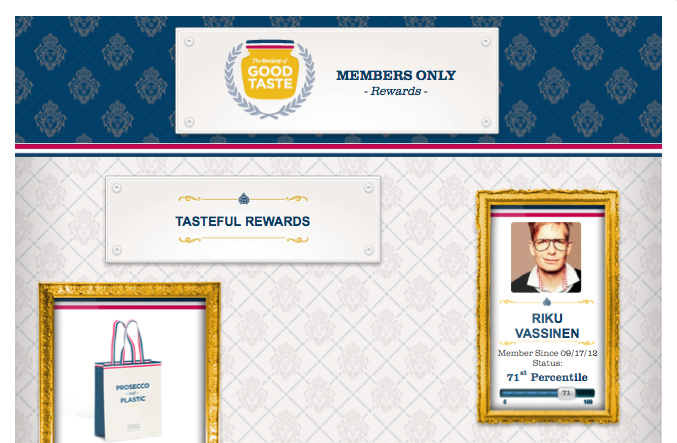
The new Grey Poupon Facebook-campaign*”The Society of Good Taste” feels like a breath of fresh air amidst the traditional like-begging campaigns. In this tongue-in-cheek application the mustard brand will only accept “classy” fans. Your “classiness” will be evaluated with algorithm searching and judging your user profile. Apparently not all of the applicants will be selected, although my social media profile seemed to be “classy enough”:

Apply for Grey Poupon fan status in their Facebook page.

Insight: When every brand is begging and bribing you to like them on Facebook, the value of the like for the consumer has become worthless. If something is easy and available to everyone, it does not seem interesting. Like Groucho Marx said “I don’t care to belong to any club that will have me as a member”.

This Grey Poupon campaign seems like a modern day and more humorous version of this classic Chivas Regal ad by Neil French:


THIS IS AN ADVERTISEMENT FOR CHIVAS REGAL.

IF YOU NEED TO SEE THE BOTTLE,
YOU OBVIOUSLY DON’T MOVE IN THE RIGHT SOCIAL CIRCLES.

IF YOU NEED TO TASTE IT,
YOU JUST DON’T HAVE THE EXPERIENCE TO APPRECIATE IT.

IF YOU NEED TO KNOW WHAT IT COSTS,
TURN THE PAGE, YOUNG MAN.

In addition to the Facebook, Grey Poupon is upping the ante in social media and has also build their website entirely on Pinterest.

*Spotted from Adrants.

Tagged , , , , ,