Author Archives: Riku Vassinen

Read This Thought Leadership Piece

“Military intelligence is a contradiction in terms”
-Groucho Marx

Since when has a mundane B2B marketing effort become thought leadership marketing?

Blog post is not a thought leadership piece. On a worst case it does not really include any thinking in it, but is only a disguised and long-winded sales pitch for the company behind it. Just that you are sharing your thoughts does not make you a thought leader. Thought leadership is always judged by audience and not the marketer.

If you are a thought leader, whatever you do, it is thought leadership marketing. And the other way around, if you are not, no matter what you write, it is just another blog post, which no one wants to read. People should aspire to really be thought leaders and not just appear to be one.

Because we as a people are naturally lazy and trying to find shortcuts, it has not been surprise that marketing companies selling thought leadership marketing have found a lucrative market. Companies and individuals should concentrate more on doing things worth telling and doing some serious thinking worth sharing instead of buying some “thought leadership toolkit”. The actual methods to reach out to your audience come quite naturally if you have your real story in order. That story should be based on the actual truth.

Thought leadership marketing is just a contradiction in terms. Too often it lacks both the actual thinking and the real leadership.

Tagged , , , , ,

Anatomy of An Insight: Grey Poupon Society of Good Taste

LIKE US ON FACEBOOK!!!!

That has been the battle cry for the brands in the social media for the last couple of years. And fair enough, for the majority of the brands the more likes you have the better. But what if you are classy luxury brand? You do not necessarily want everyone and their neighbor to like your brand if you want it to be exclusive.

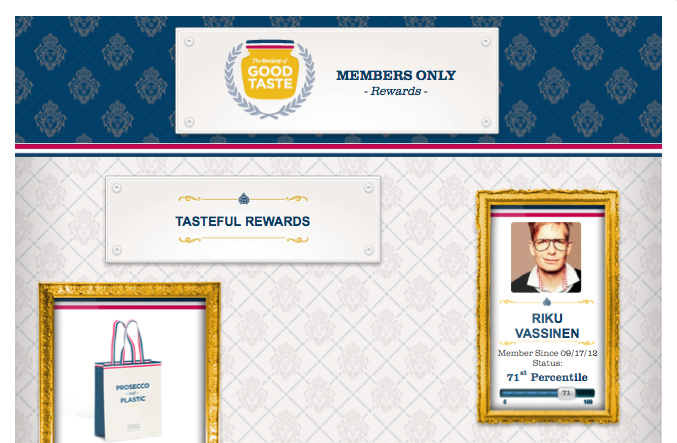
The new Grey Poupon Facebook-campaign*”The Society of Good Taste” feels like a breath of fresh air amidst the traditional like-begging campaigns. In this tongue-in-cheek application the mustard brand will only accept “classy” fans. Your “classiness” will be evaluated with algorithm searching and judging your user profile. Apparently not all of the applicants will be selected, although my social media profile seemed to be “classy enough”:

Apply for Grey Poupon fan status in their Facebook page.

Insight: When every brand is begging and bribing you to like them on Facebook, the value of the like for the consumer has become worthless. If something is easy and available to everyone, it does not seem interesting. Like Groucho Marx said “I don’t care to belong to any club that will have me as a member”.

This Grey Poupon campaign seems like a modern day and more humorous version of this classic Chivas Regal ad by Neil French:


THIS IS AN ADVERTISEMENT FOR CHIVAS REGAL.

IF YOU NEED TO SEE THE BOTTLE,
YOU OBVIOUSLY DON’T MOVE IN THE RIGHT SOCIAL CIRCLES.

IF YOU NEED TO TASTE IT,
YOU JUST DON’T HAVE THE EXPERIENCE TO APPRECIATE IT.

IF YOU NEED TO KNOW WHAT IT COSTS,
TURN THE PAGE, YOUNG MAN.

In addition to the Facebook, Grey Poupon is upping the ante in social media and has also build their website entirely on Pinterest.

*Spotted from Adrants.

Tagged , , , , ,

Decision Paralysis in Hawker Centre

Singapore is a tremendous place for foodie. I am especially fond of the concept of Hawker centres. For those unfamiliar, they are open air food complexes serving great but inexpensive food. I try to visit new stalls and new centres every week and try out new dishes.

In the beginning, my knowledge of local dishes was fairly limited. I wanted to test out new food, but as the hawker stall can be quite hectic place especially during the lunch hour, I nearly always made similar order (prawn noodles, to be precise). So after getting worried about my diet getting too monotonous, I made a simple rule to guide my lunch decision-making:

Only buy from Hawker stalls which sell only one food item.

The reasoning was two-folded:

1. If stall can make living by only selling one dish, the dish must be pretty good.

2. When you have only one alternative, your decision process is quite straightforward.

What I experienced on the stalls offering too many alternatives, was decision paralysis. And many times I still experience that. So it is probably me blocking the queue at the stall when not able to make my mind up between Mee Siam and Mee Rebus. Sorry.

The more you give alternatives to customer, the more difficult it is to make the decision and more likely that customer sticks to his learned formula of behavior. So if you have accustomed to eat chicken rice, the more new alternatives you get the more likely you are to stick with that chicken rice.

This raises couple of issues to companies. If you have only one product, the customer selection is definitely easy. It is also easy to decide against your product. So you have to have variety to address different target audience needs. However, the more you add alternatives the more difficult the selection becomes. In FMCG this usually also results to product cannibalization. The category variants do not take market share from competitor products but actually eat up the market share of your core product. Companies have to provide variety but also easy decision at the same time. Below are couple of tips to overcome this paradox.

How you can help clients to overcome decision paralysis?

1. Recommend

How many times have you taken Chef´s Special in the restaurant? If customer seems hesitant, ask and recommend. Whether you are hawker stall owner or webstore, you are also expert of your products. Highlight that expertise and make qualified recommendation to your client.

2. Show popularity

When showing Top 5 of the most popular dishes, the probabilities are quite high that the customer selects  some of them. Or just check the most popular media sites, they are always highlighting the most read stories. Popularity is a cue of superiority and it helps to make decisions.

3. Encourage word-of-mouth

Only times when I have varied from my hawker stall selection criteria was when I had recommendation from my friend or read a story about certain stall or dish on Straits Times. There is no shortcut for positive feedback. You have to provide good experience and the word-of-mouth will follow. In digital sphere you can make recommendations more visible with social media integration (showing Facebook likes, comments, FourSquare check-ins or Twitter updates regarding your company).

4. Help customer to apply his decision making rules

“I always buy the cheapest”, “I always buy the most expensive”, “I always try the new dish” or “I always eat beef on Fridays”. These are some of the rules your customer might use when selecting products. When you highlight those different motivational triggers, you make your customers selection easier. To exactly know the motivation and the rules for your customers, it requires constant monitoring and research of customer habits.

5.  Help customer to make one choice at a time

Some of the decisions are not always easy. There might be thousands of alternatives. Or there might be only couple of alternatives, but thousands different parameters affecting your choice. Especially with more complicated products, it helps if you break the decision to different parts. It is hard to make buying decision right away, but you can always take steps closer to it. Decision making in elections is great example of this, finding the right candidate requires variety of questions affecting various different categories (example: Republican primaries 2012).

Nowadays as I have learned more about different dishes I have ventured to stalls offering more variety. But even then I utilize one simple rule:

Always go to the stalls with the longest queue.

“More choice does not necessarily correlate with more business”

Tagged , , , , , , , ,

Three Cool Technologies That Have Not (Yet) Been (Totally) Exploited by Marketers

Whenever new technology emerges, marketers have a small gap of opportunity to do campaigns concentrating purely on the novelty of new technology. And get away with it.

Consider augmented reality. When it was first introduced, we marketers ate the whole thing up and ranted about nearly every simple campaign utilizing that new technology even without any real idea behind it. Nowadays clients start to yawn if you mention AR even if it just starting to reach its full potential.

Such is the cycle from boom to bore. And it is getting faster every day.

There is always the novelty value of new, but also a value in rediscovery. So take a look on these not necessarily new but definitely emerging technologies, you might have a chance to ride on the big wave of opportunity:

1. 3D Printing

Apparently you can print out wearable bikinis, working riffles, custom chocolates and even kidneys with these machines. The technology has actually been around for three decades. Now with the emerging of more affordable 3D-printers (starting from 500$), they might soon be household items.

2. Holograms

Besides raising again the hot topic of Tupac being alive (which is naturally true), the above performance in Coachella sparked a sudden interest in holograms. Actually technology utilized is technically not hologram but an over century-old reflection technique called
Pepper´s ghost
. Nevertheless it was really impressive and initial cost of CGI & projection supposedly ranged around 100k-400k, which is not that impossible for forward-minded marketer aiming for big PR wins.

3. The Leap

Time to go Tony Starks.

So now just waiting the time that you cannot mention these ones in meetings any more.

Tagged , , , , , , ,

How Making Sushi Helps You Find The Perfection

Every professional, whether they like sushi or not, should see the following movie:

Jiro Dreams of Sushi is probably one of the most impressive documentaries I have seen this year. It tells the life story of 85-year old Jiro Ono, who is regarded as one of (if not) the best shokunin. That means sushi chef and also mastery of profession in Japanese. His restaurant Sukiyabashi Jiro is probably only 3-star Michelin restaurant which is located in MRT station.

The movie is not really about coking, altough you get a decent amount of food porn and sushi money shots in the film. It is about finding the true mastery, searching the perfection and finding the meaning of life (in work). While I tend to get my nigiris from the store, there are many lessons everyone should learn from Jiro. You can be shokunin in other professions as well:

1. Inspiration (Perspiration)
Becoming a sushi master takes years and years or hard work. You first start with washing dishes and gradually move to the more difficult tasks. If you have been succesful as an apprentice, maybe after a decade you are worthy to cook the tamagoyaki. This means thousands of repetitions, iterations and failures in your working career. Good example of this in the movie is when apprentice explains how he started to cry, when he finally made egg sushi which was adequate quality for the sushi masters. He had made hundreds of attempts of making it the best.
There is never shortcut for mastery, just one way: the hard way.

2. Improvisation
The menu of good restaurant changes daily, according to what is available on the local fish market. Same way the business climate and situations vary every day and are not necessarily related to you at all. You have to find ways to cope, adapt and challenge these situations. The outcome must be great in any case.
You have to able to reach perfection, despite the circumstances.

3. Innovation
Despite the strong appreciation of the traditions, good shokunin also innovates. Jiro himself has been inventor of many sushi dishes, which did not exist before him. Like the title of the movie suggests, he used to dream about different ways to make sushi and then fulfilled those dreams in his restaurant. In similar fashion as professionals we have to keep on moving and constantly re-inventing ourselves. Otherwise we end up doing the same thing over and over again. Eventually we realize that no one wants that same thing anymore.
Knowing the history is worthless, if you are not willing to change it.

Also Jiro teaches us one important lesson: there is no retirement for true master. I hope that when I will be almost 90 year old, I am still going strong and try to find perfection.

Are you shokunin in your work?

Tagged , , , ,

Is Facebook Just a Bubble?

Facebook stock hit the new low last Thursday after Q2 results were revealed. Also closely linked to Facebook, game-maker Zynga has lost over 40% of its value. These stock falls have raised feelings of déjà vu  in investors of the merry days of the dot-com buble. Are we facing the sequel: Social-Media Bubble-Revenge of Stock Plummet?
I believe not, based on the following reasons:

What separates Facebook from the failed IT-bubble companies?

1. People: With the expection of the Great China Firewall, Facebook has conquered the world. Over 900 million users would make it the third biggest country in the world. Numbers are great, but over 500 million active users also prove that Facebook has become much more. It is incremental part of the behavior of the people and increasing number of people have developed Facebook a daily (even hourly or constant) habit. And we all know how hard the sticky habits are to break. Also we from the industry are naturally calculating Facebook profits all the time, but average user could not care about less how Facebook ad sales are going. Of course on the long run the financial performance and user satisfaction should be inseparable, but it is easier to tweak on your business model when you have the people already using your network than other way around.
2. Profits: Despite making loss in the latest quarter, the revenues of Facebook actually beat the industry estimates. Also Facebook has already been profitable many quarters before. This is a proof that their business model works, at least to some extend. That could be hardly said from many other failed Internet-companies.
3. Potential: Google has struggled with social: whether it is Google+ or making YouTube profitable. Apple has had Midas touch in everything… expect social. That is why they allegedly have talks with Twitter. Facebook has been the only company to really capitalize and succeed with social. This has made it as one of the key players in the battle of Internet domination (other participants in the ring: Apple, Google & Amazon).

So comparisons with the high-flying and crash-landing dotcom rockets to the new big blue are unjust. They pretty much had only potential, but neither the users nor the viable business model. Facebook is not a bubble, but that does not mean that it does not have certain serious challenges. The future success of Facebook lies in how it can solve the following issues:

1. Advertising revolution: The advertising model of Facebook is based on really traditional online media sales and the effectiveness has been questionable. Sometimes it feels that only drunk people click on the Facebook ads. The new ad units have been disappointing at best and almost disastrous at worst (ie. Facebook deals). Facebook has to find a way to get people to see and engage with ads when and where they want to actually see them. Google cracked this and it has been the core reason for its success. Until now Facebook has just poorly emulated Google with a mix of traditional display, with average results.
2. Going beyond advertising: The information of Facebook 900+ million users is a goldmine. There just should be a way to utilize it better. Currently the revenues beyond ad sales have been quite modest. This also raises the controversial question which Facebook has actively been avoiding. Could users pay for Facebook? And how much would they pay for it and for what elements? There is thin line between the effective utilization of user data and the utter exploitation of it. If you do the latter, the deliquate trust between the service and users has been ruined forever.
3. Mobile: Future of Internet is the Mobile. And Facebook damn well knows it, with over 500+ million mobile users. As smartphone will be the computer of the new generation, it needs more innovative and effective mobile solutions than just sponsored stories in mobile (although they have been performing above average). The rumoured Facebook phone is step to the right direction, but just one of the first steps into the mobile world.

“Facebook is not a bubble, but it has not reached its full potential either”

Tagged , , , , , , ,

Digital is Air

It is quite sad that agencies are still strugling heavily with their digital output and integration. We are not really talking about new things here. Digital has already been around for quite a long and we have had time to adjust. While agencies have been lost with, real people have been happily and easily adopted the new digital tool.

Nowadays, digital is like air to them.

It is natural: Consumers have already adopted the digital channels. They have made the unconscious selection to live digital life. The digital excellence should come with same ease in the agencies. The people are not strugling with digital, companies are. If you have to think about digital all the time, you are really missing the point. It is already a habitual part of life. The same way it should be habitual part of agency.
It is necessarity: If you do not have air you will die. The same is the way with the companies. For majority of companies the digital strategy is totally same as their overall strategy. Therefore, it is insanity to separate these two. If your business is not yet in digital, there is a good opportunity for your company to do it.

Air also flows freely. That is why there should not be different silos in the agencies. Digital department should be every department. The steps for the future success are simple:

1. Break the silos.
2. Get digital natives on board. Get rid of the opposing old baggage if necessary.
3. Fully integrated or die.

“Digital should flow freely and be a habitual part of the agency”

Advertising Should Just Aim for the Popularity

To say that people hate advertisements is a vast overstatement.

The truth is that most people just don´t care about them. Most advertising is just interruption at best and invisible at worst. Occassionally some good piece of communication fells through the cracks and people start talking about them. Those ads have made the giant leap from ads to entertainment.

What combines these highly succesful, innovative and effective ads? Where you push button to add drama? Where Eminem drives Chrysler in Detroit? Where you start thinking about the benefits of birth-control? Or where hamsters jam to the sounds of nineties hiphop in Hamsterdam?

They are all popular.

People do not even judge these ads in same category as your everyday washing liquid infomercial. They are entertainment. People do not talk about how the ad skillfully manifests the strategy and touches the nerve of certain target demography. Or how it really captures effectively the brand´s tone-of-voice, communication ladder and is on brief. They talk about funny ads, emotional ads, witty ads. Even really shit ads. They talk about work which stands out of the pack and makes them feel or act.

When you say that you work in advertising, people usually start to talk about ads to you. Usually they mock the horrible ads which have been repeated until the boredom. However, the best feeling is when person starts talking about ad that has touched him or her. And you realize you have been doing that particular piece of communication.

Even though people seldom talk about ads in watercooler, it does not mean that ads do not belong there. After all, we are working in the only creative field which should be populist by nature. There is no underground culture in advertising. Even with smaller demographics, we are still talking about mainstream-size audiences. So as we advertisers drink from the well of popular culture, we should also make sure that we do not piss in it as well.

That is why the role of advertisement is simple:

Advertising should make brands popular.

Relevant popularity or even outright populism includes all the relevant definitions of the advertising. It lowers the cost of selling. It makes the product desirable. It gets recommended. It differentiates. It wins awards. It sells. It strengthens the brand.

To make people talk about your brand, product or advertisement you have to think in terms of entertaining. Entertaining is the hardest but the most satisfying job in the world. Are we able to take the task? And make entertainment that urges people to action.

You have to make your advertising a hot topic around the watercooler.

Tagged , , ,

How to Come up with Ideas? Prt.2-Structure for the Chaos

Compared with many other planners, I have been doing quite a lot of concept work. First, because I have been working in quite agile agencies with not too narrowly defined roles. Second, I belive strongly that planner has to be able bring views and ideas to actual creative product(like everyone else working in agency).Especially if you are stand-up strategist instead of desktop one.
The following list is based on those concepting work sessions I have had over the years. This presents more of the ideal state of ideation process. Many times it is not as structured, but especially when working with tight pressure and deadlines this framework has helped me to concentrate on the most essential parts when coming up with ideas.

Ten Steps to Good Ideas

1.Write rough ideas
This is just letting off steam and make your subconscious work around the problem. Jotting down every possible idea that comes in your mind for around 15 minutes is great excercise for getting the creative juices flowing and also removing the barriers. Usually 95% of ideas generated in this phase are useless, but sometimes intuition might present us the best solution.

Duration: 15 minutes

2. Going through the creative brief, strategy & background material
To simplify this example, let´s assume that the client brief is quite on-point and the strategy is quite settled at this point. The more urgent the project is, the less time you can spend on this. Usually with bigger pitches and projects, you are able to do quite thorough deep-dive to the subject. Sometimes with tight deadline, you pretty much have to trust your own intuition, experience and point of view.

Duration: From none up to weeks depending on the project scope.

3. First idea meeting: Kicking around the business problem
It is always crucial to really ponder on about what is the business problem we are facing and how we will address it. This phase is really important, because it usually gives lots of ideas which are not straight-up advertising solutions. Usually after this session the strategy will also be refined, because everyone has come up with their valuable views on the greatest challenges our client company is facing.

Task for the team(s) before: Everyone has identified their major concerns in the case & their views on business problem.

Duration:2-4 hours

4. Second idea meeting: Kicking around ideas
Many times team jumps to this phase, but have not really done enough background work. This results in superficial ideas, which are not really solutions to the problem. With careful consideration to the steps 1-3, this will be one of the most beneficial parts of the ideation progress. Still during this phase the main emphasis is to come up with more creative quantity than sophisticated quality. These sessions are more brainstorming and the initial killing and selection of the ideas will be preferably done in separate session.

Task for the team(s) before: Everyone has prepared their own ideas (either individually or with their working partner). In the most ideal case, people have had at least couple of full days to come up with those ideas.

Duration: 2-4 hours (preferably two sessions)

5. Start killing & promoting ideas
– Are they on brief?
– Are they relevant?
– Does it make me feel?
– Does it make me act?
– Is it effective?
– Is it groundbreaking?

These are some of the questions you should be asking at this phase. If answers are no, consider ideas killed.

Duration: Couple of hours

6. Separate ideas so strong that are concepts
We have already separated the good ideas, now it is important to find out which of them have proper depth and leverage to be concepts. I wrote about the definition of concept last week. It is important to have good one-off ideas still on this phase, because they can actually make certain concepts more thorough when combined.

Duration: Several hours in conjuction with the part seven and eight.

7. Select the strongest concept(s)
One is sometimes enough, but more is preferable.

8. Refine the concepts
No shortcut with this: Revisions, rewrites, re-layouts and prototypes. This part is highly focused on perspiration abilities instead of inspiration.

Duration: Till infinity

9. Select presentation strategy
Do we present one strategy and many concepts?
Do we only present one strategy and one concept?
Do we present different strategies and different concepts?

Besides thinking the strategy for our customer, we always have to think about our internal strategy: how we grow this clientship and how we can producce as much good and effective work to them as possible. Some people are fixated about presenting only one concept at time and some people want to always have more. I think the amount of concepts in presentation is quite secondary, the most important thing is to concentrate on what is the best way to sell the project. Other important guideline is the following:

“Never present crap”

Never present “safe alternative”, which you do not truly believe. The result is always that the “safe alternative” will be selected and you end up being ashamed of the final output. You can present hundreds of concepts if they are really good. However, if you present one good concept and two weak ones, you have been presenting two too much.

10. Craft the presentation
Many people spend long time just watching the powerpoint or keynote and trying to solve the problem and come up with ideas while they are making slides. I believe the best results come when you have the whole plot of the presentation already planned and making the powerpoint is more of a mechanical task. I have also met with people, who are really able to think within powerpoint, but I am not one of them.

And finally the most important one:

Avoid the work as much possible.
I believe in effective, but relatively short planning sessions.
Sometimes it might be beneficial that the team goes for different place outside the office to do the ideation work (more on this in later part of this series), but overall I am not big fan of spending the whole day in the same meeting room trying to force the ideas. Especially when they are not coming.
No matter how tight deadline you might have, the trick is trying to maximize the idle time when you are not actively pursuing the problem. This way you are still subconsciously working on the problem. There are different methods to help this idle processing and they vary for different people. For example I usually get best ideas when I am jogging.
After certain period, you just start to come up with new ideas all the time. The most important thing is to remember to keep your notepad within. More about these methods in the next part of this series.

Although there is ten steps in this ideation progress, it might be done quite fast if the deadline is thight. In principle this whole 10-step thing can be done during one really long day. Of course the best results come when you have more time. It is about finding the balance between meeting deadlines and coming up with groundbreaking ideas.

“With proper structure for coming up with ideas, you release more time for chaos”

Tagged , , ,