Tag Archives: facebook

Why Google is Struggling with Mobile?

The future of the business is mobile.

Or so they say. Currently it seems more that future business of companies is ruined by mobile. Zynga has lost 85% of its value, because the mobile adoption has been faster than expected. Facebook has been stumbling with mobile advertising, although its recent mobile ad revenues beat the industry estimates.

Even the traditionally steady high-performer Google has been showing signs of slowing down. The problems have their root cause in mobile: Motorola acquisition has not yet paid off and mobile advertising has driven average click prices down.

Here are five other reasons why Google (like many other companies at the moment) is struggling with the mobile:

1. Status Quo Bias
For years the AdWords has been the hen that lays the golden eggs for Google. As humans, we are more likely to believe that things remain the same and are more likely to select to stay in status quo whenever possible. Every company encounters status quo bias at some point. AdWords are still selling like pancakes, the main difference is that the average click price has dropped for four consecutive quarters in row.
Although no one accuses that Google is not doing mobile innovations and investments, there has apparently not been pressing need for them to roll them out faster.
2. Android Ecosystem does not pay off (expect for Samsung)
According to certain estimates, Google makes about $6.50 through ads on Apple devices, compared with under $2 in Android. Google makes roughly the same amount of profit selling Android ads & apps in year that Apple makes selling iPhones a week. Google has regarded Android ecosystem more of an extension of the advertising. Currently it seems that it only benefits Samsung (and maybe to some extend users).
3. Mobile advertising ecosystem is currently broken.
People are not yet ready to make purchases with mobile. That is likely due to change in the future. Meanwhile, the mobile ads generate less revenue than traditional ads on average. Mobile has been thus far more about duplicating the web experience for Google, than regarding it as a center of the advertising innovations.
4. Consumers are even more unpredictable with mobile
Who would have predicted that texting will become popular? Or that tablets will become hits? Consumers are always fickle and surprising, but especially in mobile. Consumers do not really know (or at least articulate) what they want, but they still act quite fast to get it.
5. Google is not (yet) producing phones
Although Google bought Motorola, there has been a strict separation of church and state between Android and Motorola. Apple and Samsung have proven that the money in mobile lies in hardware. Microsoft has returned to hardware game as well. Facebook will probably enter the competition soon. Can Google stay away from the phone game?

I am sure that Google has certain tricks up on their sleeves regarding the mobile. Until those tricks are revealed, there will be more growing mobile pains ahead.


Tagged , , , , , , , , , ,

Why Would You Pay for Your Facebook Status Updates?

Facebook piloted the promoted post –format already last spring and now rolled out the feature in US in the beginning of this month. Basically it allows normal Facebook user to get more exposure for her post when paying money for it.

Sounds great from the Facebook standpoint. They are in desperate need for new ways to monetize the vast user base. The initial cost for rolling out this advertising format is probably quite low. And it might be hit. Judging from the reality tv shows, there are lots of celebrity-seeking self-promoters around wanting the attention at any cost. On Facebook product site for the Promoted posts, there is linfo about practicalities of the function. One crucial piece of information is however missing:

Why would anyone want do that?

The example Facebook uses is engagement announcement. But I find it hard to believe why anyone would pay for that? If you really have to make sure that people now that you are engaged, there other communication vehicles to ensure that message goes through. Also the virality of those announcements is already high and it is likely that you get hundreds of likes and comments for announcements like that naturally. How many likes will it take that you are satisfied? Of course the situation might change if Facebook decreases the reach of non-paid status updates. That has already happened with brand pages.

There seems to be only one inevitable result from this. Your newsfeed gets bombarded with marketing messages. The promoted post function seems suitable for only small-business owners, politicians, bloggers, company spammers commmunity managers, event organizers, social media con artists consultants and other narcissistic egoists. For those people, the promoted post will probably be good addition to advertising toolkit among other Facebook advertising solutions.

What will it do for the user experience?

There will be municipal election this weekend in Finland. Thus I have avoided checking my newsfeed lately because I just cannot bear all that election advertising from all “Facebook friends”. The newsfeed is almost unreadable. Especially because I do not currently live in Helsinki and I am not even eligible to vote. How worse the situation will be when these annoying self-promoters can pay for more wider reach for their propaganda?

Or maybe this is just clever marketing and the next product Facebook announces is: Unpromoted Post. By paying certain fee, you free yourself from those self-marketing promoted posts.Facebook Premium, without ads?

Someone might pay for that as well.

Tagged , ,

Anatomy of An Insight: Grey Poupon Society of Good Taste

LIKE US ON FACEBOOK!!!!

That has been the battle cry for the brands in the social media for the last couple of years. And fair enough, for the majority of the brands the more likes you have the better. But what if you are classy luxury brand? You do not necessarily want everyone and their neighbor to like your brand if you want it to be exclusive.

The new Grey Poupon Facebook-campaign*”The Society of Good Taste” feels like a breath of fresh air amidst the traditional like-begging campaigns. In this tongue-in-cheek application the mustard brand will only accept “classy” fans. Your “classiness” will be evaluated with algorithm searching and judging your user profile. Apparently not all of the applicants will be selected, although my social media profile seemed to be “classy enough”:

Apply for Grey Poupon fan status in their Facebook page.

Insight: When every brand is begging and bribing you to like them on Facebook, the value of the like for the consumer has become worthless. If something is easy and available to everyone, it does not seem interesting. Like Groucho Marx said “I don’t care to belong to any club that will have me as a member”.

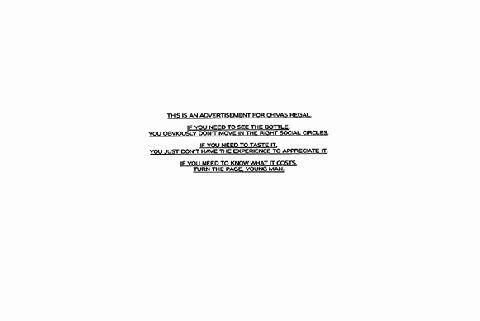
This Grey Poupon campaign seems like a modern day and more humorous version of this classic Chivas Regal ad by Neil French:


THIS IS AN ADVERTISEMENT FOR CHIVAS REGAL.

IF YOU NEED TO SEE THE BOTTLE,
YOU OBVIOUSLY DON’T MOVE IN THE RIGHT SOCIAL CIRCLES.

IF YOU NEED TO TASTE IT,
YOU JUST DON’T HAVE THE EXPERIENCE TO APPRECIATE IT.

IF YOU NEED TO KNOW WHAT IT COSTS,
TURN THE PAGE, YOUNG MAN.

In addition to the Facebook, Grey Poupon is upping the ante in social media and has also build their website entirely on Pinterest.

*Spotted from Adrants.

Tagged , , , , ,

Is Facebook Just a Bubble?

Facebook stock hit the new low last Thursday after Q2 results were revealed. Also closely linked to Facebook, game-maker Zynga has lost over 40% of its value. These stock falls have raised feelings of déjà vu  in investors of the merry days of the dot-com buble. Are we facing the sequel: Social-Media Bubble-Revenge of Stock Plummet?
I believe not, based on the following reasons:

What separates Facebook from the failed IT-bubble companies?

1. People: With the expection of the Great China Firewall, Facebook has conquered the world. Over 900 million users would make it the third biggest country in the world. Numbers are great, but over 500 million active users also prove that Facebook has become much more. It is incremental part of the behavior of the people and increasing number of people have developed Facebook a daily (even hourly or constant) habit. And we all know how hard the sticky habits are to break. Also we from the industry are naturally calculating Facebook profits all the time, but average user could not care about less how Facebook ad sales are going. Of course on the long run the financial performance and user satisfaction should be inseparable, but it is easier to tweak on your business model when you have the people already using your network than other way around.
2. Profits: Despite making loss in the latest quarter, the revenues of Facebook actually beat the industry estimates. Also Facebook has already been profitable many quarters before. This is a proof that their business model works, at least to some extend. That could be hardly said from many other failed Internet-companies.
3. Potential: Google has struggled with social: whether it is Google+ or making YouTube profitable. Apple has had Midas touch in everything… expect social. That is why they allegedly have talks with Twitter. Facebook has been the only company to really capitalize and succeed with social. This has made it as one of the key players in the battle of Internet domination (other participants in the ring: Apple, Google & Amazon).

So comparisons with the high-flying and crash-landing dotcom rockets to the new big blue are unjust. They pretty much had only potential, but neither the users nor the viable business model. Facebook is not a bubble, but that does not mean that it does not have certain serious challenges. The future success of Facebook lies in how it can solve the following issues:

1. Advertising revolution: The advertising model of Facebook is based on really traditional online media sales and the effectiveness has been questionable. Sometimes it feels that only drunk people click on the Facebook ads. The new ad units have been disappointing at best and almost disastrous at worst (ie. Facebook deals). Facebook has to find a way to get people to see and engage with ads when and where they want to actually see them. Google cracked this and it has been the core reason for its success. Until now Facebook has just poorly emulated Google with a mix of traditional display, with average results.
2. Going beyond advertising: The information of Facebook 900+ million users is a goldmine. There just should be a way to utilize it better. Currently the revenues beyond ad sales have been quite modest. This also raises the controversial question which Facebook has actively been avoiding. Could users pay for Facebook? And how much would they pay for it and for what elements? There is thin line between the effective utilization of user data and the utter exploitation of it. If you do the latter, the deliquate trust between the service and users has been ruined forever.
3. Mobile: Future of Internet is the Mobile. And Facebook damn well knows it, with over 500+ million mobile users. As smartphone will be the computer of the new generation, it needs more innovative and effective mobile solutions than just sponsored stories in mobile (although they have been performing above average). The rumoured Facebook phone is step to the right direction, but just one of the first steps into the mobile world.

“Facebook is not a bubble, but it has not reached its full potential either”

Tagged , , , , , , ,