Tag Archives: facebook

Why Do We Need Dislike Button to Facebook?

dislikebutton
The like button is valuable because it’s a quick way to share a positive sentiment. Some people have asked for a dislike button so they can say something isn’t good, and we’re not going to do that. I don’t think that’s good for the community.
Mark Zuckerberg

It is obvious that Mark Zuckerberg is not Finnish or even Singaporean for that matter. If Facebook would have dislike button, the usage would soar in certain countries. Disliking is much more honest act than boring liking. I would love to dislike all the boring status updates in my feed. Hiding the users seems so permanent. Dislike would be like yellow card in football: no more those inane updates or you get booted. I think the people would appreciate that as well: sometimes we get blinded by our own excellence that we don´t realize that it is not interesting in a larger scale at all.

The thing I think are really valuable is there are more sentiments just than people like something. There are things in people’s lives that are sad, or that or tragic, and people don’t want to Like them. We’ve talked about for a while how can people express a wider range of emotions like surprise.
Mark Zuckerberg

Disdain, hate and anger are valid human emotions and Facebook has missed an opportunity because people cannot express them. The force-fed positivity of Facebook makes you like photos of people presenting their meat trophies and showing off their boring holiday pictures. Occasional dislike would put them on check and remind them that they are not so special.

Not to mention like Zuckerberg already pointed out, you can use like-button for bad purposes as well. Someone updates that he got divorced, like it. Cat has died, like it. Someone has gotten a tropical disease, like it.

How evil is that behavior?

Like is the lightest-weight way to express positive sentiment. I don’t think adding a light-weight way to express negative sentiment wou ld be that valuable.
Facebook engineer Bob Baldwin

Why it would not be valuable?

At least dislike is honest representation of true human feeling: I do not really approve your message. You cannot be positive all the time.

Of course it might be cruel to people as not everyone has been growing their thick skin in real life, where you might get negative comments occasionally as well. It might also read to cyber-bullying and other abuse, which you cannot escape in Facebook in any case. So it will be unlikely (no pun intended) that we will get dislike button for Facebook users anytime soon. However, there is a special group that would really need the dislike:

Brands & Facebook advertisements

Dislike would be even more helpful for the brands than like. Majority of people liking comments from the brand are just waiting promotions, working in agencies or cannot read. Dislike button would be a real-time barometer of how people feel about your ads. Brands cannot get upset. Brands cannot be bullied or abused. Dislike button would show the reality for many brands. Currently as people cannot really show their true (negative) feelings in Facebook, brands have too rosy picture of the current state of their brand. Dislike button would be a much-needed reality check for the affectivity of your ads and measure for real human sentiment. It would evolve the Facebook ads to real-time research and would maybe be a business opportunity for Facebook.

I cannot wait to start disliking different brands in Facebook.

reallydislike

Tagged , , , , , ,

Who Will Be The Master of Internet Universe?

Web is dead.

That is the title of one of the greatest articles ever written about digital revolution four years ago to Wired. The main points about that brilliant piece are still valid, although speed of mobile revolution surprised many of the players for a while. The main idea of the story is that web starts to resemble more and more traditional industry with handful of players. Web is oligopoly and certain verticals almost resemble monopolies.

If you simplify the consumer-facing web business (so I am excluding infrastructure and other boring things which is where the real money is), it is about three things: products, commerce & advertising. Products enable you to connect to the Internet: smartphones, computers, watches, television sets, fridges and whatnot. Commerce is about being able to buy things from Internet and advertising is what it is: bombarding you with messages to buy more stuff.

Product category as we know it will eventually be commoditized. If you want to remain premium, you have to innovate constantly. That is the only way to remain luxury brand in this realm. Cheap smartphones will eventually beat the premium ones. In the future you are able to connect to Internet in whatever device and you do not really have to pay that much of that privilege.
Where the growth will come? Wearables can be the future winner product category, although they have not really yet taken off. The changes are rapid though. iPad was launched only four years ago, created totally new category and is currently at risk of vanishing because of the phablets. So is the life.
 
Current champions: Apple, Samsung
Challengers: Xiaomi and other cheap manufacturers
Disrupters: Luxury brands (Would connectivity enhance Rolex? I say not, but I might be wrong as well)

Commerce will become even bigger and you are able to buy pretty much everything online. Will all the physical retail vanish? Not necessarily, but the point is not about that. It is about that you are able to buy everything online, and majority of people will do exactly that, because it is more convenient and affordable.
Commerce is the biggest opportunity and a space I follow most closely. Strong brands will definitely start to create their own online retail experiences, which would enable them to bypass the more traditional retail channels. In the next decade there will be lots of turmoil in this category and many big players will fall and new challengers will arise. Biggest challenges are not that much about technology (lots of payment innovations happening), but about logistics.
Second interesting point is that idea of commerce has changed with shared economy. Both Uber and AirBnB are selling physical service, which would not be possible without digital channel. How far collaborative economy can be stretched remains to be seen. It can potentially be really big disruptor to the way we do business in general.
Last point about commerce is the ecosystem approach. Apple makes money constantly through App Store by enabling others to make money. Facebook is building app ecosystem with the acquisition of Instagram, WhatsApp and Parse. Both Amazon and Alibaba are enabling developers to build things on their platform.
 
Current Champions: Amazon, AliBaba, Ebay
Challengers: Google, Facebook, WeChat, Line, Apple (Apple Pay) 
Disrupters: Brands, FMCG brands, Collaborative economy players (Uber, Airbnb…)

Advertising will be important, because people will keep on buying stuff. Stuff makes us happy. More stuff makes us even happier. How are you able to buy that stuff if you do not know that it exists?
Will advertising become smarter in the future? Yes and no. In last decade or so, we have had one revolutionary advertising idea. That is SEM. You show people ads when they actually want to see ads. Contextual advertising and retargeting have been nice inventions, but mainly advertising is still based on interruption (some of it being more relevant like app install ads). One of the most innovative companies in the world, Facebook, makes most of its money by interrupting its users in various ways.
The advertising business is relatively simple: it is all about reach. All of the most successful advertising platforms are based on firstly to reach and then secondly the quality of those who you are reaching. That is unlikely to change. However, the biggest task is to try to narrow the gap between the interruption (advertising) and purchase (commerce). The monetary exchange is the only tangible KPI we have and less you have to travel to do it, the better.

Current Champions: Google, Facebook
Challengers: WeChat, Line, Twitter (was tempted to leave it out completely, but I give it a shot still), “Traditional media companies”(although I do not really have high hopes for their complete digital transformation, but they will remain influential on this space as well)
Disrupters: Amazon (the closer you are to the actual transaction, the less you have to interrupt), Content owners (although none of them has done any major moves and have mainly milked the status quo)

The lines are naturally blurry. The quote from Eric Schmidt summarizes the whole situation:

Many people think our main competition is Bing or Yahoo. But, really, our biggest search competitor is Amazon. People don’t think of Amazon as search, but if you are looking for something to buy, you are more often than not looking for it on Amazon.”

That is also the reason why these big companies are testing weird things and buying obscure companies. Internet has made it easier to disrupt a category and also connect categories in new way. Facebook & Google test drones, so it can bring Internet the people who don´t have it yet. Thus increasing the reach. Amazon tests drones, because shipping is the biggest bottleneck of eCommerce. When your business can start to flourish rapidly, it can also vanish rapidly. There is no time to sleep, because sleep is the cousin of death.

What do you think, who will become the master of the Internet universe?

Tagged , , , , , , , , , , , , , , , , , , , , , , , ,

What´s App Facebook? 4 Questions You Need to Ask to Understand The Acquisition of WhatsApp

Facebook´s acquisition of WhatsApp for about 19 billion (!) is the biggest deal ever for venture-capital-backed startup. As far as the money goes, it is naturally mind-boggling amount of cash but strategically I am trying to get my head around this. Four big questions came to my mind, when analyzing the acquisition:

1. What kind of ecosystem Facebook is building?
Currently Facebook is owner of three really strong (and separate) digital platforms: Facebook, Instagram and WhatsApp. Despite launching the ad units in Instagram, the photo platform has been relatively autonomous regarding Facebook. Apparently they will continue similar approach with WhatsApp and even more so as there will be no ads (in foreseeable future) in WhatsApp. See more in question 2 on that matter.
If we compare to Google, who builds their entire product offering under strong Google branding and synergies, Facebook currently resembles more of a venture capitalist and having quite separate and independent entities. Either approach is right or wrong, but at least currently Facebook ecosystem seems quite disjointed compared to the Google one. But maybe they have a bigger plan intact: see question 4.

2. How will Facebook monetize WhatsApp?
On the investor call Facebook mentioned that there would be no ads on WhatsApp and they are mainly concentrating on growth in the near future. Currently WhatsApp is free for one year and then you pay 0.99 for every additional year (and not even in all the markets).  Current business model is not exactly breaking the bank as it has quite limited growth opportunities, but compared to many other social ventures coming from Silicon Valley it is already profitable. From monetization standpoint it is interesting opportunity for Facebook to enter also to the subscription business and test it first with WhatsApp before rolling it to wider.

3. Was it strategically right decision?
Initially buying WhatsApp seemed a rather uninspiring and unsurprising act. More forward-looking would have been buying some emerging mobile instant messaging platform from Asia (Line, KakaoTalk, etc.). Especially as Facebook mentioned that the reach in emerging markets was one of the core reasons for acquiring WhatsApp. Asian mobile instant messaging platforms would have been better fit also to current Facebook monetization strategy as these platforms are currently more open to advertising as well? Cynical view of the strategic importance of the buy was that as the main Facebook platform loses steam the growth and engagement had to be bought to please the investors.

4.  Will there be Facebook Premium in the future?
How much would you pay for your Facebook account?
It might be that the goal of buying Instagram and WhatsApp is eventually to have capabilities to introduce Facebook Premium. This social network would add the best of the Facebook ecosystem and provide value on certain subscription fee. I have been toying around with that idea for a while, but currently it seems more reality than ever before. I have been quite disappointed of the unimaginative monetization strategies Facebook has had (overtly media-focused) and venturing to subscription models without endangering the crown jewel of free Facebook seems lucrative and interesting option.

The reaction from the markets to the acquisition was slightly disappointed and Facebook stock plunged slightly.

Tagged , , , , , , ,

How To Approach Your Social Media Strategy in 2014?

Year 2014 will be turbulent for both brands and agencies working with social media channels. Because of the recent IPO´s (Twitter, Facebook, etc.), the previous rebels have started to resemble more established media houses. It is a double-edged sword. Many agencies are not as stressed out as the social media ecosystem is more predictable (and none of the innovation labs is making money anyway). On the other hand, the activities have been and increasingly will be quite dull and unimaginative.

Beginning of the year is the time to think your social media strategy. For majority of the brands, year 2014 should be year of revolution instead of just evolution:

1.Facebook is the channel for reach.
Majority of your social media paid media investments should happen in Facebook to maximize the reach. In terms of sheer amount of users, it is dominant. However, the recent developments have been really worrying for brand (and other) pages as well. Certain pages have seen dips as low as 88% in organic reach. Even Facebook itself is not talking anymore about free organic reach, but instead brand pages as a way to increase the reach of the paid media. This is natural advancement and should not surprise everyone familiar with market economy. So I believe that Facebook will get bigger media share in 2014, but actually less focus in terms of engagement. I would invest more in those terms with Twitter (customer service, real-time marketing) and to visual platforms (content creation).

2.Use Twitter as the channel for real-time and customer service.
I am not saying that every brand should necessarily be in Twitter, but if you want to jump on the real-time marketing bandwagon, Twitter is the place to be. I have a love-hate relationship with Twitter throughout the years, but despite all the shortcomings the service has proven its worth. It does certain things really well (like customer service), and provides more natural ways to engage with audience than Facebook. Here is example of random interaction with Warby Parker, after I shared their innovative annual report:
Warby Parker Tweet

3.Invest heavily on visual social media channels.
Whereas online media money is going to Facebook, I would concentrate majority of the production and engagement investments to visual social platforms. No one has time to read text anymore, unless you are able to condense it to 140 characters or say it in photo.
Online video has been the fastest growing online ad format for couple of years. Naturally the pre-roll is the TVC of the new generation, but creation of good content provides great reach & engagement opportunities for brands. Video is a great tool for customer service as well:

Besides video, the photos are naturally huge and I expect the short-form video content to rise rapidly (Instagram video, Vine). Especially tutorials are naturally fit to for shorter video content (Check: #lowesfixinsix).
Many companies should actually rethink their community manager talent pool. In 2014 if you cannot take great photo or shoot a great video, you should not probably be community manager.  Social media used to be more verbal, but now it is increasingly more visual.

4. Embrace the renaissance of anonymous randomness.
Contrary to what Facebook says, many people want to remain anonymous while online. 6% of all adults on Internet use Reddit. People engage way more on Tumblr blogs nowadays than on Facebook brand pages. One reason is that not all the people want to attach their Internet personality to real-life. In Internet you can be that backpacker hiphop-dude you really are and do not need even remotely to try to sound smart. It actually reminds me of the original promise of MySpace. You did not need to use it with your real name. You could make a site for your cat if you fancied. Anonymity can naturally bring some problems, such as hate-speech, crime and stuff but it also enables refreshing randomness that is currently missing from Facebook. Many people are more interesting talking about things they are interested and not about themselves (assuming they are not completely narcissistic). So do not underestimate the power of “anonymous” social media channels. Maybe Yahoo was on to something when it bought Tumblr.

5.Experiment with the new upcoming channels.
I have written before about how you should approach your social media strategy like investor. The landscape in terms of the hot newcomers changes really rapidly. Global brands should nowadays be more tuned into what is happening on local level. Experimenting with various social media channels goes hand in hand with that. For example if you had done tests with Path, it would be easier to utilize the learnings in Indonesia (which is the third-biggest Path user country). The innovation in social media sphere is also not limited only to Silicon Valley anymore so cutting-edge firms should empower their local teams to experiment with local social media channels as well. For example WeChat is way more advanced than WhatsApp. Competitive advantage can come from everywhere. The trick is to identify it, experiment with it and scale it.

There will interesting year ahead. In 2014 companies need to dramatically update and revamp the social media strategies. Which is great. Whenever there is turmoil and crisis, there is always an opportunity.

Tagged , , , , , , , ,

Sharing is A Selfish Act

Why people share things?

Honestly, sometimes I really do not know. For example this clip below has gotten over 1M views:

Many times, it is easier to say why they are not sharing your content. Often the reason is that your content just sucks. And while it sucks, it does not suck enough to commemorate ironic share (like the video above).

While you may theorize the psychology of sharing until the end of the day, I find it relatively easy. You share either useful or funny content. Being useful is more multi-dimensional, as it might mean that the content is useful to either the sharer or the expected receivers. This is the reason why the world´s most uncreative people share all these creativity links and quotes on Facebook.
Stop it. You are not fooling anyone.
We attribute sharing to our individual image, but it is quite seldom even a slightest reflection of who we really are. When people are anonymous (discussion forums, Reddit, 9GAG, etc.) in Internet the content that is share is completely different. In real social media, what is truly shared is anti-social content. Anonymous comment is much more authentic representation of human spirit than airy-fairy “we-are-the-world”-share from the self-help guy in newsfeed near you.

It is gross misunderstanding that this age of oversharing is increasing openness to our culture. Facebook is just homogenizing what we share and has people showing their polished desired images. My feed is overpopulated with engagement announcements and baby photos. It is not even statistically possible that there is so much mating going on in my network every single day. You feel forced to like and comment those photos, which creates vicious cycle of boring content to my newsfeed. This is the reason I have decided to like every negative status update from now on to show my support to reality and attitude in 2014. Sadly, I have not been able to walk the walk and my own personal status updates are nowadays only about my sport accomplishments. Facebook has become a commodity, which has made it commercially interesting but same time really boring on an individual level.

We said in our book “Digital Fooprint” in 2010, that in digital age everyone is personal brand. Unfortunately we were right and the social media is full of overtly self-conscious personal branders optimizing every like and comment.

Tagged , , , ,

Whopper Sellout: Facebook Like is Not A Sign of Loyalty

One of the most idiotic campaigns lately has been this effort from Burger King Norway:

Effectively they subsidized their biggest competitor with 50 000 krones and lost 30k of their Facebook audience at the same time. But hey, now they have more engaged Facebook community with only those who care, right? Or they have 8000 fans who have already opted out of Facebook messages and have not seen the status updates about campaign.

Why this campaign was just really idiotic stunt?

1.Fast food is not loyalty business.
Majority of the people eat both in Burger King and McDonald´s. When you are hungry your main selection criteria is location, location & location. 72% of Pepsi drinkers drink Coke as well. Also if you offer free gift coupon for your main competitor and the only downside is that you cannot join a brand Facebook page anymore. Who would not get this deal? We are not talking about your favorite basketball team here. We are talking about burgers. How often you go to social media to really engage with burger? If your brand page disappeared today, who would mourn it?

2. Fast food is a mass business.
Even your most loyal 8k fans do not really make dent in your results. Therefore I rather had 40k disloyal bargain hunters than 8k hardcore Burger King loyalists. Sometimes Facebook is just reach and not engagement. The situation would be different if your average buy would be hundreds of dollars. Buying the fast food is low-interest buy. In reality you want the people fast in-fast out and not really expect them to discuss about your brand further.

3.Fast food business is led by promotions.
People wait for the new burger variants, one-dollar discounts and 2-in-1 deals. Why not give what they are wanting for? Majority of the brands should just realize that their Facebook page is only place for promotions, sweepstakes and occasional social media meltdowns. People go to Facebook because they want to connect with their friends. They do not want to connect with brands. They might do it occasionally, if they really want to or if they are bribed properly. Most likely they are too busy uploading selfies than answering your boring brand poll.

Liking in Facebook is quite seldom an act of loyalty. Quite often your most loyal fans do not even know that you have Facebook. It is totally delusional to argue otherwise.  And do not get me wrong, I do not think that there is necessary any value to Facebook like and there has been brilliant campaigns playing around the mindless like-chase. I have to also admit that “Whopper Sacrifice” is still one of the most brilliant FB campaigns ever. They were probably trying to come up with something like that in Norway, but failed miserably.

Much more effective campaign would be to offer people to switch their whopper to Big Mac in Burger King. Then I think more people would show loyalty and you would have gotten nice case study video material. Or do a campaign where you can only like either McDonald´s or Burger King in Facebook, and reward those who select Burger King as their solely FB Burger fan page with free Whopper. With Whopper Sellout the mechanics were just wrong and therefore it failed (and nicely done case study video does not change that fact).

Only good part of the campaign has been the publicity it has garnered (like this long piece on Fast Company). Calculated through that, it might have been worthwhile to lose those 30k fans. They also seem to have gained 2000 new ones after this latest stunt, so maybe it was just really twisted PR stunt and I fell victim to it as well.

Otherwise this just looks like award case study scam gone terribly wrong.

Tagged , , , , , , ,

How Teens Abandoned Facebook and Other Lies You Can Find From Research

First of all, I recommend everyone to read “Wrong: Why Experts Keep Failing Us”, a brilliant book by David H. Freedman. It showcases that painstakingly big portion of scientific research is completely faulty. The book did not address the subject of marketing research, but as the situation was quite bad with scientific research, I would say that nearly all of the marketing research is somewhat inferior. That does not mean it is not useful, but you should always take it with grain of salt.

I was reminded of this when there were lots of shares in social media about research on how Facebook is not the most important social network for teens. The news coverage it got made me sad and angry because of three things. First of all, that study was conducted to 802 teens (there are 20+ million teens in US). Second, it was focus group, not assessing the real behavior online. Third, it was mainly a study about privacy, which might also skew the answers to certain direction (like the previous study about social media effect on teen purchasing patterns). If you look at cold facts, not feelings coming out from the focus groups, the truth is different:

Numbers trump feelings
The so-called popular network Twitter has 24% penetration in teen audience, while Facebook has 94%. That gives a clear signal about reality: Facebook is “only” over 3.5 times bigger than the “most-liked” social network. You rather have actual reach than likes. When you are crafting your next campaign for teens, I would still concentrate on Facebook to get that actual reach. Instagram (owned by Facebook, which is good to remember) or Twitter might be good for more engagement, but by the time of writing, something new is probably surpassing them as the social network of choice for teens.

Do not replace your common sense with research
Main takeaway from the research was that teens do not find Facebook cool anymore. That is hardly surprising and you do not really need research to get that insight. Why would teens even find it cool? Their parents are using Facebook, for god´s sake. There will be always a demand for that “new thing” amongst teens (whether SnapChat or twerking). That “new thing” enables teens to differentiate from adults and hopefully shock parents as well. When Twitter becomes popular enough, teens will “abandon” it as well. That “abandonment” does not mean that Twitter would be irrelevant. On the contrary, that might mean it is just big enough to make business sense for the target audience.

This rant is not really about the teens fleeing away from Facebook (which they actually do, to some extent). It is about that I am totally sick and tired of sloppily executed research and lazy misinterpretation of that research. You run into these bullshit stats taken out of their context everyday, whether you are reading blogs, industry press or just browsing the latest deck from the research agency. When these stats get passed on in social media without any deeper thought, I sincerely hope that people are just too lazy to check details of the research. Other alternative is that marketing people are just too stupid. Hopefully not.

Especially we, as planners, should take a stand and always dig deeper to the research and be the devil´s advocate when it comes to research. Find the occasional nuggets and gems between the lines and rip the other pieces of the research apart.

Tagged , , , , , , , ,

#LufthansaFAIL: Why You Cannot Separate Customer Service and Social Media?

I am usually not a fan of writing how different brands “fail” on social media. Too often these fails are actually quite trivial and more driven by the urge of “social media experts” to nitpick on every thing. However sometimes you just stumble on things which are quite hard to believe that are still happening in 2013.

Today I noticed there was discussion from Lufthansa wall spreading in Facebook. I went to check it out. You can read the whole correspondence from here, but if post will be deleted, you can also see the highlights below:

Lufthansa fails in Facebook
Because this is all public correspondence from Lufthansa wall (part of the #fail-part), I have not censored any names or such because it is public post.

The start after the first post was a guidebook social media example answer from the company with no customer service capabilities within social media team:
Lufthansafail2

Good answer. Now Lufthansa would just need to make the final reply and everything would be ok.
How Lufthansa fails in Facebook
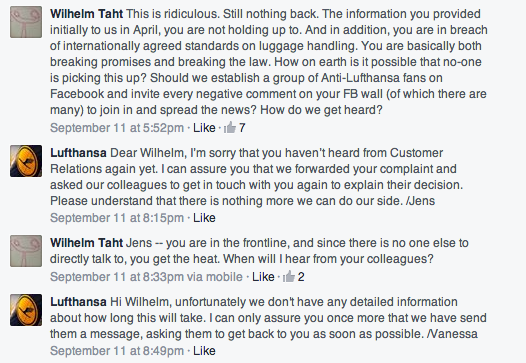
Further assurances are made that thing is progressed further, but nothing happens for a week:
Lufthansafail3

During this part of the discussion the social media team actually shows that they only work as messengers within the company with no real access to customer service personnel. It also seems that customer service personnel does not really care what comes from social media team either. It also showcases well how the airline companies (not only Lufthansa) are making the access to customer service increasingly difficult. You cannot call anyone and the mails are not answered (or your mails are bounced back). In Facebook you get answered, but unfortunately the answers are not any good. And of course nothing happens on the customer service front:

Lufthansafail4

After this something totally peculiar happens: Lufthansa Facebook team goes totally quiet. Maybe they counted that the situation will eventually die down. But as you can notice from this post, the discussion did not die down. It actually just got more vivid. People started to share this post in social media and now it has garnered almost 100 likes and 72 comments. The post has not been taken down (not that it would probably help in this situation) or not addressed in any way. If you decide to ignore someone in social media, you should make that decision first and not halfway through.

This discussion gives us three lessons:

1. You cannot have the cake and eat it too.
It is impossible to just get the “good” side of the social media such as likes and positive comments. Your Facebook page is also customer service channel whether you have customer service working in your social media team or not. This correspondence shows that the company treats social media as a nice sugarcoating and not really a part of the business. You have to also be accountable for your answers. If you say you are getting back, you really should get back. You do not really need social media expert to tell this. It is just common courtesy and common sense.

2. Handle the social media complaints first
All the customers are not equal. You should treat those better who pay more (your best customers) and you should also treat those first who can cause you the biggest damage (damage prevention). This post has been escalating for three weeks and I do not doubt that it will escalate further.  How difficult it would just to get back to the guy?

3. If you answer the questions in Facebook, follow through
It is of course respectable to have open unsolicited discussion on your Facebook page. In this case, the situation just looks bad and shows more that you do not care about customers. Also although the discussion does not show in your FB front-page it does not mean that it is forgotten. Currently the whole discussion sends the message that anyone in the organization does not really care.

Airline industry is one of the most complained industries in the world and I have had my fair share of challenges with them. Nothing new under the sun in many ways you could say. This situation could have been saved easily on many occasions during this discussion (not to mention the thing has been boiling for three months before). The situation can of course be saved, but it is much harder now.

I am looking forward to how Lufthansa will respond.  At least they have been pondering for the right comment for 1,5 weeks.

EDIT (Apparently now the situation has been sorted out):

Lufthansa Customer Service

Tagged , , , , ,

Why Facebook Allowed Promotions in Page timelines?

Facebook finally updated their promotions guidelines to allow the usage of natural Facebook functions in promotions. Brands can now collect entries by having users post on their page or comment/like a page post. Likes can also be utilized as voting mechanism. So now you do not necessarily need to build 3rd party app to host a competition.

This makes things clearer for brands, because the former guidelines of building the 3rd party apps seemed to be relatively difficult for brands to understand and caused a lot of confusion. Using status updates as competition vehicles has already been a tool, which especially smaller brands have utilized although it has been forbidden. From user´s standpoint this will mean that the newsfeed will be even more populated with promotional content in addition and conjunction with sponsored stories. The recent change is also total turnaround from the rhetoric of pre-listed Facebook about not populating user feeds with commercial messages. Besides the constant pressure of shareholders the reason for this change is super simple:

Mobile.

The biggest caveat of Facebook tabs has been that they are not working on mobile. For some reason, it has been tricky or trivial thing for Facebook to fix. Enabling the contests in normal brand page timeline allows brands to tap into the dramatic mobile usage growth of Facebook. It is also a painstaking proof that traditional status updates do not drive people to like the brands as much as the incentivized ones.

Is this the end of the Facebook tabs?

Now there is no idea to host simple competitions using Facebook tab. Status update competition with appropriate paid media push works totally fine and allows having more smaller competitions outside normal campaign cycle. It is quite limited way for customer interaction. Therefore I would not count Facebook tabs totally off just yet. They provide opportunities for deeper engagement, richer storytelling and more impressive experience than the native Facebook functions. Facebook has not really replaced the campaign microsites due to its limited offering for brands. If you want to wow your audience in Facebook, you pretty much still have to utilize tabs. Which unfortunately do not work in mobile.

Easing the promotion guidelines is a quick fix for Facebook and addresses certain key promotion issues regarding the mobile. If Facebook really wants to replace the still prevalent usage of microsites they either need to fix the tab formats to work in mobile or completely revamp the brand page structure to give more freedom to brands.

Tagged ,

Will Facebook Graph Search Replace Google?

The big news in social media front this week has been of course Lance Amstrong coming clean (sort of)  in Oprah. Despite that, maybe even more important discussion item has been the new Graph Search by Facebook. Graph in the name means demographics. In a nutshell it is a search engine, which will show results based on their “social stickiness”. You can search for the items your friends like or find correlations with things you are liking and what other people with similar taste are. If you are planning for vacation, you can see who of your friends have visited or are living in your destination. The graph search is living on the notion that you trust more your friends, family and real people than brands, media or even the experts. What remains to be seen is do you trust more social search than search algorithm.

What are the implications of Facebook Graph Search?

1. Revenge of Facebook Places
Graph Search challenges firstly Yelp & FourSquare, secondly Google. The graph search creates definite incentive to start checking more with the Facebook places compared to other location services. It will not challenge heads-on Google´s search function, but definitely will be challenger for Google in certain categories. These categories will be restaurants, hotels and events, to name a few.
In this way Graph Search continues the typical Facebook strategy of finding up & coming services and then incorporating it to Facebook user experience. However, Graph Search is much bigger concept and also first proper challenge towards its main competitor Google.

2. Privacy debate lurks ahead
In a typical Facebook fashion you expect that there will lots of brouhaha over privacy. Some of it is because the overall liberal stance Facebook has for the privacy issues. Other part will be about Facebook users overall sloppiness with privacy issues. Majority of users do not have any idea to whom they are actually sharing and they suddenly wake up that updates and pictures might be public when there are updates to Facebook platform. Whatever changes happen in Facebook, it is always a privacy issue.

3. The more you give, the more you get
When implemented right, Graph Search will also boost other Facebook usage. When you realize that the more people will share their experiences, pictures, likes and statuses the more accurate the search will be. This creates positive pressure to use Facebook more. If you have not liked anything on Facebook , you will not get recommendations. And when people use Facebook more, the more FB can sell ads to show. Also if Graph Search starts to challenge also LinkedIn, there will be sudden surge to update your job details to Facebook.

4. It is just a matter of time, when ads will come as part of Graph Search
In the current beta phase, there are no ads showing in the search bar. With pressure to monetize and bring more shareholder value we will definitely see some kind of ads in the near future. Then it also starts to make sense to the companies as well.

5. This is just a small step from Facebook, but very crucial step to the right direction.
This is the most important launch from Facebook in a long time and first serious attempt to really dig deeper to the Facebook database. The amount of data and social connections will beWhen it will be really launched we can see how the social search really catches on with its users. One form of social search is already appearing when people pose questions to FB status updates. Graph search might in some ways replace that behavior and make finding recommendations easier. So although Wall Street was not particularly delighted about the new announcement, this function will definitely be interesting. Also to make Graph Search to function on full scale, requires apparently much more work.

Maybe more of a philosophical question, but also as it core and crucial to the success is the following:

Do I trust more the social recommendation than expert recommendation?

I trust my social circles in many of the issues there are. However, with certain issues I want to get views of experts. The amount of likes does not always tell the relevance to the searcher.

It will be the battle between hyperlinks and likes.

Tagged , , , , ,