Category Archives: Planning

Rethinking The Advertising Agency Team Structure

World is changing rapidly around us. Digital revolution has shaken up all the industries. Revolution brings opportunities, but only for those who are willing and able to change within the times.

Amidst all the change, advertising agencies have been surprisingly static in their way of work. The basic advertising team structure has remained pretty much the same in most of the agencies (certain expectation to that rule). Usually core team has just been extended with channel specialists, because core team does not get digital. This has been one of the reasons why advertising agencies have lost their role in current business environment. We have hammers to solve your problems, but those problems have altered from nails to screws.

That is why it is mandatory to rethink the agency teams, to achieve the following goals:

1) To expand agency offering beyond traditional campaigns.
2) To find new business models in addition and to replace traditional retainers and project fees.
3) To create environment, which creates tangible creative products faster and more agile.
4) To enable flexible way of working to reduce over bloated organizations and bureaucracy.

New advertising agency should consist of generalists, who are accompanied with network of designated specialists. As the channel & technology knowledge gets more and more specified, the need to have the big picture is more vital than ever.

All the work is based on consumer insights and everyone has the responsibility to start their work from insights. That is why there are no separate planners.

Everyone also has to come up with ideas. Agency is as creative as its least creative link. The unified mindset is to produce things. Everyone is a producer. You will be judged by the actual stuff you are able to produce. No more room for free-riders.

Also the media knowledge should be in-house. In this day and age, you cannot separate creative work from the actual channels.

CORE CLIENT TEAM

The core of the agency client teams is built around self-guided generalists, who are insight-driven and obsessed about creative output. Ideas are teamwork and have no ownership.

Strategist
Job Description: Dual responsibility on both external & internal strategy:
How we improve our client´s business? How we improve our own business?
From my viewpoint you cannot ever separate strategy from the billings. That is why the business & strategic responsibilities are combined.
Mash-Up: Account director/Planner
Responsibility: Strategy

Presenter
Job Description: To ensure that all the products that are done to the clients are as persuasive as possible. Verbal persuasion is not limited to traditional copywriting, but is extended to all channels and to internal level as well. As the lingua franca of business world is PowerPoint, agencies should be master of that vehicle as well. Good ideas have been ruined with bad presentations. That is unacceptable.
Mash-up: Copywriter/Screenwriter/Planner/
Responsibility: Persuasion

Visualist
Job description: To ensure that all the products that are done to the client are aesthetically as beautiful as they can be. As the world is getting more and more visual, this role is increasingly more important. If you do not look good, you do not exist. Or at least, lack the quality.
Mash-up: Art Director/Film Director/Planner
Responsibility: Beauty
As you can see, these two roles are closest to traditional copy/ad-couple. There are two reasons to that. Fist, I find that pairing still the most effective unit in agencies. In majority of cases, two heads are better than. Secondly, I believe that we still need visual & verbal thinkers, although on more broad term. Usually they are two separate persons, but with certain individuals these roles can be merged.

Consumer Experience Designer

Job Description: To map out consumer journeys and find the most effective places to interact, help and to affect the consumer. As you cannot sugarcoat bad customer experience with flashy marketing communications, the customer experience should be in core of all the client teams.
Mash-up: Digital/Engagement/Media Planner
Responsibility: Consumer Experience

Creative Producer
Job Description: To ensure that the actual products will be produced. Leading the specialist network. Heading the prototyping in the agency. Creative producer is the catalyst of the new agency and the main change agent in moving to the age of experiment.
Mash-Up: Creative/Producer
Responsibility: Creative products & prototypes

Client

Yes, you read right. Client should be an important team member. In order to reinvent agency model, we should also shift our working methods more towards collaboration instead of traditional buyer-subcontractor-model. To disrupt the usual brief-creative brief-creative execution-production-cycle, we should collaborate on earlier phase. Advertising agencies should strive to be the best advisers the client can have. That requires ability to tackle problems, which cannot be put on a single brief.It is also important to look beyond just challenges, agency should be also spotting opportunities on a constant notice. From my experience, with best client relationships this works and comes also quite naturally.

EXTENDED TEAM
The generalist core team is helped by a group of specialists. These are used on case-by-case-basis and majority of them are not necessarily on the agency´s payroll. There are also certain agency-wide specialist roles, which are helping all the agency. These roles are following:

Creative Social Anthropologist
Job Description: Creative anthropologist gives unfiltered view of human behavior for the core team and keeps the whole company up-to-date with emerging audience trends. Heads the consumer research that is based on actual human behavior. Works in close cooperation with data miner.
Responsibility: Human behavior

Data Miner
Job Description: Data miner finds human patterns in big data. Helps core team and especially consumer experience designer to find ways to improve client´s business. With creative social anthropologist is creating the trend studies for the whole agency.
Responsibility: Mastering the Big Data

Creative Technologist

Job Description: Creative technologist role is two-folded. When working with core team, she helps to solve client´s business problems with technology. The other role is educational. Creative technologist keeps the whole agency up-to-date with the technologic change. These technologies are also actively tested within the agency.
Responsibility: Technologic change

Creative Lawyer/Creative Financial Personnel
This might be sound far-fetched, but if we really want to find new revenue sources in agencies, this will be mandatory. We have to expand the creativity to traditionally “boring” functions as well. And when I am talking about creative financial, that does not mean Enron or anything like that. Instead of traditional cost-cutters or salespeople, these people are seeking creative ways to improve company´s bottom line with new billing and contract models. Certain examples of these which have been already tested are revenue-share models, leasing IP-rights and creating own properties. There is plenty of room for improvement in this category.
Responsibility: Find new business models and revenue sources. Improve the agency processes.

This new team model is not that science fiction, when you think it closely. When evaluating these roles, I have already met people with these capabilities in different agencies I have worked for. The problem has been that many of them have been struggling with the old-school legacy team structures. The capabilities are already there, now it is time to unleash those capabilities, maybe throw some dead weight from the way and to radically rethink the agency team structure. Because if we will not do it, we might as well be extinct.

What is your view on agency team restructuring?

Tagged , , , , ,

Everyone Should Be a Producer

We used to live in the age of ideas, but we have already moved to the next phase:

The Age of Experiment.

It used to be about “what”. After the digital revolution we have to stress the importance of “how”. You cannot really separate the actual production from the actual idea. You cannot have real creativity in digital without the understanding and working knowledge of the actual channels. There are million ways to kill a great idea, nearly as many ways to save good one as well.

By the time you spend on polishing that perfect idea, someone else has already done ten imperfect tests. And actually reached the perfection that way. We have to do prototypes, demos and test runs to find the perfect idea. Ideas without the actual experiments are worthless. The difference between companies will be in the agility to come up with actual working executions as fast as possible. Produce something real or die.

There will neither be separation of the “thinkers” and “doers” anymore. If you want to succeed, you have to be both. Strategy will be more and more shaped with the actions and actual outcomes, not with non-productive marathon meetings discussing some incomprehensible PowerPoint presentation. Forget the “high-level” thinking or “low-level” doing. There will be just one level: the working level.

Everyone should be producer.

Tagged , , , , ,

Anatomy of An Insight: #firstworldproblems

And somewhere around the world
Someone would love to have my first world problems
Kill the moon and turn out the sun
Lock your door and load your gun
Free at last now the time has come to choose

-Matthew Good Band: Omissions of Omen

I am not huge fan of advertising for charity organizations. The work tends to be either scam or too preachy for its own good. What is usually lacking in creative idea, is compensated in shock value. That is why it was refreshing to see this:

Insight: In developed countries, our (first world) problems are quite trivial compared to (real) problems in developing countries.
#firstworldproblems

Behavior: Although the insight in the campaign is quite simple truism, it is the behavior of the brand what makes it stand out. #firstworldproblems was popular meme and DDB found a great way to hi-jack that meme to benefit WaterIsLife. Tweets about #firstworldproblems are ironic and at least meant to be tongue-in-cheek. With this campaign, you are forced to think at least for a while about real world problems while you are cracking jokes about your iPhone´s lousy battery. Of course it induces guilt, but isn´t that the main emotion you actually want to raise when doing advertising for charity organization?

It is tricky for brand to take advantage of existing memes. You have to know the meme upside down and then also bring new meaning to it. What was parody was turned to something serious. With this campaign, that was done perfectly. Zigging when everyone else is zagging.

Tagged , , , , , , , ,

Gangnam Style: The Evolution of Popular Culture

Click the video, if you have not yet see this after 462 252 104 (and counting) views on YouTube. Otherwise proceed to text below.

It has affected South Korean tourism and the stock values of software firms. Even F1 drivers are doing it.

No doubt about it, Gangnam style has been the biggest popular culture phenomenon in 2012.

What it tells about the current state of popular culture?

1. There is always demand for a catchy pop song.
You can debate about the artistic and musical merits of PSY, but you cannot deny that structurally it is typical and effective pop song. All the elements of the perfect summer jam are there: catchy chorus, shout-outs to sexy ladies and the signature dance which you can perform even after few pints. Gangnam Style is just the Macarena for 2012. Or Ketchup Song, Lambada… You catch my drift.

This brings us also to the important point about YouTube. The Internet might have revolutionized the distribution and the traditional business model of the music. It has not as much changed people´s taste for music. Although major record labels are struggling, there is still huge demand for mainstream music. If you watch top 10 of the most watched music videos in YouTube, they are all from major label artists. PSY was huge in South Korea before Gangnam style and hardly a rookie, having released his first album already in 2001.

Gangnam style would probably be not as big hit without YouTube, but it would have been hit nevertheless. You will always have gatekeepers in popular culture. The gatekeepers just might not be the same ones as before.

2. The cultural focus shifts to Asia
If you watch any new Hollywood movie, you are more than likely to see one (or all) of the following things:

a) One or more of the characters are Asian-origin (i.e. wife of Bruce Willis is Chinese in The Looper)
b) There are cultural references to Asia (i.e. Chinese gambling dens in Premium Rush)
c) The film takes place in certain Asian country (i.e. Bourne Legacy scenes in Manila)

The main reason for this is naturally the rising importance of Asian countries as the target market for Hollywood movies. As a movie producer, you have to take Asian countries in account to maximize profits and to secure investments in the future.

This cultural exchange is not unilateral. As the western companies concentrate more on Asia to keep afloat, especially the western teenagers consume more Asian culture to find their own thing and to differentiate from their predecessors.

Peculiar thing happened few years back in Finland. The teenagers started to dig everything Japanese. Whether it was J-Pop, Manga, Anime or the weird costumes. The cultural glue was the interest to everything Japanese. The same person might go to see heavy metal and dance act on same week, as long it was Japanese.

This goes against of my traditional view of how subcultures emerge. As a teenager I consumed popular culture that was majorly from USA. However it was more about certain genres than geographical areas.

K-Pop phenomenon was already making major waves before Gangnam style and something big was bound to happen. Gangnam style was just the most western-friendly, uniquely odd and the catchiest song to break into global mainstream. As a western listener you do not necessarily know where Gangnam is, or what oppa means but you can nevertheless get into singing the chorus and doing the horse-dance.

3. Ready for remix, build for parody, made for mash-up.

There used to be app for that. Nowadays there is Gangnam Style –parody for that. Even in North Korea. Here is the Singaporean version:

With current digital tools and democratization of technology, it is easier to become active culture participant. Parody is the highest form of flattery. If it has not been remixed, it does not exist. Gangnam style is the perfect song to make mash-ups on. As the money from music business now comes from different sources than traditional record sales, you have to do more than just good songs. You have to create miniature social movements, where people can participate.

Also our view of idols has evolved. When before the idol was someone you could not reach, nowadays you can just tweet to your favorite artist. And as record sales decline, the probability is just getting higher that the idol will actually respond as well. Reflecting to that PSY, who is self-proclaimed “fat father of two”, might just be the perfect idol type for the new century. At least compared to the polished superhumans of traditional broadcast era.

Will PSY be able to match the success of Gangnam style?
Most likely not.
Has he already left a permanent mark in popular culture?
Most likely.

Tagged , , , , ,

The Illusion of Hot Hand

NBA JAM
I have been playing basketball nearly all my life. I also play in two teams here in Singapore and the quality of the basketball league and how good it has been organized, has been really positive surprise. Not that positive surprise has been my shooting game, which has been uneven to say at least.

I have not had “a hot hand”, like they say.

One of the common beliefs in basketball involves streak shooting: if you have made your last shot you are more likely to make your next shot. Those who have played NBA Jam in nineties, remember that the player was “on fire” after three straight shoots.

This “hot hand” is purely a myth.

Good last shot does not predict your next shot in any way. Actually you might be more likely to miss it. Numerous studies prove this point. Amos Tversky and Thomas Gilovich went through years of NBA team Philadelphia 76ers statistics. The conclusion: Every field goal attempt was its own independent event. Jay Koehler and Caryn Conley got the same result by observing NBA three-point shooting contest.

Ok, now I know the facts. Do I believe in hot hand?

You bet, I do.
(Like actually 91% of serious NBA fans)

“Hot hand” is not based on actual statistics. It is in your mind. When you have the feeling that you are “on fire”, you tend to play better. Because simple truth in basketball is: the more you shoot, the more you tend to score. Average field goal percentage in NBA is little bit below 30%. That means that even the best players in the world miss about two out of every three shots. You need to have the illusion of “hot hand” to keep yourself positive when missing all those shots.

Winning streaks do not limit only to basketball and other sports.

People try to find patterns in random events where they do not exist. I have heard from numerous ad people that when you start losing pitches they always come in three. The reality is that every pitch is its own independent event. If you feel that you are on the roll, the setbacks feel just random mishaps. And if you feel that you have “cold hand”, every loss fulfills your prophecy of losing streak. So to succeed in business, it is important to try to be in state of streak shooter and then go with that emotion. And when you encounter losses you have to remind your rational self about the statistics and just try again.

There is not anything wrong to believe in “hot hand”, just do not fall into superstition when you are not “on fire.”

Tagged , , , , , ,

Anatomy of An Insight: Grey Poupon Society of Good Taste

LIKE US ON FACEBOOK!!!!

That has been the battle cry for the brands in the social media for the last couple of years. And fair enough, for the majority of the brands the more likes you have the better. But what if you are classy luxury brand? You do not necessarily want everyone and their neighbor to like your brand if you want it to be exclusive.

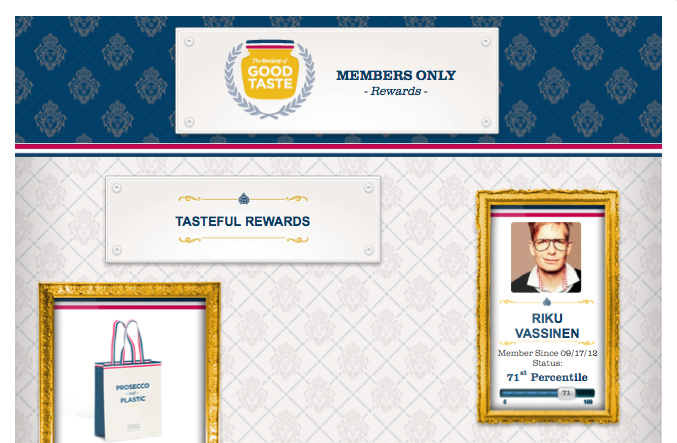
The new Grey Poupon Facebook-campaign*”The Society of Good Taste” feels like a breath of fresh air amidst the traditional like-begging campaigns. In this tongue-in-cheek application the mustard brand will only accept “classy” fans. Your “classiness” will be evaluated with algorithm searching and judging your user profile. Apparently not all of the applicants will be selected, although my social media profile seemed to be “classy enough”:

Apply for Grey Poupon fan status in their Facebook page.

Insight: When every brand is begging and bribing you to like them on Facebook, the value of the like for the consumer has become worthless. If something is easy and available to everyone, it does not seem interesting. Like Groucho Marx said “I don’t care to belong to any club that will have me as a member”.

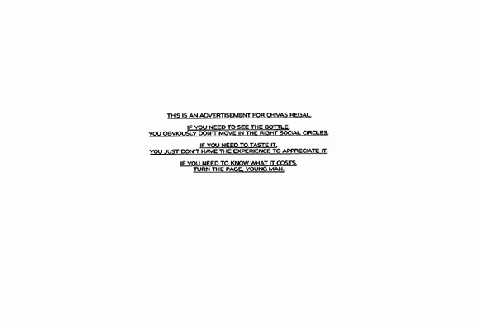
This Grey Poupon campaign seems like a modern day and more humorous version of this classic Chivas Regal ad by Neil French:


THIS IS AN ADVERTISEMENT FOR CHIVAS REGAL.

IF YOU NEED TO SEE THE BOTTLE,
YOU OBVIOUSLY DON’T MOVE IN THE RIGHT SOCIAL CIRCLES.

IF YOU NEED TO TASTE IT,
YOU JUST DON’T HAVE THE EXPERIENCE TO APPRECIATE IT.

IF YOU NEED TO KNOW WHAT IT COSTS,
TURN THE PAGE, YOUNG MAN.

In addition to the Facebook, Grey Poupon is upping the ante in social media and has also build their website entirely on Pinterest.

*Spotted from Adrants.

Tagged , , , , ,

Is Facebook Just a Bubble?

Facebook stock hit the new low last Thursday after Q2 results were revealed. Also closely linked to Facebook, game-maker Zynga has lost over 40% of its value. These stock falls have raised feelings of déjà vu  in investors of the merry days of the dot-com buble. Are we facing the sequel: Social-Media Bubble-Revenge of Stock Plummet?
I believe not, based on the following reasons:

What separates Facebook from the failed IT-bubble companies?

1. People: With the expection of the Great China Firewall, Facebook has conquered the world. Over 900 million users would make it the third biggest country in the world. Numbers are great, but over 500 million active users also prove that Facebook has become much more. It is incremental part of the behavior of the people and increasing number of people have developed Facebook a daily (even hourly or constant) habit. And we all know how hard the sticky habits are to break. Also we from the industry are naturally calculating Facebook profits all the time, but average user could not care about less how Facebook ad sales are going. Of course on the long run the financial performance and user satisfaction should be inseparable, but it is easier to tweak on your business model when you have the people already using your network than other way around.
2. Profits: Despite making loss in the latest quarter, the revenues of Facebook actually beat the industry estimates. Also Facebook has already been profitable many quarters before. This is a proof that their business model works, at least to some extend. That could be hardly said from many other failed Internet-companies.
3. Potential: Google has struggled with social: whether it is Google+ or making YouTube profitable. Apple has had Midas touch in everything… expect social. That is why they allegedly have talks with Twitter. Facebook has been the only company to really capitalize and succeed with social. This has made it as one of the key players in the battle of Internet domination (other participants in the ring: Apple, Google & Amazon).

So comparisons with the high-flying and crash-landing dotcom rockets to the new big blue are unjust. They pretty much had only potential, but neither the users nor the viable business model. Facebook is not a bubble, but that does not mean that it does not have certain serious challenges. The future success of Facebook lies in how it can solve the following issues:

1. Advertising revolution: The advertising model of Facebook is based on really traditional online media sales and the effectiveness has been questionable. Sometimes it feels that only drunk people click on the Facebook ads. The new ad units have been disappointing at best and almost disastrous at worst (ie. Facebook deals). Facebook has to find a way to get people to see and engage with ads when and where they want to actually see them. Google cracked this and it has been the core reason for its success. Until now Facebook has just poorly emulated Google with a mix of traditional display, with average results.
2. Going beyond advertising: The information of Facebook 900+ million users is a goldmine. There just should be a way to utilize it better. Currently the revenues beyond ad sales have been quite modest. This also raises the controversial question which Facebook has actively been avoiding. Could users pay for Facebook? And how much would they pay for it and for what elements? There is thin line between the effective utilization of user data and the utter exploitation of it. If you do the latter, the deliquate trust between the service and users has been ruined forever.
3. Mobile: Future of Internet is the Mobile. And Facebook damn well knows it, with over 500+ million mobile users. As smartphone will be the computer of the new generation, it needs more innovative and effective mobile solutions than just sponsored stories in mobile (although they have been performing above average). The rumoured Facebook phone is step to the right direction, but just one of the first steps into the mobile world.

“Facebook is not a bubble, but it has not reached its full potential either”

Tagged , , , , , , ,

Digital is Air

It is quite sad that agencies are still strugling heavily with their digital output and integration. We are not really talking about new things here. Digital has already been around for quite a long and we have had time to adjust. While agencies have been lost with, real people have been happily and easily adopted the new digital tool.

Nowadays, digital is like air to them.

It is natural: Consumers have already adopted the digital channels. They have made the unconscious selection to live digital life. The digital excellence should come with same ease in the agencies. The people are not strugling with digital, companies are. If you have to think about digital all the time, you are really missing the point. It is already a habitual part of life. The same way it should be habitual part of agency.
It is necessarity: If you do not have air you will die. The same is the way with the companies. For majority of companies the digital strategy is totally same as their overall strategy. Therefore, it is insanity to separate these two. If your business is not yet in digital, there is a good opportunity for your company to do it.

Air also flows freely. That is why there should not be different silos in the agencies. Digital department should be every department. The steps for the future success are simple:

1. Break the silos.
2. Get digital natives on board. Get rid of the opposing old baggage if necessary.
3. Fully integrated or die.

“Digital should flow freely and be a habitual part of the agency”